Why AI Search Optimization Is a Completely Different Game from Traditional SEO
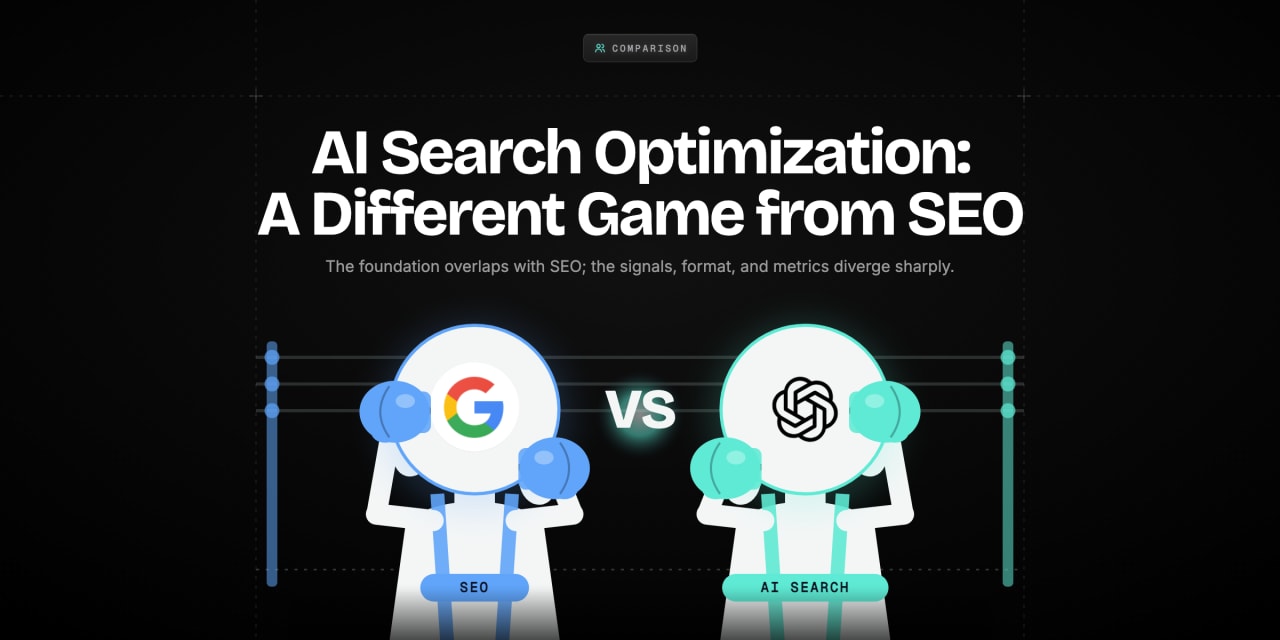
AI search optimisation requires a fundamentally different strategy, not just an extension of traditional SEO. Here is what is genuinely different and how to approach both channels intelligently.
Key Highlights
-
AI search vs SEO strategy: the foundation overlaps (quality content, E-E-A-T, topical authority) but the execution diverges sharply on signals, content format, measurement, and distribution
-
GEO vs SEO is not a question of which is more important. Both channels serve different audiences through different mechanisms. The question is how to manage two distinct disciplines without confusing one for the other
-
Separate AI search strategy is the right approach for teams with capacity for it. The signals are different enough that a unified single playbook consistently underserves both channels
-
A separate AI search strategy does not mean abandoning SEO. It means adding an explicit AI-specific programme alongside the existing SEO programme, with distinct goals, tactics, and metrics
-
The separate AI search strategy that most teams need is smaller than they expect: Reddit participation, entity building, and citation tracking added to an existing SEO programme takes four to six hours per week
-
AI search optimization vs traditional SEO diverges most sharply at the off-site distribution layer: SEO concentrates investment on your website. AI search requires substantial off-site investment in Reddit, reviews, and editorial coverage
-
AI search optimization vs traditional SEO requires different measurement systems: keyword rank tracking for SEO, citation frequency and share of voice tracking for AI search
-
Understanding AI search optimization vs traditional SEO as distinct disciplines with a shared foundation prevents the most common strategic mistake: applying SEO logic to AI citation problems
-
AEO vs SEO 2026: Answer Engine Optimization prioritises content structure for direct-answer extraction. SEO prioritises keyword relevance and backlink authority. Both serve the same content quality goal but through different tactical lenses
-
AEO vs SEO 2026 measurement divergence is the most operationally significant difference: SEO measures rankings and traffic, AEO measures citation frequency and share of voice in AI-generated answers
-
AEO vs SEO 2026 content format divergence is equally significant: SEO rewards comprehensive long-form keyword coverage, AEO rewards direct-answer openings and FAQ-structured sections that enable passage-level extraction
-
The correct strategic sequence for most teams: establish Google top-20 ranking first (retrieval eligibility for AI Overviews), then build the AI-specific signals on top
-
Two-track reporting is the practical solution: SEO track metrics (keyword rankings, organic traffic, CTR) and AI search track metrics (citation frequency, share of voice, branded search growth) reported separately but reviewed together
The most dangerous mistake in AI search right now is treating it as SEO with a new name. It is not. The mental models are different, the signals are different, the measurement is different, and in some cases the content strategy is different. According to Princeton and Georgia Tech's generative engine optimisation research that founded the GEO discipline, the interventions that most improve AI citation probability are structurally different from the interventions that most improve Google ranking. Adding statistics and authoritative citations improves AI visibility significantly. These same interventions improve Google ranking only modestly. This is not an SEO problem with an AI dimension. It is a parallel discipline with a shared foundation.
The confusion is causing real strategic problems. Teams that add AI search as an appendix to their SEO strategy are applying SEO logic to an AI-search problem and getting poor AI visibility results. Teams that abandon SEO to "focus on AI" are losing retrieval eligibility for Google AI Overviews, which require Google top-20 ranking as a prerequisite. Both mistakes have the same cause: treating AI search vs SEO strategy as a continuum rather than as two distinct disciplines with a shared foundation and different executions.
This guide maps out exactly where AI search and traditional SEO share DNA, where they genuinely diverge, what the AI-specific tactics are that have no SEO equivalent, and how teams of different sizes should organise and manage both disciplines. By the end, you will have a clear model for the two-track plan that serves both channels without confusing one for the other.
Where Do AI Search and Traditional SEO Share DNA?
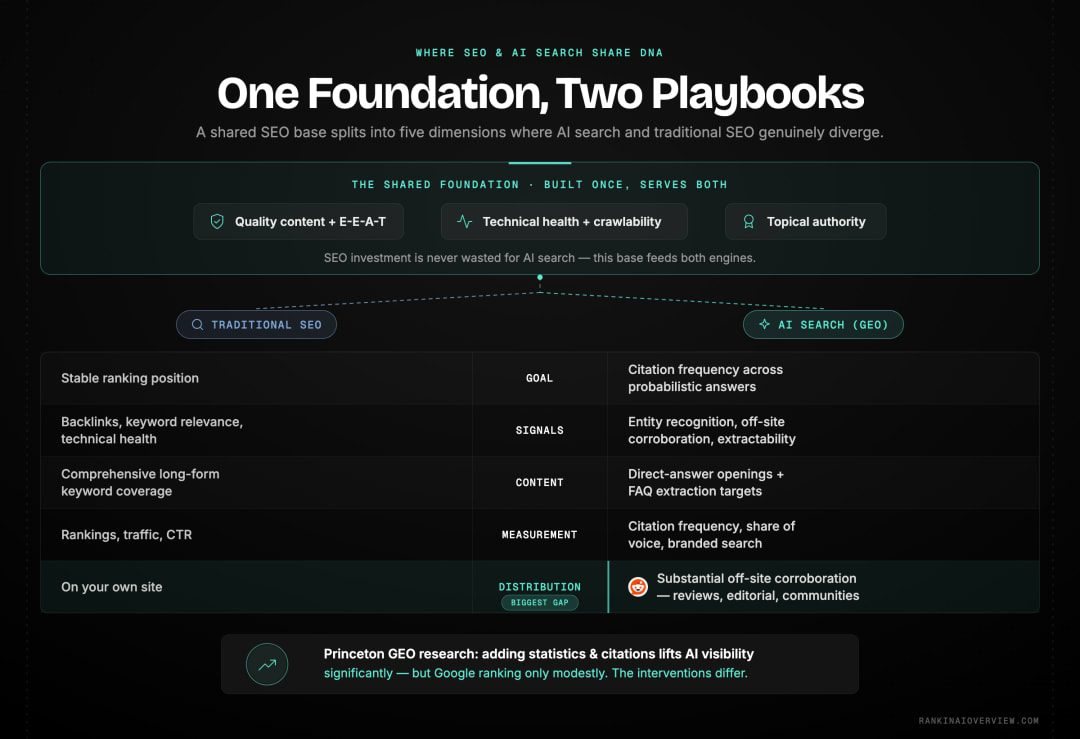
Three foundational investments serve both AI search and traditional SEO simultaneously. Quality content with E-E-A-T signals is rewarded by both channels through the same quality evaluation framework. Technical health, specifically crawlability, clean architecture, and Core Web Vitals, is required by both channels for page discovery and indexing. Topical authority, the depth and consistency of subject-matter expertise, is a primary citation-authority signal for AI search and a primary ranking signal for Google. These shared foundations mean SEO investment is never wasted from an AI search perspective.
The most important shared foundation is E-E-A-T. Google's Search Quality Rater Guidelines define Experience, Expertise, Authoritativeness, and Trustworthiness as the primary quality framework. AI engines apply the same evaluation when deciding what is safe to cite. A brand that invests in genuine E-E-A-T signals, specifically named authors with verifiable credentials, first-person experience language, and primary source citations, is building signals that serve both ranking and citation simultaneously.
Technical SEO health is the other fully shared foundation. An uncrawlable page cannot be retrieved by Google's ranking algorithm, by Google AI Overviews, or by Perplexity's independent crawler. Core Web Vitals below threshold, broken internal links, and sitemap errors all reduce visibility across every channel simultaneously. GEO vs SEO convergence is most complete at the technical health layer: the investment that maintains crawlability serves both channels without any duplication of effort.
Where Do AI Search and Traditional SEO Genuinely Diverge?
The divergence between AI search and traditional SEO is most significant across five specific dimensions: the primary goal, the signal set evaluated, the content format that performs best, the measurement framework, and the distribution channel that drives the key signals. Understanding these five divergences is what allows a team to build two coherent strategies that reinforce each other rather than one confused strategy that underserves both.
The Goal
Traditional SEO aims to achieve a stable ranking position for target keywords. A page that ranks position two for its primary keyword holds that position consistently, produces predictable traffic, and can be maintained through ongoing SEO investment. The goal is a deterministic, stable position in an ordered list.
AI search optimization aims to earn frequent citation in dynamic, non-deterministic AI-generated answers. There is no position two in ChatGPT. There is a citation frequency across many prompt runs. A brand cited in 65% of relevant ChatGPT responses has strong AI search visibility, but that citation rate fluctuates based on model updates, prompt phrasing variations, and competitive citation pressure. The goal is citation frequency across a probability distribution, not stability in a ranked list.
The Signals
Traditional SEO is evaluated primarily through backlinks (link equity transferred from authoritative domains), keyword relevance (on-page signals matching search intent), and technical health (crawlability, Core Web Vitals, structured data for rich results). These signals are evaluated by Google's ranking algorithm and are applied consistently across every page that meets the technical prerequisites. The separate AI search strategy requires a different signal set: entity recognition (is this brand a clearly identified entity in AI training data?), off-site trust corroboration (do independent sources confirm the brand's category and credibility?), and content extractability (can AI engines pull self-contained answer passages from page sections?). Princeton's GEO research found that these signals were more predictive of AI citation probability than traditional ranking signals.
The Content Format
Traditional SEO rewards well-optimised long-form content targeting head and body keywords with comprehensive coverage. A 2,500 word guide that covers all dimensions of a topic, uses the target keyword naturally, and builds internal links to related content is a strong SEO asset. The format is optimised for a user who will read the article from beginning to end.
AI search optimization rewards direct-answer content optimised for passage-level extraction. Every H2 section should open with a self-contained 40 to 60 word answer. FAQ sections create pre-formatted extraction targets. First-person experience signals build the E-E-A-T trust that makes AI engines willing to cite the source. The format is optimised for an AI engine that scans for extractable passages and for a user who may never click through to read the full article.
The Measurement
Traditional SEO is measured through keyword rankings, organic traffic, click-through rates, and conversion data from Google Search Console and Google Analytics. These metrics are deterministic and transparent: a position two ranking is a position two ranking. The measurement framework is twenty-five years old and well understood. AI search requires an entirely different measurement framework: citation frequency (how often your brand appears across many prompt runs for target queries), share of voice (your citation frequency relative to competitors), and branded search volume growth as the downstream proxy for AI-driven brand awareness. AEO vs SEO 2026 measurement divergence is the most operationally significant difference between the two disciplines.
The Distribution
Traditional SEO invests primarily on your own website. Technical improvements, content production, and on-page optimisation all happen within the domain you control. Off-site SEO (link building) targets other websites but the outcome is a signal (backlink) that benefits your website. The investment is site-centric.
AI search optimization requires substantial off-site investment. Reddit community presence, review platform building, editorial brand mentions, and Wikidata entity building all happen on platforms you do not own or control. The AI search distribution layer is the most significant departure from traditional SEO thinking and the area where most teams make the most significant strategic errors by applying SEO thinking to a discipline that requires PR and community thinking.
“ The mental model, the tactics, and the metrics are all different. Distribution is the biggest difference. AI needs off-site signals. SEO needs on-site optimisation. The foundation overlaps but the execution is completely different. Treat them separately or you will underperform in both. Growth hacker community practitioner r/GrowthHacking community, Reddit 2026 Source: Reddit: AI Search Is a Completely Separate Game from SEO
What Are the AI-Search-Specific Tactics With No SEO Equivalent?
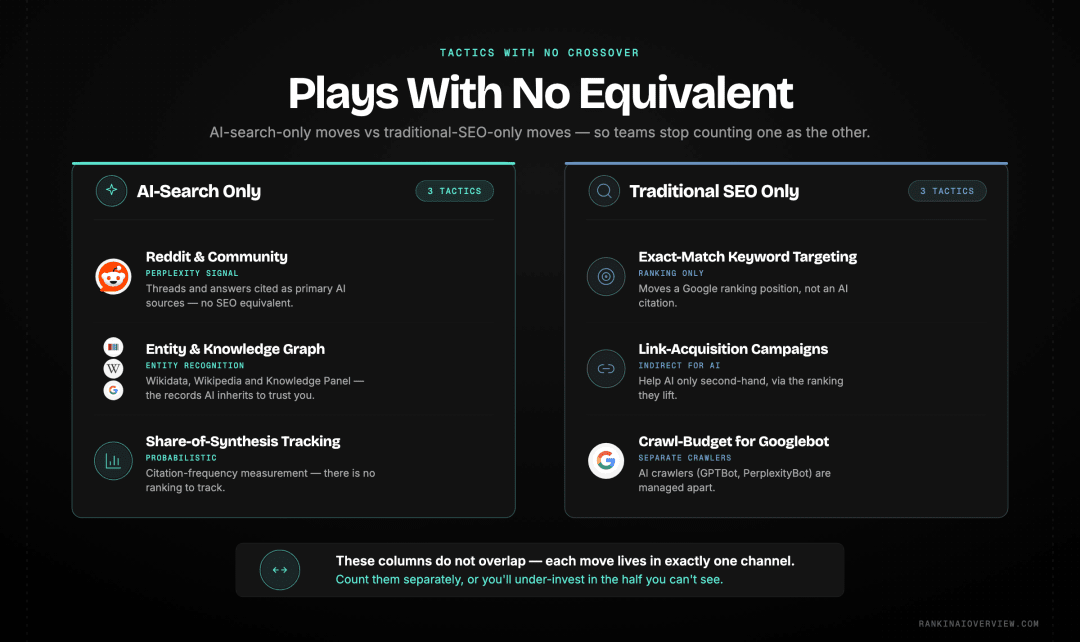
Four AI search tactics have no meaningful traditional SEO equivalent. They are specific to how AI engines build trust and entity knowledge, and they produce no direct Google ranking benefit. Teams that have completed traditional SEO fundamentals should invest in these four tactics to build AI-specific visibility that their SEO programme cannot produce.
Reddit and community participation is the first AI-specific tactic. Authentic contributions to relevant Reddit communities produce Perplexity citation signals independently of Google ranking. Reddit is among the most-cited domains across major AI platforms. Traditional SEO investment does not reach this citation pathway at all. A brand contributing genuine expert answers to relevant subreddits twice per week is building AI citation signals that cannot be produced through any SEO tactic.
Wikidata and Wikipedia entity building is the second AI-specific tactic. Wikidata entries and Wikipedia presence build the entity recognition that AI engines use to verify brand identity when deciding what to cite. Traditional SEO does not directly involve Wikipedia or Wikidata. AI search citation depends on entity clarity, and Wikidata is the most accessible entry point for establishing entity recognition in AI training and retrieval systems.
Google Knowledge Panel optimisation is the third AI-specific tactic. Claiming, verifying, and completing a Google Knowledge Panel tells Google's Knowledge Graph that your brand is a verified entity with consistent, accurate information. AI engines draw on the Knowledge Graph when generating entity-sensitive responses. A complete, verified Knowledge Panel is an AI citation trust signal with no direct SEO equivalent for most content-focused brands.
Share of synthesis tracking is the fourth AI-specific tactic. Measuring your brand's citation frequency and share of voice across AI platforms produces strategic intelligence that informs both content and off-site investment decisions. There is no traditional SEO equivalent because traditional SEO measurement does not address the probabilistic, non-deterministic citation outputs that AI search produces. This measurement infrastructure is exclusively relevant to AI search optimization vs traditional SEO as a distinct discipline.
What Are the Traditional SEO Tactics That Have No AI Search Equivalent?
Three traditional SEO tactics produce no direct AI search benefit and should be understood as channel-specific investments. This does not make them unimportant. They are important for maintaining Google ranking, which is the retrieval eligibility prerequisite for Google AI Overviews. But they should not be confused with AI search investment.
-
Exact-match keyword targeting: optimising page content for specific keyword phrases produces Google ranking benefits but does not improve AI citation probability. AI engines evaluate semantic relevance and content quality, not keyword density or exact-match presence. Keyword optimisation that serves Google does not harm AI search, but it should not be counted as AI search investment
-
Link acquisition campaigns: building backlinks from authoritative domains improves Google domain authority and ranking eligibility for AI Overviews. But the backlink itself is not an AI citation signal independent of the ranking benefit it produces. Link building serves AI search indirectly through its ranking effect, not directly as an AI trust signal
-
Crawl budget management: technical SEO work managing crawl depth, internal linking architecture, and sitemap prioritisation produces Google crawl efficiency benefits. Perplexity and ChatGPT have their own crawlers with their own crawl models. Crawl budget optimisation for Googlebot does not directly improve AI platform crawler access
Should You Run These as Separate Strategies?
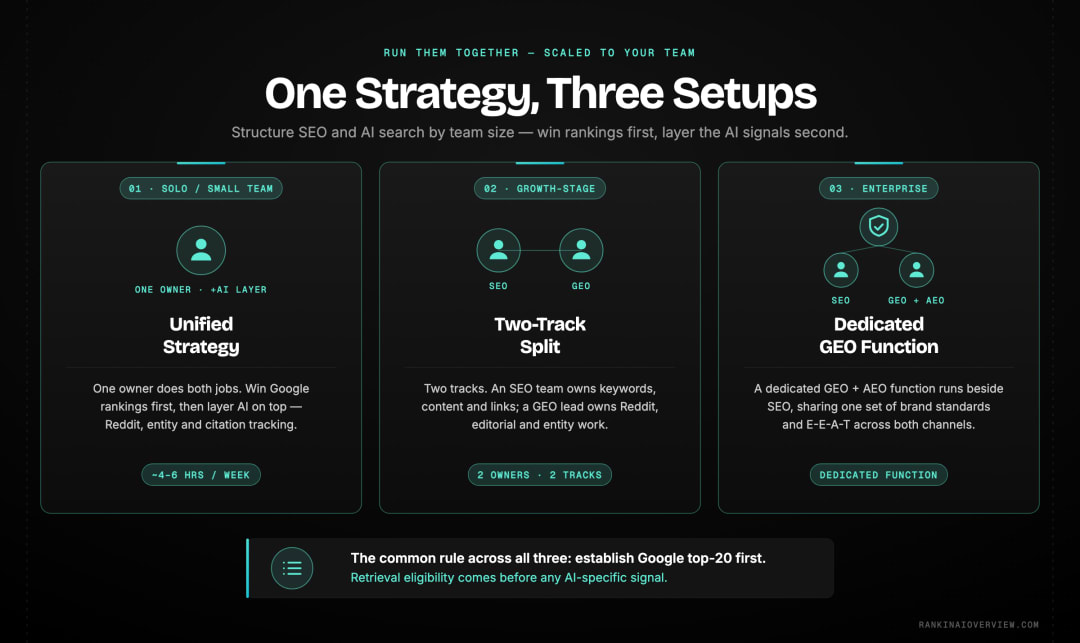
The correct organisational answer depends on team size and capacity. Small teams and solo practitioners should run a unified strategy with a shared content foundation and AI-specific tactics added on top, tracking both channels separately. Large teams should consider a dedicated GEO function alongside the SEO team because the off-site community work that AI search requires is a full-time activity that competes for attention with traditional SEO work.
For small teams and solo practitioners: the unified strategy framework prioritises Google ranking first because it is the retrieval eligibility prerequisite for AI Overviews. Once core Google rankings are established for target queries, the AI-specific layer is added: Reddit community participation two to three times per week, review platform building, entity signal standardisation, and weekly AI citation tracking. This unified approach requires approximately four to six hours per week of additional investment above the existing SEO programme.
For growth-stage companies with dedicated marketing functions: the two-track model makes more sense. The SEO team owns keyword research, content production optimised for search intent, technical health monitoring, and backlink acquisition. The GEO team, or a single dedicated GEO practitioner, owns Reddit community presence, editorial brand mention acquisition, entity recognition building, and AI citation tracking. Both teams share the content quality standards and E-E-A-T framework as their common foundation.
For enterprise marketing organisations: the GEO vs SEO question has an organisational structure answer. A dedicated GEO and AEO function alongside the existing SEO team, with shared brand standards and editorial guidelines, is the model that most efficiently executes both disciplines without the confusion that comes from trying to manage fundamentally different tactical playbooks within one team.
What Does the Integrated Two-Track Plan Look Like?
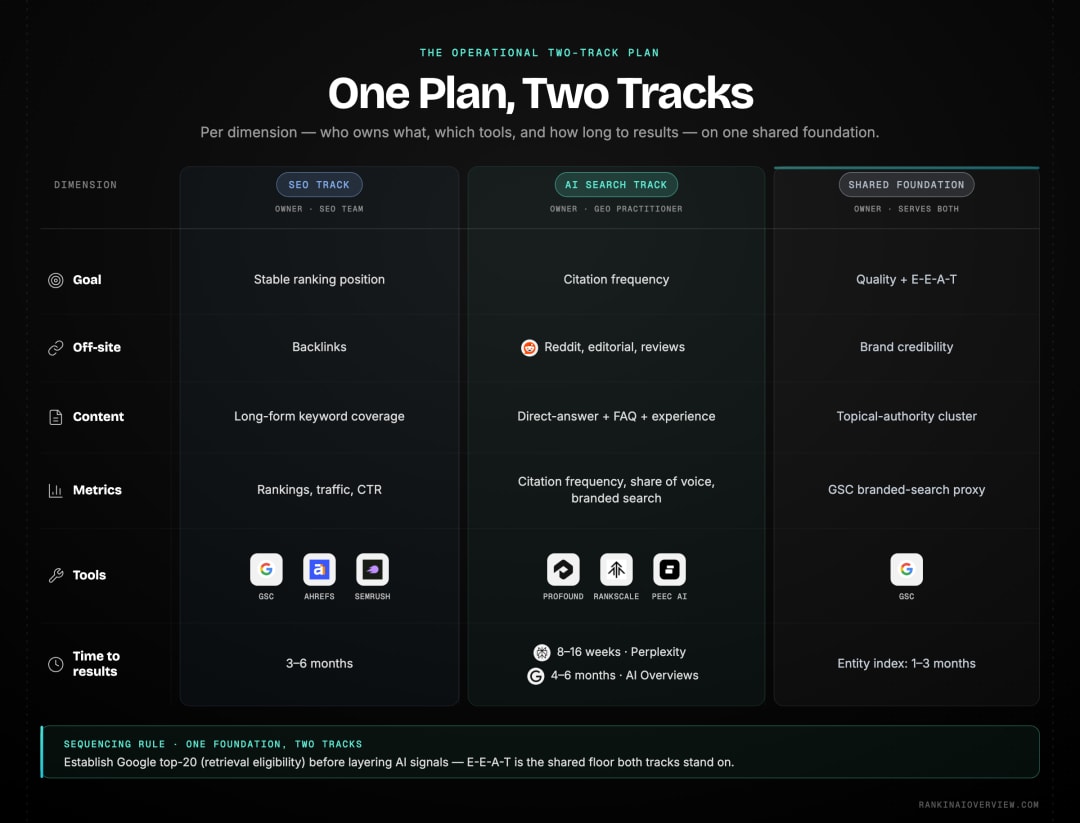
The two-track plan runs Google SEO and AI search optimization as parallel programmes with a shared content foundation and separate tactical execution. The SEO track covers keyword research, content calendar planning, technical health monitoring, and link acquisition. The AI search track covers off-site community participation, entity building, content restructuring for extraction, and citation tracking. Both tracks share the E-E-A-T editorial standard and the topical authority cluster structure as their common foundation.
| Dimension | SEO Track | AI Search Track | Shared Foundation |
|---|---|---|---|
| Primary Goal | Stable keyword ranking positions | Citation frequency in AI answers | Quality content and E-E-A-T compliance |
| Off-site Investment | Backlink acquisition from authoritative domains | Reddit presence, editorial mentions, review building | Brand credibility and category authority |
| Content Format Priority | Comprehensive long-form keyword-optimised content | Direct-answer structure with FAQ sections and experience signals | Topical authority cluster architecture |
| Key Metrics | Keyword rankings, organic traffic, CTR, conversion rate | Citation frequency, share of voice, branded search growth | E-E-A-T compliance standard across all content |
| Measurement Tools | Google Search Console, Ahrefs, Semrush | Profound, Rankscale, Peec AI, manual prompt testing | Google Search Console for branded search proxy |
| Time to Results | 3 to 6 months for ranking improvements | 8 to 16 weeks for Perplexity; 4 to 6 months for AI Overviews | Entity building: 1 to 3 months |
| Team Allocation | SEO specialist or team | GEO practitioner or community manager with SEO awareness | Shared editorial standards and brand identity |
Conclusion
Applying old SEO logic to AI search is the core trap — see why most companies get AI search optimization wrong and what to do instead.
AI search is not SEO 2.0. GEO vs SEO is a question of parallel disciplines, not competing priorities. Build your SEO foundation first: it gives you retrieval eligibility for Google AI Overviews and builds the E-E-A-T signals that both channels reward. Then add the AI-specific layer: entity building, off-site trust signals through Reddit and editorial coverage, content restructuring for passage-level extraction, and citation tracking as your primary AI search measurement framework.
The brands that treat AI search vs SEO strategy as one unified playbook will underperform in both channels because they are applying the wrong mental model to at least one of them. The brands that manage them as intelligent two-track programmes with a shared foundation and distinct execution will dominate in each channel. Start the two-track plan today while the competitive field for AI search signals is still less developed than the competitive field for Google rankings. RANK IN AI OVERVIEW covers how AI engines evaluate brand authority and what drives citation across all major platforms in depth across its content library.
Frequently asked questions
If I do traditional SEO well, will AI visibility follow?+
Partially, for Google AI Overviews specifically. Google top-20 ranking is the prerequisite for AI Overview citation, so strong traditional SEO provides the retrieval eligibility layer. However, citation selection from the top-20 pool depends on AI-specific trust signals that traditional SEO does not build: off-site community presence, entity clarity, and content extractability. For Perplexity and ChatGPT, strong Google SEO provides no meaningful advantage at all since these platforms evaluate their own independent quality signals. Good SEO is necessary but not sufficient for comprehensive AI visibility.
Can a solo marketer manage both SEO and AI search optimisation?+
Yes, with clear prioritisation and a realistic weekly time allocation. Establish Google rankings for your five to ten most important target queries first. Once those rankings are in place, add the AI-specific layer: Reddit community participation two to three times per week, review platform profile completion, entity signal standardisation across all external profiles, and weekly citation tracking for target queries. This AI search layer requires four to six additional hours per week for a solo practitioner managing a focused prompt set of 20 to 30 queries. The key constraint is prompt tracking: above 30 queries, manual tracking becomes unmanageable and a paid tool becomes necessary.
What is the biggest mistake when transitioning from SEO to GEO thinking?+
The biggest mistake is treating off-site community investment as optional rather than foundational. Traditional SEOs are accustomed to on-site work being the primary lever: technical improvements, content production, and internal linking are all activities you control directly and can execute within your domain. AI search optimization vs traditional SEO diverges most sharply at this point: the off-site community presence that AI citation requires is outside your direct control, slow to build, and unfamiliar to practitioners trained in on-site SEO thinking. Teams that skip Reddit and community presence because it feels unfamiliar or uncontrollable are leaving the most impactful AI citation signal undeveloped.
Explore with AI
Share this