Can AI-Generated Content Rank Without Backlinks? What the Data Actually Shows
Can AI-written content rank on Google or get cited in AI search without a single backlink? We dig into the 2026 data and share what is actually happening.
SummaryAI-generated content can rank and even get cited in AI answers without backlinks, especially on low-competition topics and AI search platforms like Perplexity. But those rankings are usually temporary unless supported by stronger authority signals like topical depth, entity presence, reviews, community mentions, and backlinks. In 2026, content quality and trust signals matter more than ever, while backlinks act as the long-term stability layer rather than the starting point.
Read moreShow less
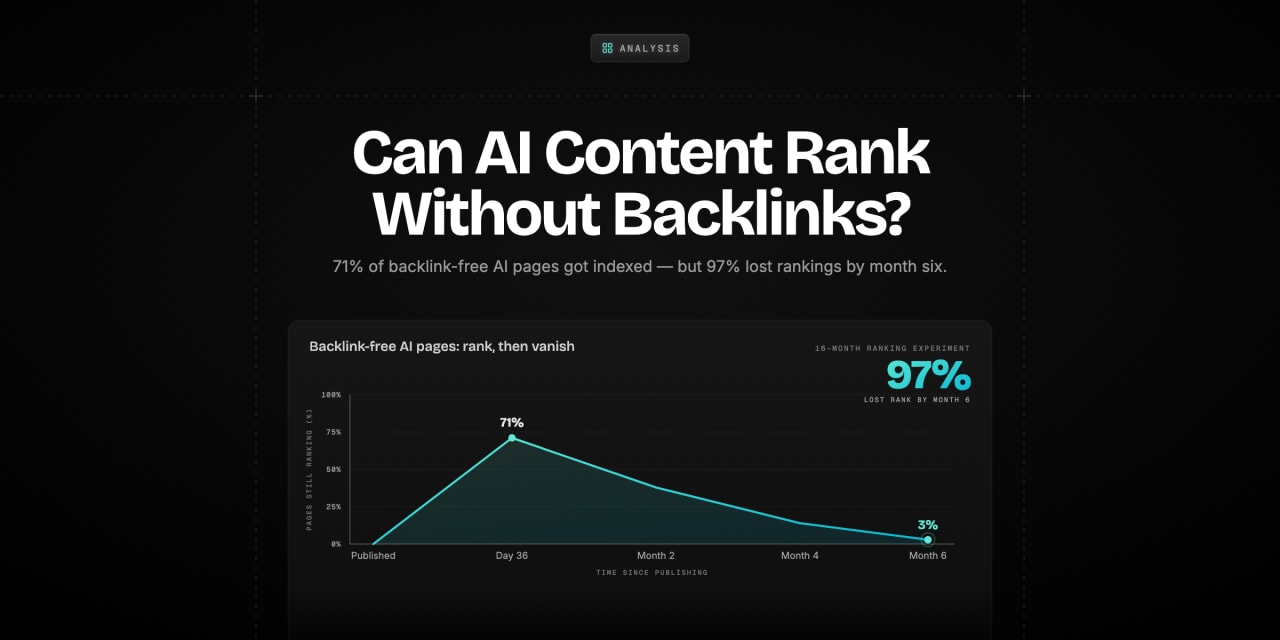
Yes, AI-generated content can rank without backlinks, at least for a while. According to SE Ranking's 16-month large-scale experiment, 71% of AI-generated pages on brand-new domains with zero backlinks were indexed within 36 days. By month three, 28% ranked in the top 100. By month six, that had collapsed to 3%. That is the real pattern behind the question.
The frustration is understandable either way. You see competitors with thin AI content outranking pages you spent months building. Does AI content beat established sites with strong link profiles? Sometimes, yes. The question is whether it stays there.
This article separates what is actually happening from confirmation bias. It explains when AI-generated content SEO works without backlinks, and gives you a framework for where to invest in 2026.
Why Did Backlinks Dominate SEO for So Long?
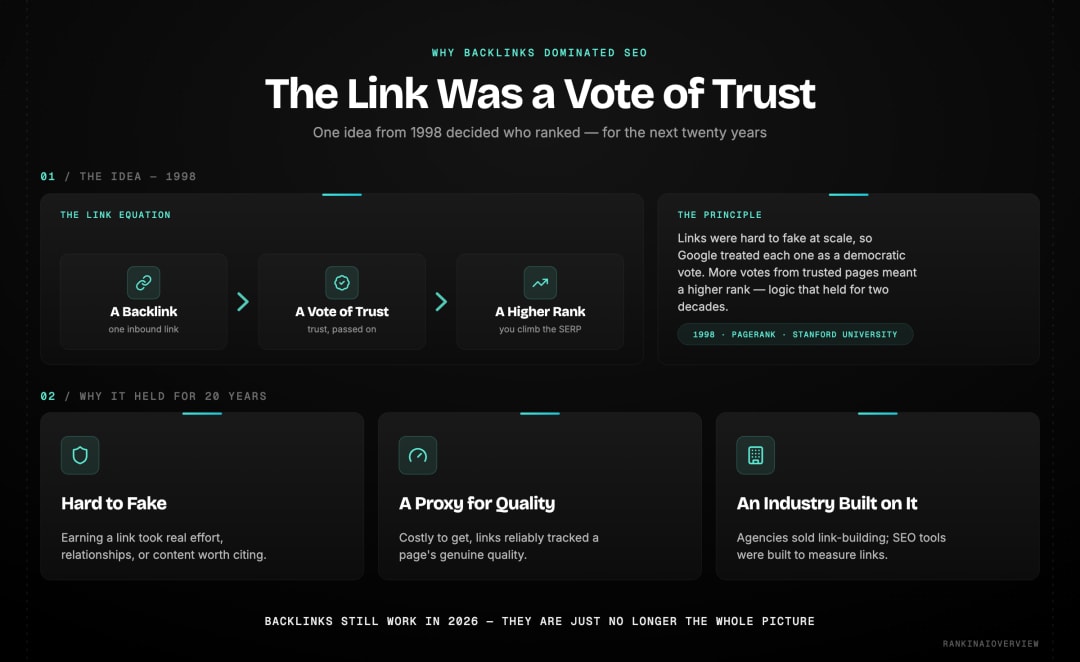
Google built its original ranking system on PageRank, which treated every link as a vote of trust. A page with more high-quality links ranked higher because links were hard to fake at scale. That logic held for two decades. It is still valid, but it is no longer the whole picture. |
|---|
When Larry Page and Sergey Brin published the original PageRank paper at Stanford in 1998, they described links as democratic votes. The more votes a page received from trusted sources, the higher it ranked. This model worked because acquiring links required genuine effort, relationships, or content worth referencing. It correlated with quality in a way that keyword placement alone never did.
For twenty years, the data confirmed this. High-ranking pages almost always had strong backlink profiles. Agencies built businesses around acquiring links. SEO tools built their core products around measuring them. The entire industry infrastructure treated backlinks vs content quality 2026 as a settled debate, with backlinks winning.
What changed is not that links stopped working. What changed is that new systems evaluate trust differently. And those systems are becoming the primary discovery layer for an increasing share of searches.
What Is Actually Happening With Backlink-Free Content in 2026?
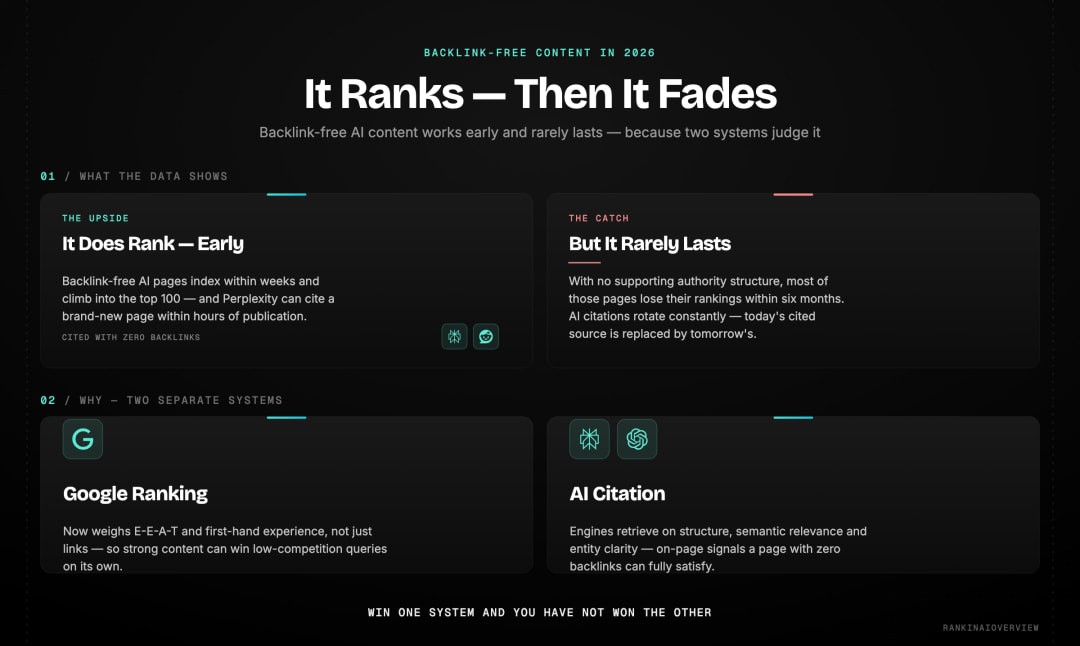
The data is clear on two things simultaneously. AI content does rank without backlinks in the early stages. And it almost always loses those rankings within six months without a supporting authority structure. Both facts are true. The question is what you do with that information. |
|---|
Cases Where It Is Working

The most rigorous data on this question comes from SE Ranking's 16-month experiment, which published 2,000 AI-generated articles across 20 new domains with no backlinks, no brand history, and no editorial intervention. The early results were striking. Over 122,000 impressions accumulated in the first five weeks. Does AI content rank on new sites with no links? Yes, briefly and meaningfully.
Beyond the experiment, practitioners are seeing AI content cited in Perplexity without any links to the source site. Does AI content rank in AI answers without links? Yes, more reliably than in Google. Perplexity's own crawler indexes content independently of Google's link graph. A well-structured page can appear in a Perplexity answer within hours of publication.
Reddit posts with no website links attached are being pulled into AI answers for their specific, first-hand insights. This matters for AI-generated content SEO because it shows that AI citation and Google ranking follow different rules. Research from Princeton and Georgia Tech confirms that AI citation is driven by structural clarity and authority signals, not link equity.
Why It Is Happening
Google's increased weight on E-E-A-T signals is the primary reason backlink-free AI content rank without backlinks SEO is possible at all in traditional search. Google's Search Quality Rater Guidelines explicitly state that experience signals, not just authority signals, are now central to quality evaluation. A page that demonstrates first-hand knowledge and addresses a query comprehensively can compete with link-rich competitors on low-competition queries.
For AI search citation specifically, the mechanism is different again. AI engines like Perplexity and ChatGPT with web search enabled crawl and retrieve content based on structural extractability, semantic relevance, and entity clarity. These are on-page signals. A page without a single backlink can satisfy all three criteria simultaneously.
This is the key insight that most discussions of backlinks vs content quality 2026 miss. Google ranking and AI citation are two separate systems. A strategy that works for one does not automatically work for the other.
“ Using AI to generate content at scale to manipulate search rankings violates our spam policies. However, using AI to create content that is helpful, reliable, and people-first is fine. Google Search Official guidance on AI-generated content Source: Google Search Central, March 2024 |
|---|
Why Are Backlink-Free Rankings Fragile?

Pages that rank without backlinks borrow Google's trust temporarily. They have not earned it permanently. When algorithm updates recalibrate what trust looks like, these pages are the first to lose their positions. The SE Ranking experiment showed this clearly: 28% in the top 100 at month three dropped to 3% at month six. |
|---|
The SE Ranking experiment documented this drop precisely. After 16 months of tracking, pages that had ranked briefly settled into near-zero visibility. The August 2025 Google spam update temporarily lifted some pages back to 20% visibility in the top 100, but this represented Google recalibrating its spam detection rather than a genuine recovery in content authority.

The pattern is consistent. AI-generated content SEO without backlinks follows a predictable arc: fast indexing, brief ranking, then a quality evaluation that the content cannot pass without genuine authority signals. Content without links is the first to fall after any update because it has no structural reason to remain visible beyond the initial novelty signal.
AI citations rotate dynamically too. Perplexity and ChatGPT do not lock in sources permanently. A page cited today can be replaced tomorrow by a competitor page with stronger entity presence or a more recent publication date. Without backlinks anchoring your authority, there is nothing to sustain your citation position when a newer or better-structured source enters the space.
Does Google's Scaled Content Abuse Policy Apply Here?
Google's guidance is clear on this. Generative AI content only breaks policy when it is published at scale without adding value for readers. Being AI-generated is not the violation. Being thin and repetitive at volume is.
Google's own Search Central documentation states that generative AI is useful for researching a topic and adding structure to original content. The line it draws is around volume without value, not authorship.
This explains why the 71% to 28% to 3% drop-off pattern shown earlier happens. Pages that rank briefly on a new domain are often part of a larger batch. Google's scaled content abuse policy is built to detect exactly that pattern over time, regardless of whether a single backlink exists.
A single well-researched AI-assisted article on a new domain faces a very different risk profile to 200 near-identical AI pages published in a week. The backlink question is almost a distraction from the real one. The real question is whether each page would still be worth reading if a human had written it slowly by hand.
This is also why backlinks were never the actual gatekeeper the traditional SEO gospel assumed. Quality detection at scale is.
When Can You Skip Backlinks and When Can You Not?

The honest answer is context-dependent. Low-competition niches, AI citation goals, and early-stage topical authority building are the only situations where skipping backlinks is a reasonable short-term strategy. For competitive keywords or long-term Google rankings, there is no reliable shortcut. |
|---|
Low-Competition Niches
In niches with low keyword difficulty and limited authoritative competitors, topical depth genuinely substitutes for link equity in the early stages. A site that covers every angle of a specific subject thoroughly, with structured content and clear entity signals, can rank without backlinks for months.
The conditions have to be right. The keyword difficulty needs to be low, the competitors need to have thin content or poor structure, and the site needs genuine topical authority through an organised content cluster. A single article without links is not enough. A cluster of ten to fifteen tightly linked articles on the same topic, without any external links, is a different proposition.
AI Search Citation vs Google Ranking
This is the most important distinction in the entire debate. Does AI content rank in AI search without backlinks? Yes, more reliably than in Google. Perplexity and ChatGPT with web search evaluate content at the passage level. A well-structured, direct-answer paragraph with strong entity signals can be extracted and cited regardless of the domain's backlink profile.
Off-site entity signals are the AI equivalent of backlinks. Brand mentions on Reddit, reviews on G2 and Capterra, listings in industry directories, and Wikipedia entries all tell AI engines that your brand is real, credible, and associated with a specific topic area. These signals are buildable without any traditional link acquisition.
High-Competition Keywords
Backlinks remain essential for competitive queries. This has not changed in 2026. The top-ranking pages for high-volume, high-intent keywords almost universally have strong backlink profiles. AI-generated content SEO without links on competitive terms produces the same result it always has: brief indexing followed by irrelevance.
If your keyword difficulty score in Ahrefs or Semrush is above 50, budget for link acquisition alongside content production. Treating backlinks as optional at that level of competition produces predictably poor results.
What Actually Replaces Backlinks for AI Citation?
For AI citation specifically, four off-site signals do the work that backlinks do for Google ranking. None of them require traditional link acquisition. All of them take time to build but compound in value in the same way that domain authority does in traditional SEO. |
|---|
Reddit and community mentions are the most direct substitute. AI engines weight Reddit heavily as a citation source because it represents genuine, unsponsored human opinion. Contributing specific, useful answers in relevant subreddits builds the kind of brand presence that AI systems cite. A brand mentioned ten times on Reddit in specific, helpful contexts carries more AI citation signal than a generic link from a mid-tier blog.
Review platform presence on G2, Capterra, Trustpilot, and TripAdvisor builds entity authority in product and service categories. When an AI is asked about tools in your space, it pulls from these structured review sources. A profile with 30 detailed reviews outperforms a new site with 30 backlinks for AI citation purposes.
Entity recognition through Wikipedia entries, Wikidata listings, and Google Knowledge Panel presence signals to AI systems that your brand is a known, verifiable entity. This is the foundation of rank without backlinks SEO for AI-specific visibility. Entity presence is slow to build but durable once established.
Brand consistency across all platforms reinforces entity recognition. Your business name, description, and category must be consistent across your website, your Google Business Profile, social platforms, and third-party directories. Inconsistency creates ambiguity that AI engines resolve by favouring clearer competitors.
What Is the Right Content Investment Hierarchy for 2026?
Backlinks have moved from first priority to fifth. That does not mean they are unimportant. It means you build them on top of a quality foundation rather than instead of one. The hierarchy below reflects what the 2026 data shows actually drives sustainable visibility. |
|---|
Priority | Signal | Serves | Why It Comes First |
|---|---|---|---|
1 | Content quality and topical depth | Google + AI | The foundation everything else builds on. Weak content defeats all other investments. |
2 | Technical SEO and crawlability | Google + AI | If Google cannot crawl it, AI cannot cite it. Clean architecture is non-negotiable. |
3 | On-page E-E-A-T signals | Google + AI | Author credentials, inline citations, original data. The trust layer. |
4 | Off-site entity and community signals | AI primarily | Reddit, reviews, Wikipedia, entity consistency. The AI citation layer. |
5 | Traditional backlinks | Google primarily | Still essential for competitive terms and ranking longevity. Not first, but never optional. |
The practical implication for rank without backlinks SEO: a new site targeting low-competition keywords with AI citation goals can operate at priority levels one through four without immediate backlink investment. For mid-to-high difficulty keywords, backlink building starts at launch.
The shift in backlinks vs content quality 2026 thinking is not that links no longer matter. It is that content quality is now the prerequisite rather than the complement. You cannot buy your way to AI citation with links. You can only earn it with content that AI engines trust enough to extract.
Conclusion
The backlink question is one slice of a bigger one — does AI-generated content help or hurt your SEO in 2026?
AI content rank without backlinks is real. The 16-month SE Ranking experiment proved it with 2,000 pages on 20 domains. The data also proved that those rankings collapse without authority support, faster and more completely than most creators expect.
The right frame for backlinks vs content quality 2026 is not either/or. Content quality is the prerequisite for both Google ranking and AI citation. Backlinks are the insurance that makes those rankings stable over time. Off-site entity signals are what drive AI-specific citation when links are limited.
Build the content first. Build topical authority through a structured cluster. Build entity presence through community and review platforms. Then add backlinks as the layer that protects everything you have earned. That sequence produces sustainable AI-generated content SEO results without wasting link budget on content that has not yet demonstrated its value. For deeper research on how AI engines evaluate content authority and what drives citation decisions, RANK IN AI OVERVIEW covers this space across its content library.
Frequently asked questions
Are backlinks still necessary in 2026?+
Yes, but their role has changed. Backlinks are the most reliable way to sustain Google rankings over time and survive algorithm updates. For AI citation specifically, off-site entity signals like Reddit mentions and review platform presence matter more. Backlinks remain necessary for competitive Google rankings and for long-term ranking stability.
What matters more backlinks or content quality?+
Content quality is now the prerequisite; backlinks are the amplifier. Quality content without backlinks can gain early traction but loses it quickly. Backlinks without quality content produce rankings that collapse under quality evaluation. For sustained performance in both Google and AI search, both are required. Content quality earns initial visibility; backlinks protect it.
Do backlinks still matter for AI content?+
For Google ranking, yes. Pages with stronger backlink profiles hold rankings longer after algorithm updates, which is critical for AI-generated content that is otherwise prone to volatility. For AI search citation specifically, off-site entity signals matter more than link equity. The two systems evaluate authority differently.
Why does some AI content rank with no backlinks?+
Three conditions allow it. First, low keyword difficulty means competitors are also weak. Second, strong topical depth and E-E-A-T signals satisfy Google's quality evaluation temporarily. Third, AI search engines evaluate structural clarity rather than link equity, so well-formatted content gets cited regardless of backlink count. The ranking is real but usually temporary without link support.
Explore with AI
Share this