
Google Just Revealed How It Picks Sources for AI Overviews — What SEOs Need to Know
Google published official AI Overview ranking factors guidance and a senior exec spoke on the record. Here's what it actually says, and what it doesn't.
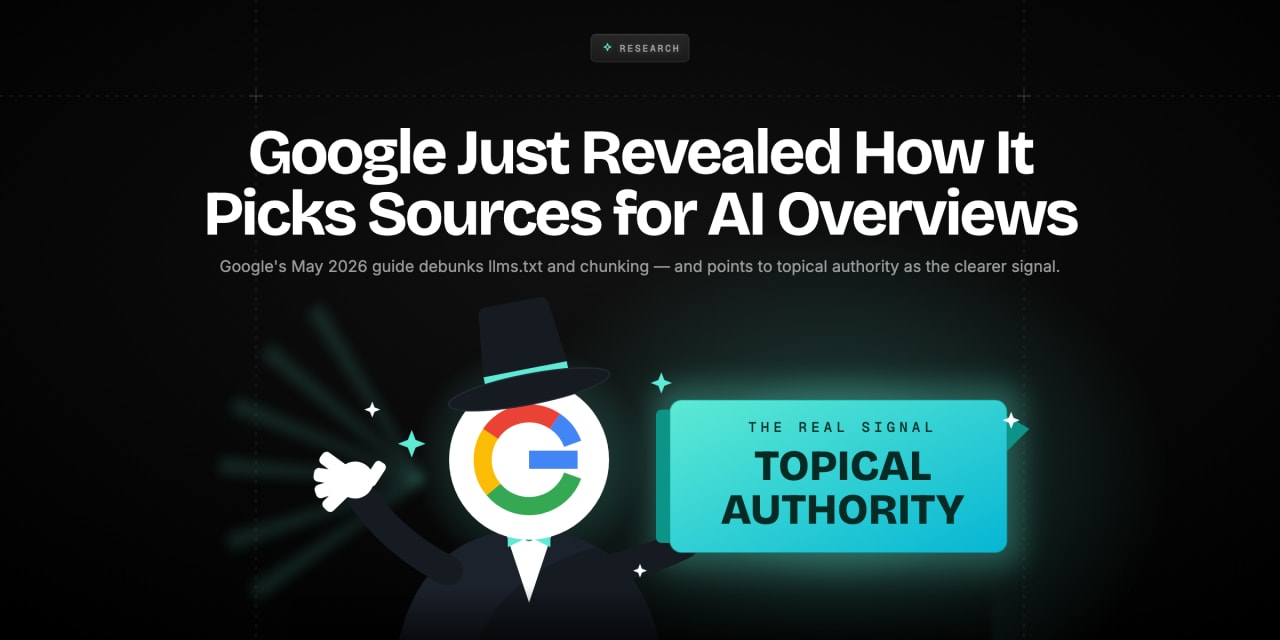
Key Highlights
-
Google published an official, consolidated guide on AI Overview and AI Mode optimisation in May 2026.
-
The guide explicitly debunks several popular AI SEO tactics, including llms.txt files and content “chunking.”
-
Google's Nick Fox separately said content needs to go “one level deeper” than the AI's own summary.
-
Topical authority, not single-page authority, is the clearer signal across both sources.
-
Google still has not disclosed exact signal weighting, and says it does not plan to.
-
SEOs lack official clarity on what Google uses to decide which pages feed AI Overviews, and this guide is honest about where that gap remains.
SEOs lack official clarity on what Google uses to decide which pages feed AI Overviews, and most coverage of Google's recent statements has either oversimplified them or repeated unverified statistics. According to Google's own AI optimisation guide, published in May 2026, several widely circulated AI SEO tactics are not required at all.
That gap between what Google actually said and what got repeated about it is exactly where confusion sets in. Classic Google vagueness about precise signal weighting hasn't helped, but a real, citable document now exists, alongside on-the-record comments from a senior Google executive.
Much of the immediate reaction played out in a widely discussed thread on Reddit, where SEOs picked apart the announcement in real time. The most useful threads in that discussion weren't the excited ones, they were the ones cross-checking specific claims against what Google actually published.
This piece works through both sources directly, translates them into concrete Google AI Overview ranking factors you can act on, and flags the parts that are still genuinely unclear rather than pretending otherwise. Where other coverage has stretched Google's actual wording into specific numbers or formulas, this piece sticks to what's verifiably in the source material.
What did Google actually say about AI Overview source selection?
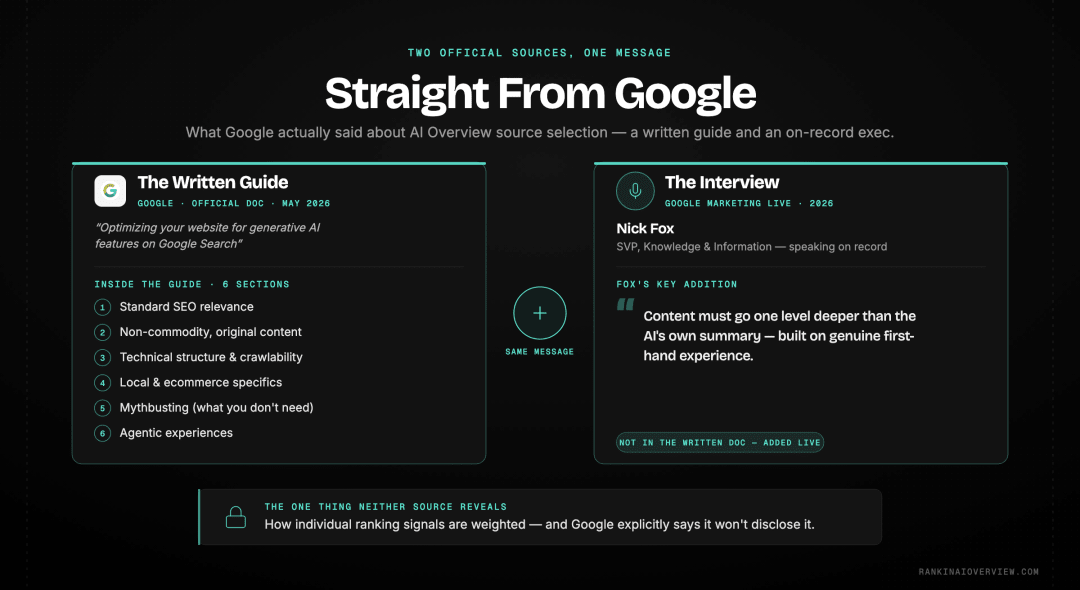
Google published a consolidated guide titled Optimizing your website for generative AI features on Google Search in May 2026. It largely restates existing guidance in one place, rather than revealing a new algorithm, but it does explicitly rule out several tactics that had become common advice.
Separately, Nick Fox, Google's senior vice president of Knowledge and Information, spoke about AI search directly in an interview at Google Marketing Live 2026. His comments add a layer the written guide doesn't: a clearer sense of what content needs to do once an AI Overview has already given a basic answer.
“ As humans we want to hear from humans. Nick Fox SVP, Knowledge & Information, Google Source: https://searchengineland.com/google-nick-fox-ai-search-deeper-content-478686
Neither source hands over a weighted list of ranking signals. Google said helpfulness and authority are key, but that still doesn't tell anyone the actual signal weighting. That criticism, voiced widely when the guide came out, is fair. What Google did provide is a clear list of what it says doesn't matter, which is its own kind of useful signal.
The guide itself is organised into a handful of sections: standard SEO relevance, creating non-commodity content, technical structure, local and ecommerce specifics, a mythbusting section, and a short note on agentic experiences. The mythbusting section is the part most worth reading closely, since it directly contradicts several pieces of advice that had spread widely before the guide was published.
The agentic experiences section is brief but notable. It signals Google's awareness that AI agents, not just AI Overviews, will increasingly interact with sites directly, though the guidance there is general rather than prescriptive at this stage. It's worth revisiting as that section gets expanded in future updates.
What are the confirmed ranking factors for AI Overviews?
The closest thing to confirmed AI Overview ranking factors right now is a short list: standard SEO and indexing eligibility, non-commodity and helpful content, E-E-A-T signals, clear technical structure, and topical depth across a site rather than one page.
Helpfulness and E-E-A-T
Google's guide repeats its long-standing helpful content position and ties it directly to generative features: provide a unique point of view, avoid generic or commodity content, and organise pages around what readers actually need.
This is not a new standard invented for AI Overviews specifically. It's the same Helpful Content and E-E-A-T framing Google has used in its Search Quality Rater Guidelines for years, now explicitly extended to cover generative features rather than treated as a separate system.
Nick Fox's comments sharpen this further. He specifically described the content most likely to perform well as going “one level deeper, two levels deeper” than the AI's own surface-level answer, built around real, first-hand experience. RANK IN AI OVERVIEW's research on trust versus rankings found the same pattern independently: pages without named authors or genuine first-hand detail get skipped even at strong ranking positions.
Fox gave a concrete example during the interview: someone researching a purchase doesn't just want the AI's summary, they want to hear from someone who actually used the product, including what went wrong and what accessories they needed. That's a higher bar than restating manufacturer specifications, and it's not one most commodity content clears.
This is also where the E-E-A-T thread from the discussion online picked up real traction: several SEOs read Google's explicit mention of first-hand experience signals as confirmation that author credibility, not just page-level optimisation, now has a direct bearing on AI feature inclusion.
Topical authority vs page authority
Google's guide doesn't use the phrase “topical authority” directly, but its repeated emphasis on organising content around real reader needs, rather than one page per keyword, points the same way. A site that covers a subject from several genuine angles gives Google's systems more material to draw from than a single, isolated page.
This lines up with a wider pattern: citing multiple sources across a topic means a page doesn't need to rank #1 to be useful to an AI Overview, it needs to be authoritative enough on its specific sub-topic. RANK IN AI OVERVIEW's guide to building a GEO and AI Overview content cluster walks through how to structure a site around that idea directly.
This is also where Google's silence is most notable. The guide doesn't quantify how much topical clustering helps relative to page-level authority, leaving practitioners to infer the relationship from observed citation patterns rather than from any disclosed formula.
The Reddit comment that the big reveal was topical authority mattering more than individual page authority is a fair read of the direction Google's guide points, even though Google never uses that exact phrase. It's an inference from emphasis, not a confirmed statement, and it's worth treating it with that distinction in mind.
Content structure and direct answers
The official guide asks for clear technical structure, semantic HTML that prioritises human readability, and reduced duplicate content. Notably, it does not ask for any of the more exotic structural tactics that have circulated in SEO advice over the past year.
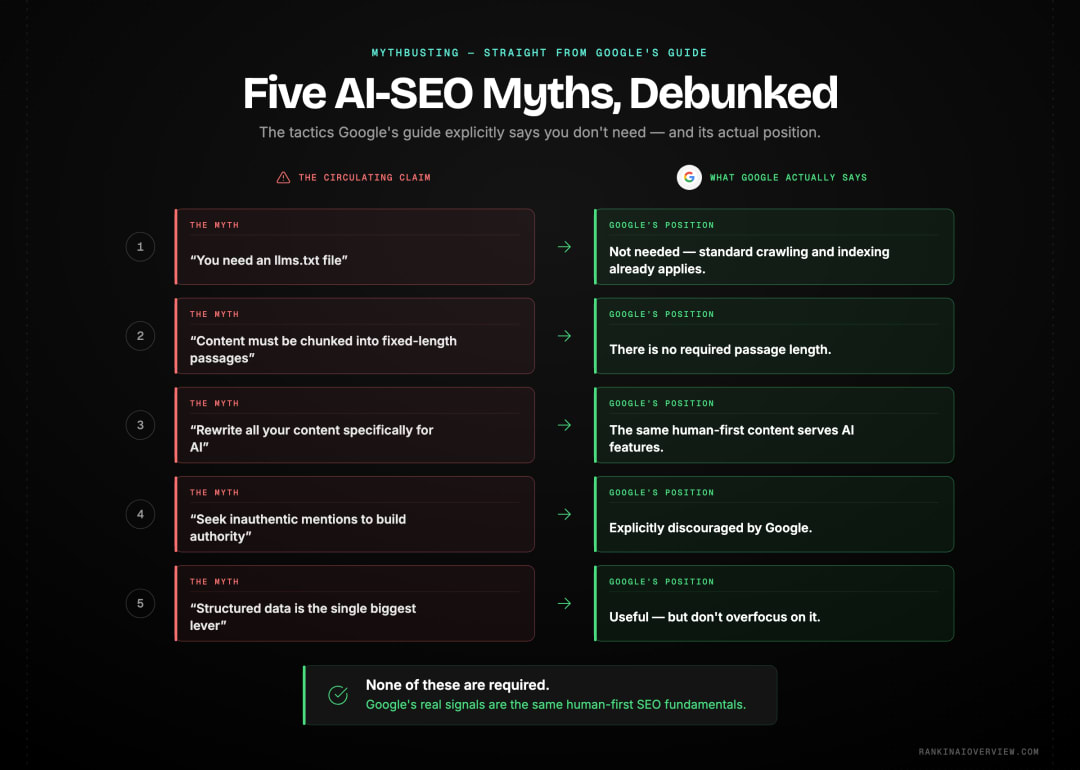
Specifically, Google's mythbusting section states a site does not need an llms.txt file, does not need special markup beyond standard schema, does not need its content “chunked” into fixed-length passages, and does not need rewriting specifically for AI systems. Standard, well-structured content written for people is the stated bar.
Laid out directly against the advice that has circulated, the contrast is stark:
| Google's claim | What it actually means in practice |
|---|---|
| “You need an llms.txt file” | Google says this isn't needed. Standard crawling and indexing rules already apply. |
| “Content must be chunked into 134–167 word units” | Google's guide makes no mention of a required passage length. Write clearly; don't engineer to a number. |
| “Rewrite all content specifically for AI” | Not required. Google says the same content that serves human readers well also serves its AI features. |
| “Seek inauthentic mentions to build authority” | Explicitly discouraged. Authority should come from genuine recognition, not manufactured signals. |
| “Structured data is the single biggest lever” | Google says not to overfocus on structured data specifically, despite how often this claim circulates. |
None of this means structure, schema or technical hygiene stopped mattering. It means the more extreme, specific claims attached to them, the exact word counts, the mandatory new file types, are not coming from Google.
A practical version of this: a product page with clean headings, a clear written description, and standard Product schema meets Google's stated bar. Restructuring that same page into rigid 150-word answer blocks because a blog post claimed it was required adds effort without backing from the source Google actually published.
The same caution applies to any future claim about AI Overview ranking factors that arrives without a direct link back to Google's own documentation or a named, on-record Google spokesperson. Treat secondhand summaries of secondhand summaries as the least reliable layer in this entire topic.
What does this mean for your content strategy?
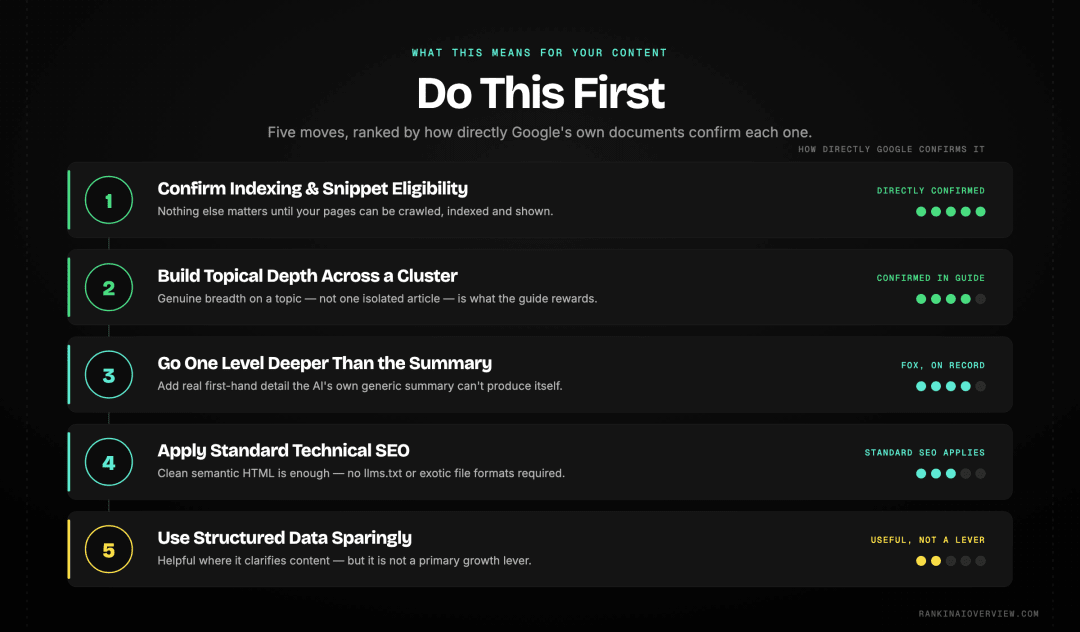
In practice, this confirms a smaller, less exotic set of priorities than much of the AI SEO advice circulating suggests: solid technical SEO, genuinely useful and original content, clear structure, and topical depth.
It also reframes a few debates that had been running without a clear answer. Whether E-E-A-T was still relevant for AI features, whether structured data was now mandatory, and whether content needed AI-specific rewriting were all genuinely open questions before this guide. They aren't open questions anymore, even if the exact mechanics behind each remain undisclosed.
It also means a reasonable share of recent advice can be safely ignored. Specific llms.txt files, content rewritten into rigid word-count chunks, and inauthentic mention-building all appear directly in Google's own “what you don't need to do” list. Time spent on those is time not spent on the things Google did confirm matter.
The practical priority order: confirm technical eligibility first, then build genuine topical depth around real reader questions, then layer in standard structural good practice. Skipping straight to advanced tactics without the first two in place rarely pays off.
A short, honest priority list
In order of how directly each is confirmed by Google's own guidance and Fox's comments, rather than by speculation:
-
Confirm indexing and snippet eligibility. Nothing else matters until this is in place.
-
Build genuine topical depth across a cluster of pages, not a single isolated article.
-
Write content that goes a level deeper than a generic summary, with real first-hand detail.
-
Apply standard technical SEO and clean semantic HTML, without chasing exotic new file formats.
-
Use structured data where it genuinely clarifies content, not as a primary growth lever on its own.
Most of this list will look familiar to anyone who has done SEO for more than a year or two. That familiarity is, itself, useful information: it suggests the underlying skill set hasn't been replaced, only resequenced and pointed at a slightly different output.
Which types of pages are most likely to be selected?
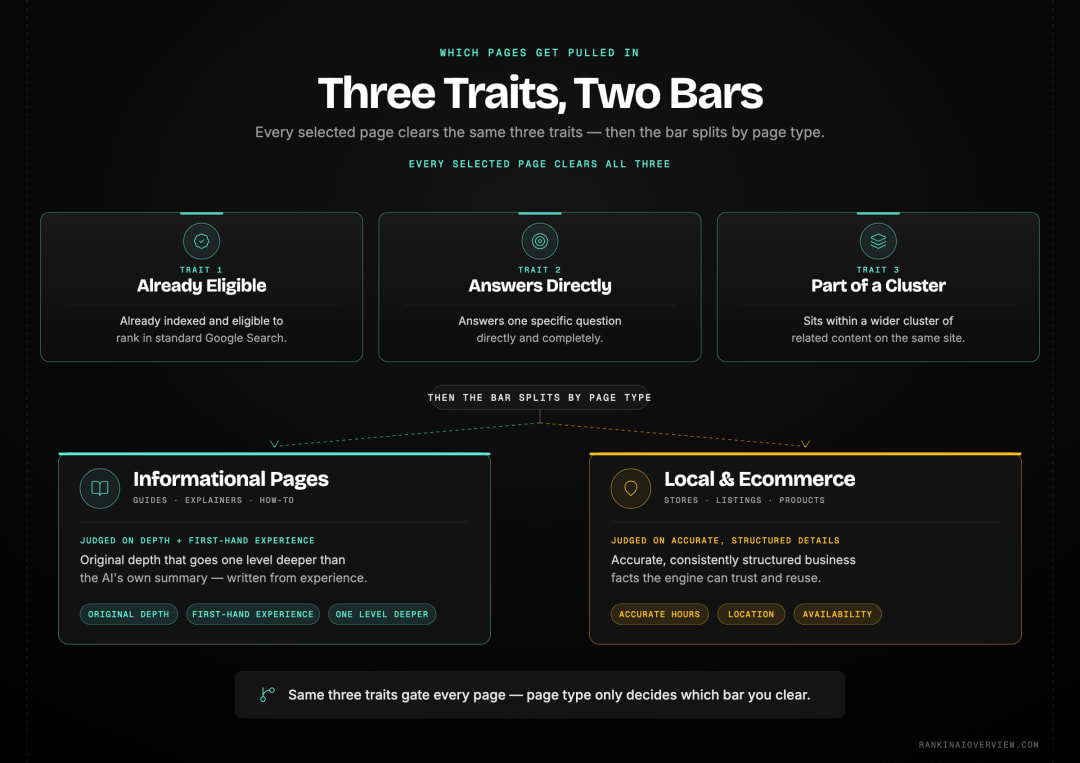
Pages most likely to be selected combine three things: they already meet standard indexing and ranking eligibility, they answer a specific question directly and completely, and they sit within a wider cluster of related content on the same site.
One widely shared test in the wake of Google's announcement involved building an exact-match question-and-answer page from scratch. It was reportedly pulled into an AI Overview within a week, which fits Google's own emphasis on direct, complete answers, though a single anecdotal test isn't proof of a universal rule.
The bit about citing multiple sources matters here too: because an AI Overview can draw on several pages rather than one, a page covering a narrow sub-topic thoroughly competes on different terms than it would in classic search, where it would need to outrank everyone for the exact same broad query.
Pages built purely to chase a keyword, with no surrounding topical context, are the type least likely to be selected under this framework, even when well-written. RANK IN AI OVERVIEW's breakdown of what ‘ranking’ means in AI search goes into why isolated pages structurally struggle here.
What about ecommerce and local pages specifically?
Google's guide gives ecommerce and local business pages their own short section, separate from general content advice. The emphasis there is on keeping business details, such as hours, locations and product availability, accurate and consistently structured, since AI features pull this kind of factual detail directly.
This is a narrower, more mechanical requirement than the content-depth advice elsewhere in the guide. A local business page can meet this bar through accurate, well-maintained structured listings even without the kind of first-hand narrative content Fox described for informational queries.
The split is useful to keep in mind: informational content is judged more on depth and first-hand experience, while transactional and local content is judged more on factual accuracy and consistency. Treating both with the same playbook misreads what Google's own guidance actually separates out.
Does Google tell you when your page is in an AI Overview?
Not directly through a dedicated notification, but Search Console's Performance report does include AI Overview appearances as a filterable search type, which is the closest official signal currently available.
This is a relatively recent addition and doesn't yet offer the same granularity as standard ranking data. Filtering by search type in the Performance report, then cross-checking specific queries manually, remains the most reliable combined approach for now.
Worth noting: this filter shows whether a query triggered an AI Overview and whether your page appeared, but it doesn't show position within the AI Overview, which sources appeared alongside yours, or why one page was chosen over another. For that level of detail, manual spot-checks and third-party AI visibility tools still fill the gap Search Console leaves.
It's reasonable to expect this reporting to deepen over time, given how much attention AI Overview visibility is getting industry-wide. For now, treat the current Search Console filter as a useful starting signal rather than a complete measurement system.
Conclusion
Google's May 2026 guide and Nick Fox's comments together amount to a real, citable clarification, not a dramatic new reveal. The most useful part isn't what Google confirmed matters; it's the explicit list of tactics it confirmed don't.
Acting on this honestly means deprioritising llms.txt files, content chunking and inauthentic mention-building, and reinvesting that effort into technical eligibility, genuine topical depth, and content that goes a level deeper than a generic AI summary ever could.
The gap between official guidance and the more dramatic claims circulating around it is unlikely to close completely. Treating Google's own documents as the baseline, and everything else as an unverified hypothesis until proven otherwise, is the more defensible position for now.
Revisit this guide alongside Google's own documentation periodically rather than treating either as fixed. Both the official guidance and the public commentary around it are still evolving, and the gap between the two is exactly where most wasted SEO effort tends to happen.
For ongoing tracking of what Google does and doesn't confirm about AI Overview ranking factors, RANK IN AI OVERVIEW covers this space across its content library.
Frequently asked questions
Which AI does Google use for AI Overviews?+
Google's AI Overviews are powered by its own Gemini models, integrated directly into Google Search's existing index and ranking systems rather than running as a separate product.
Is there an official Google AI Overview ranking factors list?+
Not as a weighted list. Google has published guidance describing the categories that matter, helpfulness, E-E-A-T, technical structure, but has not disclosed how heavily each one is weighted in selection.
Does topical authority replace the need to rank well?+
No. Standard ranking and indexing eligibility still come first. Topical authority improves the odds once that baseline is met; it doesn't substitute for it.
What is E-E-A-T and why does it matter for AI Overviews?+
E-E-A-T stands for experience, expertise, authoritativeness and trustworthiness. It matters because Google's own guidance and Nick Fox's comments both point to genuine, first-hand content as a stronger AI Overview signal than generic summaries.
Do I need an llms.txt file to appear in AI Overviews?+
No. Google's own May 2026 guide explicitly states this isn't needed. Standard crawling, indexing and robots rules already govern how AI features access a site's content.
Why doesn't Google just publish the exact ranking weights?+
Google has never published exact weighting for traditional search either, partly to limit manipulation. There's no indication that approach changes for AI Overviews, despite the new guidance being more detailed than before.
Has Google's guidance on AI Overviews changed since the May 2026 update?+
The core guidance has stayed stable since publication, though Google continues to update related documentation incrementally. Treat the May 2026 guide as the current baseline, and check Search Central's own update log periodically for revisions.
Explore with AI
Share this


