Why Ranking #1 on Google Doesn't Guarantee You'll Appear in AI Answers
Being number one on Google and appearing in AI-generated answers are two different things. Here is why the signals have diverged and what actually determines AI citation

SummaryA #1 Google ranking no longer guarantees AI visibility. AI engines prioritize trust, clear answers, entity authority, and third-party validation over traditional ranking signals.
To earn citations in ChatGPT and AI Overviews, optimize for credibility and extractability, not just rankings.
Read moreShow less
It is one of the most counterintuitive discoveries in modern SEO: the page that ranks number one on Google is often not the page AI answers cite. According to a 5WPR research report released May 2026, the overlap between top Google ranking pages and sources cited in AI-generated answers has collapsed from 70% to under 20%, and continues to fall. A brand holding the number one position on Google can no longer assume it will appear in ChatGPT, Claude, Gemini, or Perplexity answers for the same query. The signals have diverged.
The confusion this creates is real and growing. You have a page that has held position one for months. It ranks for the right keywords, has strong backlinks, and passes every technical audit. But when your customers ask ChatGPT the same question your page answers, your brand is nowhere to be found. A competitor with a fraction of your domain authority is being cited instead. Google ranking vs AI citation is two different games with different rules. Understanding google ranking vs ai citation as a structural divergence is the first step to closing it.
This article explains exactly what those rules are. We will show you the data behind the disconnect, compare the Google ranking signal set against the AI citation signal set side by side, explain the five most common reasons a number one ranked page gets skipped by AI, identify what AI-cited pages consistently have in common, and give you a four-step audit process to diagnose and close your own gap. By the end, you will know precisely what to fix and in what order.
What Does the Research Actually Show About This Disconnect?

The disconnect is structural and accelerating. Research consistently shows that AI engines and Google evaluate content authority using substantially different signals. The pages AI cites most frequently are not the pages Google ranks highest. And the gap between the two systems is widening as AI engines develop more sophisticated trust evaluation methods that diverge further from PageRank logic. |
The clearest primary evidence comes from 5WPR research published in May 2026. The research documents a structural break: the overlap between Google's top-ranked pages and the sources cited by AI engines has fallen from 70% to under 20% in approximately 18 months. At 70% overlap, optimising for Google was effectively optimising for both channels simultaneously. At 20% overlap, that logic is mathematically broken. Rank 1 not cited by AI is now the statistical majority, not the exception.
The data at the individual page level is equally striking. Research consistently finds that approximately 28% of ChatGPT's most-cited pages have zero organic visibility in Google. They rank nowhere in traditional search yet are cited heavily in AI answers. Conversely, pages holding position one on Google appear in AI Overview top-three citations only around 33% of the time. Up to 47% of AI Overview citations come from pages ranking below position five. Understanding why AI ignores top ranked pages so frequently requires separating the signals each system uses, which the next section does directly.
The academic foundation for understanding why this happens comes from Princeton and Georgia Tech's generative engine optimisation research. AI engines evaluate content at the passage and concept level using semantic context and entity authority, not the page-level signals like keyword relevance and backlinks that drive Google rankings. The retrieval layer and the ranking layer use fundamentally different evaluation criteria. Understanding Google ranking vs AI citation as two separate evaluation systems is the first step to fixing the gap.
“ When the overlap between Google's top results and AI citations was 70%, optimising for Google was effectively optimising for both. At under 20%, that thinking is broken. The CMOs who understand this are reallocating budget right now. Ronn Torossian Founder, 5W PR Source: 5WPR GEO vs SEO Research Report, PR Newswire, May 2026 |
What Does Google Rank You For Versus What AI Cites You For?

Google and AI engines ask different questions when evaluating a page. Google asks: is this page relevant, authoritative, and technically accessible? AI engines ask: is this page trustworthy, extractable, entity-clear, and corroborated by sources I already trust? The signals that answer these questions overlap partially but diverge significantly on the dimensions that matter most for AI citation. |
Google Ranking Signals
Google's ranking algorithm is built on PageRank logic: links from authoritative sources transfer trust to the pages they link to. The more high-quality backlinks a page receives, the higher its authority score and the higher it ranks for relevant queries. Keyword relevance in the title, headers, and body text tells Google what query the page should rank for. User engagement signals including dwell time, click-through rate, and bounce rate tell Google whether the page is satisfying the users it attracts. Technical health including crawlability, Core Web Vitals, and mobile performance ensures the page is accessible and renders correctly.
This model has been refined over 25 years and is extremely good at identifying pages that are genuinely authoritative in their category and relevant to specific queries. It is less good at identifying pages that can be cleanly extracted and synthesised into a generated answer, because that was never what it was designed to evaluate.
AI Citation Signals
AI engines evaluate a different set of properties. Content extractability is the most critical: does the page contain self-contained, direct-answer passages that can be pulled and cited without surrounding context? A page that buries its answer in long paragraphs after a lengthy preamble is structurally invisible to AI retrieval. Research from Princeton and Georgia Tech confirmed that adding specific statistics, clear formatting, and direct-answer structure increased AI citation probability by 30 to 40 percent.
Off-site trust corroboration is the second major AI citation signal. AI engines evaluate whether your brand is mentioned in the communities and platforms they already trust: Reddit discussions, G2 and Capterra reviews, Wikipedia entries, and industry publications. A page from a brand with no third-party presence is not trusted enough to cite confidently, regardless of how many backlinks its domain has accumulated.
Trust signals, not just rankings, increasingly decide AI citation — the data on this is worth a closer look.
Entity recognition tells AI engines who your brand is and what category it belongs to. Without consistent entity signals across your own site and third-party references, AI engines treat your brand as an unknown quantity. Unknown quantities are not cited. Content objectivity matters because AI engines are risk-averse: they avoid promotional content that could expose them to accusations of bias. And E-E-A-T signals, specifically named author credentials and demonstrated first-hand experience, tell AI systems the content is trustworthy at the source level.
Signal | Google Weight | AI Citation Weight | Why It Differs |
|---|---|---|---|
Backlink authority | Very High | Low to Medium | AI uses entity corroboration, not link equity, to measure trust |
Keyword relevance | Very High | Medium | AI retrieves by semantic meaning, not keyword match |
Content extractability | Low | Very High | AI needs passage-level self-contained answers to cite confidently |
Off-site entity mentions | Low to Medium | Very High | AI validates brand credibility through third-party corroboration |
Entity clarity and schema | Medium | Very High | AI needs structured signals to understand content context |
Author E-E-A-T signals | Medium | High | AI weights human expertise evidence more than algorithmic quality signals |
Content tone (objective vs promotional) | Low | High | AI avoids citing sales-forward content to avoid appearing biased |
Technical crawlability | Very High | Very High | Shared requirement: both systems need to access and index the page |
How Big Is the Gap, According to the Data?
Pew Research Center found organic click-through rates fall from 15% to 8% when an AI Overview appears on a search page. That is a 47% relative decline in clicks to any traditional result, including position one.
This finding came from tracking 900 US adults across 68,879 real Google searches in March 2025. It is the clearest public evidence that ranking #1 and being cited are no longer the same outcome. Our diagnostic on why page-1 rankings still miss AI Overviews walks through the same gap query by query, for anyone who wants the practical audit steps rather than the topline data.
The gap exists because Google's ranking systems and its AI Overview selection process evaluate different signals. Google's own Search Essentials guidance emphasises helpful, people-first content for both. But citation selection weighs completeness and extractability far more heavily than position alone, and trust signals increasingly decide that selection more than raw ranking ever did.
A page can satisfy classic ranking signals, like backlinks and keyword relevance, while failing the self-contained-answer test that AI citation rewards. That mismatch is the entire subject of this article.
Does It Matter Which AI Platform Is Ignoring You?
Yes. Google AI Overviews still lean heavily on Google's own rankings. ChatGPT and Perplexity mostly do not. If you diagnose the gap without knowing which platform is skipping you, you will apply the wrong fix to a problem with a different cause. |
Research across ChatGPT, Perplexity, Gemini, and Copilot consistently shows that only around 12% of the links these platforms cite also rank in Google's top 10 for the same query. Put the other way, 88% of what they cite is content Google either does not rate highly or does not know about.
Google's own AI Overviews behave very differently. Around 76% of AI Overview citations do rank in Google's top 10. So a #1 page missing from an AI Overview usually has an extractability or trust problem on the page itself. A #1 page missing from ChatGPT usually has an entity and off-site problem, because ChatGPT is not reading your rank at all.
A documented case shows how this plays out. A solar energy company held the #1 Google ranking for its main category keyword for more than two years. When users asked ChatGPT to recommend solar panel providers in that market, it listed three competitors and one international brand. The market leader was missing. The difference was not SEO. It was PR coverage, Reddit discussions, review volume, and structured citations. ChatGPT knew the competitors existed in context. It did not have enough trust signal to include the leader.
That is what being ignored by AI really means. The engine does not dislike your content. It simply has not seen enough third-party evidence to trust your brand.
“ Brands cannot win on rankings alone anymore; they win on trust. Modern discovery happens where people talk, not where algorithms dictate, and that means investing in authentic community presence and social visibility is as critical to search as backlinks once were. Nick Liddell Co-founder and Search Everywhere Director, Deviation |
What Are the 5 Reasons a Number One Page Gets Skipped by AI?
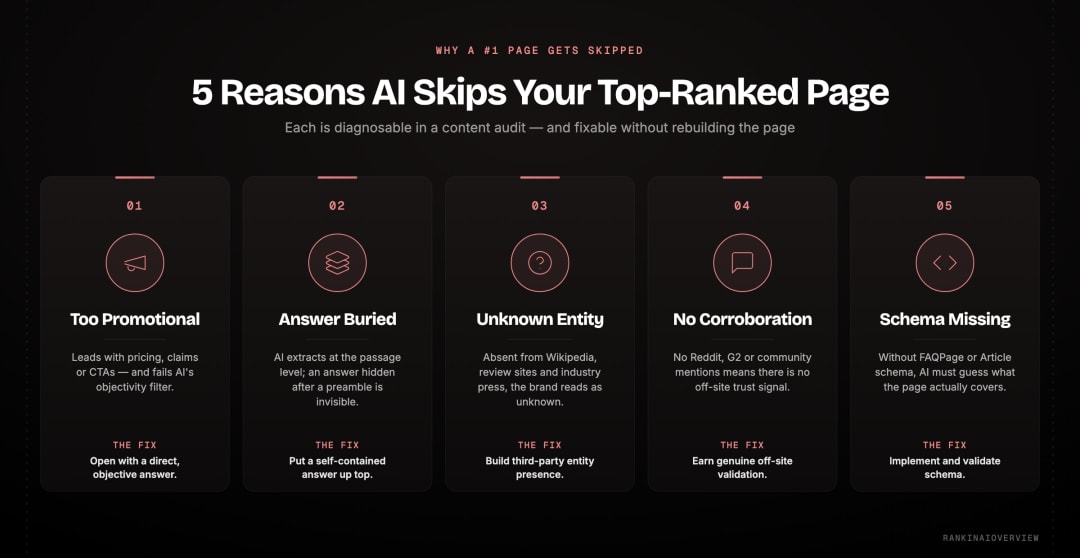
Five specific gaps account for the majority of cases where a page holds strong Google rankings but receives zero AI citations. Each is diagnosable through a content audit. Each is fixable without rebuilding the page from scratch. The order matters: fix content structure first because it affects all AI platforms simultaneously. |
Understanding why AI ignores top ranked pages is most useful when you can see it in specific, fixable patterns rather than abstract signal theory. Here are the five most common reasons, in order of frequency.
Reason 1: The content is too promotional. AI engines skip pages that lead with pricing, feature claims, testimonials, or calls to action. A page designed to convert visitors rather than inform them fails the objectivity filter that AI systems apply. The language patterns of promotional content are recognisable at the passage level. Pages that open with "We offer the best solution for..." are structurally disqualified from AI citation regardless of their Google rank. The fix is to rewrite the opening 150 words to lead with a direct, objective answer to the query the page targets.
Reason 2: The answer is buried. AI engines extract answers at the passage level. A page with its best content in section four, after three sections of context-setting, is skipped by AI retrieval. The model scans for self-contained answer passages early in the page. If it does not find one quickly, it moves to the next candidate. Page 1 Google AI invisible status from this cause is the easiest to fix: rewrite each H2 section to open with a direct 40 to 60 word answer.
Reason 3: The brand is not a recognised entity. AI engines do not only evaluate what is on the page. They evaluate whether the brand publishing the page is a known, trusted entity in their knowledge structure. A brand absent from Wikipedia, review platforms, and industry publications is an unknown entity. Unknown entities are not cited. The fix is to build entity presence through consistent third-party mentions, review platform profiles, and Knowledge Panel optimisation. This is the slowest fix to implement and the most durable once in place.
Reason 4: No off-site corroboration exists. AI search trust signals include third-party validation: Reddit discussions mentioning your brand, G2 reviews referencing your product, industry newsletters citing your research, and community platforms where genuine users discuss your category. A brand whose only presence is its own website has no corroboration signal. AI engines treat un-corroborated brands the way a careful researcher treats uncited claims: with scepticism. Building off-site presence through genuine community participation is the most direct path to improving AI citation for brands with strong Google rankings but weak third-party presence.
Whether AI-generated content can rank without backlinks at all is a related question worth separating from this one.
Reason 5: Schema markup is missing or broken. Schema.org's FAQPage specification and Article schema tell AI engines exactly what your page covers, how the content is structured, and which sections answer which questions. Without schema, AI systems must infer this information from unstructured text, which is less reliable and produces lower citation confidence. Validate your schema implementation using Google's Rich Results Test after every implementation. Broken schema produces no benefit and occasionally produces harm by surfacing incorrect signals.
What Do AI-Cited Pages Consistently Have in Common?

AI-cited pages share five structural and trust characteristics regardless of their Google ranking position. These characteristics are observable, replicable, and directly implementable. Pages that combine all five are significantly more likely to achieve consistent citation across ChatGPT, Perplexity, and Google AI Overviews than pages missing any single one. |
Direct answers in the first 100 words. Why AI ignores top ranked pages is often answered by looking at the opening paragraph alone. Every page cited consistently by AI engines opens with a self-contained answer to its primary query. A reader could excerpt those first 100 words and understand the core point without reading further. This is what AI engines do when they extract and cite.
FAQ sections with schema markup. AI-cited pages almost universally include a FAQ section structured as question-and-answer pairs with FAQPage schema implemented correctly. These sections are directly parseable by both Google and AI retrieval systems. Question-and-answer format matches the conversational query structure that AI engines process most efficiently. FAQ sections with proper schema are the single highest-return structural investment for improving AI search trust signals.
Visible author expertise signals. A named author with verifiable credentials, a linked bio page showing their background and other published work, and inline citations to authoritative external sources all appear consistently on AI-cited pages. These E-E-A-T signals tell AI systems the content is published by a real person with demonstrated expertise on the topic, not by an anonymous editorial team or a content farm.
Positive brand mentions in third-party sources. The most consistently AI-cited brands are mentioned regularly on Reddit, G2, Quora, and in industry publications. AI engines encounter these brands repeatedly in trusted contexts before they decide to cite them. This prior brand exposure across trusted platforms is the off-site equivalent of a confidence score that AI systems use alongside on-page signals.
Valid schema markup on every relevant page. Google's structured data documentation confirms that entity understanding is central to how its AI systems evaluate content credibility. Pages with correctly implemented Article, FAQPage, and Person schema consistently outperform unstructured pages for AI citation across all major platforms. Schema is infrastructure, not decoration.
Why Does Entity Recognition Decide So Much?
An entity is a named organisation, product, or person that an AI engine can uniquely identify. Before citing your brand, the engine runs something like a background check: does it know who you are, what category you operate in, and whether trusted sources describe you consistently? If the answer is unclear, it leaves you out. |
Google trust and AI trust run on different evidence. Google trusts your site because other sites link to it. AI engines trust your brand because independent sources describe it the same way: Wikipedia, Wikidata, Reddit, review platforms, industry directories, and major publications. A brand can collect thousands of links from partners and customers without any of them appearing in the places AI engines use to build entity knowledge.
Three entity gaps show up again and again in well-ranked brands that AI skips.
No Knowledge Panel or Wikipedia presence. AI engines use Wikipedia and Google's Knowledge Graph as primary verification sources. Wikipedia alone accounts for approximately 7.8% of all ChatGPT citations. A brand with neither is hard for AI to verify, however strong its rankings.
Inconsistent naming across the web. "Acme Corp", "ACME Corporation", and "Acme" can be read as three different entities. A brand listed under slightly different names has split its entity signal instead of compounding it. This is the easiest gap to fix, because it needs no one else's permission: pick the canonical name in your Organisation schema, Google Business Profile, and Wikidata record, then make LinkedIn, Crunchbase, G2, Capterra, and your industry directories match it exactly.
Ambiguous brand names. If your name is a common word, a place name, or shared with a company in another sector, AI engines may not be able to tell you apart. Rather than risk citing the wrong entity, they drop the ambiguous one. Organisation schema that states your name, category, and official profiles is one of the most direct ways to reduce that ambiguity.
The entity work splits into fast and slow parts. Organisation schema, a claimed Knowledge Panel, and name standardisation each take a few hours and tend to show results within four to eight weeks. A Wikidata entry takes one to two hours and has a lower notability bar than Wikipedia. Wikipedia itself needs genuine independent coverage first: an entry deleted for lack of notability is worse than a complete Wikidata record with no Wikipedia article. Editorial mentions and community contributions take three to six months to compound, but they are the signals that hold citations in place once you have them.
“ Entity ambiguity is a real thing. If AI cannot disambiguate your brand from other uses of the same name, it avoids citing you entirely. Build your Wikipedia entry and knowledge panel. Entity establishment changes everything. Digital marketing practitioner r/digital_marketing community, Reddit 2026 Source: Reddit: Why Does a Brand Sometimes Rank Fine in Google but Not Show in AI? |
How Do You Audit Your Own Ranking-to-Citation Gap?

The audit process takes four steps and can be completed using free tools in under two hours. The goal is to identify which of your high-ranking pages are receiving AI citations, which are not, and what structural and trust differences explain the gap. This diagnostic produces a prioritised fix list specific to your actual content, not a generic optimisation checklist. |
Step 1: Identify which of your pages are appearing in AI answers. For your 20 highest-priority keywords, run each query in ChatGPT and Perplexity three times each. Note which pages from your domain appear and how often. Use Google Search Console to cross-reference which of those same keywords your site currently ranks in the top five for. Build a simple spreadsheet with three columns: keyword, current Google ranking position, AI citation frequency (0 to 3 per platform).
Step 2: Compare cited pages to uncited pages. For any keyword where you rank in the top five but receive zero AI citations, analyse the specific page and compare it to whichever page is being cited instead. Focus on four differences: Does the cited page open with a direct answer? Does it have FAQ schema? Does the publishing brand have reviews on G2 or Capterra? Is the content objective rather than promotional? The answer pattern across multiple comparisons will reveal your dominant gap.
Step 3: Prioritise fixes by impact and effort. Content structure fixes (rewriting opening paragraphs for direct-answer extraction, adding FAQ sections, implementing schema) are low effort and affect all AI platforms simultaneously. Off-site entity building (review platform profiles, community participation, PR coverage) is medium effort and compounds over three to six months. Author authority signals (author bios with credentials, linked external publications) are low effort and produce measurable trust signal improvements within four to eight weeks.
Step 4: Implement in sequence and remeasure. Make one category of changes, wait four weeks, and remeasure your AI citation frequency across the same prompt set. Single-variable testing produces cleaner signal about what is working. The most common finding: rank 1 not cited by AI is almost always a content structure or off-site signal problem, rarely a technical one. Because AI citation rotates, treat this as a recurring check rather than a one-off fix — see how consistently AI search citations actually hold. This iterative process produces a progressively accurate picture of which AI search trust signals your specific content is missing.
How Do You Diagnose a Single Page in Ten Minutes?
The audit above tells you which pages have a gap. These quick checks tell you why a specific page has one. Each takes a few minutes, needs no paid tool, and points straight at one of the five reasons. |
The 200-word read. Read the first 200 words of the page as if you had never heard of your company. Warning signs: your company name in the first sentence before any answer, benefit statements before facts, pricing in the introduction, or testimonials before the page has taught anything. If you see these, the page is too promotional.
The cover-up test. Cover everything below the first 100 words. Can you answer the page's target query from what is left? If not, the answer is buried. Also check whether the first sentence of each H2 section would make sense if it were lifted out on its own.
Here is the difference in practice, for a page about project management software:
BEFORE: Project management software has become essential for modern teams navigating complex workflows. In this guide, we will explore the top options available, how they compare on key features, and what to look for when making your selection.
AFTER: The best project management software for most teams in 2026 is either Asana, ClickUp, or Monday.com, depending on team size and budget. Asana leads for large teams needing workflow automation. ClickUp offers the most flexibility for smaller teams. Monday.com is the strongest option for visual project tracking.
The after version gives an AI engine a self-contained, citable answer straight away. The before version gives it nothing to extract, so it moves to the next source.
The schema check. Run the page through Google's Rich Results Test. Look for no structured data at all, a Q&A section with no FAQPage markup, Article schema without a named author, or a homepage without Organisation schema.
The "what do people say" test. Ask ChatGPT and Perplexity: "What do people say about [brand name]?" If they find no third-party context, your off-site layer is empty. Then search Reddit for your brand and category, and check your G2 or Capterra profile. Fewer than 10 reviews means your corroboration signal is negligible.
The Knowledge Panel check. Search your brand name on Google. No Knowledge Panel, no Wikipedia entry, and no Wikidata record means the entity layer is missing.
“ First I check if the page answers the question directly in the first 100 words. Usually it does not. That single fix, rewriting the opening to lead with the answer, resolves the AI citation gap for more than half the pages I diagnose. SEO practitioner r/SEO_Xpert community, Reddit 2026 Source: Reddit: What's the First Thing You Fix if a Page Ranks in Google but Not AI? |
What Does a Four-Week Fix Plan Look Like?
Once the audit has named your gaps, run the fixes in a fixed order. Content structure goes first because it helps every AI platform at once. Off-site and entity work goes last because it compounds slowly and depends on the content already being in shape. |
Week | Focus | Key Actions | Expected Impact |
|---|---|---|---|
Week 1 | Content rewrite for extractability | Pick the top 10 pages by query potential. Rewrite the opening 150 words of each to lead with a direct answer. Remove or rewrite promotional sections. Add FAQ blocks. | Perplexity citations often improve within 2 to 4 weeks as it crawls frequently |
Week 2 | Schema markup | Add FAQPage and Article schema to all priority pages. Validate with Google Rich Results Test. Add BreadcrumbList schema to show topical hierarchy. | Google AI Overview citations begin improving within 4 to 6 weeks |
Week 3 | Off-site gaps | Audit Reddit, Quora, G2, Capterra, and Trustpilot for brand mentions. Fill gaps with genuine contributions and review requests. Find threads where competitors appear and you do not. | ChatGPT citation probability rises over 6 to 12 weeks as off-site signals compound |
Week 4 | Entity and author authority | Claim and complete the Knowledge Panel. Create or update Wikidata, and Wikipedia where eligible. Add verified author bios with credentials. Add Person and Organisation schema. | Sustains long-term AI visibility across all platforms |
On author bios, specific beats generic. A line like "tested 40 tools in 2025" tells an AI engine far more about first-hand experience than "written by our editorial team".
Research from SE Ranking in November 2025 adds weight to week three: domains with profiles on Trustpilot, G2, Capterra, and Yelp have three times the citation probability in ChatGPT compared to domains without them.
Is an AI Citation Worth as Much as a Number One Ranking?
They are worth different things. A #1 ranking wins on click volume and stability. An AI citation wins on lead quality and brand association. The strongest position is holding both for the same query, which is why closing the gap in this article matters. |
On volume, position one still leads. Without an AI Overview, it earns roughly 28 to 34% click-through rate on informational queries. When an AI Overview appears, that drops to roughly 15 to 20%, because the summary answers the question before anyone scrolls. Citation alone brings fewer clicks than position one for the same query.
On quality, AI citation leads. Seer Interactive's case study found ChatGPT-referred traffic converted at 15.9% against 1.76% for standard organic traffic. People arriving from an AI answer have already read a summary of your category and your place in it, so they come in further along.
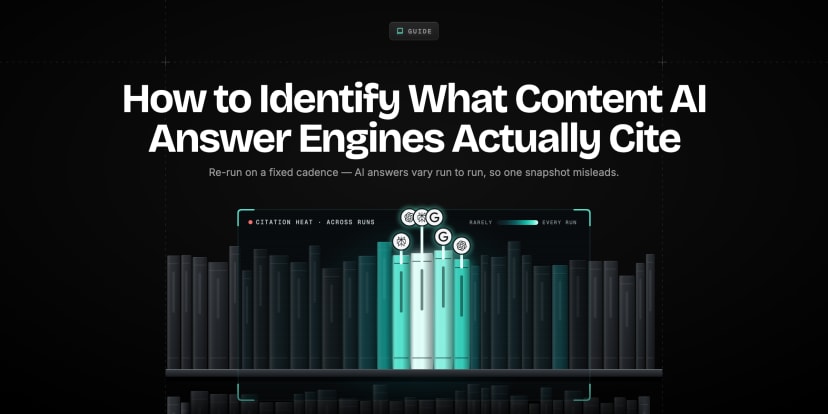
On stability, ranking leads by a wide margin. Research finds only 30% of brands cited in AI answers keep that citation the following month. That is why citation frequency across repeated runs, not a single check, is the metric to watch, ideally tracked as a rolling average with a dedicated AI rank tracker.
Dimension | Google Number One | AI Citation | Winner |
|---|---|---|---|
Click volume | 28-34% CTR without AIO, 15-20% with AIO present | Lower. Fewer users click cited sources | Google Number One |
Traffic quality | Mixed intent, variable conversion | High intent. Seer documented 15.9% vs 1.76% organic | AI Citation |
Brand impact | Brand seen in a ranked list | Brand named as a source inside the answer | AI Citation |
Stability | Holds for months to years with upkeep | Only 30% of brands keep citation month to month | Google Number One |
Measurability | Transparent in Search Console | Needs repeated testing or a tracking tool | Google Number One |
The two are not rivals. Around 97% of AI Overview citations come from pages in Google's top 20, so ranking remains the entry ticket for Google's AI answers. Treat your ranking as the base layer and citation as the quality layer on top.
What Actually Happens After You Close the Gap?
One practitioner shared a 16-week account of taking a brand from uncited to a consistent ChatGPT citation using only the fixes in this article. The results were real, but not the ones most teams expect: less direct traffic, much better leads, and citations that needed ongoing upkeep. |
The programme, described by a practitioner on r/AI_Agents, ran in the same order this article recommends. Weeks one to four: rewrite twelve pages so each answer sat in the first 60 words, plus FAQPage and Article schema. Weeks four to ten: genuine answers in four subreddits twice a week, with no brand mentions in the first three posts to any community. Weeks eight to sixteen: Knowledge Panel claim, a Wikidata entry, and a guest article in a publication AI engines already cited in the category. The first tentative ChatGPT citations appeared in week six.
Traffic was lower than expected. Most people who saw the brand in ChatGPT did not click. They searched the brand on Google later or came in directly, so the ChatGPT referral line barely moved.
Brand awareness was the clear win. Branded search impressions in Google Search Console rose 34% in the first four weeks after consistent citation.
Lead quality was the standout. AI-referred leads converted at about three times the rate of average organic leads, and the sales cycle shortened by roughly 30%. The sales team noticed first: prospects were saying "I asked ChatGPT about your category and your name came up" before the analytics showed anything. Once ChatGPT, Perplexity, Claude, and AI search were added as options on the intake form, AI discovery became the third-largest new lead source.
Citations were unstable. Three weeks after reaching first mention for the main query, the brand slipped to a secondary mention, then vanished for two weeks with no changes made. Refreshing the cited page (new statistics, updated examples, a new FAQ pair) and adding two fresh Reddit contributions brought it back within ten days.
The practical lessons: start branded search tracking on day one to get a baseline, keep Reddit participation steady at two to three genuine contributions a week, and review cited pages every six to eight weeks. Set expectations early that this builds brand and lead quality first, and traffic later.
Conclusion
Your Google ranking got you into the retrieval pool. Your AI search trust signals determine whether you get cited from it. Rank 1 not cited by AI is now the majority experience, not a fringe problem. The page 1 Google AI invisible pattern is fixable with the right sequence of changes. Start with content structure, add schema, build your off-site entity presence, and surface your author authority. Fix the trust gap and the citation follows. RANK IN AI OVERVIEW covers the full landscape of AI citation signals and what drives visibility across ChatGPT, Perplexity, and Google AI in depth across its content library.
Frequently asked questions
Does improving AI citation affect Google rankings?+
The relationship is correlational, not directly causal. Page 1 Google AI invisible and strong AI citation are not mutually exclusive. Improving content structure, adding schema, and building off-site entity presence improve both AI citation frequency and Google ranking signals simultaneously. The tactics share a common foundation: content quality, technical accessibility, and genuine authority. Brands that invest in AI search trust signals typically see Google ranking improvements alongside AI citation improvements because the underlying quality signals reinforce each other.
Should I optimise for AI citation or Google ranking first?+
Prioritise Google ranking first, then layer AI citation optimisation on top. Ranking in Google's top 20 is a prerequisite for Google AI Overview citation. For ChatGPT and Perplexity, Google ranking matters less, but a technically sound, well-structured site optimised for Google is the right foundation for AI citation work. Begin with technical health, content quality, and E-E-A-T signals. These serve both channels. Then add the AI-specific layer: FAQ schema, answer-first formatting, and off-site entity building.
What is the fastest fix for a page that ranks but is not cited?+
Rewrite the opening 150 words to lead with a direct, self-contained answer to the page's primary query. Remove any promotional language from the opening. Add a FAQ section with at least five question-and-answer pairs and implement FAQPage schema. Validate the schema using Google Rich Results Test. These three changes can be implemented in under two hours per page and typically show measurable Perplexity citation improvements within two to four weeks. For Google AI Overview citation, add Article schema and ensure the page ranks in the top 10 for its primary query.
Is it possible to be cited in AI without a Google top-ten ranking?+
Yes, particularly for ChatGPT and Perplexity. Research shows that a significant majority of ChatGPT-cited pages do not rank in Google's top ten. Both platforms evaluate content structure, entity clarity, and off-site corroboration more heavily than organic ranking position. A well-structured, entity-rich page on a domain with strong community presence can be cited by ChatGPT without ever ranking on Google for the same query.
How quickly will fixing these issues show results in AI search?+
Content structure fixes produce measurable Perplexity citation improvements within two to four weeks because Perplexity crawls frequently and updates its retrieval index quickly. Google AI Overview improvements typically take four to six weeks after schema implementation and content restructuring. Off-site signal improvements take six to twelve weeks because the new community mentions need to be crawled and incorporated into AI retrieval systems. Entity building improvements take one to three months because Wikidata and Knowledge Graph updates propagate slowly.
Does being cited in AI hurt your Google ranking CTR?+
Yes, when an AI Overview is present for the same query. Research finds that Google position one CTR drops from approximately 28 to 34% to approximately 15 to 20% when an AI Overview appears for the query. This CTR reduction applies to position one regardless of whether your page is cited in the AI Overview. Being cited in the AI Overview partially compensates for this by ensuring that users who do not click organic results have still encountered your brand. Pages cited in AI Overviews earn more organic clicks over time than uncited peers because the AI citation builds brand familiarity that converts to future branded searches.
Is AI citation or Google ranking harder to achieve?+
Google number one ranking is harder to achieve for most queries in most categories because the competitive field is more developed and link acquisition costs are significant. AI citation is currently less competitive because most teams are not yet systematically investing in the entity signals, content structure, and off-site presence that AI engines evaluate. The window for early-mover advantage in AI citation is closing as more teams recognise and act on this gap. For most businesses in 2026, AI citation represents a relatively less competitive path to category visibility than Google number one for the same queries.
How do I know if my brand is recognised as an entity by AI?+
Run two simple tests. First, search your brand name on Google and check whether a Knowledge Panel appears in the right sidebar. If it does, Google's Knowledge Graph recognises your brand as an entity. If it does not, you are either not in the Knowledge Graph or your entity signals are too weak to trigger a panel. Second, ask ChatGPT: "What is \[brand name\]?" If the response is accurate and detailed, your brand is in ChatGPT's training data with reasonable entity clarity. If the response is vague, incorrect, or states that it does not have information about your brand, your entity recognition is weak.
Can a small brand build entity recognition without PR budget?+
Yes. The highest-impact actions in the five-step programme require no PR budget. Wikidata entry creation is free and can be completed by anyone. Organisation schema implementation is a technical task requiring no external spend. Reddit and Quora community contributions require only time. Industry publication contributions as a bylined expert are frequently unpaid. The steps that benefit from PR budget are Wikipedia entry creation and tier-one media coverage. Both are achievable without paid PR for brands that have genuine expertise and a documented track record.
How do you track if customers found you via ChatGPT?+
Four tracking methods work together to give a complete picture. First, add ChatGPT, Perplexity, Claude, and AI search as explicit options in your intake form. Review weekly. Second, monitor branded search impressions in Google Search Console month over month. Rising branded impressions alongside improving ChatGPT citation rates confirms AI awareness is driving downstream Google searches. Third, instruct your sales team to ask specifically during discovery calls how prospects researched the category and which tools they used. Fourth, set up a GA4 segment for sessions where the source includes citation link parameters if your cited URLs carry UTM tags.
How do you maintain citation stability after achieving it?+
Citation maintenance requires three ongoing activities. Content freshness: review and update cited pages every six to eight weeks, adding current statistics, new examples, and any updated FAQ pairs. Off-site signal maintenance: maintain your Reddit community participation at two to three genuine contributions per week. Any pause of more than three to four weeks produces measurable citation rate decline. Entity signal consistency: ensure your brand name and description remain consistent across all external profiles whenever any profile is updated. Citations become more stable over six to twelve months of consistent maintenance, but they never become a set-and-forget achievement.
Explore with AI
Share this