Where Do ChatGPT and Claude Rank on Accuracy in 2026?
How ChatGPT and Claude compare on factual accuracy in 2026, where each one slips, and which to trust for research, writing and citation work.
Key Highlights
- No single model wins accuracy across the board. ChatGPT and Claude trade the lead depending on task type, prompt quality, and whether the model can browse for current information.
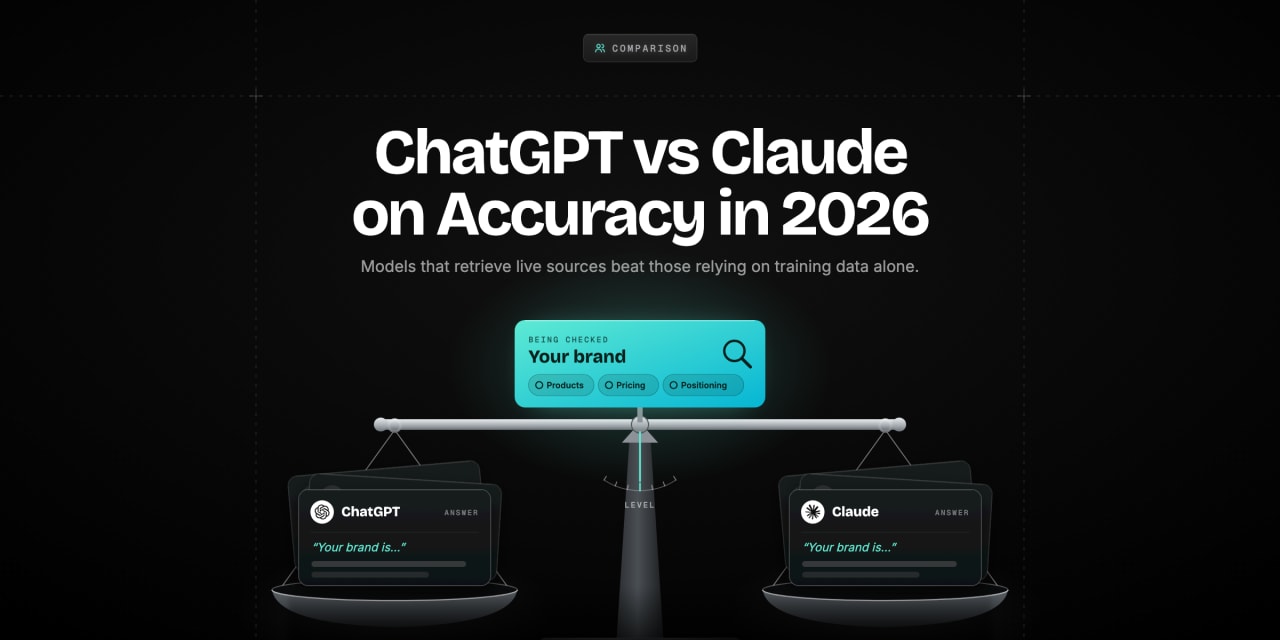
- For factual, cited answers, models that retrieve live web sources tend to be more accurate than those relying on training data alone.
- For your brand, what matters is not which model is "smartest" but whether each one represents your business accurately when users ask.
Ask ten people whether ChatGPT or Claude is more accurate and you will get ten confident, contradictory answers. The truth is less tidy. Accuracy is not one number. It shifts by task, by prompt, and by whether the model is pulling from live sources or its training data. Treating it as a simple leaderboard misleads more than it helps, and it distracts from the question that actually affects your business.
For most readers, the real question hiding behind "which is more accurate" is more practical. It is whether these models describe your brand, your products, and your industry correctly when people ask. A model can be brilliant at math and still get your company facts wrong, and that error reaches real customers.
This comparison takes accuracy seriously without overclaiming. It covers how the models compare, why accuracy varies so much, what drives factual reliability, and why brand accuracy in AI answers is the metric most businesses should actually watch. For a related experiment, our piece where we asked ChatGPT, Claude, Gemini, and Perplexity to rank each other shows how the models judge themselves.
How Do ChatGPT and Claude Compare on Accuracy?
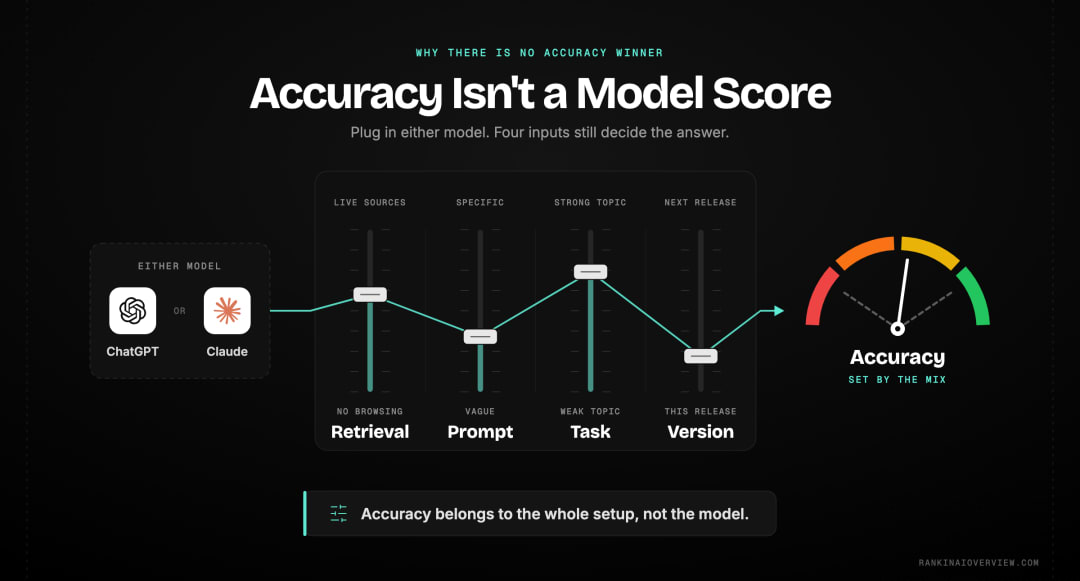
ChatGPT and Claude are both highly capable and trade the accuracy lead depending on the task. Neither is universally more accurate. Results vary with the type of question, how the prompt is framed, and whether the model retrieves live information or answers from training data.
On reasoning-heavy and factual tasks, both perform strongly, and independent evaluations tend to show them close rather than one dominating. The differences that exist are often task-specific and change as new model versions ship, so any snapshot ranking is temporary by nature.
So the honest headline is parity with variation. Picking a clear winner on accuracy alone oversimplifies a moving target. What matters more is understanding what makes any answer accurate in the first place, because that is the part you can actually influence.
Why Does AI Accuracy Vary So Much?
AI accuracy varies because it depends on the task, the prompt, the model version, and whether the model can access current information. A model may be accurate on one topic and wrong on another, especially when a question falls outside or beyond its training data.
The biggest single factor is often retrieval. A model answering from training data alone can be confidently wrong about recent events or niche facts. The same model, able to browse and cite live sources, is usually more reliable on those questions. This is why the same model gives different-quality answers depending on whether search is enabled.
Prompt quality matters too. Vague prompts invite vague or fabricated answers, while specific, well-scoped prompts produce more accurate responses. Accuracy is a property of the whole interaction, not just the model, which is easy to forget when comparing tools in the abstract.
Model versioning adds another layer. These systems update frequently, and an accuracy gap that exists today can close or reverse within weeks. Treating any comparison as permanent is a mistake, which is why brand-level accuracy is a steadier thing to track.
What Makes an AI Answer Factually Reliable?
An AI answer is most reliable when the model retrieves and cites current, trustworthy sources rather than relying solely on training data. Reliability improves with clear prompts, verifiable citations, and questions that fall within well-documented, widely-sourced topics.
The presence of citations is a useful signal. When a model shows the sources it used, you can verify the claim rather than trust it blindly. Answers built from cited web results are generally safer than unsourced ones, especially for current or specific facts. Our look at how often ChatGPT cites sources digs into this behavior.
This is also why source quality flows into answer quality. Models draw on what exists across the web, so accurate, well-structured information about a topic makes accurate AI answers about it more likely. Garbage in, garbage out applies to AI answers too, which is precisely why your own content matters.
Why Does Brand Accuracy in AI Answers Matter More Than Model Rankings?
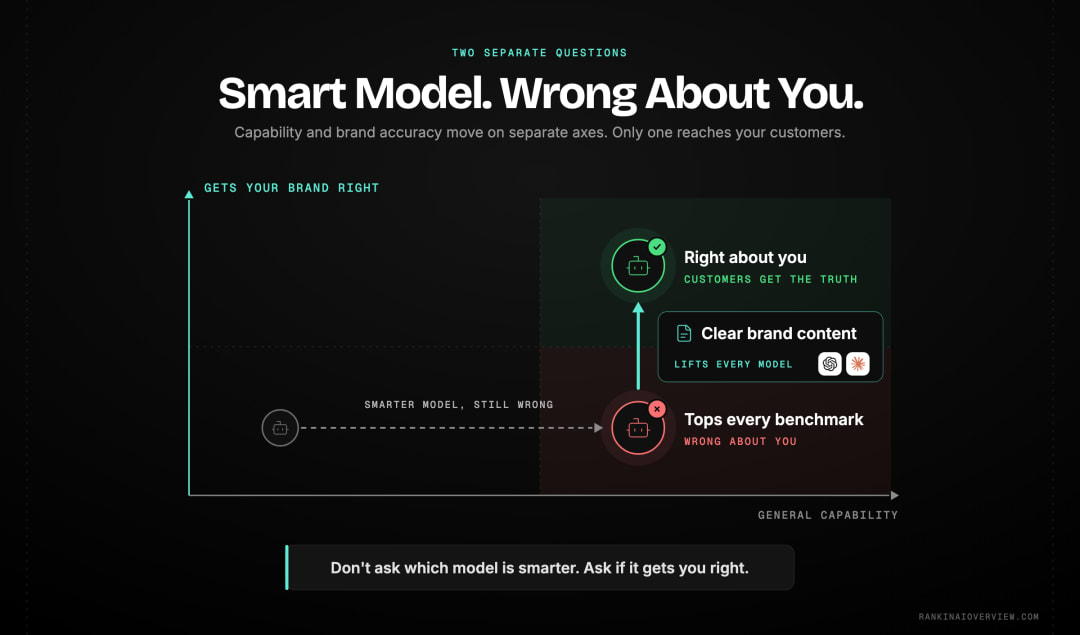
Brand accuracy matters more because your business is affected by how models describe you, not by which model scores highest overall. If ChatGPT or Claude states wrong facts about your products, pricing, or reputation, that misinformation reaches customers regardless of the model's general accuracy.
This reframes the whole comparison for businesses. The abstract question of which model is smarter is less relevant than a concrete one: do these models get your brand right? A model can top every benchmark and still misrepresent your company, and that specific error is what costs you customers.
The fix is to shape the information the models draw on. Clear, accurate, well-structured content about your brand across trusted sources improves how every model describes you, regardless of which one is momentarily "more accurate." To see how ChatGPT, Claude, and others currently represent your brand, Rank in AI Overview offers a free AI-visibility audit.
How Do You Improve How AI Models Describe Your Brand?
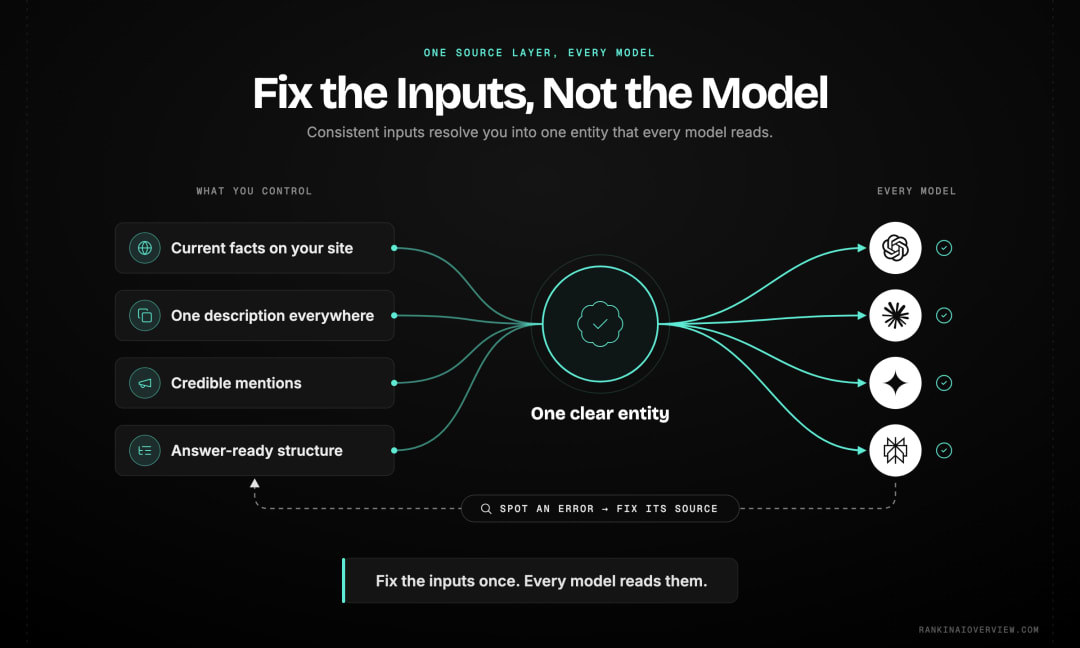
Improve how AI describes your brand by publishing clear, accurate, well-structured information across trusted sources, and by keeping your entity data consistent everywhere. Models draw on what exists across the web, so better, more consistent source material yields more accurate answers about you.
Practical steps that improve brand accuracy in AI answers:
- Keep your core facts (products, pricing, positioning) clear and current on your own site
- Ensure consistent brand descriptions across profiles, press, and directories
- Earn credible mentions that reinforce the correct version of your brand
- Structure key content so models can extract accurate answers easily
- Monitor how each model describes you, and correct the sources behind errors
The through-line is that you influence AI accuracy about your brand by improving the inputs, not by arguing with the model. Consistency across the web resolves you into one clear, correct entity, which is what reduces AI errors about your business over time.
Conclusion
Ranking ChatGPT and Claude on accuracy is tempting but misleading. They are both strong, they trade the lead by task, and their reliability depends heavily on retrieval and prompt quality. There is no permanent winner, only a shifting, task-specific picture that changes with each model update.
For businesses, the more useful question is brand accuracy: whether these models describe you correctly. That you can actually influence, by improving the content and sources the models learn from. Focus there, and the abstract model debate matters far less than the accuracy of what AI says about you.
Want to know how accurately AI models describe your brand today? Run a free AI-visibility audit with Rank in AI Overview and find out what ChatGPT, Claude, and others are saying about you.
Frequently asked questions
Is ChatGPT or Claude more accurate?+
Neither is universally more accurate. They trade the lead depending on task type, prompt quality, and whether the model can browse for current information. Independent evaluations usually show them close rather than one dominating.
Why do AI models give inaccurate answers?+
Because they may answer from training data without current information, respond to vague prompts, or address topics with thin or conflicting sources. Accuracy improves when models retrieve and cite trustworthy, current sources.
Do AI models cite their sources?+
Some do when browsing the web, showing the sources used so you can verify claims. Answers generated purely from training data often lack citations, which makes them harder to verify and sometimes less reliable.
How can I check if AI describes my brand accurately?+
Ask several AI models direct questions about your brand and compare their answers to the facts. Tracking this over time, across models, reveals inaccuracies you can address by improving your content and sources.
Can I influence how accurately AI describes my business?+
Yes. Publishing clear, accurate, well-structured information about your brand across trusted sources improves how models describe you. AI draws on what exists across the web, so better source material yields more accurate answers.
Which AI model should I optimize my brand for?+
All the major ones, since your audience uses different models. Rather than optimizing for a single model, improve the shared inputs, clear content and consistent entity data, that make every model describe your brand more accurately.
Explore with AI
Share this