Claude vs Gemini: We Ran 16 Real Tests Side by Side
Claude vs Gemini on code, writing rules, live facts and 10 real buying questions. See who got it right, what each cites and what the plans cost.
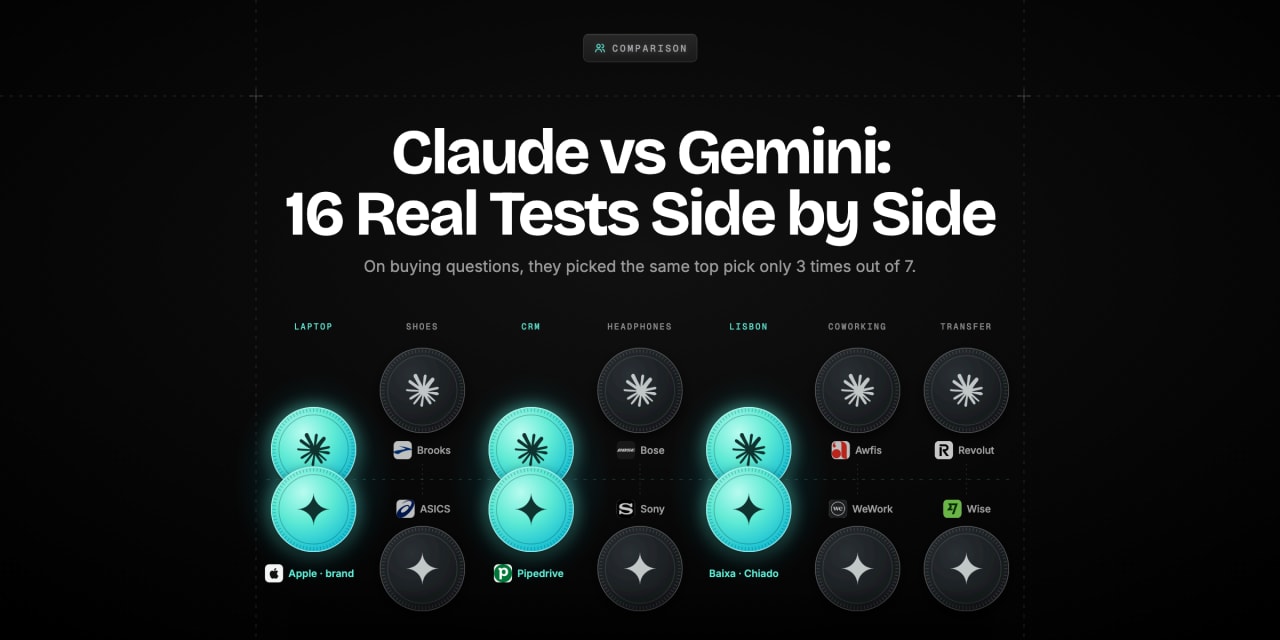
SummaryClaude and Gemini both scored 6 out of 6 on our checkable tasks, but agreed on the top pick for only 3 of 7 buying questions. Claude used the sources we gave it; Gemini leaned on Google's product and place cards.
Read moreShow less
Key Highlights
- This is our own test, run on 1 November 2026. We gave Claude and Gemini six tasks with checkable answers, then asked both the same ten real buying and local questions.
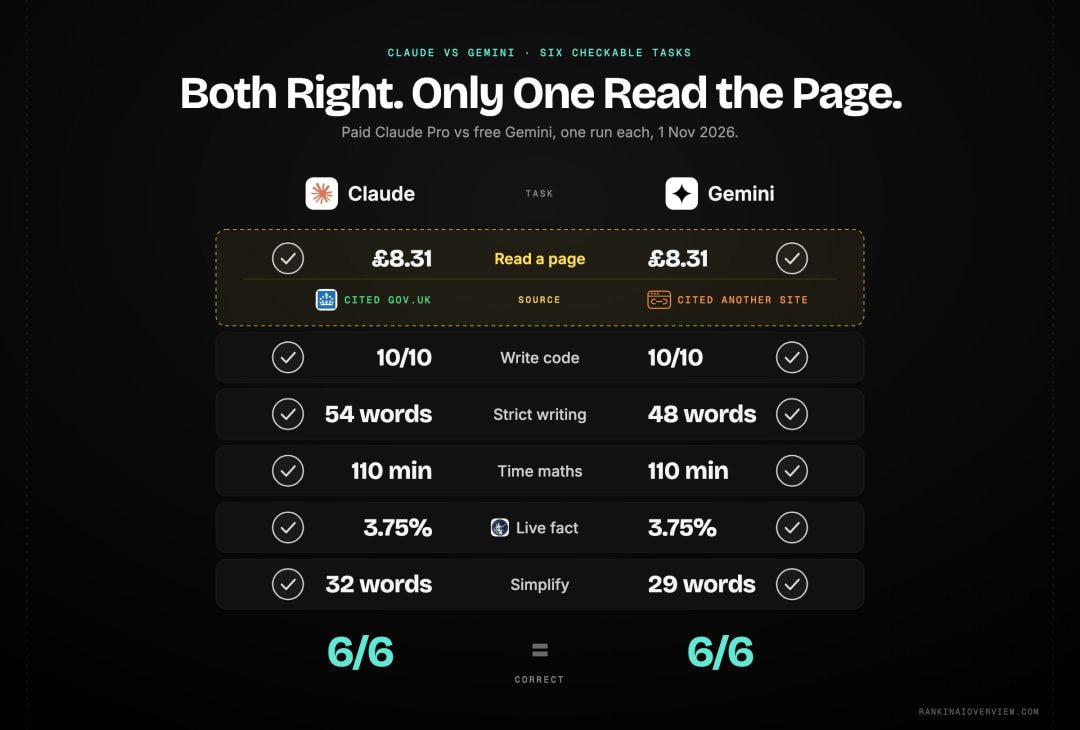
- Both got all six tasks right. Their Python code passed all 10 of our test cases, both hit every word limit, and both gave the correct Bank of England rate.
- When we handed both a gov.uk link, Claude read that page and cited it. Gemini gave the right number but cited a different, third-party site.
- On the ten buying questions, Claude and Gemini picked the same top recommendation only 3 times out of 7.
- Gemini was the only one of the six AI engines we've tested that didn't mention the Brooks Adrenaline for flat feet. Claude put it first.
- Claude used Google Maps data for local questions, so "Google's assistant" isn't the only one drawing on Google's place listings.
- Claude also used what it remembered about the account holder on one question. That's handy for you, but it means two people can get different answers.
Most comparisons of Claude and Gemini lean on benchmark scores. Those are useful, but small wording changes can swing them a lot. A study shows that across 46 language models, performance dropped by up to 61.8% when prompts were changed in subtle ways. A model that tops a chart can still trip over the way you actually phrase things.
So we skipped the leaderboards and typed real requests, the way people do, into both apps. Some had a single right answer we could check. Others were everyday questions about laptops, shoes, lawyers and money, where what matters is who gets recommended and why.
Below you'll find the results task by task, how each one handled buying and local questions, where each gets its information, what the plans cost and which one fits your work.
Claude vs Gemini: What's the Short Answer?
Choose Claude if you want careful writing, clean code and answers that use the sources you give it. Choose Gemini if you live in Google's apps and want quick product and place cards with prices and ratings. On basic accuracy, they were level in our test.
| What matters to you | Better pick | What we saw |
|---|---|---|
| Following strict writing rules | Either | Both hit every word, sentence and banned-word limit |
| Coding | Either | Both functions passed 10 of 10 tests |
| Using a page you give it | Claude | It read and cited the link; Gemini cited a different site |
| Live figures and dates | Either, Gemini slightly | Both right; Gemini also gave the next decision date |
| Product and local shortlists | Depends | Gemini showed shopping and map cards; Claude explained trade-offs |
| Working inside Gmail and Docs | Gemini | It's built into Google's apps on paid plans |
What's the Difference Between Claude and Gemini?
Claude is made by Anthropic and sold as a standalone assistant, with apps for the web, desktop and phone. Gemini is Google's assistant, built into Android and Chrome and, on paid Google plans, into Gmail and Docs.
Which versions did we test?
We used Claude on a paid Pro plan, running Opus 5.5 at its default setting. We used Gemini on the free plan in its default "Auto" mode. That's a real gap, and you should read our results as paid Claude against free Gemini, which is how many people first try each.
Do they search the web?
Both do, and both decide for themselves when to search. In our test, Claude searched the web on six of ten everyday questions and searched for places on two more. It answered the remaining two from what it already knew. Gemini showed web sources on most answers, and on shopping and local questions it showed Google's product and place cards instead.
How Did We Test Claude and Gemini?
We typed every prompt word for word into each app, in a fresh chat each time, from one Chrome browser in India on 1 November 2026.
What were the six tasks?
| Task | What we asked | How we scored it |
|---|---|---|
| Read a page | What the gov.uk minimum wage page says the apprentice rate will be from April 2027 | Right answer is £8.31; did it use the page? |
| Code | A Python function returning the second largest unique number, or None | Ran both against 10 test cases |
| Strict writing | A water bottle description in exactly 3 sentences, under 60 words, UK English, without "perfect" or "sleek" | Counted sentences, words and banned words |
| Time maths | Free minutes in a meeting room between 9:00 and 15:00, given three bookings | Right answer is 110 |
| Live fact | The Bank of England base rate right now | Checked against the Bank of England on the day |
| Simplify | Explain an inflation sentence for a 10-year-old in 40 words or fewer | Word count and meaning |
What were the ten everyday questions?
They came from our wider study of AI engines: a laptop for video editing, running shoes for flat feet, a CRM for a small sales team, Notion or ClickUp, headphones for flights, a dermatologist in Bangalore, where to stay in Lisbon, finding a divorce lawyer in London, coworking in Mumbai and the cheapest way to send money from the UK to India.
Which Is Better at Following Instructions?
They were level. Both met every rule we set, and both made the same kind of slip.
Did they stick to the word and sentence limits?
Yes. Claude wrote 54 words in three sentences and said "(54 words)" at the end, which was accurate. Gemini wrote 48 words in three sentences. Neither used "perfect" or "sleek". Claude used the British spelling "colours"; Gemini avoided words where UK and US spelling differ, so that part wasn't really tested.
The two descriptions opened almost identically, both with "Crafted from" stainless steel that keeps drinks cold for 24 hours or hot for 12. Both also invented details we never gave them, such as a leak-proof lid. If you use either for product copy, check every claim against the real product.
How did they simplify the inflation sentence?
Both kept it short and clear. Claude used 32 words and a candy bar that doubles in price. Gemini used 29 words about money buying fewer toys and snacks. Both reached for dollars, even though we didn't name a country.
Also read: What happened when we asked ChatGPT, Claude, Gemini and Perplexity to rank each other
Which Is Better at Code and Maths?
Both were correct. They differed in style, and in how much they explained.
Did the Python code work?
Both functions passed all 10 of our test cases, including empty lists, repeated numbers, negatives and decimals. Gemini's version turned the list into a set, sorted it and took the second-last number, with clear comments. Claude's walked through the list once, keeping track of the top two, then offered the shorter set-and-sort version as an alternative and explained when each is the better choice.
For a beginner, Gemini's commented version is easier to read. For a large list or a stream of data, Claude's single pass is the more efficient one, and it said so.
Did they get the meeting room sum right?
Both said 110 minutes. Claude showed a table of the four free slots and double-checked by subtracting the 250 booked minutes from the 360-minute window. Gemini listed the same four slots and added them up. Claude also offered to turn the answer into a spreadsheet.
Which Is Better With Live Facts and Your Own Sources?
Both gave correct live figures. The clearest difference came when we gave them a specific page to use.
What happened when we gave them a gov.uk link?
We pasted the gov.uk minimum wage page and asked what the apprentice rate would be from April 2027. Both said £8.31. Claude showed that it had fetched that exact page, cited it, and added who the apprentice rate applies to.
Gemini gave the same number, plus a correct note that it's a 31p rise. But its only citation was a third-party site, not the government page we'd asked it to use. The answer was right, but if you're checking a source for a report or a client, that matters.
"Our findings highlight nuance-oriented reliability as a crucial yet underexplored next step" Jianshuo Dong and colleagues, authors of a 2026 study of instruction-following across 46 language models. Source: arXiv, Revisiting the Reliability of Language Models in Instruction-Following
Using the source you were given is exactly that kind of nuance. A tool can get the number right and still miss the instruction behind it.
Who got the Bank of England rate right?
Both said 3.75%, which matched the Bank of England's own page on the day. Gemini added that the rate was held in September and that the next decision was due on Thursday 5 November 2026, which was spot on. Claude said a decision was likely in early November and suggested checking the Bank's site.
Neither cited the Bank itself. Claude used a tax site, a building society and Moneyfacts. Gemini used Uswitch twice.
Which Gives Better Answers to Real Buying Questions?
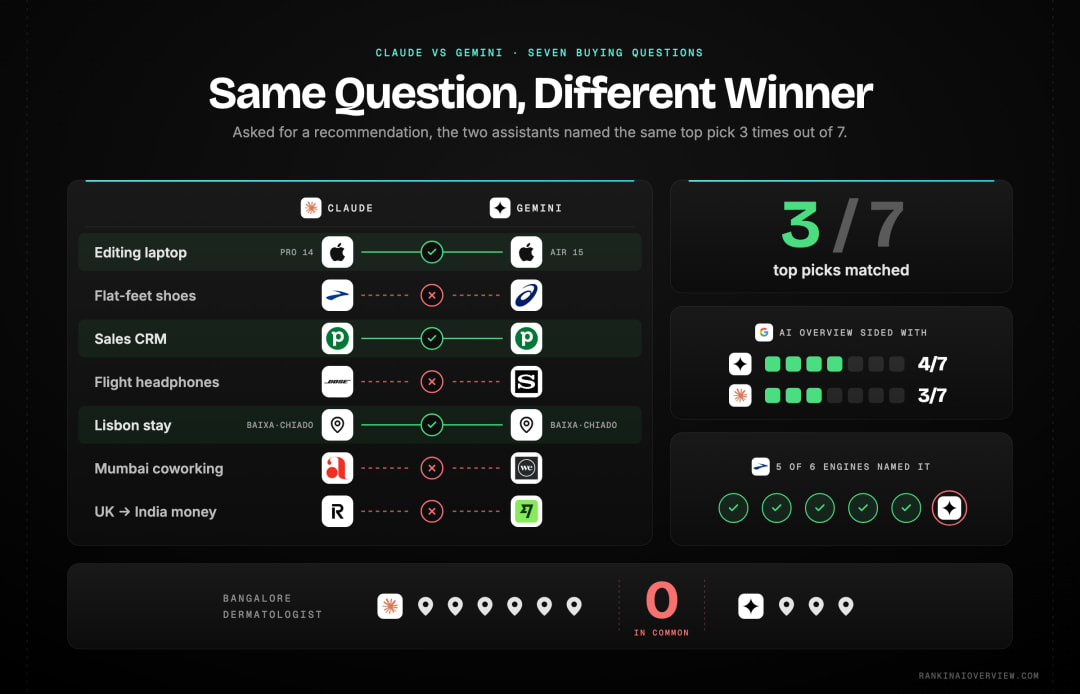
They often disagreed. On the seven questions with a clear top pick, Claude and Gemini chose the same brand or answer only three times.
Where did they agree and disagree?
| Question | Claude's top pick | Gemini's top pick |
|---|---|---|
| Laptop for video editing under $1500 | MacBook Pro 14 (M5) | MacBook Air 15 (M3) |
| Running shoes for flat feet | Brooks Adrenaline GTS 25 | ASICS GT-2000 14 |
| CRM for a 5-person sales team | Pipedrive | Pipedrive |
| Headphones for long flights | Bose QuietComfort | Sony WH-1000XM4 |
| Where to stay in Lisbon | Baixa or Chiado | Baixa and Chiado |
| Coworking in Mumbai for 6 | Depends on area, starting with Awfis in BKC | WeWork |
| Cheapest UK to India transfer | Revolut | Wise |
We counted the laptops as a match on brand, since both chose Apple.
What stood out?
Two things. First, Gemini was the only one of the six AI engines in our study that didn't name the Brooks Adrenaline for flat feet. Claude, ChatGPT, Perplexity, Grok and Copilot all did. Second, Gemini recommended the older Sony WH-1000XM4. Claude picked the Bose and listed the newer Sony XM5 as an option.
Claude also tended to add advice beyond the shortlist. On shoes, it said knee pain may not be about shoes alone and suggested when to see a physio. On dermatology, it told readers not to buy a treatment package at the first visit.
How did they compare with Google's own AI Overview?
We also typed the same questions into Google that day. Gemini matched Google's AI Overview on 4 of 7 top picks, and Claude matched it on 3. So Google's own assistant was only slightly closer to Google Search than Claude was.
How Do They Handle Local Searches?
Both drew on Google's place data, which surprised us. Gemini showed Google Maps cards with star ratings and opening times. Claude ran a place search too, and its answers carried Google map data and links to Google Maps.
Did they recommend the same local businesses?
No. For a dermatologist for acne scars in Bangalore, Claude listed six clinics and Gemini listed three. None appeared on both lists. One of Claude's clinics also appeared in Google's AI Overview, and another had been named by ChatGPT in our earlier run.
For coworking in Mumbai, Claude grouped options by area, BKC, Lower Parel and Powai, because "best" depends on where the team commutes from. Gemini gave a ranked list led by WeWork.
What does that mean for a local business?
Your Google Business Profile now feeds more than one AI assistant. Keep its name, category, hours and reviews accurate, because both tools leaned on that kind of data. Still, being listed doesn't guarantee being picked, as the zero overlap shows.
Whose Sites Do They Cite?
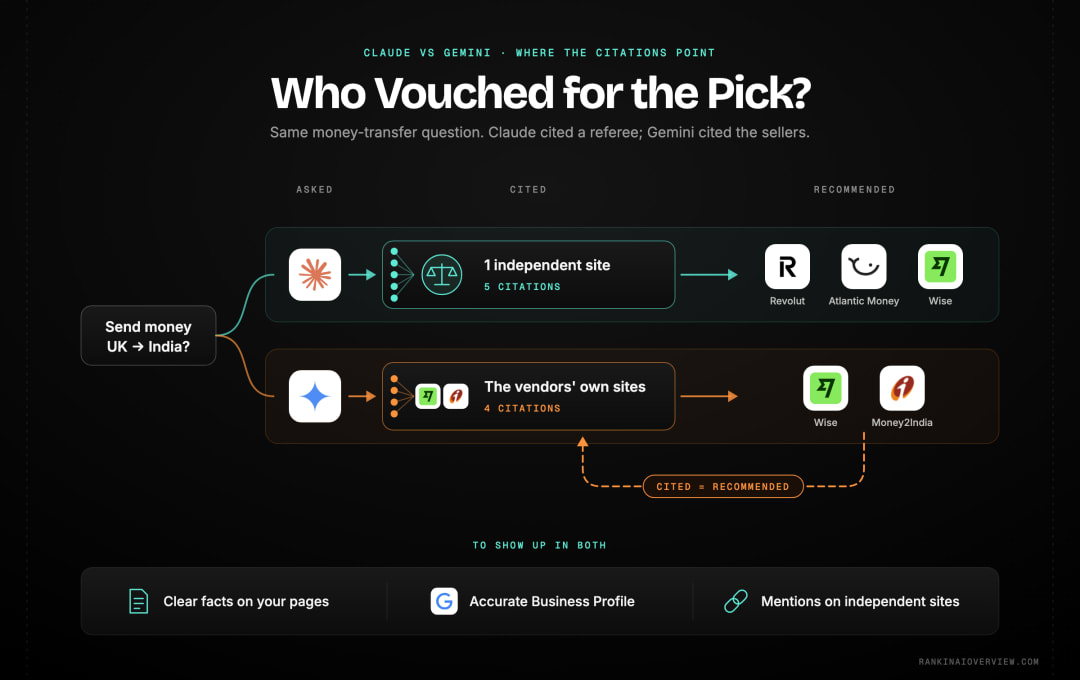
Claude more often cited independent comparison and professional sites. Gemini more often cited the businesses it was recommending.
What did that look like?
For the cheapest way to send money to India, Claude's five citations all pointed to one independent comparison site, and it recommended Revolut, Atlantic Money and Wise based on a test of £1,000 transfers. Gemini's four citations were Wise and Money2India, the two services it then recommended.
For a London divorce lawyer, Claude cited the Law Society, Resolution, a legal news site and one law firm. Both Claude and Google's AI Overview cited Resolution and the same law firm.
Did Claude cite anything odd?
Yes, once. On the laptop question, the two roundup pages it linked sat on websites whose names had nothing to do with laptops. We saw the same pattern with Copilot. Claude did tell readers to be wary of cheap "best under $1500" lists, but it's worth clicking through before trusting any shortlist.
Do Claude and Gemini Remember You?
Claude did, in our test. Asked whether Notion or ClickUp suits a small agency, it answered for "an agency your size, doing mostly content work across several clients". That came from what it remembered about the account holder, and it didn't search the web.
Is that a good thing?
For you, often yes. Advice that knows your situation is more useful than a generic list. But it means two people asking the same question can get different answers, so a single screenshot of "what Claude recommends" doesn't tell a brand what everyone sees. We left that answer out of our comparisons.
Can you turn it off?
Both companies let you manage what their assistants remember in the app settings. If you're testing how an AI talks about your brand, use a fresh account or switch memory off first.
How Much Do Claude and Gemini Cost?
Both have free plans. Claude's paid plans start at $20 a month; Google's main plan, Google AI Pro, cost ₹1,950 a month when we checked from India.
How do the plans line up?
| Level | Claude | Price | Google (Gemini) | Price (India) |
|---|---|---|---|---|
| Free | Free | $0 | Free | ₹0 |
| Entry paid | Not offered | n/a | Google AI Plus | ₹399 a month |
| Main paid | Pro | $20 a month, or $17 a month billed yearly | Google AI Pro | ₹1,950 a month |
| Higher use | Max | $100 a month | Google AI Ultra | From ₹6,500 a month |
| Highest use | Ultra | $200 a month | Google AI Ultra, top tier | ₹19,500 a month |
Claude's prices come from Anthropic's pricing page, which showed US dollars. Google's came from its Google AI plans page, which showed rupees from India. Both were checked on 1 November 2026.
What do the paid plans add?
Claude Pro adds higher usage and the extra features listed on its pricing page. Max gives five times Pro's usage, and Ultra removes the five-hour limit. Google AI Plus doubles Gemini's free usage, while Google AI Pro gives four times the free usage, its top model and Gemini inside Gmail and Docs.
Which is better value?
If you already pay Google for storage or live in Gmail and Docs, Google AI Pro bundles that in. If you mainly want a writing, research and coding assistant, Claude Pro is the more focused buy. Try both free plans on your real work before paying.
Which Should You Choose?
Choose by the work you do most.
When does Claude win?
- You write a lot and need it to stick to rules and use your sources.
- You code and want the trade-offs explained.
- You want advice that goes beyond the shortlist.
- You work across Microsoft 365, Chrome and other tools.
When does Gemini win?
- You live in Gmail, Docs, Sheets and YouTube.
- You want product and place cards with prices, ratings and opening hours.
- You want an entry-level paid plan for less money.
Can you use both?
Yes. A sensible split is Gemini for anything inside Google's apps and for quick local lookups, and Claude for writing, coding and research. For anything with a date, a price or a rule, check the source either way.
What Does Claude vs Gemini Mean for Your Brand?
It means they're two separate audiences that often disagree. On our buying questions, they shared the same top pick less than half the time, and on a local question they shared no names at all.
What helps you show up in both?
- Clear facts on your own pages: what you offer, what it costs and where you are, written in plain sentences an AI can quote.
- An accurate Google Business Profile: both tools used Google's place data for local questions.
- Mentions on independent sites: Claude leaned on comparison and professional sites more than on vendors' own pages.
How should you check it?
Ask both the questions your buyers ask, from the market you sell into, using an account without memory of you. Log who's named and who's cited, and repeat it, because single answers move.
Also read: Is AI search visibility more about trust than rankings?
Conclusion
On checkable tasks, Claude and Gemini were level in our test. Both wrote working code, met strict word limits, did the maths and gave the correct Bank of England rate. Claude's edge was in using the sources we gave it and explaining its choices. Gemini's edge was Google's own data: product cards, map cards and a precise date for the next rate decision.
Where they really differed was on recommendations. They agreed on the top pick less than half the time, named entirely different clinics for the same local question, and leaned on different kinds of sources. Picking one doesn't tell you what users of the other will see.
This was one run on one day, from India, with Claude on Pro and Gemini on its free plan. Next, we'll re-run the same set and report which picks held.
RANK IN AI OVERVIEW tests how Claude, Gemini, ChatGPT and Google's AI Overviews answer real buyer questions, and its AI visibility tool is launching soon. Want to see whether Claude and Gemini mention your brand? Get a free AI visibility audit.
Frequently asked questions
Is Claude better than Gemini?+
Not overall in our test. Both got all six checkable tasks right. Claude was better at using a source we gave it and explaining trade-offs. Gemini was better at quick product and place cards inside Google's world.
Is Claude or Gemini better for coding?+
Both wrote correct Python in our test, passing all 10 cases. Claude explained the efficiency trade-off and gave two versions. Gemini gave one clearly commented version that's easier for beginners to follow.
Does Gemini use Google Search?+
It uses Google's services, including shopping and maps data. But in our test, its top picks matched Google's AI Overview on only 4 of 7 buying questions, so it doesn't simply repeat Google Search.
Does Claude search the web?+
Yes. In our test, Claude searched the web on six of ten everyday questions and ran place searches using Google map data on two more. It answered the other two from what it already knew.
Is Gemini free?+
Yes. Gemini has a free plan on the web and in the app. Paid Google AI plans add higher limits and Gemini inside Gmail and Docs. Claude also has a free plan, with Pro at $20 a month.
Explore with AI
Share this