How to Rank Your Website in AI Search Results: A Local SEO Guide for 2026
Local businesses are being left behind in AI search. This guide gives you the exact tactics to appear in AI-generated answers for local queries in 2026.
SummaryAI search is becoming the new local search engine, but most businesses never appear because AI tools only recommend brands they trust. This guide explains the seven practical fixes that improve your visibility in ChatGPT, Gemini, and Google AI Overviews before your competitors catch up.
Read moreShow less
Most AI search optimisation advice is written for SaaS companies and enterprise brands. According to the BrightLocal 2026 Local Consumer Review Survey, AI tools like ChatGPT and Gemini went from 6% to 45% of consumers using them for local business discovery in just one year. That is a 7x jump in 12 months. Local businesses, including plumbers, dentists, consultants, and restaurants, are the ones most affected and the least served by existing guidance.
The problem is real. You have a great Google ranking. You get solid reviews. But when someone asks ChatGPT for the best plumber near them, your business is nowhere. The rules are different in AI search and no one has explained them in plain language for local business owners. That gap costs you enquiries every day.
This guide fills that gap. You will learn exactly why local businesses are invisible in AI search results, the seven tactics that fix it, and how to check if your efforts are working. Every step is practical, concrete, and designed for a local business with no dedicated marketing team.
Why Are Local Businesses Invisible in AI Search?
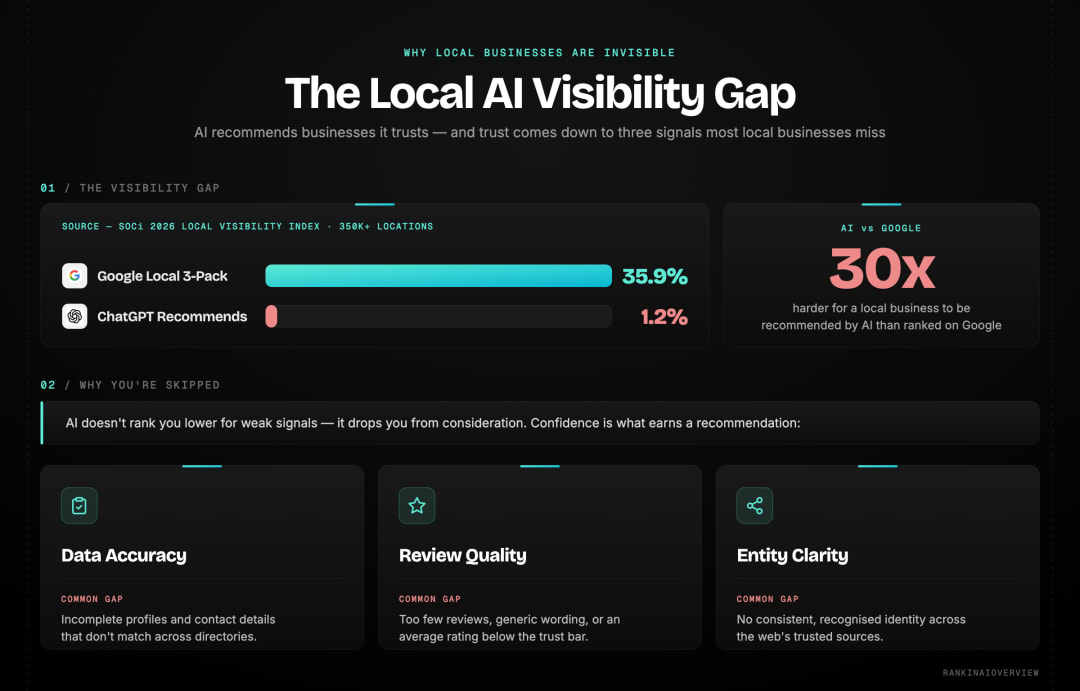
AI engines are selective. They only recommend businesses they have high confidence in. Confidence comes from data accuracy, review quality, and entity clarity across directories. Most local businesses have gaps in all three areas. The good news is that each gap is fixable and relatively fast to address. |
|---|
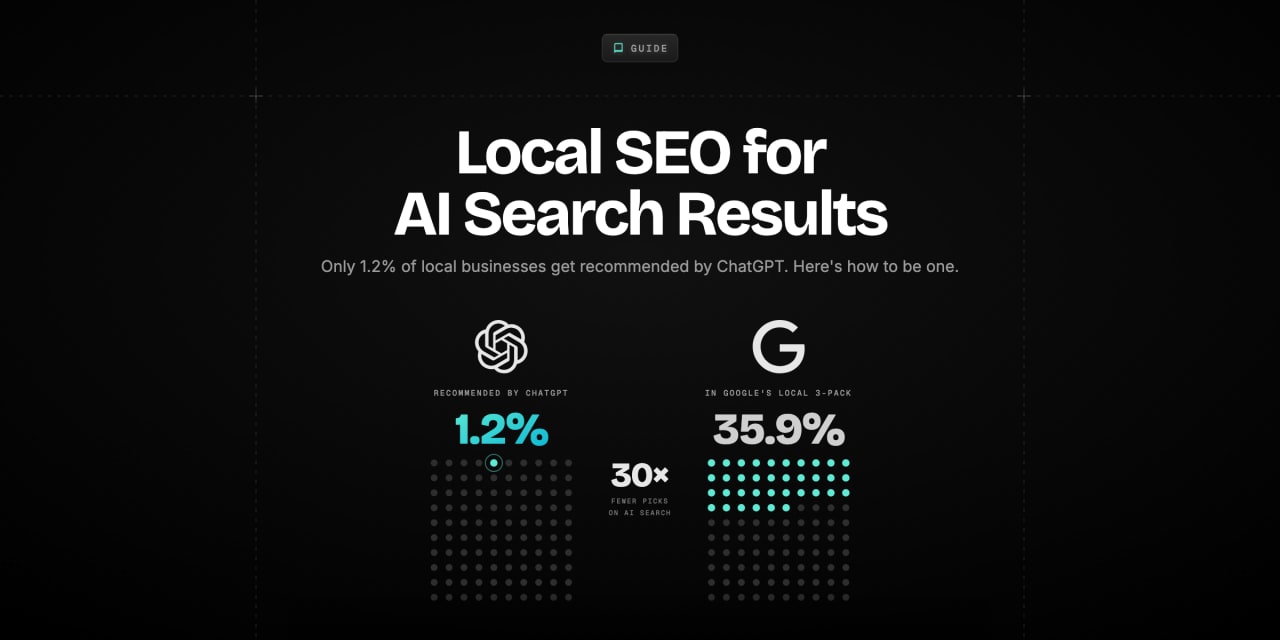
According to SOCi's 2026 Local Visibility Index, which analysed over 350,000 locations across 2,751 brands, only 1.2% of locations are recommended by ChatGPT. By comparison, those same brands appeared in Google's local 3-pack 35.9% of the time. AI search local visibility is up to 30 times harder to achieve than a traditional local ranking.
The reason is not that AI search ignores local businesses. It is that AI engines evaluate confidence differently from Google. Google ranks on relevance and proximity. AI evaluates trust. A business with incomplete profile data, inconsistent contact details, or thin reviews fails that trust threshold and is excluded entirely. Local SEO for AI search is not a separate discipline. It is traditional local SEO executed to a much higher standard.
As SOCi's CMO Monica Ho explained in January 2026: AI search does not lower your rank. It removes you from consideration altogether if your signals are weak.
“ Traditional search still exists, but AI chat often delivers a short list instead of a results page. That changes the economics of visibility. If your brand is not trusted, accurate, and consistently present across the signals AI pulls from, you do not fall down the rankings. You fall out of consideration entirely. Monica Ho CMO, SOCi Source: Localogy, January 2026 |
|---|
What Are the 7 Local SEO Tactics That Drive AI Search Visibility?
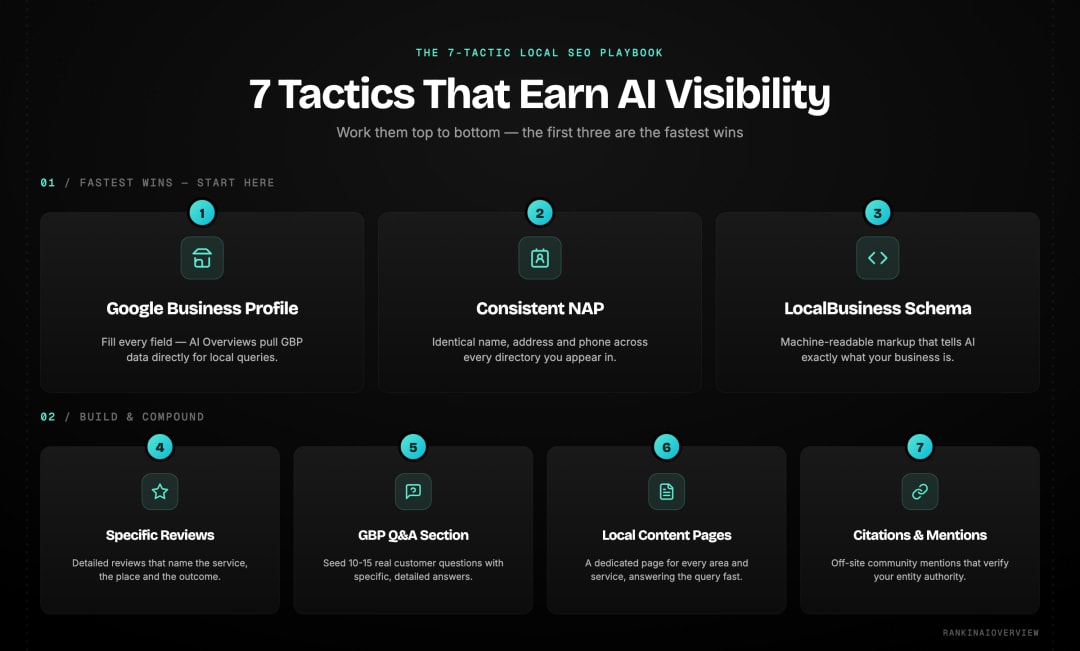
These seven tactics directly improve how AI engines perceive and recommend your business. Each one builds a signal that AI systems use to evaluate trust and accuracy. Start at the top and work through them in order. The first three produce the fastest results. |
|---|
1. Fully Optimise Your Google Business Profile

Your Google Business Profile is the most important asset for Google AI local results. AI Overviews pull directly from GBP data for local queries. A complete profile is 50% more likely to result in a purchase consideration, according to Backlinko's Google Business Profile research.
Fill every field without exception. That means business category, description, services, products, opening hours, and service areas. Add at least 10 photos, including the exterior, interior, and team. An incomplete profile signals uncertainty to AI engines, and uncertain businesses are not recommended. To appear in AI answers as a local business, your GBP must be the most reliable source of information about your business anywhere on the web.
The Q&A section is especially valuable. Seed it with 10 to 15 questions your customers actually ask, with specific detailed answers. AI Overviews extract directly from GBP Q&A for local queries. This is one of the fastest ways to appear in AI answers local business owners have available, and it costs nothing.
2. Build Consistent NAP Across Every Directory
NAP stands for Name, Address, and Phone number. Every directory where your business appears must show exactly the same information. Not approximately the same. Exactly the same, including abbreviations, suite numbers, and phone number format.
AI engines use entity resolution to match business data across sources. Inconsistencies signal unreliability and reduce AI search local visibility. The core directories to fix first are Google Business Profile, Yelp, Apple Maps, and Bing Places. Run a free audit using Moz Local to find discrepancies across your listings in one place.
3. Implement LocalBusiness Schema Markup
Schema markup is machine-readable code that tells AI engines exactly what your business is, where it is, and what it does. Schema.org's LocalBusiness specification is the standard. Add it to your homepage and contact page at minimum.
The essential fields are: name, address, telephone, openingHours, geo coordinates, and priceRange. Each field reduces the interpretive work AI engines need to do. Less ambiguity means higher confidence. Higher confidence means you rank website in AI search more reliably.
Use Google's Rich Results Test to verify your schema is implemented correctly after you add it. The test is free and shows exactly what Google can read from your page.
4. Collect Specific, Detailed Reviews

Generic reviews do not help AI search local visibility. AI engines pull from review content when evaluating and describing your business. A review that says "great service, highly recommend" gives AI systems almost nothing to work with. A review that says "Mike fixed our boiler on a Saturday morning, had parts in the van, done in two hours" is exactly what AI is looking for. According to the BrightLocal 2026 Local Consumer Review Survey, 31% of consumers now only use a business with 4.5 stars or above, up from 17% in 2025. The bar is rising fast.
After each completed job, ask customers to mention the specific service, location, and outcome in their review. A simple text message like "if you have a moment, it really helps if you mention what we did and where" is enough to change the quality of what you receive.
Prioritise Google Reviews above all other platforms. Then Yelp and TripAdvisor depending on your category. For restaurants, TripAdvisor reviews are heavily cited in AI answers for dining queries. Specific, detailed reviews are the fastest way to appear in AI answers local business owners have without creating any new content.
5. Optimise Your GBP Q&A Section
Most local businesses leave the Q&A section of their Google Business Profile completely empty. This is a missed opportunity. AI Overviews extract directly from GBP Q&A when answering local queries.
Add 10 to 15 questions that reflect what your customers genuinely ask. Include questions about pricing, availability, service areas, parking, and any common concerns in your category. Write each answer in full sentences with specific details. "We serve all of Greater Manchester, including Salford, Trafford, and Stockport" is far more useful than "we cover most of Manchester."
6. Create Locally-Focused Content Pages
AI engines serve content that directly answers local queries. "Best plumber in Shoreditch" and "emergency boiler repair Hackney" are queries that require dedicated content to answer authoritatively. A generic services page is not enough. If you want to appear in AI answers as a local business for location-specific queries, you need location-specific pages.
Build a location page for each area you serve with a service description, FAQ section, and locally relevant detail. A restaurant in Notting Hill should have a page that answers "best brunch in Notting Hill" directly in the first two paragraphs. That is how you appear in AI answers for local business queries.
Add FAQPage schema to each location and service page using Google's Structured Data Markup Helper. This makes the page readable for AI Overviews and improves your chances of being cited in Google AI local results.
7. Build Local Citations and Community Mentions
Off-site mentions of your business name in local contexts build the entity authority that AI engines use to verify credibility. This is local SEO for AI search done at the community level rather than the directory level.
Relevant sources include your local chamber of commerce website, neighbourhood Facebook groups, local news coverage, and community blogs. Even an unlinked mention in a local publication, "Joe's Plumbing, based in Bermondsey, is now offering emergency callouts," adds to the entity signal AI systems use when deciding whether to recommend your business.
Sponsor a local event, contribute a quote to a local news story, or join a neighbourhood business association. These actions generate the kind of community-grounded mentions that no paid directory submission replicates. They are the signals AI engines trust most for AI search local visibility.
How Do You Check If You Are Appearing in Local AI Search?
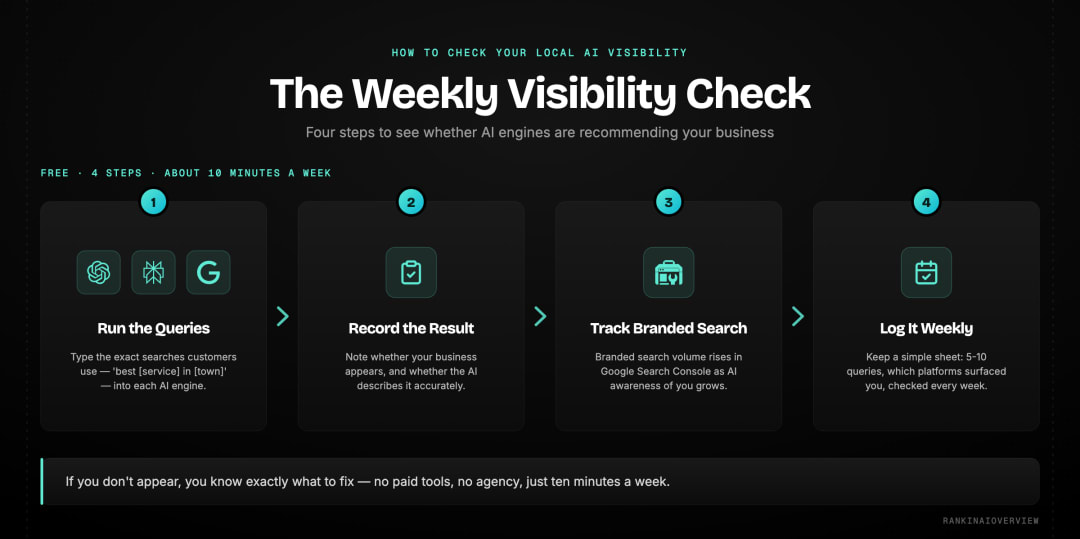
Manual testing is free and takes 10 minutes. Search your main services and location directly in ChatGPT, Perplexity, and Google AI Overviews. Note whether your business appears and how it is described. Do this weekly to track progress. Branded search volume in Google Search Console is a reliable proxy for growing AI-driven awareness. |
|---|
Open ChatGPT and type "best [your service] in [your town]." Then try "who is the best [your category] near [your postcode]?" Do the same in Perplexity. These are the exact queries your customers are using. If your business does not appear, you know exactly what to fix.
In Google Search Console, monitor branded search volume month over month. When AI search local visibility improves, branded searches increase as people who encountered your business in an AI answer follow up with a direct Google search. This correlation is the clearest evidence that your Google AI local results are translating into real business activity.
For ongoing monitoring without a paid tool, keep a simple spreadsheet. Run five to ten target queries each week, note which AI platforms surface your business, and track whether the description is accurate. That data guides exactly where to focus your optimisation effort next.
What Is the Local Business AI Search Checklist?

Use this checklist to audit your current AI search local visibility. Work through each item in order. Items in the first section produce the fastest results. Items in the second section compound over time. Return to this checklist every quarter to track progress. |
|---|
Use this to audit where you stand. Working through the foundation section is how most local businesses first manage to rank website in AI search with no paid tools or agency help.
Foundation (fastest wins:
-
Google Business Profile is 100% complete, including all categories, services, photos, and hours
-
NAP is identical across Google Business Profile, Yelp, Apple Maps, and Bing Places
-
GBP Q&A section has at least 10 questions with specific, detailed answers
-
LocalBusiness schema is implemented on your homepage and contact page
-
Schema is verified using Google's Rich Results Test with no errors
Reviews:
-
Google Reviews average is 4.5 stars or above
-
You have at least 20 reviews that mention specific services, locations, and outcomes
-
You respond to every review, positive and negative, within 48 hours
-
You actively ask customers to leave detailed reviews after each completed job
Content:
-
You have dedicated location pages for every area you serve
-
Each location page has a FAQ section with LocalBusiness and FAQPage schema
-
Each service page answers its target query in the first two paragraphs
-
Local community mentions and citations exist outside your own website
Monitoring:
-
You manually test five target queries in ChatGPT and Perplexity each week
-
You have confirmed you appear in AI answers local business searches return for at least three of your primary service queries
-
You track branded search volume monthly in Google Search Console
Conclusion
Local AI search visibility is more accessible than it looks. You do not need a large content budget or an SEO agency. You need accurate data, specific reviews, and structured content that AI engines can read with confidence.
Start with your Google Business Profile. Fix your NAP consistency across directories. Add LocalBusiness schema and seed your GBP Q&A. These three steps alone move you from the 98.8% of local businesses AI ignores to a position where you appear in AI answers local business searches produce. Every owner who wants to rank website in AI search starts here, not with content.
The shift from 6% to 45% consumer adoption of AI for local discovery happened in one year. It is not slowing down. Local businesses that build these foundations now will have a compounding advantage. The opportunity to rank website in AI search before competitors is still wide open in most local categories. For deeper research on how AI engines evaluate business authority and what drives citation decisions, RANK IN AI OVERVIEW covers this space across its content library.
Frequently asked questions
How do AI search engines show local businesses?+
AI engines like ChatGPT and Perplexity evaluate confidence rather than ranking position. They pull from Google Business Profile data, third-party directories, review platforms, and business websites. A business with accurate, consistent, and detailed data across all sources is far more likely to be recommended than one with incomplete or conflicting information.
How to Appear in AI Answers for 'Near Me' Searches+
To appear in AI answers for "near me" searches, complete your [Google Business Profile](https://business.google.com) fully, build consistent NAP across directories, and add LocalBusiness schema to your website. Create dedicated pages for each service and location with FAQ sections. AI engines pull from these structured sources when answering proximity-based queries. According to [Think with Google research](https://www.thinkwithgoogle.com/consumer-insights/consumer-trends/micro-moments-understand-new-consumer-behavior/), 76% of people who search "near me" visit a business within 24 hours, making this one of the highest-intent queries available.
Does Google Business Profile affect ChatGPT results?+
Yes, indirectly but significantly. ChatGPT uses Bing's index, which crawls and evaluates GBP data. Gemini uses Google's Maps data directly, which is sourced from GBP. A fully optimised GBP improves your visibility across all AI platforms because it is the most authoritative and structured source of local business information available.
How long until local AI optimisation shows results?+
Basic fixes like completing your GBP and correcting NAP inconsistencies can produce visible improvements within four to eight weeks. Review quality improvements take two to three months to accumulate enough signal. Content and citation building compounds over six months. Manual testing in ChatGPT each week shows you real progress as it happens.
Do I need a website to appear in local AI search?+
A website is not strictly required, but it helps significantly. AI engines use your website content to understand what you do and where you do it. Without a website, you rely entirely on GBP data and third-party mentions. A simple, well-structured website with LocalBusiness schema, service pages, and FAQ sections dramatically improves your chances of appearing in Google AI local results.
Explore with AI
Share this