Is SEO Dead or Evolving in 2026? An Honest Assessment
AI answers now sit above organic results on more than half of real-user queries. Here is the honest read, and how to evolve with it.
Key Highlights
- AI answers now appear above the organic results on more than half of real-user queries, which is the real mechanism behind the click loss driving the "SEO is dead" narrative.
- SEO is not dead, it is evolving, because the fundamentals still decide who is even eligible while the goal expands from ranking a page to being cited in an answer.
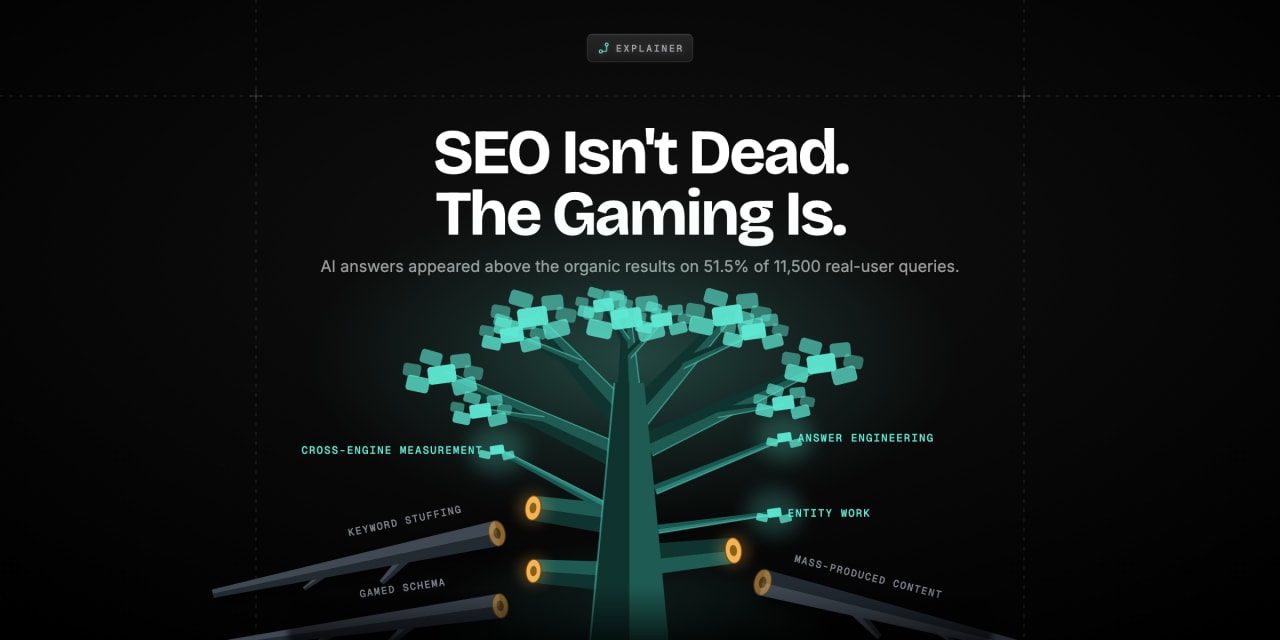
- What is actually dying is the gaming, the keyword stuffing, mass content and gamed schema, while genuine quality, structure and trust matter more than before.
- New technical realities arrive with AI search: whether you allow the AI crawler now affects retrieval, and citation is probabilistic rather than a fixed position you hold.
- The evolution is an expansion of the craft, not a replacement, so your hard-won SEO expertise remains the foundation rather than becoming obsolete.
- The durable strategy is quality-first and measured across engines, because substance is exactly what these systems keep converging toward as they close the gaps tactics used to exploit.
Every year someone declares SEO dead, and every year it keeps driving traffic and revenue. But 2026 genuinely feels different, because AI answers are reshaping how people find information at a scale that is hard to wave away. The question deserves a serious, honest answer rather than a hot take in either direction, because the stakes for how you invest your time and budget are real and immediate.
According to an empirical study of generative search published on arXiv, researchers built a benchmark of 11,500 real-user queries and compared Google Search, its AI Overview and Gemini for each one. They found that an AI Overview was generated and displayed above the organic results for 51.5% of those queries. That single figure is the mechanism behind most of the anxiety: when a synthesised answer sits above your link on more than half of searches, holding a top organic position no longer reliably delivers the click it used to, and the old promise of SEO starts to look broken.
But a broken promise is not a dead discipline. This guide gives an honest, evidence-based assessment. It covers why people think SEO is dying, whether it is actually dead or just the old version of it, what is genuinely changing, which fundamentals still hold, the new technical realities AI search introduces, how to evolve your approach and how to future-proof it. For the underlying mechanics of the shift, our overview of why AI search optimisation is a different game from SEO is a useful companion.
Why Do People Think SEO Is Dying?

People think SEO is dying because AI answers now resolve questions directly, above the organic links, which suppresses clicks even when rankings hold. When a top position no longer reliably produces a visit, the traditional promise of SEO looks broken, and that gap between ranking well and getting nothing for it is what fuels the death narrative.
The anxiety is not baseless, because the click loss is real and measurable. When an AI Overview answers the question in place above your result, a share of users who would have clicked simply read the summary and move on. The study behind this guide found those overviews generated on more than half of real-user queries, and they lean heavily toward controversial and question-shaped searches, which are exactly the informational queries SEO has traditionally served best. Losing clicks on your strongest query types while your ranking stays put genuinely undermines the old model.
It also helps to separate two different fears that usually get bundled together. One is that AI answers reduce clicks, which is happening and is measurable. The other is that AI answers make content itself worthless, which is not happening at all, because the answers are assembled from content that still has to exist, be accurate and be trusted before a system will use it. Conflating those two fears is what turns a manageable shift into an apparent apocalypse. Your content is not being made redundant; it is being consumed and surfaced through a new intermediary, and the intermediary still needs good sources to function.
But declining clicks on some queries is a shift in where visibility happens, not the end of visibility itself. The attention did not disappear; it moved into the answer. Reading that as an ending misses the new surface forming alongside the loss, where being the source an answer is built from becomes the prize instead of the blue link. Our piece on why Google ranking is becoming less important explores that reallocation of attention in more detail, and it reframes the loss as a relocation.
Is SEO Actually Dead, or Just the Old Version of It?
SEO is not dead, but a specific version of it is dying: the version built on winning a click from a list through ranking alone. What survives, and grows more valuable, is the underlying work of being genuinely useful, technically sound and trusted, because that is precisely what makes you eligible to appear in an answer as well as in a list.
History is a useful check here. Search has been through several disruptions that were each declared the death of SEO in their moment: the rise of universal results, the mobile shift, featured snippets pulling answers onto the results page, the long march of zero-click boxes. Each one killed a particular tactic and rewarded practitioners who adapted to the new surface. The AI answer is the latest and largest of these shifts, but it fits the same pattern rather than breaking it, and the people who treated the earlier disruptions as evolutions came through them stronger than the ones who declared the whole discipline finished.
The confusion comes from treating SEO as a single fixed thing that either lives or dies. It has never been that. SEO has always been the practice of making your content findable and credible to the systems people use to find information, and those systems are changing rather than disappearing. When the dominant surface was a ten-blue-links results page, SEO optimised for that surface. Now that a synthesised answer sits above it on most queries, the practice extends to that new surface too. The discipline adapts to where attention goes, which is exactly what it has always done through every previous shift.
So the honest framing is neither corpse nor unchanged. The parts of SEO that were really just manipulation of a ranking algorithm are losing their leverage, because the answer layer is harder to game and is built on trust signals that accumulate rather than tricks that can be deployed. The parts that were always about genuine quality and authority are becoming more decisive, not less. If you built your practice on substance, very little of what matters is dying; if you built it on gaming, a great deal is. Which is why the ongoing debate about whether ranking is still the goal matters more than the tired "dead or alive" question.
What Is Genuinely Changing in SEO?
What is genuinely changing is that visibility is expanding from ranking pages to being cited in AI answers, while the tactics that gamed the old system are losing their power. Success now leans more on clarity, trust and entity authority, and far less on keyword manipulation or raw link volume, because the answer layer selects sources differently from a ranking list.
The real shifts underway are these:
- The goal is broadening from holding a ranking toward being cited as a source in a synthesised answer.
- The metrics are expanding from fixed positions toward citation share and AI referral traffic across engines.
- Manipulative tactics, keyword stuffing, mass-produced generic content and gamed schema, are steadily failing.
- Entity authority and verifiable trust signals are becoming dominant factors rather than supporting ones.
- Content optimisation is moving toward direct answers and clean structure that a system can extract cleanly.
It is worth noticing that every item on that list points in the same direction: away from things you can fake and toward things you have to genuinely earn. Keyword density could be manufactured; entity authority cannot. Link volume could be bought; being the source a system trusts enough to cite cannot be, at least not durably. That common direction is the real signal about where the discipline is heading, and it explains why the change feels threatening to some practitioners and overdue to others. The people who find it threatening are usually those whose results depended on the manufacturable levers that are now losing power.
These are significant changes, but they are evolution rather than extinction. The discipline is widening its scope and raising its quality bar at the same time, which is uncomfortable for anyone who relied on shortcuts and liberating for anyone doing the work honestly. What dies is the gaming; what grows is the substance. That is a healthy correction, even though it feels like upheaval in the moment, and it rewards the practitioners who were already investing in genuine quality rather than exploiting gaps.
Which SEO Fundamentals Still Hold in 2026?
The fundamentals that still hold are genuinely useful content, technical health, clear structure, real authority and demonstrable helpfulness. AI answers are built on top of existing ranking systems, so strong SEO fundamentals remain the base the AI layer sits on, not something the AI era discards or makes irrelevant.
Google itself has said that its AI Overviews are constructed on the same underlying ranking machinery and the same people-first quality standards that govern ordinary search. So the core work you already know, useful content, technical soundness and earned credibility, is more valuable than ever rather than obsolete. It is the prerequisite that qualifies a page for consideration in the first place, because a page that cannot rank or be crawled cleanly is not a candidate for citation either. The foundation did not move; the building on top of it got taller.
This is the reassuring half of the honest answer. If you already do genuine, high-quality SEO, you are building the exact foundation AI visibility requires, and you are not starting from zero. You are extending a practice you already understand into a new surface, which keeps your accumulated expertise valuable rather than stranded. The teams that struggle are usually the ones who treated SEO as a bag of tricks, because tricks are precisely what is losing leverage, while the teams who treated it as a craft find most of their skills transfer directly.
What New Technical Realities Does AI Search Introduce?

AI search introduces realities classic SEO never had to weigh: whether you permit the AI crawler now affects whether you can be cited, and citation is probabilistic rather than a stable position you hold. The same query can surface different sources on different runs, so visibility becomes something you influence across many attempts rather than a rank you occupy.
The crawler point is concrete and easy to get wrong. The study behind this guide found that websites blocking Google's AI crawler were significantly less likely to be retrieved by AI Overviews, even though the overview system technically had access to their content through search. In practical terms, a well-meaning decision to block AI crawlers, taken to protect content, can quietly remove you from the answer layer entirely. That is a genuinely new trade-off: access and visibility are now linked in a way they never were when the only crawler that mattered was the classic search bot.
The consistency point is just as important for how you think about results. The same research observed that AI Overviews were less consistent across two runs of the same query and less robust to minor edits in wording. So there is no single fixed position to win and defend. You are optimising for a probabilistic system that may cite you on one phrasing and not another, which means you track presence and share across many prompts and runs rather than a lone ranking. This is why diagnosing AI visibility feels different, and why our guide to the SEO metrics worth tracking in 2026 leans on trends across many checks rather than any single reading.
Where Does the Traffic Actually Go When Clicks Fall?

When AI answers absorb a click, the attention does not vanish; it is redistributed toward whatever sources the answer is built from and toward the platforms that host the answer. So the honest way to read falling click-through is as a reallocation of visibility rather than a disappearance of it, which changes what you compete for rather than whether you compete at all.
Part of that redistribution favours the platform itself, and it is worth understanding rather than resenting. The study behind this guide found that generative search was significantly more likely to retrieve Google-owned content, while traditional search leaned more toward popular institutional sites in areas like government and education. That tells you the answer layer has its own gravitational pull toward certain source types, and that a strategy built purely on classic institutional-style authority may not map cleanly onto what the generative layer tends to surface. It is not that authority stopped mattering; it is that the definition of a preferred source is being partly rewritten by the platform's own incentives.
The practical consequence is that you compete for inclusion in the answer, not just for the click beneath it. If your content is the source an AI Overview cites, you gain brand exposure and a share of the users who do click through to verify or go deeper, even on queries where overall click-through has fallen. That is a smaller, more concentrated prize than the old click firehose, but it is a real one, and it accrues disproportionately to the sources the system trusts. Chasing it deliberately is the difference between mourning lost clicks and capturing the visibility that replaced them.
How Should You Evolve Your SEO Approach?

Evolve your SEO by keeping the fundamentals and adding AI-era skills: optimise key pages for citation with direct answers and clean structure, build entity and trust signals, ensure the AI layer can actually access your content, and measure across engines. Turn your SEO into a broader visibility practice that spans traditional search and AI answers rather than choosing between them.
A practical evolution plan looks like this. Keep the strong fundamentals of quality, technical health, authority and helpfulness, because they remain the entry ticket. Then front-load direct answers on your most important pages so the answer layer can lift them cleanly, since a buried answer is invisible to extraction even on a page that ranks. Build entity and trust signals through consistent factual data and credible mentions, because the answer layer rewards sources it can recognise and corroborate, a theme our guide to the trust signals AI systems recognise develops further.
Sequencing this work matters as much as doing it. Start with the technical access check, because it is fast and a single misconfiguration can silently disqualify you no matter how good your content is. Move next to front-loading answers on your highest-value pages, since that is the change most likely to recover citations quickly on content that already ranks. Then commit to the slower entity and trust work, which compounds over months and cannot be rushed. Doing them in that order means early, visible wins fund the patience the slower work demands, and it stops you from pouring effort into authority building while an accidental crawler block keeps you out of the answer layer entirely.
The mindset shift underneath all of it is from "SEO for rankings" to "visibility across search and AI." That is an expansion of your practice, not a replacement of it, and it keeps your existing expertise firmly in play. Check your technical access so you are not accidentally blocking the very system you want to appear in, expand your metrics to include citation share and AI referral traffic, and cover the engines your audience actually uses rather than optimising for Google alone. Each of these is an addition to what you already do well, not a repudiation of it.
How Do You Future-Proof Your Strategy?
Future-proof your strategy by anchoring it in genuine quality and trust rather than tactics that exploit temporary gaps, and by measuring visibility across both search and AI. Because these systems keep rewarding substance and closing loopholes, an honest, quality-first practice is the most durable bet available as the landscape continues to shift underneath everyone.
The tactics most exposed to obsolescence are the manipulative ones, because each model update tends to close the gaps they relied on. Anchoring your strategy in real helpfulness, clear structure and earned trust insulates you from that churn, since those are exactly the qualities the systems are converging toward rather than away from. You cannot reliably predict the next algorithm change, but you can predict that it will reward genuine value more than a clever exploit, and building for that removes most of the fragility from your plan.
Then diversify your measurement and your presence. A strategy dependent on a single engine or a single tactic is brittle by construction, because one change can erase it. One built on genuine authority and measured across search and AI adapts as the mix shifts, absorbing changes rather than being broken by them. That resilience is the whole point of treating this as an evolution, and it connects directly to the larger question of the future of SEO rankings as answers keep absorbing more of the journey that used to end in a click.
"We call for revenue frameworks to foster a sustainable and mutually beneficial ecosystem for publishers and generative search providers." Riley Grossman, Songjiang Liu, Michael K. Chen, Mike Smith, Cristian Borcea and Yi Chen, authors, How Generative AI Disrupts Search: An Empirical Study of Google Search, Gemini, and AI Overviews. Source: arXiv
That call is worth sitting with, because it frames the honest truth about 2026 better than any death notice. The relationship between publishers and the systems that surface their work is being renegotiated, not severed. Visibility still exists and still matters; the terms on which you earn it are simply changing, and the practitioners who adapt to the new terms rather than mourning the old ones are the ones who keep showing up in front of audiences.
Conclusion
SEO in 2026 is not dead, it is evolving, and quite meaningfully. AI answers now sit above the organic results on more than half of real-user queries, absorbing clicks and shifting the goal from ranking a page toward being cited in the answer. The version of SEO built on gaming a ranking is losing its leverage, while genuine quality, clarity and trust matter more than they ever did.
The honest takeaway is to evolve rather than panic or cling. Keep the fundamentals that still decide eligibility, add the AI-era skills of citation optimisation, entity building, technical access and cross-engine measurement, and treat the whole thing as an expansion of a craft you already know. Do that, and you thrive in the search landscape that is actually forming rather than clinging to the one that is quietly fading from view. Want to see how your evolving strategy performs in AI search? Run a free AI visibility audit with Rank in AI Overview and get a clear, prioritised read on exactly where you stand across the engines that matter.
Frequently asked questions
Is SEO dead in 2026?+
No. SEO is evolving, not dying. AI answers now sit above organic results on more than half of queries, which suppresses some clicks, but the fundamentals still decide eligibility. The goal is expanding from ranking pages to being cited in answers.
How is SEO changing because of AI?+
Visibility is broadening from rankings toward citations in AI answers, metrics are expanding to citation share and AI referral traffic, and manipulative tactics are failing. Clarity, trust and entity authority now matter more than keyword volume or link count.
Do SEO fundamentals still matter?+
Yes, more than ever. AI answers are built on existing ranking systems, so quality content, technical health, structure and authority remain the base. A page that cannot rank or be crawled cleanly is not a candidate for citation either.
What SEO tactics are dying in 2026?+
The manipulative ones: keyword stuffing, mass-produced generic content and gamed schema. The answer layer is harder to game and leans on trust signals that accumulate, so genuine quality and clear structure are replacing tactics that exploited the old ranking system.
Should I block AI crawlers to protect my content?+
Be careful. Research found sites that block Google's AI crawler are significantly less likely to be retrieved by AI Overviews. Blocking to protect content can quietly remove you from the answer layer, so weigh access against visibility deliberately.
Will AI replace SEO entirely?+
No. AI is changing where visibility happens, not removing the need for it. The work of being findable and trusted is expanding into AI answers, so SEO evolves into a broader visibility practice rather than being replaced outright.
Explore with AI
Share this