Is AI Search Visibility Actually Generating Revenue? What Small Business Owners Say
Is AI search visibility worth investing in for small businesses? We gathered real experiences from business owners who have measured the revenue impact, honest results included.
SummaryAI search visibility already drives measurable revenue for B2B services and SaaS, but local shops and e-commerce are still stuck in awareness mode. Real business owners share where attribution is clear, where it's indirect, and how to capture the data.
Read moreShow less
AI search visibility ROI is real for B2B services and SaaS businesses in 2026, while local and consumer categories are still in the brand awareness stage.
Big brands talk about AI search visibility in terms of brand equity and long-term strategic positioning. Small business owners want to know one thing: is it making money? According to Gartner's February 2024 press release, traditional search engine volume is projected to drop 25% by 2026 as AI search tools become the primary answer engines for research queries. For small businesses deciding whether to invest in AI search optimisation now or wait, the question is whether this shift is already producing revenue or still in the awareness-building phase.
The honest answer is that it depends entirely on your industry and your buyer's research behaviour. Does AI search drive sales for B2B professional services? Yes, directly and measurably. Does AI search drive sales for local plumbers and restaurants? Not yet in any meaningful volume. Does AI search drive sales for B2B SaaS? Yes, through branded search growth and higher-intent inbound leads. Does AI search drive sales for general e-commerce? Rarely, because transactional queries are still Google and Amazon dominated. Does AI search drive sales at all? The answer is yes for the right business types.
This guide gathers real small business AI search practitioner experiences, including the sectors where revenue attribution is clear, the sectors where it is still indirect, and the practical steps for capturing AI search revenue data. Small business AI search investment decisions require honest, sector-specific data rather than generic optimism about AI's potential.
What Is the Honest State of AI Search ROI for Small Businesses Right Now?
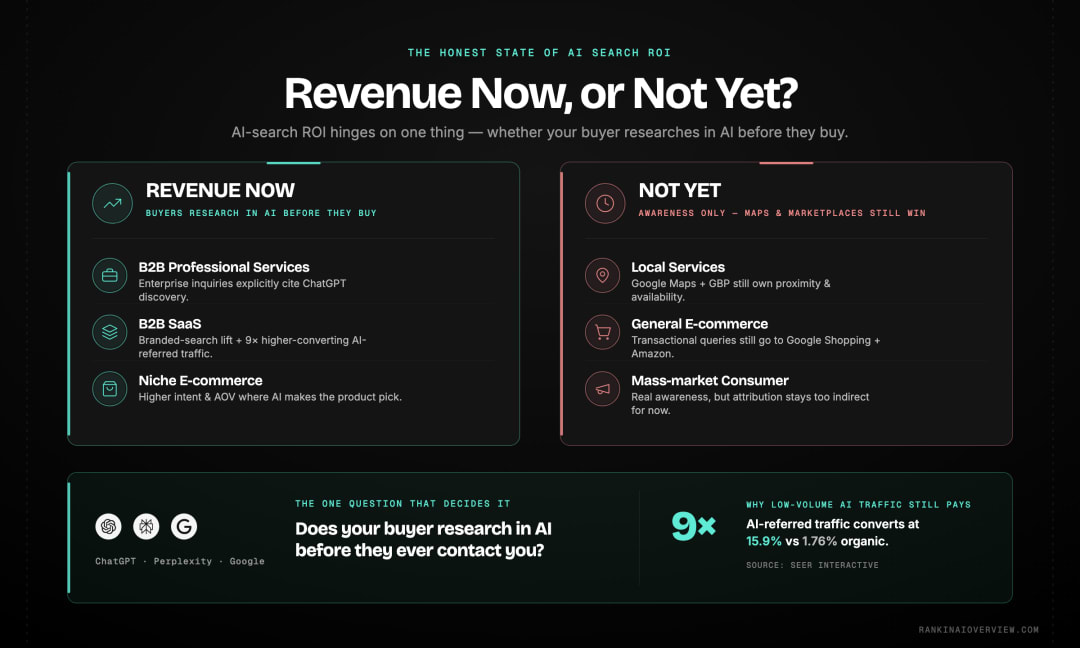
AI search visibility ROI varies significantly by business type and buyer behaviour. For businesses whose customers use AI tools to research before purchasing, AI search visibility is already producing measurable revenue signals. For businesses whose customers rely on Google Maps, word of mouth, or marketplace discovery, AI search impact is minimal in 2026. The most important question for any small business evaluating this investment is: does my target buyer use ChatGPT or Perplexity before they contact me?
Attribution is the central challenge for small business AI search. A user who discovers your brand through a ChatGPT answer, then searches for your brand name on Google, then visits your website, then contacts you will appear in your analytics as a branded search conversion. The ChatGPT source is invisible in standard attribution unless you specifically ask. This means most small businesses are underestimating their AI-driven revenue because their measurement systems are not designed to capture the indirect attribution path.
The most reliable revenue attribution method available without enterprise analytics tooling is simple and free: add "ChatGPT," "Perplexity," "AI assistant," and "AI search" as options in your "how did you hear about us?" intake form. This single change has produced clarity for dozens of practitioners who previously assumed AI search was producing nothing. In many cases, they discovered it was the fastest-growing discovery channel in their business.
Where Is AI Search Already Generating Revenue?
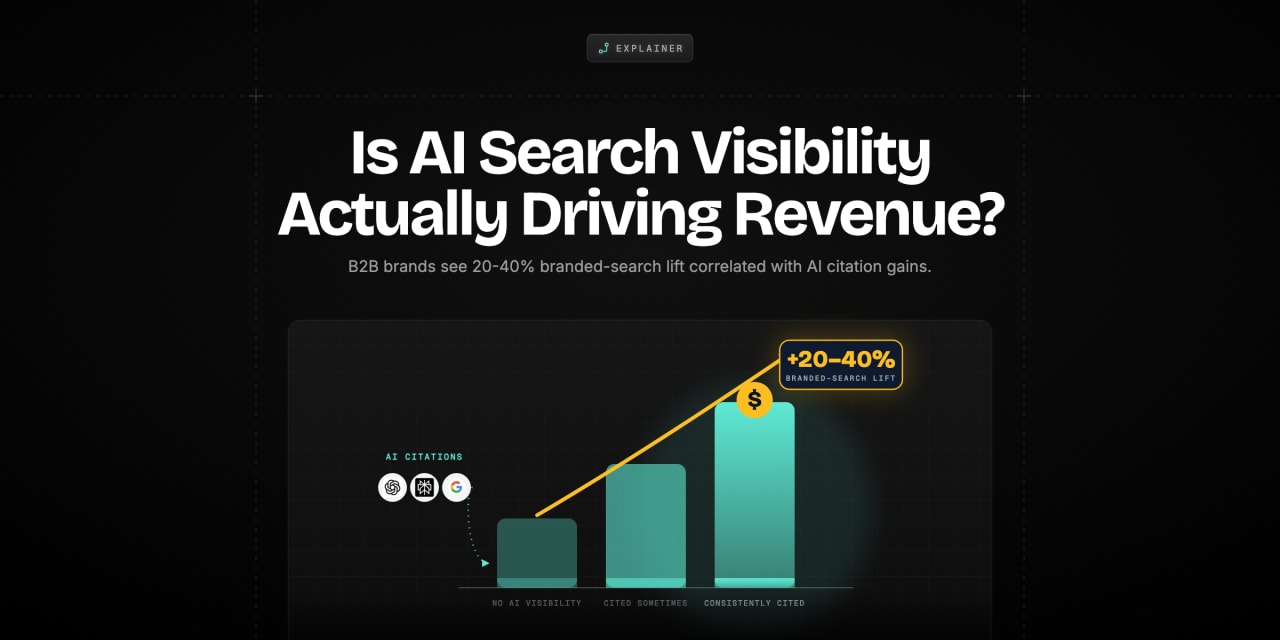
Three business types are seeing clear, direct AI search visibility ROI in 2026. B2B professional services businesses are receiving enterprise inquiries that explicitly cite ChatGPT or Perplexity discovery. B2B SaaS businesses are seeing branded search volume increases of 20 to 40% correlated with improved AI citation rates. Niche e-commerce businesses in specific product categories where AI provides recommendation answers are seeing higher-intent visitors with higher average order values from AI-referred traffic.
B2B Professional Services: Enterprise Inquiries From AI Discovery
Consultants, agencies, IT service providers, and specialist firms are seeing the clearest AI search revenue signal of any small business category. The research behaviour of enterprise buyers has shifted significantly: a procurement manager or decision-maker who starts their vendor research in ChatGPT rather than Google is now a common pattern. When that research produces a clear recommendation of your firm, the resulting inquiry arrives with a higher level of prior knowledge about your services and a shorter sales cycle.
The practitioner community reports receiving enterprise inquiries with specific references: "I asked ChatGPT which compliance consultancies specialise in X and your firm came up." These are warm introductions generated by AI citation rather than cold outreach or SEO-driven search. The revenue from AI visibility in this context is direct and attributable when the intake form includes AI discovery as an option.
Case Study: B2B Consultancy (Anonymous, UK Professional Services) Industry: B2B Professional Services Strategy: Invested in entity building (Knowledge Panel, Wikidata, industry publication features) and Reddit community participation over six months. Added AI tools to intake form. Results: 3 enterprise deal inquiries in a single month explicitly citing ChatGPT discovery. Two converted to clients within 90 days. Total attributed revenue: over USD 40,000. Source: r/smallbusinessowner community practitioner account, 2026
B2B SaaS: Branded Search as the Revenue Proxy
For B2B SaaS businesses, the revenue from AI visibility is most visible in the branded search proxy rather than direct AI-referred traffic. Seer Interactive documented that users arriving via AI citations converted at 15.9% compared to 1.76% for standard organic traffic from Google. This 9x conversion rate difference explains why even low-volume AI-referred traffic can produce disproportionate revenue impact for SaaS businesses with high average contract values.
The branded search correlation is the most reliable revenue proxy for B2B SaaS. When a SaaS brand's AI citation rate improves, branded search volume in Google Search Console typically rises within four to eight weeks as users who encountered the brand in an AI answer later search for it directly. A 20 to 40% increase in branded search volume is the signal that AI visibility is converting to awareness and beginning to produce pipeline impact.
Case Study: Airbyte Industry: B2B SaaS / Data Integration Strategy: Invested in GEO optimisation and AI citation building using Profound for tracking. Built off-site Reddit and community presence in data engineering communities. Results: Brand visibility in ChatGPT grew 3x. 16% increase in inbound pipeline. One enterprise deal directly attributed to ChatGPT discovery worth over USD 100,000. Source: Profound customer case study (tryprofound.com)
Niche E-Commerce: Higher Intent From AI-Referred Visitors
Niche e-commerce businesses in specific product categories where AI engines provide recommendation answers are seeing measurable AI search business results. Broad-market e-commerce is still Google and Amazon dominated. But in categories where buyers ask AI assistants for specific product recommendations, the businesses appearing in those recommendations are receiving visitors who have already completed their initial research and arrive with higher purchase intent.
The pattern: a user asks ChatGPT "what is the best [specific product category] for [specific use case]" and receives a recommendation that includes your brand. They click through from the ChatGPT citation or subsequently search your brand name. They arrive on your product page already knowing what they want. Average order values from this discovery pathway are consistently higher than from standard organic search because the research work has already been completed before the visit.
Where Is AI Search Not Yet Moving the Needle?
Three business types are not seeing meaningful revenue impact from AI search in 2026. Local services businesses, including plumbers, clinics, and restaurants, rely on proximity and availability signals that AI search does not yet deliver reliably. General e-commerce transactional queries remain Google and Amazon dominated. Mass market consumer businesses are building brand awareness through AI mentions but the revenue attribution is too indirect to justify significant AI-specific investment over standard SEO.
Local Services: Google Maps Still Dominates
For plumbers, electricians, dental practices, restaurants, hair salons, and other local service businesses, AI search is not yet producing meaningful revenue. The reason is structural: local service discovery depends on proximity, current availability, and real-time booking, which AI engines cannot reliably provide. A user who needs a plumber today does not ask ChatGPT. They search Google Maps. The local pack and Google Business Profile remain the primary discovery channels for local intent queries in 2026.
The practical implication for local service businesses: do not deprioritise Google Business Profile optimisation, local SEO, and review platform building in favour of AI search investment. These are still the channels that drive revenue for local businesses. Monitor AI search citation rates for your category, but do not shift investment until the data shows AI search is generating local discovery queries in your specific market.
General E-Commerce and Mass Market Consumer
Broad-market e-commerce transactional queries, product availability checks, and price comparison searches are still dominated by Google Shopping and Amazon. AI engines are not yet the preferred interface for these transaction-oriented queries because they cannot complete purchases, confirm availability, or guarantee pricing accuracy. The small business AI search investment is premature for general e-commerce when the buyer intent is primarily transactional.
For mass market consumer brands, AI search business results are primarily brand awareness rather than direct revenue in 2026. AI search business results in the form of named mentions in comparison answers do eventually convert to branded search growth and direct traffic, but the conversion timeline is longer than in B2B contexts, making near-term revenue attribution harder to demonstrate.
“ We got three enterprise inquiries last month that mentioned finding us through ChatGPT. 100% real. Hard to attribute directly but branded search is up 40% since we started appearing in Perplexity. The revenue from AI visibility is real but indirect. It is awareness first, conversion later. Small business owner community r/smallbusinessowner, Reddit 2026 Source: Reddit: Has Anyone Seen Revenue from AI Search Visibility?
Why Is AI Search Revenue Attribution So Hard to Measure?
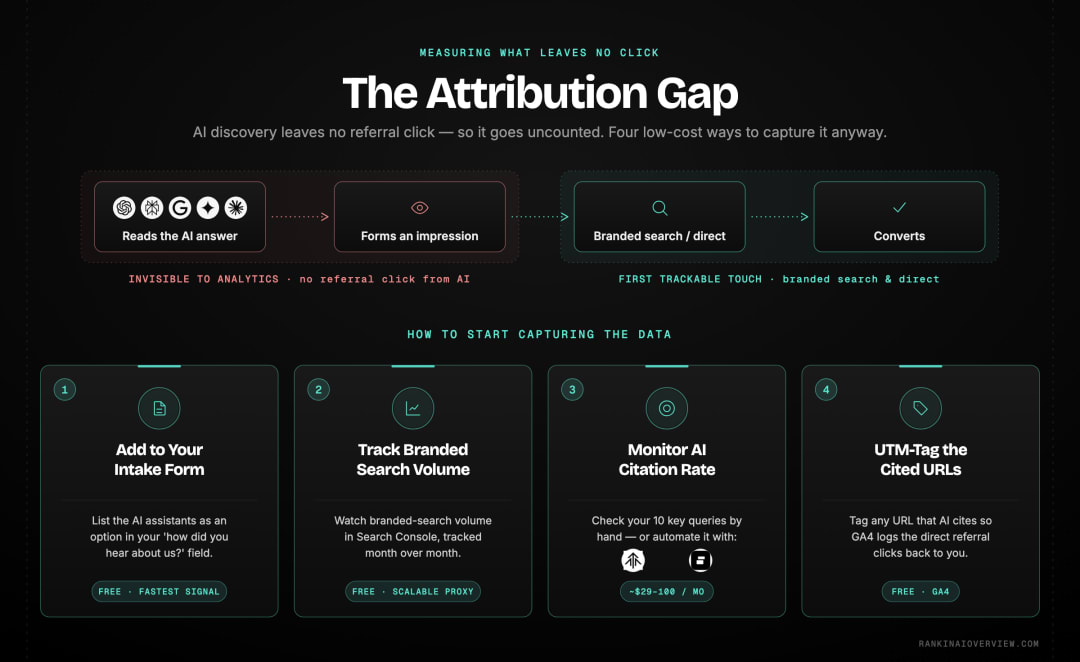
Attribution is hard because AI search sessions do not generate trackable referral data the same way web links do. A user who discovers your brand in ChatGPT and then searches your brand name on Google appears in your analytics as a branded search conversion. The ChatGPT source is invisible. Without explicitly asking customers how they found you or tracking branded search volume as a proxy, most businesses systematically undercount their AI-driven revenue.
Standard web analytics track clicks from URLs. When a user reads a ChatGPT answer, forms a brand impression, and later visits your site directly or through a branded search, no URL click from ChatGPT occurred. Revenue from ChatGPT visibility is structurally invisible to standard attribution. Revenue from ChatGPT visibility runs through branded search, direct visits, and intake form declarations, not through tracked referral clicks. Understanding this is the first step to measuring revenue from ChatGPT visibility accurately.
Three measurement approaches produce partial attribution visibility without requiring enterprise-level analytics infrastructure. The "how did you hear about us?" intake form is the most direct: add AI tools explicitly as options and track monthly. Branded search volume in Google Search Console is the most scalable proxy: monitor month-over-month trends. And direct citation tracking through tools like Rankscale or Peec AI shows when and where your brand appears in AI answers, which provides the upstream corroboration for downstream branded search growth.
How Do You Start Capturing AI Search Revenue Data?
Four specific measurement actions give a complete picture of AI search business results without requiring enterprise analytics. Adding AI tools to your intake form captures direct attribution. Tracking branded search in Google Search Console captures the downstream awareness proxy. Setting up AI citation monitoring captures the upstream signal. And segmenting AI-referred traffic in GA4 using UTM parameters captures quality and conversion data for the small but valuable volume of direct AI referral clicks.
Step 1: Update your intake form or discovery call questionnaire immediately. Add "ChatGPT," "Perplexity," "Claude," "Gemini," and "AI assistant/search" as specific options under "how did you hear about us?" Review responses monthly. This is the fastest zero-cost change that produces direct AI revenue attribution data. Step 2: Set up a branded search volume tracking report in Google Search Console. Filter for queries containing your brand name and track month-over-month impression trends. A sustained upward trend in branded impressions alongside improving AI citation rates confirms that AI mentions are creating real brand awareness.
Step 3: Set up AI citation monitoring for your ten most important target queries. Manual monitoring in ChatGPT and Perplexity costs nothing beyond fifteen to thirty minutes per week. Tools like Rankscale or Peec AI automate this for under USD 100 per month for small prompt sets. Step 4: Where possible, add UTM parameters to any URL that appears in AI citations. When users click through from cited URLs, the UTM data captures that source in GA4, allowing you to measure conversion rates and revenue from direct AI referral traffic.
Should Small Businesses Invest in AI Search Optimisation Right Now?
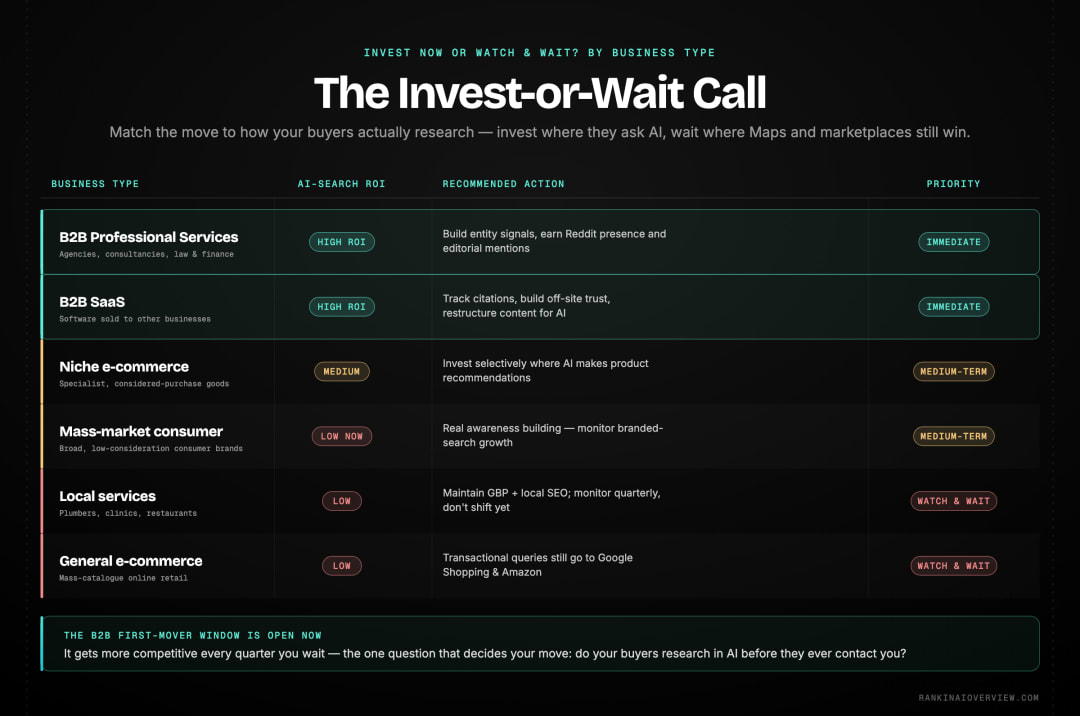
The investment decision depends on your buyer's research behaviour. If your buyers research their purchase in ChatGPT or Perplexity before contacting you, invest now. The competitive field for AI citation in most B2B categories is still early enough that building citation authority in 2026 produces a compounding first-mover advantage. If your buyers primarily use Google Maps, marketplaces, or word of mouth, prioritise those channels first and monitor AI search closely.
| Business Type | AI Search ROI in 2026 | Recommended Action | Priority |
|---|---|---|---|
| B2B Professional Services | High. Direct enterprise inquiry attribution reported | Invest now. Entity building, Reddit presence, editorial mentions | Immediate |
| B2B SaaS | High. Branded search proxy shows clear revenue signal | Invest now. AI citation tracking, off-site trust building, content restructuring | Immediate |
| Niche E-Commerce | Medium. Higher AOV from AI-referred visitors in specific categories | Invest selectively. Focus on product categories where AI makes recommendations | Medium-term |
| Local Services | Low. Google Maps and GBP still dominate local discovery | Maintain GBP and local SEO. Monitor AI search quarterly. Do not shift investment yet | Watch and wait |
| General E-Commerce | Low. Transactional queries still Google and Amazon dominated | Watch and wait. Invest when category data justifies it | Watch and wait |
| Mass Market Consumer | Low short-term. Real awareness building, thin direct revenue | Monitor branded search growth. Invest when brand scale justifies it | Medium-term |
Conclusion
AI search is generating revenue for B2B businesses today. For most local and consumer businesses, it remains a brand awareness investment whose revenue conversion timeline is longer and harder to attribute. The right question for your business is: does your customer use AI to research before they buy? If yes, the investment window for building AI search visibility ROI is open now and getting more competitive every quarter. If not, monitor closely and move when your customer's research behaviour changes.
Start measuring before investing. Add AI tools to your intake form this week and track branded search volume in Google Search Console. Revenue from ChatGPT visibility begins with knowing whether it is happening. That measurement costs nothing and gives you the baseline data to make an informed investment decision. RANK IN AI OVERVIEW covers how AI engines evaluate brand trust and what drives citation across all major platforms in depth across its content library.
Frequently asked questions
How long before AI search drives meaningful revenue for a small business?+
For B2B businesses, the first meaningful small business AI search revenue signals typically appear within three to six months of implementing entity building and off-site presence. Direct enterprise inquiry attribution through intake forms starts appearing within two to four months in most B2B professional services categories. Branded search growth becomes visible within six to eight weeks of improved AI citation rates. For B2C and local businesses, the timeline is longer and the revenue impact less direct.
What is the minimum investment to establish AI search visibility?+
The minimum viable investment is zero in cash and four to six hours per week in time. Free actions: complete your Wikidata entry, standardise your brand description across all external profiles, contribute two to three genuine expert answers to relevant Reddit communities per week, and add AI tools to your intake form. This free programme produces measurable Perplexity citation improvements within eight to twelve weeks. When citation rate tracking becomes impractical manually (above thirty target queries), the minimum paid investment is approximately USD 29 to 50 per month for an AI citation tracking tool.
Is AI search visibility worth it without a big marketing budget?+
Yes, specifically for B2B businesses and niche e-commerce, because the highest-impact AI visibility actions are time-intensive rather than budget-intensive. Reddit community participation, Wikidata entry creation, Google Knowledge Panel optimisation, and brand description standardisation across external profiles all cost nothing except time. The businesses that have built the strongest AI citation authority in their categories are not the ones with the largest marketing budgets. They are the ones that invested consistently in off-site community presence and entity clarity over twelve to eighteen months.
Explore with AI
Share this