The Fastest Ways to Increase Your AI Search Visibility Right Now
Not every AI visibility tactic works on the same clock. Here is what moves the needle this week, what takes weeks, and what is slow.

Key Highlights
- The genuinely fast wins are the ones that change how easily an engine can extract your existing answer, because those take effect at the next recrawl rather than after months of authority building.
- Freshness is a real and measurable lever: controlled research shows language models systematically promote recently dated content, so a genuine update to a stale page can lift it within a crawl cycle.
- Structure helps eligibility, but formatting alone is not a citation trigger, and treating schema as a magic fast win is the most common way teams waste their first week.
- Trust and authority run on a slower clock that cannot be rushed, so the mistake is not doing them but judging them by a one-week yardstick and quitting early.
- Prioritise by effort against impact on your highest-value pages first, because an hour spent on a page with real demand beats ten changes on pages nobody asks about.
- Measurement against a fixed baseline is what separates a tactic that worked from a coincidence, so track the same prompts before and after every change.
When AI search visibility starts slipping, most teams want one thing, and they want it quickly. They do not have six months to rebuild a content strategy from scratch. They need to know which actions move the needle this week and which can safely wait. That sense of priority is exactly what generic advice tends to strip out, because it presents every tactic as equally urgent and leaves you to guess which ones actually pay off soon.
According to a controlled study of recency bias in language models published on arXiv, researchers tested seven models by injecting artificial publication dates into retrieval passages and found that fresher content was consistently promoted, shifting the top ten's mean publication year forward by as much as 4.78 years and moving individual items by up to 95 ranks. That single finding tells you something useful about speed: some of what decides whether you get surfaced is mechanical and fast, and some of it is cultural and slow. Knowing which is which is most of the battle.
This guide ranks tactics by how quickly they pay off. It covers why some levers work faster than others, the quick wins you can ship in under a week, the medium-term plays that register in a few weeks, the long-term foundation, how to sequence all of it, and how to measure whether any single change actually did anything. For the content-craft side that sits underneath these tactics, our guide to AI content optimisation pairs well with everything here.
Why Do Some AI Visibility Tactics Work Faster Than Others?
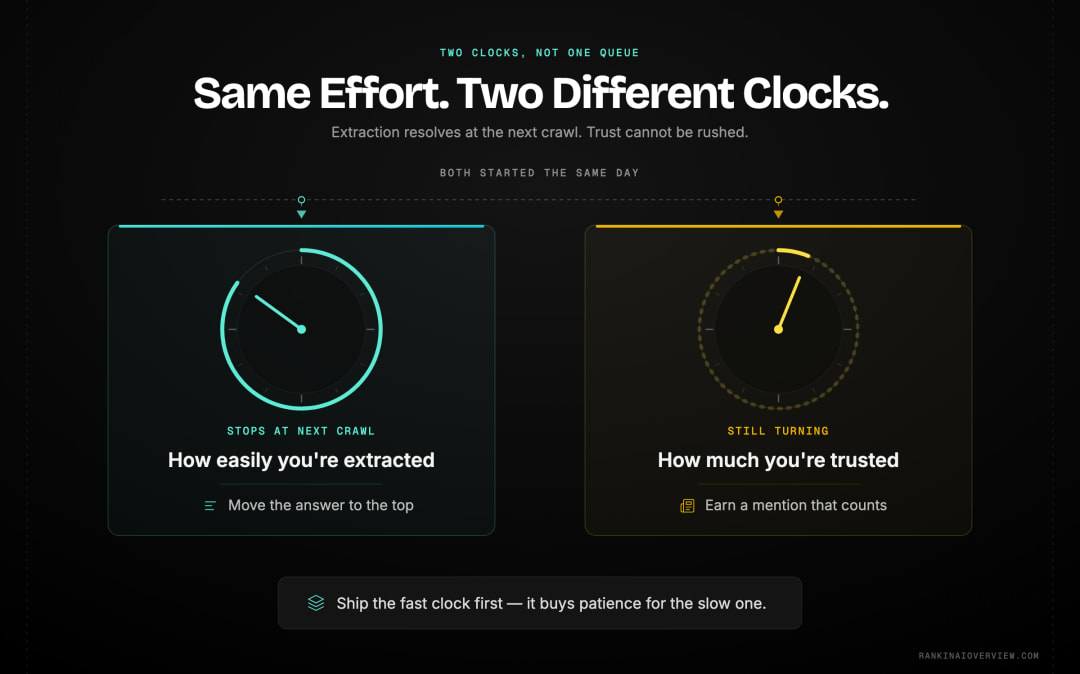
Some tactics work faster because they change how easily an engine can extract an answer you already have, which takes effect the moment your pages are recrawled. Slower tactics change how much the system trusts you, and trust accumulates over weeks or months. The dividing line is simple: extraction is fast, reputation is gradual, and almost every disappointment comes from confusing the two.
Think of it as two separate clocks running at once. When you reorganise a page so the answer sits at the top, you have changed an extraction problem, and the payoff arrives with the next crawl because nothing about your standing in the world had to change. When you earn a credible mention on a site the model already respects, you have nudged a trust problem, and that moves slowly because trust is cumulative by nature and cannot be manufactured on demand. The same effort produces a different waiting time depending on which clock it belongs to.
Knowing which clock you are on prevents the frustration that kills good work. If you make a structural change and see movement within a crawl cycle, that is the system behaving normally. If you invest in authority and see nothing for a fortnight, that is also the system behaving normally. Teams abandon tactics that were working perfectly well because they measured a months-long play against a one-week expectation, then concluded it had failed when it had simply not finished.
The framing also tells you how to sequence the work. Ship the fast, cheap, structural wins first, because they create early momentum and buy you the patience to keep going. Then layer the slower trust-building underneath, where it can compound quietly while the quick wins are already showing results. Running both clocks deliberately, with a realistic expectation for each, is how visibility improves now and keeps improving later. To see which pages are closest to a win before you touch anything, it helps to understand what actually gets cited in AI answers so you aim your first hour at the right target.
What Are the Quick Wins for AI Search Visibility Under One Week?
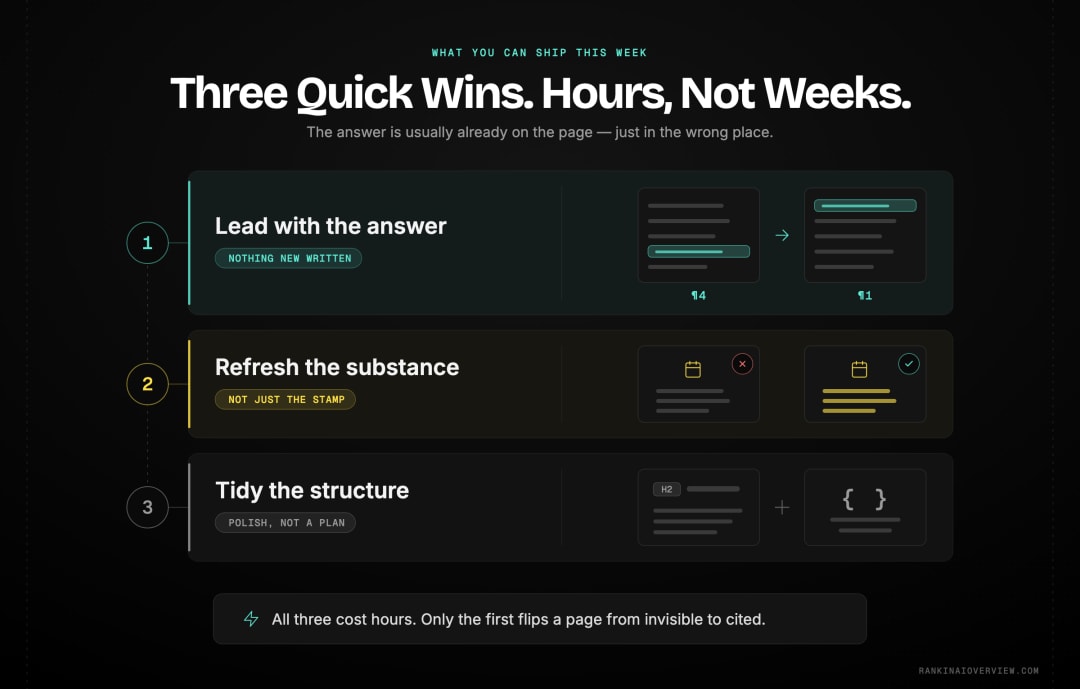
The fastest wins are rewriting a page so the direct answer leads, genuinely refreshing dated or outdated content, and making sure your answer is cleanly parseable. Each takes hours rather than weeks, each changes how easily an engine can lift your content, and each can show movement as soon as your pages are recrawled rather than after a long authority build.
These are the changes worth doing in your first week, in rough order of impact.
Lead With the Direct Answer
Move the core answer from paragraph four to paragraph one. Generative engines extract passages, so an answer buried under throat-clearing gets passed over while a front-loaded one gets lifted cleanly. This is the single change that most often flips a page from invisible to cited, and it is usually the fastest of all, because you are not writing anything new. The answer almost always exists on the page already. It is simply in the wrong place, and surfacing it costs minutes rather than hours.
The reason this works so reliably is that relevance and position are the strongest, most reproducible drivers of whether a passage gets selected. A clear, self-contained answer near the top of a genuinely relevant page is doing the two things that matter most at once. Rewrite the opening of your ten highest-value pages this way before you touch anything else, and you will have spent your first afternoon on the highest-leverage change available.
Refresh Stale Content Honestly
Updating a page with current figures, a corrected date and genuinely revised detail signals freshness, and freshness is a measurable advantage. The recency-bias research behind this article found that models systematically favour recently dated content, so a real update to a page that has drifted out of date can lift how often it gets surfaced, especially on time-sensitive topics where stale figures actively undermine trust.
There is an important honesty caveat here. That same research shows the effect is a bias triggered by the date signal itself, which means changing a timestamp without changing the content is a form of gaming, and it is exactly the sort of shortcut these systems and their operators are working to detect and discount. Update the substance, not just the stamp. Correct the statistics, revisit the claims, and let the newer date reflect a page that genuinely became more current. Done that way, freshness is one of the cleanest quick wins you have.
Make the Answer Cleanly Parseable
Give the engine content it can read without ambiguity: clear headings that match real questions, self-contained paragraphs, and structured data where it genuinely describes the page. This helps because it removes friction from extraction, not because markup is a magic word. It is worth doing in your first week, but keep it in proportion, because the substance of the answer matters far more than the wrapper around it.
This is the point where a lot of quick-win advice goes wrong, so it deserves a section of its own.
Does Adding Schema Actually Give You a Fast Citation Boost?
Not on its own. Structured data helps an engine understand and cleanly extract content that is already good, but formatting-only changes are among the weakest levers in the controlled evidence. Schema makes a strong page easier to lift; it does not make a thin page worth citing. Treating markup as a shortcut is the most common way teams burn their first week and then wonder why nothing moved.
The confusion is understandable, because schema does something real. When an engine can read a clean question-and-answer structure, extracting a tidy citation becomes easier, and on a genuinely helpful page that ease can matter at the margin. The mistake is inflating that marginal help into a headline tactic. Controlled testing that isolates individual content factors consistently finds that relevance and position dominate, that explicit figures and current timestamps help steadily, and that formatting-only edits move very little by themselves. Schema belongs on the list of quick wins, but near the bottom of it, as a finishing touch on a page that already answers the question well.
The practical takeaway is to sequence it correctly. Fix the answer first, refresh the substance second, and add or tidy structured data third, as the polish rather than the plan. If a page is being ignored, adding schema to it rarely rescues it, because the problem is almost never that the engine could not parse the answer. The problem is usually that the answer was buried, out of date, or not actually the best available. If your pages rank on Google but vanish from AI answers, our AI citation fix diagnostic walks through the handful of causes worth checking before you reach for markup.
What Are the Medium-Term AI Visibility Tactics From One to Four Weeks?
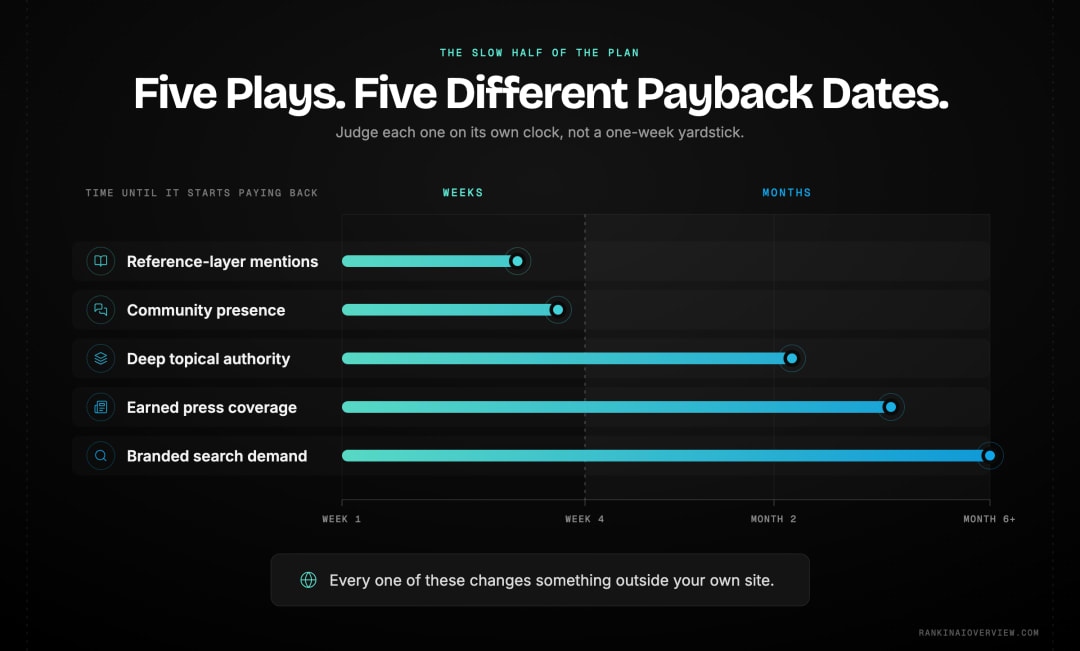
Medium-term tactics build discovery and early trust: earning genuinely warranted reference-layer mentions, and establishing a real, useful presence in the communities where your audience already asks questions. These take a few weeks to register rather than a single crawl, because they work by strengthening the entity and trust signals that drive consistent citation rather than by making one page easier to read.
Here are the plays that pay off on the multi-week clock.
Reference-Layer and Encyclopedic Mentions
Where it is genuinely warranted, a well-sourced mention in an established reference work in your field feeds directly into the trust and entity signals these systems lean on. A single credible reference-layer presence can reinforce how the model understands who you are and what you are known for, and that value is durable once earned. The weight it carries is exactly why it sits in the medium-term tier: it takes real effort and proper sourcing to secure, and it must be earned legitimately rather than manufactured, because reference platforms and AI systems both discount manipulation quickly.
The reason this is slower than a page rewrite is that it changes something outside your own site. You are adding a corroborating signal in a place the model already trusts, and corroboration is cumulative. One good mention helps; a consistent, verifiable presence across several trusted references is what genuinely moves your standing, and that is a build measured in weeks.
Genuine Community Presence
Answering questions honestly and usefully in the forums and communities where your audience gathers builds a kind of presence that AI systems draw on, and it costs nothing but time and expertise. The goal is to become a recognised, helpful voice over several weeks, not to drop links, because link-dropping is transparent, unwelcome, and self-defeating. Consistent, substantive contribution is what compounds into visibility, and it connects directly to the broader trust signals AI systems recognise.
Treat this as reputation work rather than a distribution channel. The value is not any single post; it is the accumulated evidence that a knowledgeable, named presence stands behind your brand across the places your topic gets discussed. That evidence takes a few weeks to build and keeps paying back long after, which is precisely why it earns a place on the medium-term clock rather than the fast one.
What Are the Long-Term AI Visibility Plays?
The long-term plays are building deep, connected topical authority, earning credible press and editorial coverage, and growing genuine branded search demand. These take months rather than weeks, and they form the durable foundation of AI visibility by making your brand a recognised entity that systems trust and cite by default, without needing to be nudged page by page.
This is where lasting visibility is actually won. Quick wins get you extracted; authority gets you trusted, and the two are not substitutes. Deep, interlinked content across your core topics, credible earned media from sources the models already respect, and rising branded search combine into an entity strength that no stack of fast fixes can replicate. The brands that dominate AI answers are almost always the ones that started this work early and kept at it while also shipping the quick wins, running both tracks in parallel rather than choosing between them.
The temptation is to skip long-term work precisely because it is slow, and that is the error that quietly caps a brand's ceiling. The foundation you build now becomes your biggest advantage later, when competitors who only ever chased fast fixes find themselves without the underlying authority that makes citation consistent. Being featured reliably, rather than occasionally, is the payoff of this compounding work, which our guide to getting your pages featured in Google AI Overviews covers step by step.
"Across seven models, GPT-3.5-turbo, GPT-4o, GPT-4, LLaMA-3 8B/70B, and Qwen-2.5 7B/72B, 'fresh' passages are consistently promoted, shifting the Top-10's mean publication year forward by up to 4.78 years and moving individual items by as many as 95 ranks in our listwise reranking experiments." Hanpei Fang, Sijie Tao, Nuo Chen, Kai-Xin Chang and Tetsuya Sakai, authors, Do Large Language Models Favor Recent Content? Source: arXiv
That result is worth sitting with, because it quantifies why freshness earns its place among the fast wins while also warning you not to fake it. The promotion is real and mechanical, which is what makes a genuine update pay off quickly. But it is triggered by the date signal, which is exactly why an update that changes the stamp without changing the substance is the kind of shortcut worth avoiding.
How Do You Prioritise Which Tactic to Try First?

Prioritise by effort against impact, and always on your highest-value pages first. Start with the fast structural changes that fix extraction, because they are cheap and quick, then move to the medium-term trust plays, then to the slow authority work. Fixing extraction before building trust means you see early movement that funds the patience the slower work demands.
A workable priority order looks like this:
- Lead with the direct answer on your top ten pages, because it is fast and high impact.
- Genuinely refresh the substance and figures on your most time-sensitive content, because freshness is a measured lever and the update is cheap.
- Tidy structured data on those same pages as a finishing touch, not as the plan.
- Earn reference-layer mentions and build genuine community presence over the following weeks.
- Invest in deep topical authority, earned press and branded search as the long-term foundation.
Sequence matters because early wins buy you patience. Ship the fast changes, show measurable movement, and use that evidence to make the case internally for the slower authority investment that follows. This ordering also keeps stakeholders engaged, since visible early progress is far easier to fund than a promise that things will improve in six months. Before you spend a single hour, it is worth measuring where you stand so you optimise the pages closest to a win rather than the ones that merely feel important.
How Do You Measure Whether a Tactic Worked?
Measure each change against a fixed baseline: record which target queries a page should win and whether the major engines cite you today, make one change, wait for a recrawl, then re-check the exact same prompts across ChatGPT, Perplexity and Google AI Overviews. Comparing like with like on a schedule is what lets you attribute movement to the specific change rather than to noise.
The discipline that makes this work is changing one thing at a time. If you rewrite the intro, refresh the statistics and add schema all in the same afternoon and citations improve a week later, you have learned that something worked but not what, and you cannot repeat it deliberately. Isolate the variable where you can, log the date of each change, and give the engines a crawl cycle to catch up before you judge the result. A vague sense that things are getting better is not a signal you can act on; a tracked before-and-after on a fixed prompt set is.
Watch the supporting metrics as well, because appearances are not the whole story. Branded search growth and AI referral traffic tell you whether visibility is translating into actual value rather than just showing up in more answers. Our guide to the AI visibility metrics that matter explains which numbers deserve your attention and which are vanity counts that feel like progress without being it. If you baseline properly, even a modest free audit of your current standing will point you at the pages where an hour of work pays back fastest.
What Mistakes Slow Down AI Visibility Gains?
The biggest mistakes are chasing slow tactics for fast results, judging every play by a one-week yardstick regardless of its real clock, and spreading effort thinly across low-value pages. Each one wastes time and, worse, obscures whether anything is working at all, which delays the gains you could otherwise be capturing and banking.
The most common version is expecting authority work to pay off immediately and then abandoning it when it does not. Trust building is a months-long play by nature, and quitting a few weeks in throws away the compounding you had already started, leaving you to begin again later from zero. The fix is not more patience in the abstract but matching your patience to each tactic's actual clock, so you stop judging a slow lever by a fast standard.
The second version is optimising pages nobody searches for. A single quick win on a high-demand page beats ten polished changes on pages with no real intent behind them, because visibility only converts to value where demand already exists. Concentrate your fast wins where search intent and traffic are genuinely present, and reserve broad, exhaustive optimisation for after you have captured the obvious opportunities. Do those two things and most of the time teams waste on AI visibility simply disappears.
Conclusion
AI search visibility has genuine quick wins, and knowing which levers are fast and which are slow is most of the battle. Structural changes that improve extraction, leading with the answer and honestly refreshing stale content, pay off within a crawl cycle. Schema helps a good page get lifted but is not the shortcut it is often sold as. Trust and authority pay off over weeks and months, and both belong in the plan alongside the fast work.
Prioritise by effort and impact, ship the one-hour changes on your best pages first, then build the medium and long-term trust that makes citation consistent rather than occasional. Measure every change against a fixed baseline, avoid the mistakes that waste weeks, and run both clocks together so your visibility improves now while it compounds for later. Want to know which of your pages can win fastest? Run a free AI visibility audit with Rank in AI Overview and get a prioritised view of your quickest opportunities before you spend a single hour optimising.
Frequently asked questions
What is the single fastest way to improve AI search visibility?+
Rewriting your highest-value pages so the direct answer leads is usually the fastest win. It reorganises content you already have rather than creating new material, and it can show results as soon as your pages are recrawled, often within days to a couple of weeks.
How quickly can AI visibility actually improve?+
Structural changes that improve extraction can register within days to a couple of weeks, once pages are recrawled. Trust-based tactics like reference mentions, community presence and authority take several weeks to months, because they accumulate gradually rather than taking effect at the next crawl.
Does adding schema give a fast citation boost?+
Not by itself. Structured data helps an engine cleanly extract a page that is already strong, but controlled evidence shows formatting-only changes move very little. Treat schema as a finishing touch on a good answer, not as the fast win itself.
Do content freshness updates help AI visibility?+
Yes, when they are genuine. Research shows models systematically favour recently dated content, so a real update to a stale page can lift how often it is surfaced. Change the substance and figures, not just the date, because timestamp-only edits are a shortcut worth avoiding.
Should I focus on quick wins or long-term visibility work?+
Both, in sequence and in parallel. Ship the fast structural wins on high-value pages first to create momentum, then invest in the slower trust and authority work that makes citation consistent. Running both tracks at once, with realistic expectations for each, is the point.
How do I know which page to optimise first?+
Prioritise high-value pages that target questions the engines answer often and where you already have search demand. A quick structural win on a page with real intent behind it beats many changes on low-priority pages that nobody is actually searching for.
Explore with AI
Share this