Is It Actually Possible to Rank Consistently in AI Search Right Now?
AI search citations swing harder than Google rankings ever did. Here is the real data on AI search volatility and what consistency actually looks like.

Key Highlights
-
BrightEdge tracking across major AI platforms found that 96.8% of cited domains saw zero change week over week, with 87% of the moves that did happen being declines.
-
Frequently cited domains see roughly 0.7% weekly volatility versus 50%+ swings for sporadically cited ones, a 70x stability gap between the two groups.
-
A single backend change at Google was enough to send ChatGPT's citation share of one major site from roughly 14% to under 1% within days.
-
Brands holding the #1 or #2 mention position for a prompt are nearly cemented there; the volatility concentrates in the middle and tail of the citation set.
-
One marketing agency saw its own daily search impressions fall by roughly 90% within a single quarter after its publishing schedule went inconsistent.
-
Consistency in AI search is achievable, but it is earned through authority and tracked with discipline, not granted by a stable algorithm.
-
Tracking a fixed set of prompts over time, rather than checking AI answers occasionally, is the only reliable way to separate a real trend from normal noise.
Ask whether it's possible to rank consistently in AI search right now and the honest answer starts with a number that cuts both ways. According to BrightEdge's weekly citation tracking across ChatGPT, Gemini, Perplexity and Google AI Overviews, 96.8% of cited domains saw no change at all from one week to the next. That sounds stable, until the second half of the finding: among the small slice of domains that did move, 87% of those moves were losses, not gains.
If that feels like a confusing answer, it is meant to. Most teams asking this question have already watched a citation appear and disappear for no reason they can point to, and they reasonably wonder whether the entire exercise is a coin flip. Some teams have also watched a competitor hold the same cited position for months without doing anything visibly different. Both experiences are real, and they are not contradictions. They describe two different zones of the same system.
This guide separates those zones clearly: what the data actually says about how often AI citations change, why the volatility concentrates where it does, what a real loss of consistency looks like when it happens to a brand, and what a realistic, achievable version of “consistent” looks like once a brand stops chasing a stable rank and starts tracking the right things instead.
What Does “Ranking Consistently” Even Mean in AI Search?
In AI search, ranking consistently means being named or cited for the same set of buyer prompts on a reliable, repeatable basis, not holding a fixed numeric position. Because AI answers typically name only a handful of sources per prompt, consistency is better measured as a stable presence rate over many weeks than as a single snapshot of today's answer.
A single check of how ChatGPT or Perplexity answers a prompt today tells a team almost nothing on its own, because any one AI response is a sample, not a measurement. The same prompt asked five times in the same week can return a different mix of named sources, partly due to normal model randomness and partly due to genuine shifts happening underneath. Consistency only becomes visible once a brand tracks a fixed set of prompts, asked the same way, on a recurring schedule, and watches the presence rate over weeks rather than judging from any single answer.
This redefinition matters because it changes what counts as a meaningful signal. A brand that disappears from one answer on one day has not necessarily lost consistency; it may simply have hit normal sampling variance. A brand that disappears from the same prompt cluster across three consecutive weekly checks has a real signal worth investigating. Treating the first case like the second leads to constant, unproductive firefighting over noise that was never going to persist.
How Volatile Is AI Search Really?
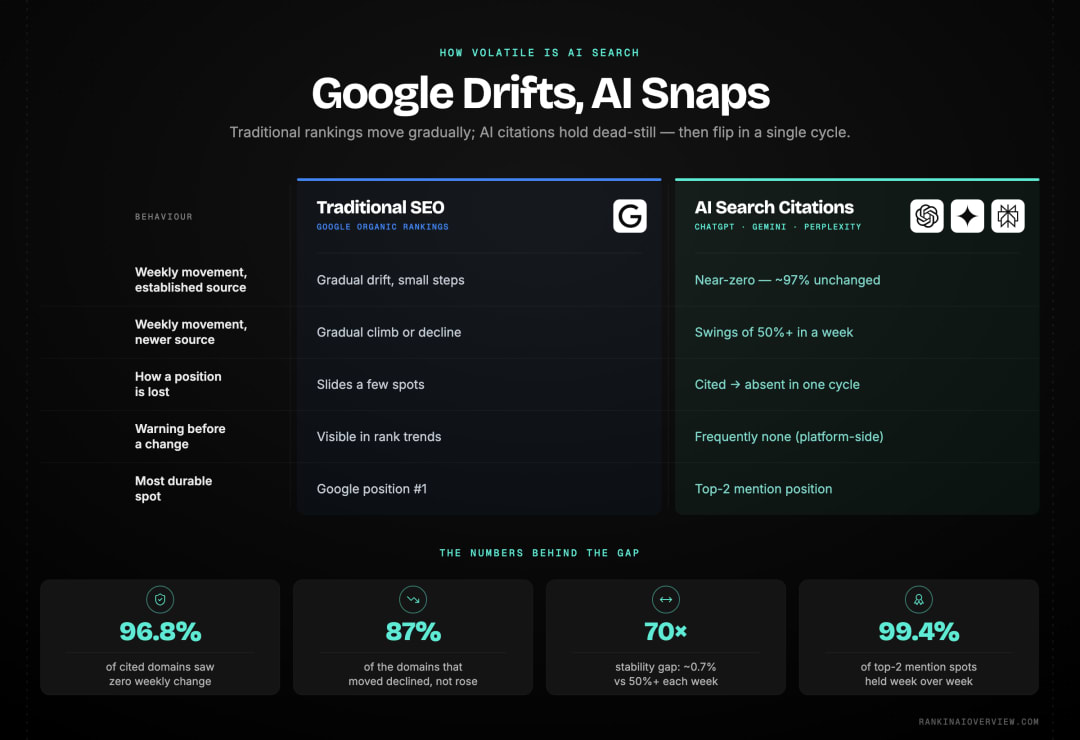
Citation movement in AI search is concentrated, not evenly spread. Core, frequently-cited sources are remarkably stable, while sources that appear only occasionally swing wildly. The overall system looks volatile in conversation, but the actual weekly data shows most of that volatility sitting in a relatively small, fragile group of sources.
The 70x gap is the clearest way to see this. BrightEdge's volatility analysis found that domains cited frequently experience roughly 0.7% weekly volatility, while domains cited only sporadically swing by 50% or more, a 70 times difference that holds across every AI platform tested. The same research identified a rough threshold, around 50 citations, where a source's stability jumps sharply: below it, presence is fragile; above it, presence behaves like a settled, durable position.
Even within that stable core, the system is not gentle when it does move. The same BrightEdge tracking found that AI engines are not redistributing citations evenly when a source drops out; they are pruning their trusted set without proportional replacement, and most changes are binary rather than gradual. A source does not slowly lose a few percentage points of citation share over several weeks the way a Google ranking might slide from position four to position seven. It tends to go from cited to not cited in a single cycle, with no gradual warning beforehand. For a brand watching its own numbers, that means the absence of any warning sign in one week's data is not the same as a guarantee that nothing will change in the next.
What Happened When a Single Backend Change Erased a Citation Lead?
In September 2025, ChatGPT's share of citations referencing Reddit fell from roughly 14% to under 1% within a matter of days, a collapse large enough that it was covered as a market-moving event by The Motley Fool, given Reddit's reliance on AI-referred traffic at the time. The trigger traced back to a change in how Google's search results were being pulled for retrieval, not to anything Reddit did differently. The episode is a useful, concrete illustration of the binary pattern the broader BrightEdge data describes: a source can hold a strong, settled citation share for months and then lose nearly all of it within a single update cycle, for reasons entirely outside its own content decisions.
Lining traditional SEO volatility up against AI search volatility side by side makes the difference in degree easier to see. The table below is illustrative, built from the patterns documented across the BrightEdge tracking and the Reddit episode above, not a single brand's exact numbers.
| Behaviour | Traditional Google SEO | AI Search Citations |
|---|---|---|
| Typical weekly movement for an established source | Small, gradual position shifts | Near zero for ~97% of sources |
| Typical weekly movement for a newer source | Gradual climb or decline over weeks | Swings of 50% or more are common |
| How a position is usually lost | Slides down a few spots at a time | Drops from cited to absent in one cycle |
| Warning before a major change | Often visible in rank-tracking trends | Frequently none; the trigger sits in the platform |
| Most durable position in the system | Position 1, with steady defence required | Top 2 mention position, ~99.4% held weekly |
What Actually Breaks Consistency for a Brand?
External platform shifts explain some volatility, but the most common cause sits inside a brand's own control: inconsistent publishing. AI systems weight recent, regularly reinforced expertise more heavily than a one-time burst of content, so a publishing schedule that starts and stops tends to show up directly in citation and impression data.
It is tempting to treat every citation loss as evidence of a platform problem, since the Reddit example above shows just how real that cause can be. But the more common, more controllable cause is far less dramatic: a content program that runs hot for a few months, earns a strong citation position, and then quietly goes quiet. AI systems do not appear to give long-term credit for past output the way a domain's accumulated backlink profile might in traditional SEO. Recency and ongoing reinforcement seem to matter more, which means a pause in publishing can erode a hard-won citation position faster than most teams expect.
What Happened When a Consistent Publishing Schedule Stopped?
Xponent21, a Richmond, Virginia digital marketing agency, built its own AI search visibility on a baseline of roughly 90,000 daily search impressions at its peak, driven by a steady publishing cadence on AI search topics. When the agency scaled back its own content program in early 2026 to focus on internal growth, impressions fell from around 70,000 to between 8,000 and 9,000 per day by March, a drop of roughly 90% within a single quarter, according to a case study the agency published about its own visibility loss. The pattern the agency drew from its own data was direct: authority compounds with consistent output and erodes quickly without it, and the erosion shows up in AI-driven impressions faster than most teams expect.
Why Is AI Search So Volatile Right Now?
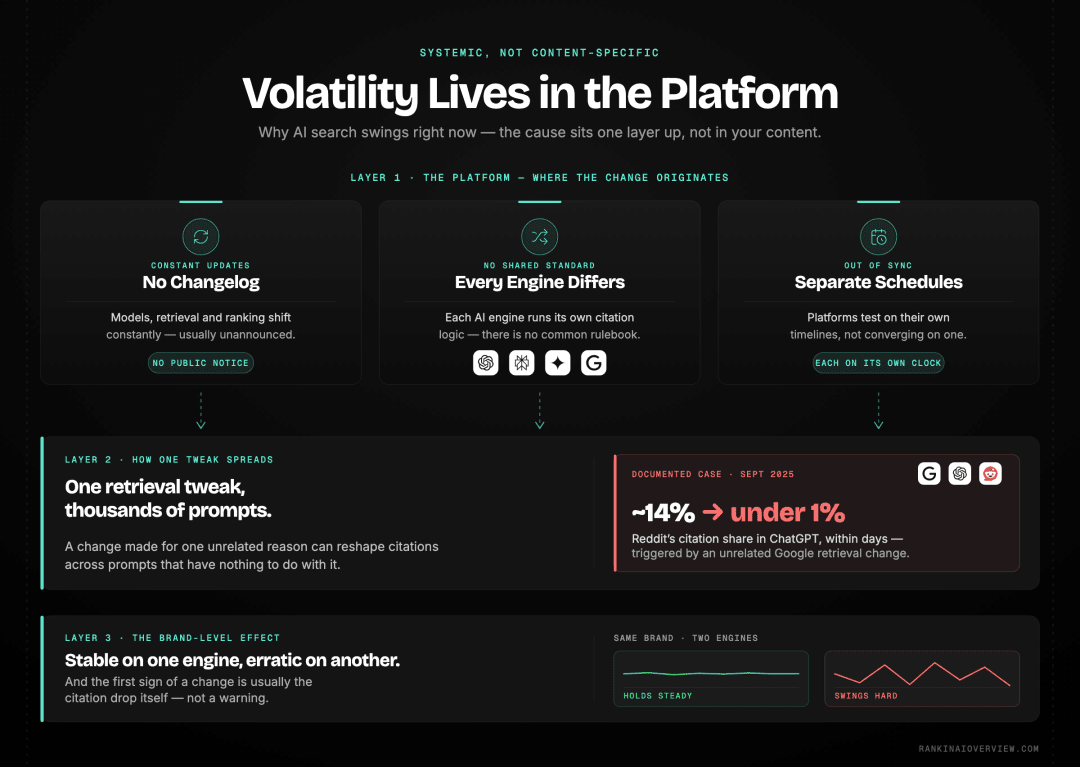
AI search volatility comes from a combination of frequent model and ranking updates, genuine testing behaviour by the platforms themselves, and citation logic that differs from one engine to the next. None of these causes are unique to a single brand's content; they are systemic, which is exactly why they cannot be fully engineered around.
Frequent Model and Backend Changes
Every major AI platform updates its underlying model, retrieval pipeline, or ranking logic on a rolling basis, often without a public changelog. A change made for an entirely different reason, like adjusting how many search results get pulled into a retrieval step, can reshape which sources get cited for thousands of unrelated prompts as a side effect. Brands experience this as their own citations changing, with no visibility into the actual cause sitting one layer up in the platform's infrastructure. Because these changes are rarely announced in advance, the first sign a brand gets is usually the citation drop itself, not a heads-up that something upstream is about to shift.
Platform-Specific Citation Logic
ChatGPT, Perplexity, Gemini and Google AI Overviews do not share a single citation engine, so the same brand can be stable on one platform and erratic on another at the same time. Documented baseline research has found ChatGPT holding consistently high volatility in the 35 to 45% range, while Google AI Overviews has shown climbing instability over time, evidence that each platform is testing and adjusting on its own schedule rather than converging toward one shared standard. A brand that only tracks one platform can mistake a single-engine pattern for the whole picture, missing the fact that its citation behaviour on a second or third platform is moving in a completely different direction.
What Actually Stays Consistent in AI Search?
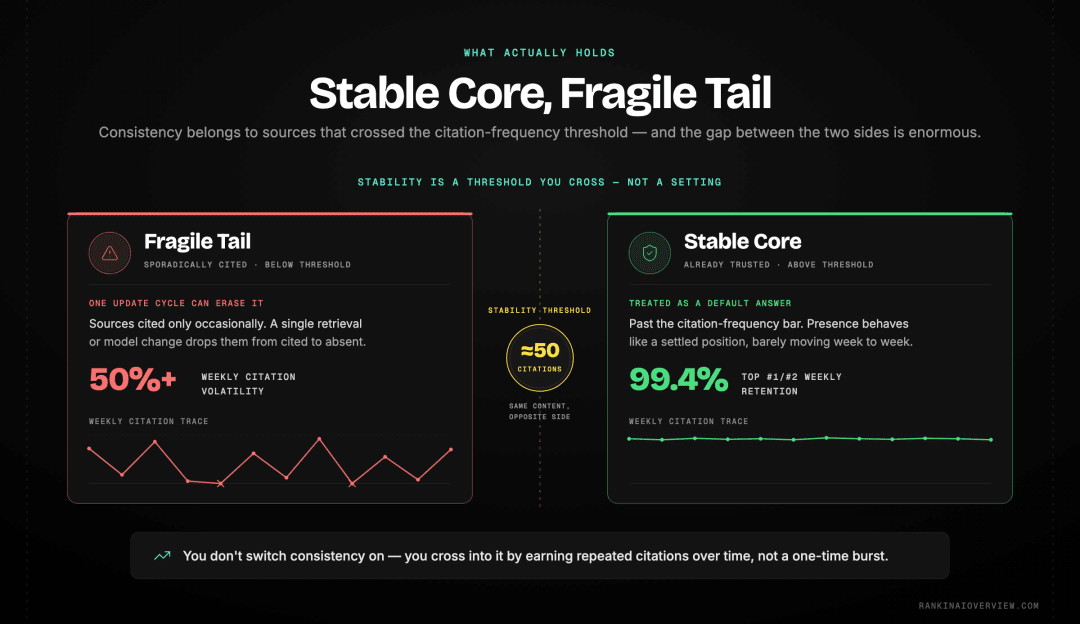
The sources that stay consistent are the ones that have already crossed an authority and citation-frequency threshold, not the ones with the most recently published content. Positions at the very top of a citation set, the #1 or #2 most-mentioned source for a given prompt, are the most durable positions in the entire system.
The same BrightEdge tracking that found 96.8% weekly stability also found that positions at the top of the mention rankings are especially durable: roughly 99.4% of #1 and #2 positions held steady week over week. That durability is concentrated, not universal. It belongs to sources that have already built the kind of authority signal that AI systems treat as a default answer, and a prioritised breakdown of which signals actually drive that kind of AI ranking durability is worth reviewing before assuming every optimisation tactic carries equal weight.
This creates an uncomfortable but realistic picture for newer or smaller brands. The system rewards sources that are already trusted with extreme stability, and punishes sources without that history with extreme volatility, and there is no shortcut that converts one into the other overnight. Consistency in AI search is less a setting a brand turns on and more a threshold a brand earns its way across, one repeated citation at a time.
That threshold effect also explains why two brands publishing similar content can have wildly different experiences with the same AI platform in the same month. One has already crossed into the stable core for its category's prompts, and benefits from the same 99.4% retention rate every other top-positioned source enjoys. The other is still in the fragile, sporadically-cited tail, where a single update cycle can erase a position that took months to earn. Neither outcome says much about content quality on its own; it mostly reflects which side of the threshold each brand currently sits on.
Can You Actually Control Your AI Search Visibility?
Brands can influence AI search visibility, but largely by strengthening the same signals that already drive traditional organic visibility, rather than through tactics unique to AI platforms. The growing body of research suggests AI citation tracks organic ranking strength closely enough that treating the two as separable strategies is a common and costly mistake.
This question sits at the centre of most AI search anxiety, because the honest answer is neither the optimistic version some vendors sell nor the fatalistic version frustrated marketers sometimes land on after a bad week. Two well-known voices in the SEO research community have made the strongest, most specific cases for where the real influence sits, and where the limits of that influence are.
“ ranking number one on Google gets you more citations Lily Ray VP of SEO Strategy & Research, Amsive PPC Land, May 2026
Ray's broader argument is that a lot of what gets credited to standalone AI optimisation tactics is really a brand's existing organic authority showing up in a new channel. A site that loses organic rankings after a Google update tends to lose AI citations at the same time, because many AI systems lean on the same underlying web index and ranking signals when deciding what to retrieve and cite.
“ Correlation doesn't always imply causation Sergei Rogulin Head of Organic and AI Visibility, Semrush Semrush Blog, November 2025
Rogulin's caution matters here too. Not every citation swing has a single clean explanation, and not every correlation between organic rank and AI citation proves one causes the other directly. The honest position sits between both views: a brand has real influence over its AI search consistency through the fundamentals it already controls, but it does not have the kind of direct, isolated control over any one platform's citation logic that a rank tracker once implied was possible for Google. Acting on that honest position means investing in the fundamentals with realistic expectations, not abandoning the effort because one platform update proved control was never total.
What Does Realistic Consistency Look Like, Practically?

Realistic consistency means tracking a fixed set of prompts over months rather than checking answers occasionally, treating any single citation loss as a data point rather than a crisis, and building the same authority and publishing fundamentals that have always driven durable organic visibility.
None of the steps below require predicting the next platform update, which is good, because that part genuinely cannot be predicted from outside the companies running these systems. What they do require is a shift in how a team measures success: away from a single daily check of how an AI assistant answers one prompt, and toward a recurring, dated record that can actually show a trend when one exists.
-
Track a fixed prompt set, not a rotating one. Comparing the same 30 to 50 prompts week over week is the only way to tell a real shift from ordinary sampling noise.
-
Expect the core to hold and the edges to move. A brand with an established citation position should expect stability; a brand newly breaking in should expect volatility as the normal cost of entry.
-
Treat a sudden, binary loss as a signal to investigate, not necessarily a sign of doing something wrong. Many losses trace back to platform-side changes rather than content quality.
-
Keep publishing on a steady cadence. The clearest documented driver of lost AI visibility is an inconsistent content schedule, not a single algorithm update.
-
Review quarterly at minimum, and immediately after any major model release from a platform a brand depends on for citations.
-
Separate platform-level noise from brand-level signal by checking whether competitors in the same category saw a similar shift at the same time; a category-wide move points to a platform change, not a brand-specific problem.
How Do You Actually Track Consistency Over Time?
Tracking AI search consistency requires a tool that samples the same prompts repeatedly and logs results over time, rather than a single manual check. Several platforms now specialise in exactly this kind of longitudinal citation tracking across ChatGPT, Perplexity, Gemini and Google AI Overviews.
-
BrightEdge AI Catalyst tracks weekly citation and mention shifts across major AI platforms at scale, the methodology behind most of the volatility figures cited in this guide.
-
Profound monitors how often and how favourably a brand appears across AI platforms over time, built specifically for longitudinal AI visibility tracking.
-
Peec.ai tracks citations and brand mentions against named competitors, logging sources over time rather than relying on a single snapshot.
-
Otterly AI focuses on monitoring brand mentions across ChatGPT, Perplexity and other AI assistants, with alerts when citation patterns shift.
Whichever tool a team uses, the same principle from the practical takeaways above applies: a fixed, repeated prompt set tracked weekly tells a far more honest story than refreshing a chat window a few times and drawing conclusions from what shows up.
Can you actually control your ranking in AI search?
Partly. Brands influence AI visibility mainly by strengthening organic authority, structured content and citation-worthy proof, the same fundamentals that drive traditional SEO. Direct, isolated control over any single platform's citation logic is far more limited.
Why did my AI citations disappear overnight?
AI citation losses are typically binary rather than gradual: a source is cited one week and not the next, often due to a platform-side model or retrieval change rather than a quality drop in the content itself.
How often do AI search rankings change?
For most established sources, rarely; roughly 97% of cited domains see no week-over-week change. For newer or sporadically cited sources, change is frequent, with swings of 50% or more in citation share considered normal.
Is AI search ranking more volatile than Google SEO?
At the edges, yes. Traditional Google rankings move gradually and the same pages tend to hold positions for months. AI citations for less-established sources can flip from cited to absent in a single update cycle, with no intermediate decline.
Should I still invest in AI search optimization if it keeps changing?
Yes. The volatility is concentrated in sources that have not yet built citation authority; the data shows that once a source becomes a frequently cited core source, its position becomes remarkably durable, which makes the investment worthwhile over time.
Conclusion
Is it actually possible to rank consistently in AI search right now? Yes, for sources that have already earned a place in the trusted, frequently cited core, where the data shows real and durable stability. For everyone else, the honest answer is that consistency has to be built, not assumed, and it gets built through the same authority and publishing fundamentals that have always mattered, tracked with a discipline that matches how genuinely volatile the edges of this system still are.
The practical takeaway is to stop judging AI search performance from any single check of any single answer. Track a fixed set of prompts over months, expect the core to behave very differently from the edges, and treat a sudden citation loss as a prompt to investigate rather than evidence that nothing about AI search optimisation works.
None of this guarantees a fixed position the way a decades-old Google ranking once felt permanent. What it offers instead is something more honest: a clear-eyed view of where real stability exists in the system today, and a realistic path toward earning a place inside it.
Frequently asked questions
Can you actually control your ranking in AI search?+
Partly. Brands influence AI visibility mainly by strengthening organic authority, structured content and citation-worthy proof, the same fundamentals that drive traditional SEO. Direct, isolated control over any single platform's citation logic is far more limited.
Why did my AI citations disappear overnight?+
AI citation losses are typically binary rather than gradual: a source is cited one week and not the next, often due to a platform-side model or retrieval change rather than a quality drop in the content itself.
How often do AI search rankings change?+
For most established sources, rarely; roughly 97% of cited domains see no week-over-week change. For newer or sporadically cited sources, change is frequent, with swings of 50% or more in citation share considered normal.
Is AI search ranking more volatile than Google SEO?+
At the edges, yes. Traditional Google rankings move gradually and the same pages tend to hold positions for months. AI citations for less-established sources can flip from cited to absent in a single update cycle, with no intermediate decline.
Should I still invest in AI search optimization if it keeps changing?+
Yes. The volatility is concentrated in sources that have not yet built citation authority; the data shows that once a source becomes a frequently cited core source, its position becomes remarkably durable, which makes the investment worthwhile over time.
Explore with AI
Share this


