The 4 Tools That Actually Track Microsoft Copilot in 2026
Only a handful of tools genuinely track Microsoft Copilot. Compare Profound, Peec AI, AthenaHQ and Otterly.ai on price, depth and citations.

Key Highlights
- A Copilot rank tracker checks whether Microsoft Copilot mentions or cites your brand across its Windows, Edge, Bing and Microsoft 365 footprint.
- Copilot coverage across the market is still thin, so the honest shortlist that genuinely tracks it is short: Profound, Peec AI, AthenaHQ and Otterly.ai.
- Copilot leans on Bing's index and shows its sources, so favour tools that record exact citation URLs, not just brand mentions.
- Profound leads on enterprise depth, Peec AI balances depth with fair pricing, AthenaHQ ties visibility to revenue, and Otterly.ai is the cheapest way in.
- Match the tool to your stage and budget, then re-measure over time as Copilot answers shift.
- Rank in AI Overview researches how AI answers surface brands, offers a free AI visibility audit, and has a scoring tool arriving soon.
Most brands watch ChatGPT and Google, and quietly forget Microsoft Copilot. That is a mistake, because Copilot sits inside Windows, Edge, Bing and Microsoft 365, reaching an enormous base of professionals who ask it questions all day. If it never cites you, a whole channel is passing you by. According to a 2026 measurement study of AI search citations published on arXiv, researchers logged 21,143 valid citations across 602 prompts and found that the pages earning the most influential citations were longer, more structured and richer in extractable evidence. Being cited, not just ranked, is the new game.
That finding matters for Copilot specifically. Copilot builds answers by pulling candidate pages from Bing's index, ranking them, then citing a handful inside a summarised reply. So the question is not simply where you rank on Bing. It is whether Copilot chooses your page as one of the sources it shows. Measuring that is a different job from classic rank tracking, and most AI visibility tools do not yet do it for Copilot at all.
This guide covers the four tools that genuinely track a Microsoft Copilot rank position today. For each you get a plain overview, a pros and cons table, per-plan pricing, who it suits and a short verdict. The aim is a decision you can defend, not a feature race. If you want the wider view first, our roundup of the best AI rank trackers of 2026 is a useful companion read.
What Is a Microsoft Copilot Rank Tracker?
A Microsoft Copilot rank tracker is a tool that runs the prompts your buyers ask and records whether Copilot names or cites your brand in its answer. Because Copilot draws on Bing and shows sources, the best trackers log the exact cited URLs, not just a mention flag, across regular refreshes.
Traditional rank tracking reports a numbered position on a results page. Copilot has no ordered list of ten blue links. It generates one answer and footnotes a few sources. So a Copilot rank tracker measures presence and citation share inside that answer, which is a fundamentally different signal.
That difference shapes everything that follows. If a tool only counts how often your brand name appears in the text, it misses the sources panel, which is the surface that actually sends clicks. A capable tracker tells you when your page, not merely your name, earns the footnote.
Why Should You Track Microsoft Copilot Separately?
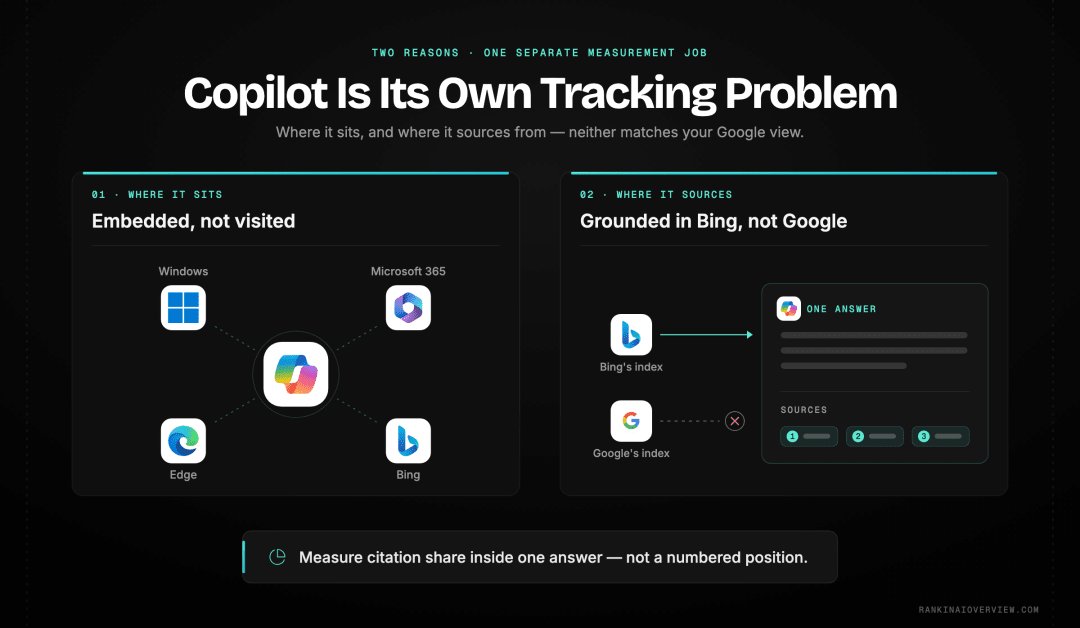
You should track Microsoft Copilot separately because its reach and its sourcing are distinct. It is embedded across Windows, Edge, Bing and Microsoft 365, in front of a huge professional audience, and it grounds answers in Bing's index rather than Google's, so the pages it cites often differ from what ranks elsewhere.
The audience alone justifies the attention. People do not open Copilot as a novelty. They meet it inside the operating system and the productivity apps they already use for work, which means high-intent, commercial questions land there every day. Ignoring that surface leaves a professional channel unmeasured.
The sourcing is the second reason. Because Copilot grounds on Bing, your Bing performance and structured, evidence-dense content influence whether you are cited, sometimes independently of your Google standing. A page that stalls on Google can still be pulled into a Copilot answer, and the reverse is equally true.
That gap between ranking and being retrieved is exactly what changed. Duane Forrester, who once ran Bing's global webmaster programme and now advises brands through UnboundAnswers, puts the shift in seven blunt words.
"Search engines rank pages. Assistants retrieve chunks." Duane Forrester, founder of UnboundAnswers and author of Duane Forrester Decodes. Source: Your Brand Is Being Cited by AI
His point reframes what you are buying. If Copilot retrieves chunks and cites them, a Copilot rank tracker has to watch retrieval and citation, not a static position. Keep that lens as you weigh the four tools below.
What Makes a Good Copilot Rank Tracker?
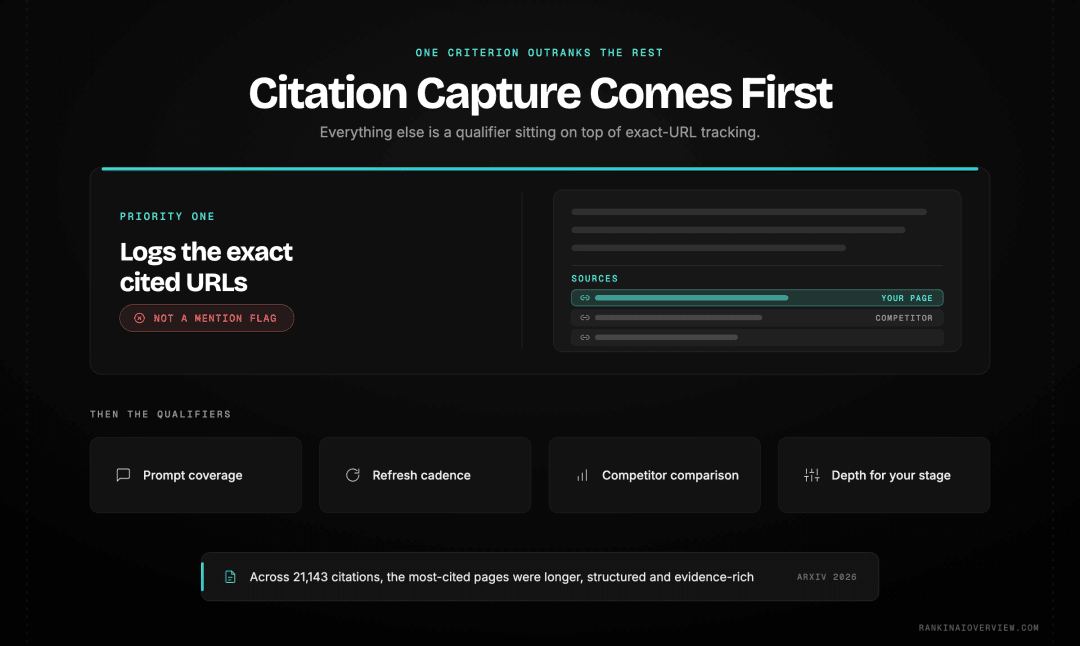
A good Copilot rank tracker captures whether Copilot cites your brand as a source and records the exact URLs, not just a mention. Because Copilot shows the pages it uses, citation tracking is the priority, alongside solid prompt coverage, competitor comparison and frequent refreshes that keep pace with shifting answers.
Start with citations. Copilot's sources panel is where traffic can flow, so a tracker that ignores it is measuring the wrong thing. Confirm any tool logs the specific cited URLs and can tell you when a competitor's page is chosen over yours.
Coverage and freshness come next. Copilot answers vary by phrasing and change over time, so a wide prompt set and a regular refresh cadence keep the picture honest. Our guide to the AI visibility metrics that matter sets out which numbers deserve reporting weight, and that citation-first thinking applies to Copilot as much as any engine.
Finally, weigh depth against cost. Some teams need sentiment, share of voice and revenue links, while others simply need to know whether Copilot mentions them at all. The right tool is the one whose depth matches your stage without forcing an enterprise contract.
What Are the Best Microsoft Copilot Rank Trackers in 2026?
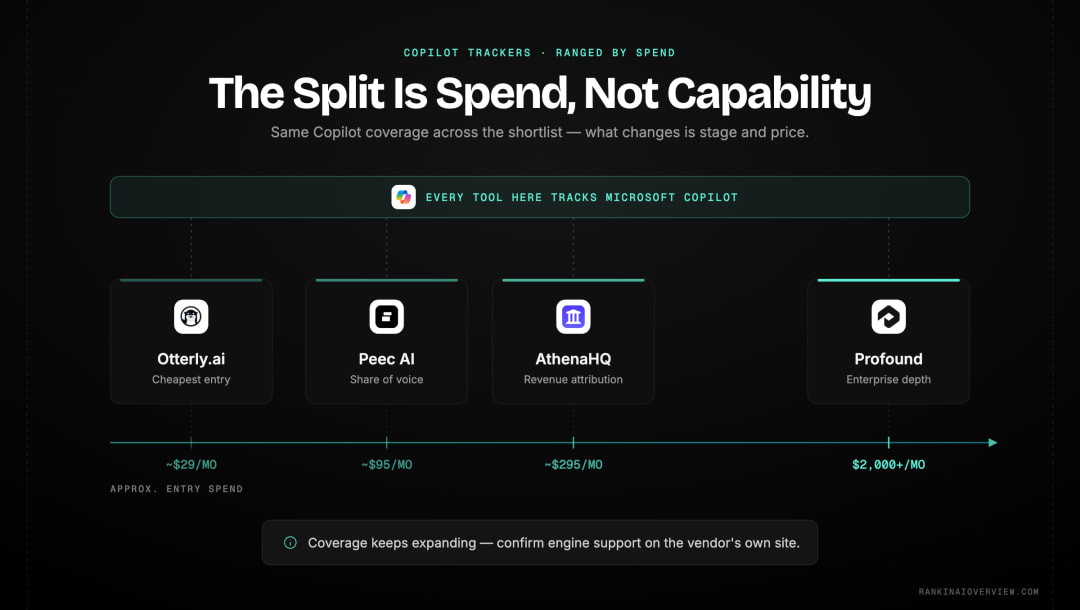
The four tools that genuinely track Microsoft Copilot today are Profound, Peec AI, AthenaHQ and Otterly.ai. Each covers Copilot alongside other engines, spanning enterprise analytics, mid-market value, revenue attribution and affordable entry monitoring, so your best pick depends on stage and budget.
Here is each one in turn, with the detail you need to shortlist.
1. Profound
Profound is the depth leader, and its higher tiers track a Microsoft Copilot rank position alongside ChatGPT, Perplexity, Gemini and more. It suits large organisations because of its crawler-level monitoring, structured daily prompting and SOC 2 posture. If your programme is formal and well funded, no tool watches Copilot more thoroughly.
| Pros | Cons |
|---|---|
| Deepest Copilot analytics and crawler visibility | Copilot sits on higher, pricier tiers |
| Structured daily prompts across many engines | Enterprise deployments run into thousands monthly |
| Strong competitor and sentiment signals | Heavier than a small team needs |
Pricing: (confirm on Profound's pricing page)
- Entry tier: roughly $99 per month, ChatGPT focused
- Mid tier: roughly $399 per month, several engines
- Enterprise: custom, commonly $2,000 to $5,000+ per month, with full Copilot coverage
Best for: Enterprises that want the deepest Copilot analytics inside one multi-engine platform.
Verdict: Profound earns its place as the most thorough Copilot tracker, provided your budget reaches the tiers where Copilot coverage lives.
2. Peec AI
Peec AI is a mid-market analytics platform that tracks Microsoft Copilot among wide engine coverage, including ChatGPT, Gemini, Perplexity and DeepSeek. It is one of the more accessible ways to get genuine Copilot tracking with real analytical depth, thanks to transparent self-serve pricing and direct founder access.
| Pros | Cons |
|---|---|
| Real Copilot tracking with clean analytics | Diagnoses gaps rather than fixing them |
| Transparent self-serve pricing, no sales call | Engine access varies by tier |
| Clear share of voice and sentiment views | Some engines reserved for higher plans |
Pricing: (confirm on Peec AI's pricing page)
- Entry: around $95 per month for roughly 50 prompts
- Mid: around $245 per month for roughly 150 prompts
- Higher: around $495 per month for roughly 350 prompts
- Enterprise: custom, unlocking wider engine access
Best for: Growing teams that want Copilot tracking and strong analytics at a price they can justify.
Verdict: Peec AI earns its spot as the value pick, pairing honest Copilot coverage with pricing you can read on the page before you commit.
3. AthenaHQ
AthenaHQ is a premium GEO platform that tracks Microsoft Copilot alongside ChatGPT, Perplexity, Gemini, Claude and Grok, then ties that visibility to revenue through commerce and analytics integrations. It stands out for connecting Copilot presence to sales and region, which most trackers never attempt.
| Pros | Cons |
|---|---|
| Copilot tracking linked to revenue outcomes | Entry price around $295 per month |
| Wide engine coverage with geographic breakdowns | No free trial to test first |
| Commercial framing leadership understands | Overpowered for a lean team |
Pricing: (confirm on AthenaHQ's plans page)
- Entry plan: around $295 per month
- Higher self-serve plan: up to around $499 per month
- Enterprise: custom pricing
- No free trial
Best for: Commercial brands that want Copilot visibility expressed in revenue and regional terms.
Verdict: AthenaHQ earns its place by tracking Copilot while tying the data to sales and geography, an angle few rivals match.
4. Otterly.ai
Otterly.ai is the affordable on-ramp, monitoring a Microsoft Copilot rank position alongside Google AI Overviews, AI Mode, ChatGPT, Perplexity and Gemini. Its low entry price and simple setup make it the friendliest starting point for smaller brands and agencies testing the water.
| Pros | Cons |
|---|---|
| Cheap Copilot and multi-engine monitoring | Entry tiers cap prompt volume |
| Simple onboarding, quick to start | Growing programmes may outgrow it |
| Beginner-friendly interface | Fewer enterprise-grade features |
Pricing: (confirm on Otterly.ai)
- Entry plan: from around $29 per month for roughly 15 prompts
- Higher plans scale with prompts and features
Best for: Small brands and agencies beginning Copilot tracking on a tight budget.
Verdict: Otterly.ai earns its spot as the accessible entry point, delivering genuine Copilot monitoring at the lowest starting price on this list.
Also read: What ranking really means in AI search, and why citation beats position
How Do the Copilot Rank Trackers Compare?
The four span enterprise depth, mid-market value, revenue-focused GEO and budget entry monitoring. Profound goes deepest, Peec AI balances depth against price, AthenaHQ links Copilot presence to revenue, and Otterly.ai offers the cheapest start. All four genuinely track Copilot, so the split is really about stage and spend.
| Tool | Best for | Approx. entry price | Standout strength |
|---|---|---|---|
| Profound | Enterprise depth | Copilot on higher tiers | Deepest analytics and crawler monitoring |
| Peec AI | Mid-market value | Around $95 per month | Copilot tracking with transparent pricing |
| AthenaHQ | Revenue attribution | Around $295 per month | Copilot visibility tied to sales and region |
| Otterly.ai | Budget entry | Around $29 per month | Cheapest genuine Copilot monitoring |
Copilot coverage is still expanding across the market, so confirm current engine support and pricing on each vendor's own site before you buy. Then trial your shortlist on real prompts, because the fit only shows on your own data. If you want to sanity-check whether any of these tools deliver, our honest look at whether AI rank tracker tools actually work is worth a read first.
How Do You Choose the Right Copilot Rank Tracker?
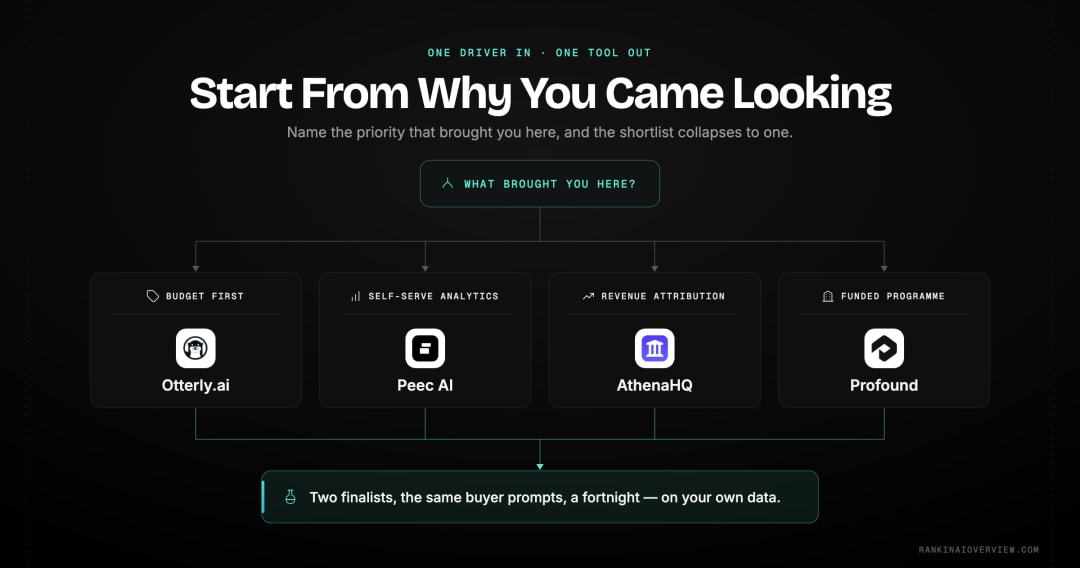
Choose by naming your priority, then matching it to a tool. Pick Otterly.ai for cheap entry monitoring, Peec AI for mid-market analytics at a fair price, AthenaHQ for revenue attribution, and Profound for the deepest enterprise view. All four track Copilot, so lead with budget and depth, not a feature checklist.
The discipline is to start from the reason you are looking. If cost drove you here, do not overspend on enterprise depth you will not use. If you need Copilot presence framed as revenue, a cheap monitor will leave the important question unanswered. The driver narrows a wide field fast.
Then validate before you commit. Run the same buyer questions through two finalists for a fortnight and see which surfaces the citations you care about. Comparing traditional and AI measurement is easier with our SEO versus AI visibility benchmarking guide, which helps you judge what you are actually testing.
Whatever you choose, prioritise citation tracking with exact URLs, since Copilot grounds on Bing and shows its sources. Rank in AI Overview studies how those citations form and offers a free audit if you want to baseline your Copilot visibility before spending on a subscription.
Conclusion
Microsoft Copilot is the answer engine most brands forget, and that is exactly why tracking it can pay off. Its reach across Windows, Edge, Bing and Microsoft 365 puts it in front of a large professional audience whose questions you want to help answer, and its Bing-grounded sourcing can favour you even where Google does not.
Coverage remains limited, so the honest shortlist stays four names: Profound for depth, Peec AI for value, AthenaHQ for revenue attribution, and Otterly.ai for the cheapest start. Match the tool to your stage, insist on citation tracking with exact URLs, and re-measure as answers move.
Rank in AI Overview investigates how AI engines decide which brands to cite, publishes that research openly, and is finishing an AI visibility scoring tool that lands soon. Want to know whether Copilot cites your brand today? Get your free AI visibility audit and see how every major answer engine represents you.
Frequently asked questions
Which tools genuinely track Microsoft Copilot rankings?+
The tools that truly track Copilot today are Profound, Peec AI, AthenaHQ and Otterly.ai. Copilot coverage is still expanding across the market, so always confirm engine support on your chosen plan before you commit any budget.
Why is Microsoft Copilot worth tracking at all?+
Copilot is built into Windows, Edge, Bing and Microsoft 365, reaching a large professional and enterprise audience. Being cited in its answers reaches high-intent users many brands overlook, which makes it a quiet but valuable channel to measure.
Does Copilot actually show its sources?+
Yes. Copilot grounds answers in Bing's index and usually footnotes the web pages it uses. A capable tracker records those exact citation URLs, so you learn when your page, not just your brand name, is being referenced.
Is there a cheap Copilot rank tracker worth trying?+
Otterly.ai tracks Copilot from around $29 per month, the most affordable genuine option here. Peec AI adds deeper analytics and share of voice from around $95 per month if you want more than basic monitoring.
How is tracking Copilot different from tracking Google?+
Google rank tracking reports a numbered position. Copilot generates one answer, so tracking measures whether you are mentioned or cited as a source. Copilot also leans on Bing rather than Google, so its sourcing often differs.
How often should I re-check my Copilot visibility?+
Copilot answers shift with phrasing and model updates, so weekly or fortnightly checks suit most teams. Fast-moving or competitive niches benefit from more frequent refreshes, which is why refresh cadence is worth confirming on any tool.
Explore with AI
Share this