AI Ranking Factors in 2026: What Actually Matters Most for AI Search Visibility
Too many AI SEO guides list 20 factors without telling you which ones actually move the needle. Here is a prioritised breakdown of what matters most for AI search visibility in 2026.
Key Highlights
-
AI search visibility factors are not equal. Topical authority and Google top-20 ranking are Tier 1 non-negotiables. Everything else is built on top of these two prerequisites
-
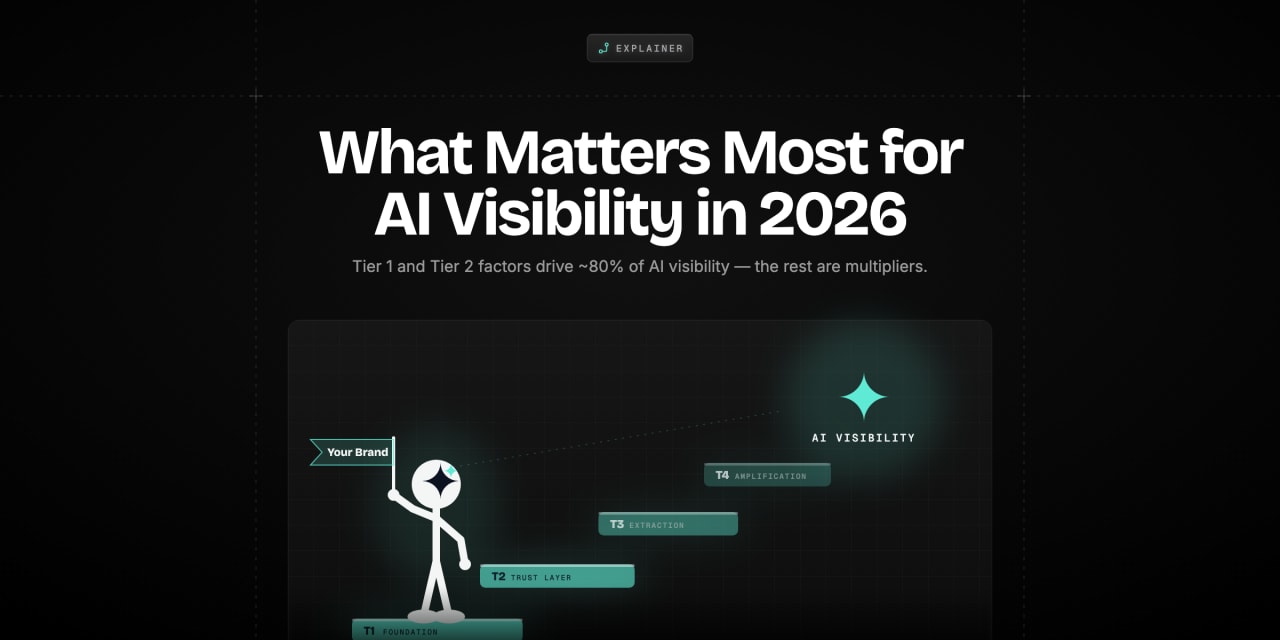
What affects AI search ranking is a tiered question: Tier 1 determines retrieval eligibility, Tier 2 determines trust selection, Tier 3 determines extraction success, Tier 4 amplifies all three
-
What affects AI search ranking differs by platform: Google AI Overviews weight organic ranking heavily. Perplexity weights community signals and crawlability independently
-
What affects AI search ranking is not the same as what affects Google ranking. The two overlap by approximately 60% but diverge sharply on off-site trust signals and entity recognition
-
What affects AI search ranking most is the factor your site is weakest on. Diagnose your specific gap before investing in any improvement programme
-
What affects AI search ranking for ChatGPT specifically includes Bing indexing, entity recognition, and training data presence alongside traditional SEO signals
-
GEO ranking factors across ChatGPT, Perplexity, and Google AI Overviews share a common foundation but diverge at the off-site trust layer: Perplexity weights community signals; AIO weights Google ranking
-
AI SEO checklist 2026: implement Tier 1 and Tier 2 before investing in Tier 3 or Tier 4. Most sites are missing one or two Tier 1 factors. Fix those first
-
How to improve AI visibility: the 80/20 principle applies. Tier 1 plus Tier 2 account for approximately 80% of AI visibility outcomes. Tier 3 and 4 are multipliers, not foundations
-
Domain authority correlation with AI citation has dropped significantly. Entity recognition, topical depth, and off-site corroboration are now stronger predictors of AI citation than domain authority alone
-
The single most underinvested factor in most SEO programmes is topical authority. Most sites have isolated content pieces where they need content clusters
The internet is full of AI SEO checklists. Most of them list 15 to 25 factors with no indication of priority, leaving practitioners overwhelmed and unsure where to start. According to Princeton and Georgia Tech's generative engine optimisation research that coined the GEO discipline, AI citation probability responds to a specific set of interventions with measurably different magnitudes of impact. Some interventions improve AI visibility by 30 to 40 percent. Others produce minimal measurable effect. The factors are not equal, and treating them as equal produces unfocused strategy.
The frustration behind this question is familiar. You have read three different AI SEO guides and received three different lists of the most important AI search visibility factors, each presented as equally critical. You have limited time and budget. You need to know which five things to do first, not which twenty things to eventually do. The practitioner community has been converging on a consensus through trial and observation, and this guide captures that consensus in a prioritised framework.
This breakdown organises the AI search visibility factors into four tiers based on their actual impact and their dependency relationship with each other. Tier 1 factors must exist before Tier 2 factors produce any benefit. Tier 2 factors must exist before Tier 3 factors compound effectively. Understanding the dependency structure is what transforms a list of factors into a strategy.
Why Do Most AI SEO Factor Lists Fail Practitioners?
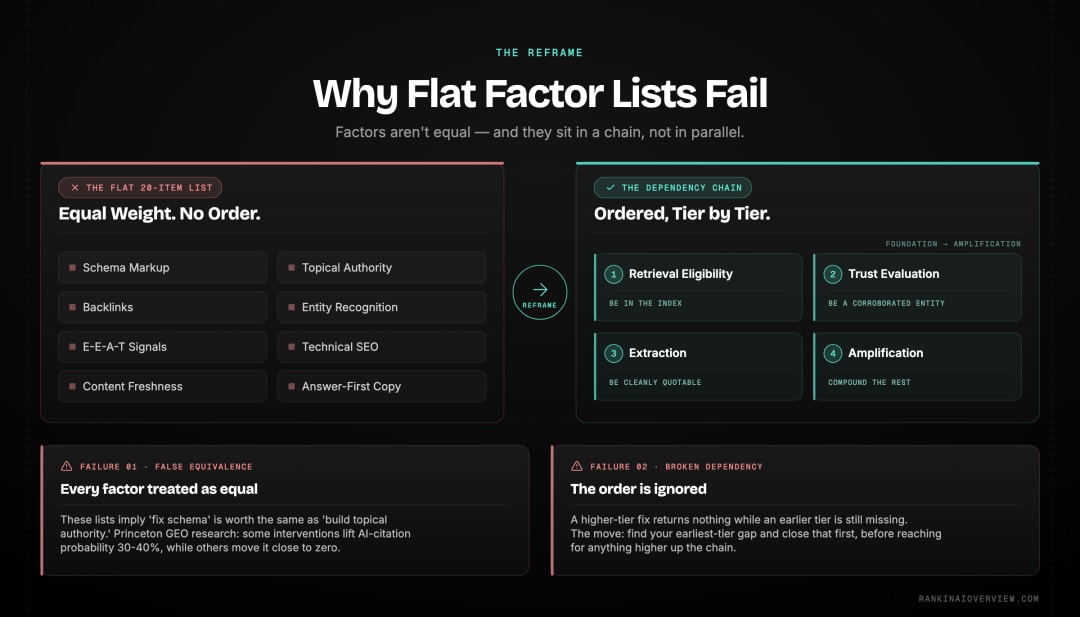
Most AI SEO factor lists fail for two reasons. First, they treat all factors as equally important, which is demonstrably false. Second, they ignore the dependency structure between factors: some factors are prerequisites for others, meaning that investing in a Tier 3 factor before completing Tier 1 produces no measurable benefit. A prioritised, dependency-aware framework is what practitioners actually need.
The equivalence problem is the primary failure. When a list presents "schema markup" and "topical authority" as items three and seven in an undifferentiated list, it implies that fixing schema is roughly as valuable as building topical authority. This is not accurate. Topical authority is a prerequisite for everything else. Schema markup is an amplifier that produces no benefit if the topical foundation does not exist. A practitioner who implements schema before building topical authority has invested effort in the wrong tier.
The dependency problem compounds this. GEO ranking factors do not operate in parallel. They operate in a dependency chain: retrieval eligibility enables trust evaluation, trust evaluation enables extraction, and extraction enables amplification. Each GEO ranking factor sits in a tier that depends on the tier below it being established first. The framework below makes this dependency structure explicit.
Tier 1: What Are the Non-Negotiable Foundation Factors?

Tier 1 factors are the prerequisites for AI citation. Without them, no other investment in AI search visibility produces reliable returns. Most sites that are invisible in AI search are missing one or two Tier 1 factors, not all of them. Identify which Tier 1 factor your site is weakest on and fix it before investing in any other tier.
Topical Authority
Topical authority is the most important single AI search visibility factor in 2026. AI systems default to recognised topic experts when constructing answers. A site that has published ten interconnected articles covering every dimension of a specific topic is treated differently from a site that has one excellent article on the same topic. The ten-article cluster signals that the site is the reference point for that topic area. The single article signals that the site has touched the topic once.
The action: before optimising anything else, ensure your site has a complete topical cluster around your primary category. A topical cluster consists of a hub article covering the topic comprehensively and eight to fifteen supporting articles covering specific sub-topics and related questions. Each article should link to others in the cluster. Google's Search documentation confirms that topical depth is central to how its AI systems evaluate content authority. The same principle applies across all AI search platforms because topical authority is the signal that reduces citation risk most effectively.
Google Top-20 Ranking
For Google AI Overviews specifically, ranking in the top 20 results for the target query is a prerequisite for citation. Approximately 97% of AI Overview citations come from pages in this pool. Google's AI Overviews documentation confirms that AI-generated answers pull from the same index that powers traditional organic search. Traditional SEO investment, specifically technical health, backlink authority, and keyword relevance, is the foundation that determines AIO retrieval eligibility. For ChatGPT and Perplexity, Google ranking matters less, but Bing indexing is a parallel prerequisite for ChatGPT Search.
The action: treat traditional SEO as the retrieval eligibility baseline, not as a separate programme from AI visibility. The same investments that improve Google ranking improve AI Overview citation eligibility. Teams that separate "SEO" from "AI SEO" as two distinct budgets are inefficiently managing what is fundamentally one shared signal infrastructure.
Clean Technical SEO
An uncrawlable page cannot be retrieved by any system. Technical SEO remains a non-negotiable Tier 1 factor because it is the access layer for all other signals. A page with broken schema, blocked crawlers, or Core Web Vitals failures below threshold cannot be evaluated for topical authority, entity recognition, or content quality. It is simply absent from the evaluation pool.
The action: use Google Search Console to identify coverage errors, crawl issues, and Core Web Vitals problems. Resolve these before any other AI visibility investment. For ChatGPT Search eligibility, separately verify Bing indexing through Bing Webmaster Tools. AI-specific crawl access, ensuring GPTBot and PerplexityBot are not blocked in your robots.txt, is a technical check that belongs in Tier 1.
Tier 2: What Are the High-Impact Trust Layer Factors?
Tier 2 factors determine whether your content is selected for citation from the retrieval pool that Tier 1 has placed you in. A page in the top 20 on Google can still fail to be cited if it lacks entity recognition, off-site corroboration, or E-E-A-T signals. Tier 2 is where the trust selection process operates, and it is where most established brands with strong Google rankings are failing in AI search.
Entity Recognition
AI engines evaluate whether your brand is a verifiable, unambiguous entity before citing it. Entity recognition requires a Google Knowledge Panel, a Wikidata entry, and consistent brand information across all external platforms. A brand that AI engines cannot uniquely identify is avoided to prevent inaccurate citations.
The action: implement Organisation schema on your homepage. Claim your Google Knowledge Panel. Create or verify a Wikidata entry with complete, accurate information. Standardise your brand name, description, and category across LinkedIn, Crunchbase, G2, Capterra, and every industry directory where your brand appears. This standardisation is how to improve AI visibility for established brands faster than any other single action.
Off-Site Corroboration
Off-site corroboration is the most underinvested AI search visibility factor for brands with established Google rankings. AI engines verify brand credibility by checking whether independent sources confirm your category positioning. Reddit, G2, Quora, industry publications, and analyst reports all constitute corroboration. The absence of any of these signals leaves AI engines with only your own content as evidence, which they treat as unverified.
The action: identify the three platforms where your category buyers most frequently discuss your topic area. For B2B, this is typically a relevant subreddit, G2, and an industry-specific forum or publication. For consumer brands, this is typically Reddit, Quora, and review platforms. Commit to genuine expert contributions across these platforms for twelve weeks and measure the change in Perplexity citation frequency. This is how to improve AI visibility specifically for the Perplexity and ChatGPT channels.
E-E-A-T Signals
Google's Search Quality Rater Guidelines define Experience, Expertise, Authoritativeness, and Trustworthiness as the primary quality framework. AI engines apply the same evaluation when deciding what is safe to cite. A named author with verifiable credentials, demonstrable first-hand experience with the topic, and inline citations to primary sources produces E-E-A-T signals that AI engines extract and use as citation confidence indicators. Anonymous content from 'the editorial team' fails this evaluation at the Experience and Expertise dimensions.
The action: add a named author bio with specific credentials to every long-form article. Include one or two sentences demonstrating direct experience with the subject. Add inline citations to primary sources for every significant factual claim. These changes typically require thirty to sixty minutes per page and produce measurable improvements in AI citation frequency within four to six weeks.
Tier 3: What Are the Important Extraction Layer Factors?
Tier 3 factors determine whether AI engines can efficiently extract a citable answer from content that has already passed the Tier 1 retrieval eligibility check and the Tier 2 trust selection check. Even trusted content from topically authoritative sources gets skipped if the answer is buried in long paragraphs with no direct-answer structure. The extraction layer is where content formatting decisions become citation decisions.
Content Directness and Answer-First Structure
AI engines extract answers at the passage level. The model scans a page for self-contained answer passages that make sense without surrounding context. A page that opens with two paragraphs of context-setting before delivering the answer is harder to extract than a page that answers the query in the first 60 words. This is the most commonly cited AI visibility fix by experienced practitioners, and the one with the fastest measurable improvement timeline.
The action: rewrite the opening of each H2 section to lead with a direct, self-contained answer of 40 to 60 words. The answer should be complete without requiring a reader to read the section that follows. Test by covering everything below the opening and asking: does this opening answer the query fully? If not, it needs rewriting. This single change addresses the most common extraction failure mode across all AI platforms.
Schema Markup
Schema markup makes page structure and content type explicit to AI retrieval systems. FAQPage schema labels question-and-answer pairs as directly extractable units. Article schema with author and organisation identifiers connects the content to its entity signals. BreadcrumbList schema shows topical hierarchy. Without schema, AI systems must infer these properties from unstructured text, which is less reliable and produces lower citation confidence. Validate every implementation with Google's Rich Results Test before publishing.
Content Freshness
AI engines, particularly Google AI Overviews, weight recently updated content more heavily for queries where recency matters. A guide that was last updated eighteen months ago and contains statistics from two years prior fails the freshness signal for queries about current-year topics. Quarterly content reviews that update statistics, examples, and dates produce meaningful freshness signals without requiring complete rewrites.
The action: identify your ten most AI-visible target queries. For each one, check when the relevant page was last updated and whether any statistics it contains are over twelve months old. Update outdated statistics with current data from authoritative sources. Update the article date and meta description to reflect the refresh. This maintenance task takes thirty to sixty minutes per page and prevents freshness-based citation decay.
Tier 4: What Are the Good-to-Have Amplification Factors?
Tier 4 factors amplify the citation frequency of content that has already satisfied Tier 1, 2, and 3 requirements. They do not substitute for lower-tier factors. A brand with weak topical authority and no entity recognition will not see meaningful AI visibility improvement from YouTube presence or traditional backlinks alone. But a brand that has completed Tier 1 through 3 will see its citation frequency increase with Tier 4 investment.
Multi-Platform Brand Presence
YouTube content is cited by ChatGPT and Perplexity with increasing frequency as both platforms improve their video transcript retrieval. LinkedIn articles from subject-matter experts produce citation signals in professional and B2B query categories. Podcast appearances and transcript-indexed audio content add entity presence in additional formats. Each additional platform where your brand produces expert content adds a citation pathway that AI engines can draw from independently of your website ranking.
Traditional Backlinks
Backlinks remain relevant as a signal in 2026 but their role has shifted. Domain authority correlation with AI citation has dropped significantly as AI engines have developed entity recognition and off-site corroboration evaluation systems that weight trust signals differently from link equity. However, backlinks from genuinely authoritative, editorially relevant sources still produce trust signals that serve both traditional ranking and AI citation. The distinction is quality and relevance rather than volume.
“ Topical authority is number one. If you own a topic cluster, AI defaults to you. Traditional backlinks still matter as a trust proxy, but they are not sufficient on their own anymore. SEO community practitioner r/SEO community discussion, Reddit 2026 Source: Reddit: What Matters More for AI Search Visibility?
What Is the 80/20 Rule for AI Search Visibility?

The 80/20 principle applies directly to AI search visibility investment. Approximately 80% of AI visibility improvement comes from Tier 1 and Tier 2 factors. Tier 3 and Tier 4 are multipliers that compound the gains from the foundation. Most sites that are investing in AI SEO have not yet completed their Tier 1 and Tier 2 work. The correct diagnosis before any AI SEO investment is to identify which Tier 1 and Tier 2 factors are missing and fix those first.
The practical implication: if you have limited time or budget for AI visibility work this quarter, spend it on topical authority and entity recognition before spending anything on schema markup or content freshness. A site with a complete topical cluster, a verified entity, and strong off-site corroboration will achieve higher AI citation frequency than a site with perfect schema markup and no topical depth.
The self-diagnostic question: which Tier 1 or Tier 2 factor is your site weakest on? If your topical cluster has fewer than eight articles on your primary topic, that is your Tier 1 gap. This is how to improve AI visibility in practice: you identify your earliest-tier gap and fix it before investing in any higher tier. If your brand has no Wikidata entry, fix entity recognition before improving schema. If you have no off-site presence, build it before optimising content structure.
What Is the Complete AI SEO Checklist 2026?
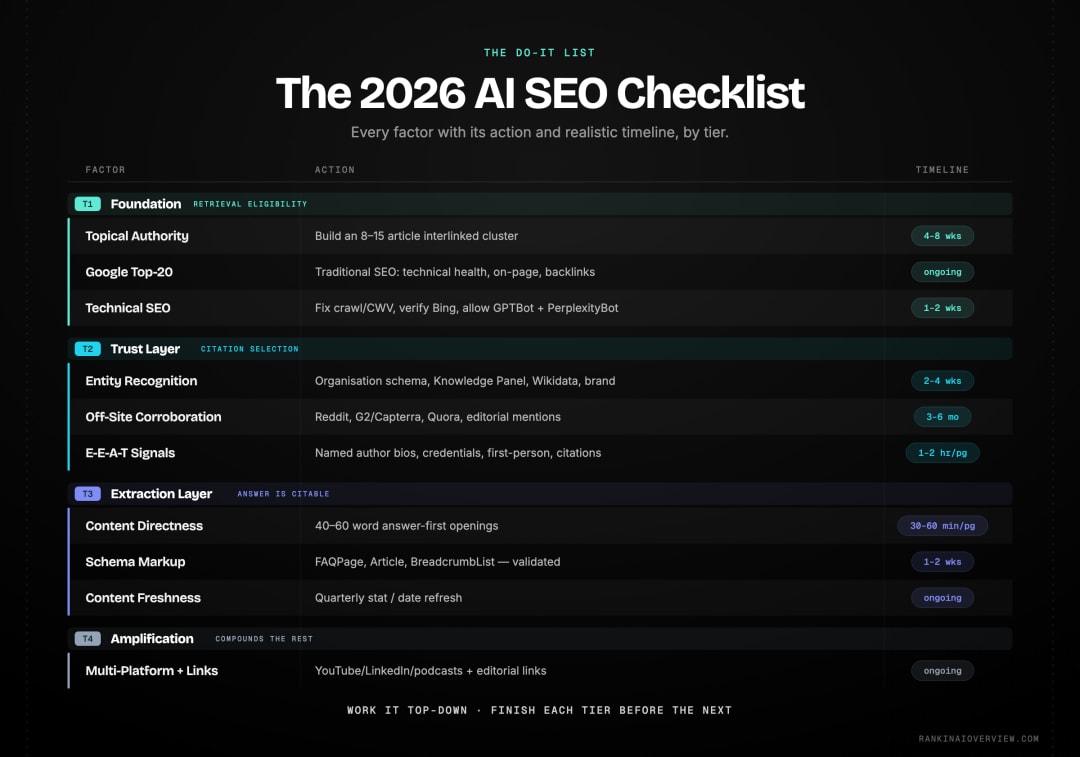
The AI SEO checklist 2026 below organises all factors by tier and gives you the specific action for each one. The checklist is designed to be worked through sequentially from top to bottom. Completing Tier 1 before starting Tier 2 is more effective than working through all four tiers simultaneously.
| Tier | Factor | Action | Timeline |
|---|---|---|---|
| 1. Foundation | Topical Authority | Build 8-15 article cluster around your primary topic. Hub article plus supporting pieces, all interlinked | 4 to 8 weeks to build |
| 1. Foundation | Google Top-20 Ranking | Apply traditional SEO: technical health, on-page optimisation, backlink acquisition for primary queries | Ongoing programme |
| 1. Foundation | Technical SEO | Fix crawl errors, Core Web Vitals, verify Bing Webmaster Tools, allow GPTBot and PerplexityBot | 1 to 2 weeks |
| 2. Trust | Entity Recognition | Implement Organisation schema, claim Knowledge Panel, create Wikidata entry, standardise brand everywhere | 2 to 4 weeks |
| 2. Trust | Off-Site Corroboration | Build Reddit presence, claim and populate G2/Capterra, contribute to Quora, seek editorial mentions | 3 to 6 months |
| 2. Trust | E-E-A-T Signals | Add named author bios, credentials, first-person experience language, and primary source citations | 1 to 2 hours per page |
| 3. Extraction | Content Directness | Rewrite opening of each H2 to lead with 40-60 word direct answer. Remove context-setting preamble | 30-60 mins per page |
| 3. Extraction | Schema Markup | Implement FAQPage, Article, and BreadcrumbList schema on all long-form content. Validate with Rich Results Test | 1 to 2 weeks |
| 3. Extraction | Content Freshness | Quarterly review: update statistics, examples, and dates. Update article date after each refresh | Ongoing quarterly |
| 4. Amplification | Multi-Platform Presence | Add YouTube content, LinkedIn expert articles, podcast appearances in your category | Ongoing programme |
| 4. Amplification | Quality Backlinks | Earn editorially relevant links from authoritative industry sources through content and PR | Ongoing programme |
Conclusion
Before trusting any factor list, it pays to separate AI-search fact from fiction.
These priorities line up with the official signals — Google itself revealed how it picks sources for AI Overviews.
Stop trying to do everything at once. Identify which Tier 1 and Tier 2 factors your site is missing and fix those before investing in Tier 3 or Tier 4. Topical authority and Google top-20 ranking are the foundation. Entity recognition and off-site corroboration are the trust layer. Content directness and schema are the extraction layer. Multi-platform presence and backlinks are amplifiers.
The AI SEO checklist 2026 is not a list of parallel priorities. It is a dependency chain. The GEO ranking factors that matter most are the ones in the lowest tier you have not yet completed. Investing in the right tier first is what separates practitioners who see measurable AI visibility improvement from those who invest without results. RANK IN AI OVERVIEW covers how AI engines evaluate and cite content across all major platforms in depth across its content library.
Frequently asked questions
Is topical authority more important than backlinks for AI search?+
Yes, for AI citation specifically. Topical authority is a Tier 1 prerequisite: without it, backlinks produce minimal AI citation benefit regardless of their quality. Backlinks remain important for Google ranking, which is itself a Tier 1 factor for AI Overview eligibility. The relationship is sequential: backlinks support Google ranking, Google ranking enables AIO retrieval eligibility, and topical authority determines whether you are selected from that pool. Topical authority is the final selection criterion that backlinks alone cannot substitute for.
How many pieces of content do I need to establish topical authority?+
A minimum of eight to ten interlinked articles on a specific topic is the practical threshold for topical authority signals that AI engines respond to. This means a hub article covering the topic comprehensively and seven to nine supporting articles covering specific sub-questions, use cases, and related concepts. All articles should link to each other through relevant anchor text. Sites with fewer than eight interconnected pieces on a topic are treated as having touched the topic rather than owning it. The GEO ranking factors research consistently identifies topical cluster depth as the highest-correlation signal with sustained AI citation frequency.
What is the single biggest lever for AI search visibility?+
Topical authority is the single highest-impact AI SEO checklist 2026 action for most sites. The vast majority of sites pursuing AI visibility have isolated content pieces rather than complete content clusters. Building the cluster, by publishing the eight to fifteen interlinked articles that establish genuine topic ownership, produces a step-change in AI citation frequency that no other single action matches. If you can only do one thing for AI visibility this quarter, build the content cluster for your most important category.
Explore with AI
Share this