Why Your #1 Google Ranking Gets Ignored by AI Search (And How to Fix It)
Ranking #1 on Google does not mean you will appear in ChatGPT or AI Overviews. Here is exactly why your Google rank gets ignored by AI and the 6 fixes that bridge the gap.

SummaryRanking #1 on Google no longer guarantees visibility in ChatGPT, Perplexity, or other AI search engines. AI platforms rely less on rankings and more on trust signals like entity recognition, third-party mentions, structured content, and author credibility. Brands missing from AI answers usually lack strong off-site presence, extractable content structure, or clear E-E-A-T signals.
Read moreShow less
You have done the work. You rank number one on Google for your target keywords. But when someone asks ChatGPT or Perplexity the same question, your brand is nowhere to be found. According to Google's own Search documentation, AI-generated answers pull from a retrieval layer built on top of the same index that powers traditional search. Yet independent research consistently shows that most AI citations come from sources that are nowhere near Google's top 10. The rank 1 Google not in AI answers problem is real, it is growing, and it is not a glitch.
The frustration is significant. You have invested years building authority on Google. You have the rankings, the traffic, and the backlinks. And then a competitor you outrank organically appears in every ChatGPT answer while your page is invisible. Wondering why not showing up in ChatGPT despite a number one Google ranking is the most common question we see in practitioner communities right now. Google SEO vs AI visibility is a very real gap costing brands pipeline.
This guide explains exactly why it happens, which signals you are missing, and what to do about it. We will give you a four-week action plan to fix AI search invisibility, show you how to measure progress, and explain the important distinction between Google AI Overviews and independent AI engines that most guides get wrong.
Why Do Google Rankings and AI Visibility Work So Differently?

Google SEO vs AI visibility: the two systems evaluate authority using almost completely different signals. Google rewards backlinks, keyword relevance, and technical quality. AI engines reward trust, entity clarity, and off-site corroboration. Understanding Google SEO vs AI visibility as two separate disciplines is the first step to closing the citation gap.
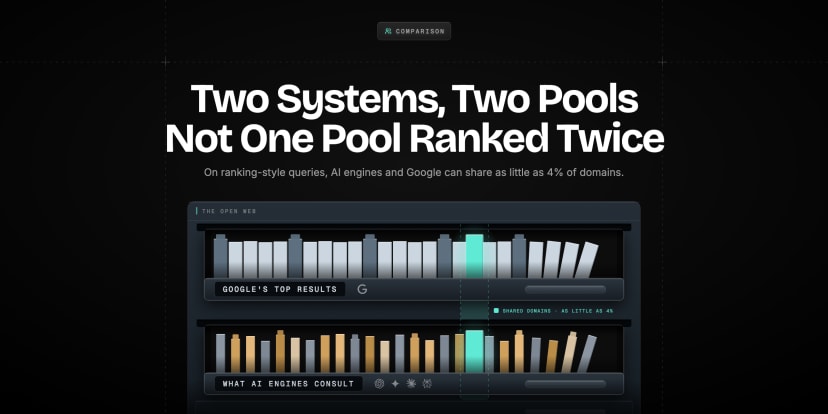
The data on this is striking. Research across ChatGPT, Perplexity, Gemini, and Copilot consistently shows that only around 12% of links cited by these platforms also rank in Google's top 10 for the same query. That means 88% of the sources AI engines cite are pages that Google either does not rate highly or does not know about.
This is not the case for Google's own AI Overviews. Around 76% of Google AI Overview citations do rank in Google's top 10. The two systems behave very differently. Google AI Mode and AI Overviews are deeply tied to Google's organic ranking algorithm. ChatGPT and Perplexity are not. Understanding this distinction prevents you from applying the same fix to a problem that has different causes depending on which AI platform is ignoring you.
A documented case illustrates this clearly. A solar energy company held the number one ranking on Google for its primary category keyword for over two years. When users asked ChatGPT to recommend solar panel providers in that market, the model listed three competitors and one international brand. The market leader was absent. The differentiating factor was not SEO performance. It was PR coverage, Reddit discussions, review volume, and structured citations. AI knew the competitors existed in context. It did not have sufficient trust signal to include the market leader.
This is what Google rank ignored by AI actually means. It is not that AI engines dislike your content. They simply have not encountered enough third-party evidence to trust your brand. Google rank ignored by AI is an entity trust problem, not an SEO problem.
“
Brands cannot win on rankings alone anymore; they win on trust. Modern discovery happens where people talk, not where algorithms dictate, and that means investing in authentic community presence and social visibility is as critical to search as backlinks once were.
Nick Liddell
Co-founder and Search Everywhere Director, Deviation
Source: Search Engine Land, November 2025
Why Does AI Ignore Well-Ranked Pages? The 6 Most Common Reasons

AI engines skip pages for specific, identifiable reasons. None of them are random. Each one represents a fixable gap between what your content currently signals and what AI engines need to see before they will cite it. Work through each reason against your own highest-priority pages and you will know exactly where to focus your effort.
Reason 1: Your Content Is Too Promotional
AI engines are risk-averse. They do not cite sales pages or promotional content. Why not showing up in ChatGPT is often traced back to this single issue: your highest-ranking page is optimised for conversion, not for answering questions. A page that leads with pricing, testimonials, and calls to action signals commercial intent rather than authoritative information.
AI systems evaluate tone as a trust signal. Google's Search Quality Rater Guidelines explicitly identify pages with an obvious commercial agenda alongside thin content as low-quality. The same framework AI engines apply when deciding what is safe to cite. If your highest-ranking page reads like a brochure, rewrite it to be objective, educational, and genuinely helpful before worrying about anything else.
Reason 2: You Are Not Recognised as a Trusted Entity
AI engines do not only evaluate what is on your website. They evaluate whether your brand exists as a recognisable, verified entity in their knowledge structure. If your brand is not mentioned in Wikipedia, does not have a Google Knowledge Panel, and does not appear consistently across authoritative third-party sources, AI systems lack the corroboration they need to cite you with confidence.
Research from SE Ranking in November 2025 found that domains with profiles on Trustpilot, G2, Capterra, and Yelp have three times the citation probability in ChatGPT compared to domains without such presence. Google's structured data documentation confirms that entity understanding is central to how its AI systems evaluate content credibility. Build your entity presence before you expect AI citation to follow.
Reason 3: Your Off-Site Signals Are Weak
The most common reason for Google rank ignored by AI is simple: the brand does not exist in the places AI engines look for corroboration. Reddit discussions, Quora answers, G2 reviews, industry newsletter mentions, and Wikipedia citations are the off-site signal layer that AI engines use to verify that a brand is genuinely known in its category.
This is why brands with strong PR coverage get cited more often than brands with stronger domain authority but weaker external presence. AI engines are not running a PageRank calculation. They are pattern-matching brand presence across contexts they already trust. If your brand is not in those contexts, it does not exist from the AI's perspective, regardless of your Google ranking.
Reason 4: Your Content Structure Makes Extraction Hard
AI engines extract answers at the passage level. Why not showing up in ChatGPT is frequently a structural issue, not an authority issue. A page with dense paragraphs and no direct answer in the first 100 to 150 words is skipped. Even highly authoritative content gets ignored when the AI cannot identify a self-contained, citable passage at the top of the page.
The fix is structural, not substantive. Princeton and Georgia Tech's GEO research found that adding specific statistics, quotations, and clear structure improved AI citation probability by 30 to 40 percent. Every H2 section should open with a direct answer in one to two sentences. That passage is what AI engines extract. If it is not there, the page is skipped regardless of how good the content below it is.
Reason 5: Missing or Broken Structured Data
Structured data tells AI engines exactly what your page is about, who wrote it, and how the content is organised. Without schema markup, AI systems must infer this information from unstructured text, which is less reliable and less trusted. Schema.org's FAQPage specification and the Article schema are the two most impactful types for AI citation. Implement them on every long-form page and validate them using Google's Rich Results Test. Broken or missing schema is a fixable technical issue that produces measurable citation improvement within weeks of resolution.
Reason 6: Your Author Authority Is Unclear
AI engines heavily weight E-E-A-T signals when deciding what is safe to cite. A page without a named author, credentials, or any evidence of direct experience with the topic fails the experience component of the Search Quality Rater Guidelines. This is not a minor issue. It is one of the fastest ways to fix AI search invisibility for pages that are otherwise well-structured. Add a named author bio with verifiable credentials to every article. Link the author bio to a full About page. Include specific language indicating direct experience: "tested 40 tools in 2025" is more powerful than "written by our editorial team."
What Is the 4-Week Action Plan to Fix This?

The four-week framework addresses each of the six reasons systematically. It prioritises the changes with the fastest measurable impact first. Week one produces the most immediate results because content structure and answer-first writing affect all three major AI platforms simultaneously.
Week
Focus
Key Actions
Expected Impact
Week 1
Content audit and rewrite for extractability
Identify top 10 pages by query potential. Rewrite opening 150 words of each to lead with a direct answer. Remove or rewrite promotional sections. Add FAQ blocks to each page.
Perplexity citations often improve within 2 to 4 weeks as it crawls frequently
Week 2
Schema markup implementation
Implement FAQPage and Article schema on all priority pages. Validate with Google Rich Results Test. Add a BreadcrumbList schema to show topical hierarchy.
Google AI Overview citations begin improving within 4 to 6 weeks
Week 3
Off-site presence audit and gap filling
Audit Reddit, Quora, G2, Capterra, Trustpilot for brand mentions. Fill gaps with genuine contributions and review acquisition. Identify community threads where competitors appear but you do not.
ChatGPT citation probability increases over 6 to 12 weeks as off-site signals compound
Week 4
Entity building and author authority
Create or update Wikipedia entry where eligible. Claim and complete Google Knowledge Panel. Add verified author bios with credentials to all articles. Implement Person and Organisation schema.
Sustains long-term AI visibility across all platforms
The sequencing matters. Fix content structure first because it serves all three major AI platforms simultaneously. Rank 1 Google results not in AI answers are almost always a content structure problem as much as an entity problem. Schema, second, because it directly improves Google AI Overview performance. Off-site, third, because it compounds slowly. Entity building lasts because it depends on the content improvements already in place. Track rank 1 Google not in AI answers' progress through weekly citation frequency monitoring rather than individual prompt checks.
How Do You Track Whether the Fix Is Working?
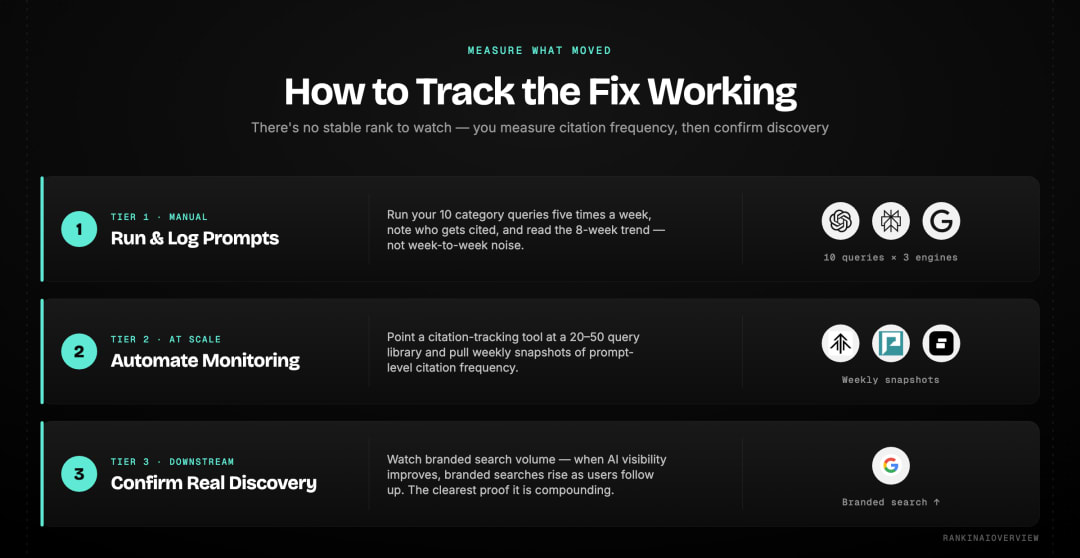
Tracking AI visibility requires a different approach from traditional rank tracking. There is no stable position to monitor. Instead, you measure citation frequency across repeated prompt runs, track share of voice against competitors, and watch branded search volume as a downstream indicator that AI mentions are translating into real discovery behaviour.
Start with manual testing. For your ten most important category queries, run each one in ChatGPT, Perplexity, and Google AI Overviews at least five times per week. Note which AI platform cites you, how often, and how your brand is described. If you are asking why not showing up in ChatGPT after implementing changes, the answer is usually that off-site signals need more time to accumulate. Log weekly results in a spreadsheet and look for trend movement over eight weeks rather than week-to-week variation.
For structured citation tracking at scale, tools like Rankscale, Profound, and Peec AI automate prompt-level citation monitoring across ChatGPT, Perplexity, and Google AI Overviews. Set up a prompt library of 20 to 50 category-level queries and run weekly snapshots to track citation frequency trends.
Watch branded search volume in Google Search Console as a downstream signal. When AI visibility despite Google ranking improves, branded searches typically increase as users who encountered your brand in an AI answer follow up with a direct Google search. Rising branded search confirms that AI mentions are translating into real discovery. That correlation is the most actionable evidence that the fix is compounding.
Conclusion
Being ignored by AI despite ranking number one is not a failure of your SEO. It is a signal that your strategy needs a second layer. Google ranked you for relevance. AI needs to trust you. The fix is concrete: structure content for extraction, implement schema, build off-site entity presence, and add verifiable author authority. Those four actions address every reason why not showing up in ChatGPT is happening, every case of Google rank ignored by AI, and every gap in AI visibility despite Google ranking. Run them in sequence, measure citation frequency weekly, and the gap between your Google rank and AI search visibility closes predictably. For more research on what drives AI citation and how brands build trust in generative search, RANK IN AI OVERVIEW covers this space in depth.
Frequently asked questions
What is the single biggest reason Google-ranked pages get ignored by AI?+
Weak off-site entity signals. Most pages that rank well on Google but are ignored by AI have the same gap: they are not mentioned in the communities, review platforms, and third-party sources that AI engines use to verify authority. A brand that does not exist on Reddit, G2, Quora, or Wikipedia in a recognisable form has no third-party corroboration. Without corroboration, AI engines cannot confidently cite the brand, regardless of how well it ranks on Google.
Is it possible to be cited in AI without a Google top-ten ranking?+
Yes, particularly for ChatGPT and Perplexity. Research shows that a significant majority of ChatGPT-cited pages do not rank in Google's top ten. Both platforms evaluate content structure, entity clarity, and off-site corroboration more heavily than organic ranking position. A well-structured, entity-rich page on a domain with strong community presence can be cited by ChatGPT without ever ranking on Google for the same query.
How quickly can a page go from Google number one to AI cited?+
Content structure and schema changes can produce Perplexity citation improvements within two to four weeks because Perplexity crawls frequently. Google AI Overview improvements typically take four to six weeks after schema implementation. ChatGPT citation improvements from off-site entity building take longer: three to six months of consistent community presence before meaningful signal accumulates. The full framework shows measurable results at eight to twelve weeks.
How to Get Your Website Cited in AI Answers+
To get your website cited in AI answers, address six factors in order: rewrite content to lead with direct answers and remove promotional language; build entity recognition through Wikipedia, Google Knowledge Panel, and consistent brand presence across directories; build off-site signals through Reddit, G2, Quora, and industry publications; restructure content with clear H2 and H3 hierarchy and FAQ sections; implement FAQPage and Article schema markup; and add named author bios with verifiable credentials.
Does ranking #1 guarantee AI visibility?+
No. Research consistently shows that pages ranking number one on Google appear in AI Overview top-three citations only around 50% of the time. For independent AI engines like ChatGPT and Perplexity, the correlation between Google rank and AI citation is statistically close to zero. Ranking first is a prerequisite for Google AI Overviews, which draw heavily from Google's own index. It is not a sufficient condition for ChatGPT or Perplexity citation.
Explore with AI
Share this