Will AI Search Visibility Become as Important as Google Rankings? What the Data Suggests
Is AI search visibility already as important as Google rankings for some industries? We look at the data and trends to forecast where marketing investment should go

SummaryAI search is no longer replacing Google, it's reshaping how people discover brands. While Google rankings remain essential, AI visibility increasingly determines which brands make it into buyers' consideration sets, especially for research-heavy industries. The winners in 2026 are not choosing between SEO and AI optimisation. They're building both.
Read moreShow less
Two years ago, this was a speculative question. In 2026, it is a live strategic debate with real budget implications. According to Gartner's February 2024 press release, traditional search engine volume is projected to drop 25% by 2026 due to AI chatbots and virtual agents. That projection is tracking accurately. AI Overviews appear in up to 47% of all Google queries. ChatGPT reached 400 million monthly users. And 37% of consumers now start their research in AI tools rather than Google. AI visibility vs Google rankings is no longer a future question. It is a present budget decision.
The frustration for marketing teams is real. You have a mature Google SEO programme delivering predictable traffic and clear attribution. Now you are being asked to invest in AI search visibility with different metrics, different measurement tools, and no established benchmark for what "good" looks like. The future of SEO 2026 question is not just about what to do next. It is about how to justify reallocating investment without abandoning what is already working.
This guide gives you a clear answer based on current data, not speculation. We will examine which industries have already shifted toward AI search as a primary discovery channel, which sectors still depend on Google rankings above all else, what the generational data suggests about the trajectory, and how to structure your investment across both channels without doubling your workload or abandoning your existing SEO foundation.
What Does the Current State of AI Search Adoption Actually Look Like?

AI search adoption in 2026 is past the tipping point for research-heavy queries. AI Overviews appear in up to 47% of Google searches. 37% of consumers start searches in AI tools. Zero-click rates are above 58% across all searches. The data no longer supports treating AI search as a future consideration. It is a present reality for any brand producing informational content. |
The scale of AI search is the most important context for any AI visibility vs Google rankings discussion. Google confirmed that AI Overviews reached two billion monthly users by mid-2024. Google AI Mode has grown to over 75 million daily active users and expanded across 53 languages and more than 40 markets. ChatGPT processes hundreds of millions of queries per month. These are not experimental platforms. They are mainstream discovery channels operating at scale.
The zero-click data makes the AI search importance case most clearly. Over 58% of Google searches now end without a click to any external website. For informational queries specifically, the rate is higher still. AI Overviews answer the question on the search results page itself. A brand that ranks position one but is not cited in the AI Overview for the same query is losing a significant share of the visibility that its ranking would have delivered two years ago.
The competitive landscape of AI search importance differs by content type. Commercial-intent queries, those where users are evaluating, comparing, or preparing to buy, still drive meaningful click-through because users want to visit the page before purchasing. Informational queries, definitions, how-to content, and comparative research, are increasingly resolved without a click. This distinction is the key to understanding which parts of your content portfolio are most exposed to AI displacement and which remain protected by purchase intent.
In Which Industries Has AI Visibility Already Overtaken Google Rankings?

Three sectors have already experienced the shift most sharply: B2B SaaS and technology, professional services, and financial services. In all three, buyers now use AI tools as the primary research layer before they ever visit a vendor website. Google rankings remain important as an eligibility prerequisite, but AI citation drives the brand awareness that fills the top of the funnel. |
B2B SaaS and Technology
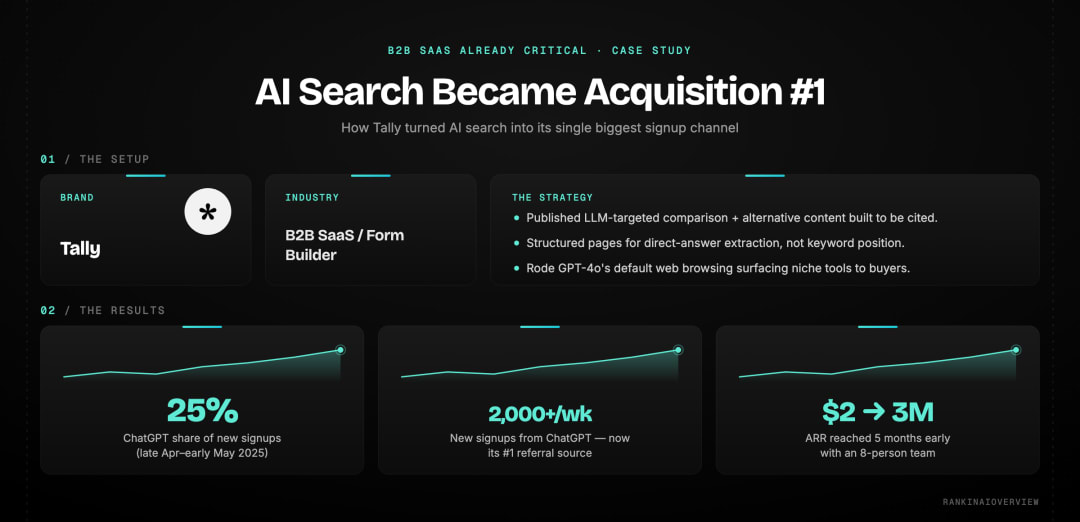
B2B technology buyers research tools differently from consumer buyers. They use AI to generate shortlists, compare capabilities, and evaluate vendor credibility before they submit a single form. In this category, AI search importance is already equal to or greater than Google rankings for top-of-funnel discovery. A B2B SaaS brand that holds strong Google rankings but is absent from ChatGPT and Perplexity answers for category queries is invisible at the moment buyers are forming their consideration sets.
The data reflects this. B2B tech is among the highest-exposure categories for Google AI Overviews, with AI answers appearing in up to 70% of informational queries in this vertical. Practitioner communities report that 40% of knowledge-worker research now begins in AI tools. For technology vendors specifically, SEO vs GEO investment is no longer a future debate. It is an immediate strategy question with measurable pipeline implications.
Professional Services
Consultants, lawyers, accountants, and agencies are being discovered via AI answers for the first time. When a potential client asks ChatGPT to recommend a specialist in their area, the models surface brands and individuals with the strongest off-site authority signals: publications, speaker credits, peer mentions, and review platform presence. Traditional Google rankings matter for this segment but they are no longer the primary discovery mechanism for many service queries.
The strategic implication for professional services is that content publishing alone is insufficient. Will Google rankings matter for professional services in 2026? Yes. But AI search importance means that practitioners who are genuinely known in their field through third-party mentions will be cited in AI answers regardless of whether their own website ranks well. Building an off-site professional presence has become a core visibility strategy, not an optional reputation exercise.
Financial Services and Complex Research
Financial products and services involve high-stakes decisions where users research extensively before acting. AI tools are increasingly the starting point for this research: what is the best savings account, which mortgage type suits my situation, what should I look for in a pension fund. The AI answer provides orientation. The user then validates on Google and visits specific provider websites. This two-step journey means AI citation drives the awareness that makes subsequent Google searches branded rather than generic.
For financial services brands, this creates a distinct SEO vs GEO investment challenge. The goal is to appear in the AI orientation layer so that when the user subsequently searches on Google, they are already looking for your brand by name. AI search importance in financial services is therefore upstream of Google ranking in the buyer journey, not a replacement for it.
“ In 2026, personalisation stops being a feature and becomes the operating system. There is no Position 1 anymore. There is only intent and relevance, and the brands that understand this will outperform those still chasing a static rank number. Mike King CEO, iPullRank Source: Search Engine Land, January 2026 |
In Which Industries Do Google Rankings Still Clearly Dominate?

Three sectors remain primarily Google-ranking-dependent in 2026: local services, e-commerce, and real-time content including news and entertainment. In all three, the purchase or discovery behaviour requires proximity, inventory, or recency signals that AI search currently handles less reliably than Google. This does not mean AI is irrelevant in these sectors, but the priority investment for now remains traditional SEO. |
Local Services
For plumbers, dentists, restaurants, and other local businesses, Google Maps and the local pack remain the primary discovery mechanism. When someone needs a service provider near them, proximity and reviews are the primary filters and Google's local products are optimised for exactly this use case. AI search local visibility is growing, as documented by SOCi research on local AI recommendation rates, but will Google rankings matter most for local businesses in 2026? Yes, substantially. AI search importance in local services is real but secondary to Google Maps and local pack presence.
E-commerce
Product search remains Google and Amazon dominated. When a user is looking for a specific product to purchase, they use Google Shopping, Amazon search, or a retailer's own search function. AI Overviews appear for e-commerce queries at a much lower rate than informational queries, around 4% compared to 39% for informational content. The future of SEO 2026 for e-commerce is about maintaining strong Google Shopping and organic listings while adding structured data to improve AI Overview eligibility for category and comparison queries.
Entertainment and Real-Time Content
News, sports, entertainment, and any content that requires recency still favours traditional Google search. AI models have training data cutoffs and real-time retrieval limitations that make Google more reliable for breaking news and current events. The AI search importance question for this sector will shift dramatically as AI platforms improve their live retrieval capabilities, but in 2026, traditional search dominates for time-sensitive content.
What Does the Generational Data Tell Us About the Trajectory?

The generational shift is the most important long-term signal in the AI visibility vs Google rankings debate. Users under 35 are adopting AI search at significantly higher rates than older cohorts. As this group becomes the dominant consumer and business buyer demographic over the next five to seven years, AI search importance will increase across most verticals regardless of current adoption patterns. |
The current data shows 37% of all consumers now starting searches in AI tools rather than Google. That figure is higher among younger users. In knowledge-intensive sectors, where under-35 workers increasingly hold purchasing authority, this shift is already changing how discovery happens. A 25-year-old marketing manager researching SEO software is more likely to open ChatGPT than Google for initial category orientation. That behaviour shapes the consideration set before any Google search occurs.
The trajectory is accelerating. ChatGPT grew from 100 million to 400 million monthly users in approximately 18 months. Google AI Mode expanded to over 75 million daily users within its first year. AI search is not a niche behaviour. It is a mainstream discovery channel that has grown faster than any major search product since the original Google launch. Will Google rankings matter in five years? Yes. Will AI search importance be equal to or greater than Google ranking importance by 2028 for research-heavy queries? The generational data strongly suggests yes.
For content teams, this trajectory creates a compounding advantage for early movers. Research published at Princeton and Georgia Tech found that optimised content improves AI visibility by 30 to 40 percent. Brands that build AI citation authority now create an asset that compounds in value as AI search adoption increases. The cost of building this authority is lower now than it will be as more competitors recognise the SEO vs GEO investment requirement and begin competing for the same citation signals.
How Should You Allocate Budget Between Google SEO and AI Visibility?

The right SEO vs GEO investment split depends on your industry vertical and buyer demographics. The framework below provides a starting point. The foundational principle applies universally: Google ranking is the prerequisite for AI Overview eligibility, so the two investments are not independent. Optimising for Google strengthens your AI visibility position simultaneously for the 80% of signals they share. |
Vertical | 2026 Recommended Split | Primary AI Risk | Priority AI Action |
|---|---|---|---|
B2B SaaS / Technology | 55% Google SEO / 45% AI GEO | Category queries bypass Google entirely via ChatGPT | Off-site entity building: G2, Reddit, analyst mentions |
Professional Services | 60% Google SEO / 40% AI GEO | Practitioner discovery via AI answers before Google search | Author authority signals, Wikipedia presence, PR coverage |
Financial Services | 65% Google SEO / 35% AI GEO | Research orientation happening in AI before branded search | FAQ schema, answer-first content, entity consistency |
Local Services | 80% Google SEO / 20% AI GEO | AI recommendation rates improving but still secondary | Google Business Profile completion, review quality |
E-commerce | 85% Google SEO / 15% AI GEO | Category comparison queries increasingly AI-mediated | Product schema, comparison content, review integration |
News / Entertainment | 90% Google SEO / 10% AI GEO | Real-time content less affected by current AI limitations | Monitor but do not prioritise until AI live retrieval matures |
The practical implementation follows a clear sequence for any vertical. Start with your existing Google SEO foundation and ensure it is technically sound. Crawlability, indexing health, and Core Web Vitals affect AI Overview eligibility as directly as they affect organic ranking. A site with technical problems is invisible in both channels simultaneously.
Layer AI-specific optimisation on top. Add FAQPage and Article schema to all long-form content. Rewrite the opening 150 words of your top pages to lead with direct answers. Build your off-site entity presence through review platforms and community participation. These actions require approximately 20 to 30 percent additional effort above a standard SEO programme and produce measurable AI citation improvements within eight to twelve weeks.
The future of SEO 2026 is not a choice between Google and AI. It is a sequenced investment that uses Google ranking as the retrieval eligibility foundation and adds the AI citation layer on top. Teams that frame it as either/or are solving the wrong problem. Teams that integrate it as a layered programme are building the right compounding asset.
Conclusion
AI search visibility is not replacing Google rankings. It is layering on top of them. The brands building both in 2026 are the ones gaining compounding early-mover advantage as AI search adoption accelerates. For B2B and professional services, SEO vs GEO investment is an immediate decision with measurable pipeline implications. For local and e-commerce, Google SEO remains primary with AI as a growing secondary channel. The window for building AI citation authority without heavy competition is still open, but it is closing. For deeper research on how AI engines evaluate brand authority and what drives citation frequency, RANK IN AI OVERVIEW covers this space across its content library.
Frequently asked questions
How much should I budget for AI search optimisation?+
For most verticals in 2026, a 15 to 25 percent budget reallocation from traditional link building toward AI-specific tactics is a reasonable starting point. The specific tactics include schema markup implementation, off-site entity building, content restructuring for answer-first extraction, and citation frequency monitoring. The cost is lower than building backlinks at scale and the compounding returns are higher for AI search importance as adoption grows. Start with your existing team and content programme before buying dedicated AI SEO tools.
Will Google rankings eventually become obsolete?+
No, for two specific reasons. First, Google rankings determine retrieval eligibility for Google AI Overviews, which is the largest AI search surface by user volume. If you stop ranking on Google, you lose eligibility for AI Overviews simultaneously. Second, purchase-intent and local queries remain primarily Google-driven. Will Google rankings matter less as a standalone metric? Yes. Will they become irrelevant? No. The future of SEO 2026 and beyond is a dual-channel discipline where Google ranking is the foundation, not the goal.
Is it too early to invest in AI search visibility?+
No. For any brand producing informational or research-oriented content, AI search visibility is already a live channel that is actively shaping buyer awareness. Early movers in AI citation are building authority that compounds over time. The cost of building that authority will increase as competition for AI citation signals intensifies. For B2B SaaS and professional services specifically, the time to start is now, not when AI search adoption is even more advanced.
Explore with AI
Share this