Google AI Mode vs Regular Search: Is AI Mode Really Better?
A clear comparison of Google AI Mode vs regular search: when AI Mode wins, when traditional search still wins, and why AI Mode benefits remain underrated.
Key Highlights
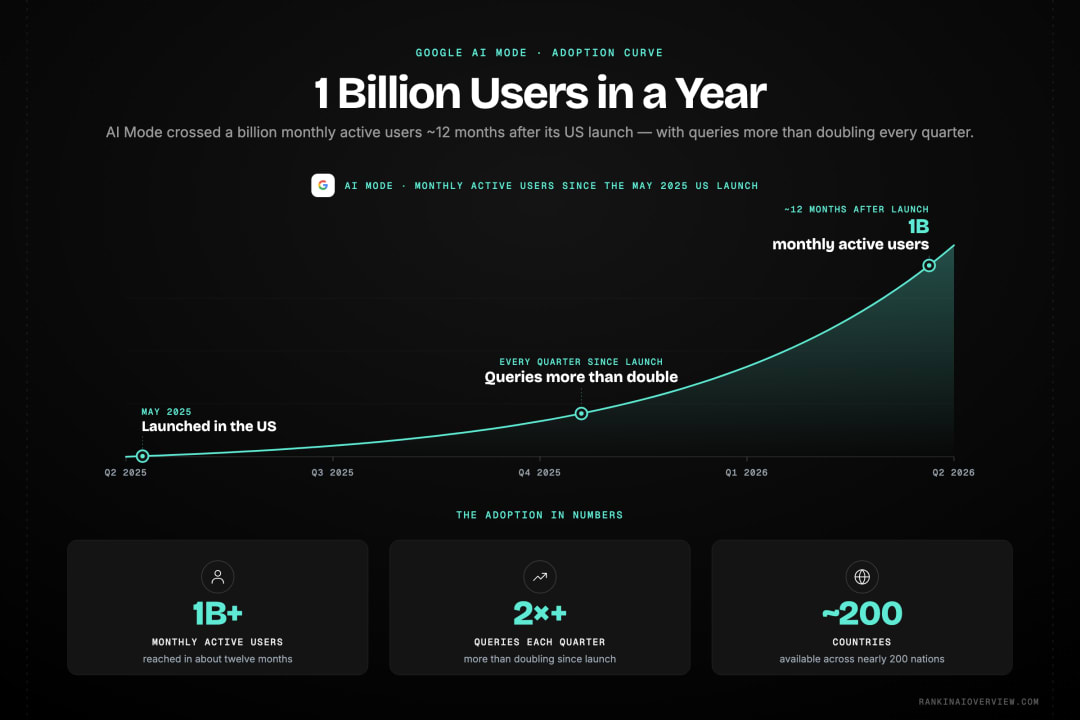
- Google AI Mode crossed 1 billion monthly users about a year after launch, with queries more than doubling every quarter since.
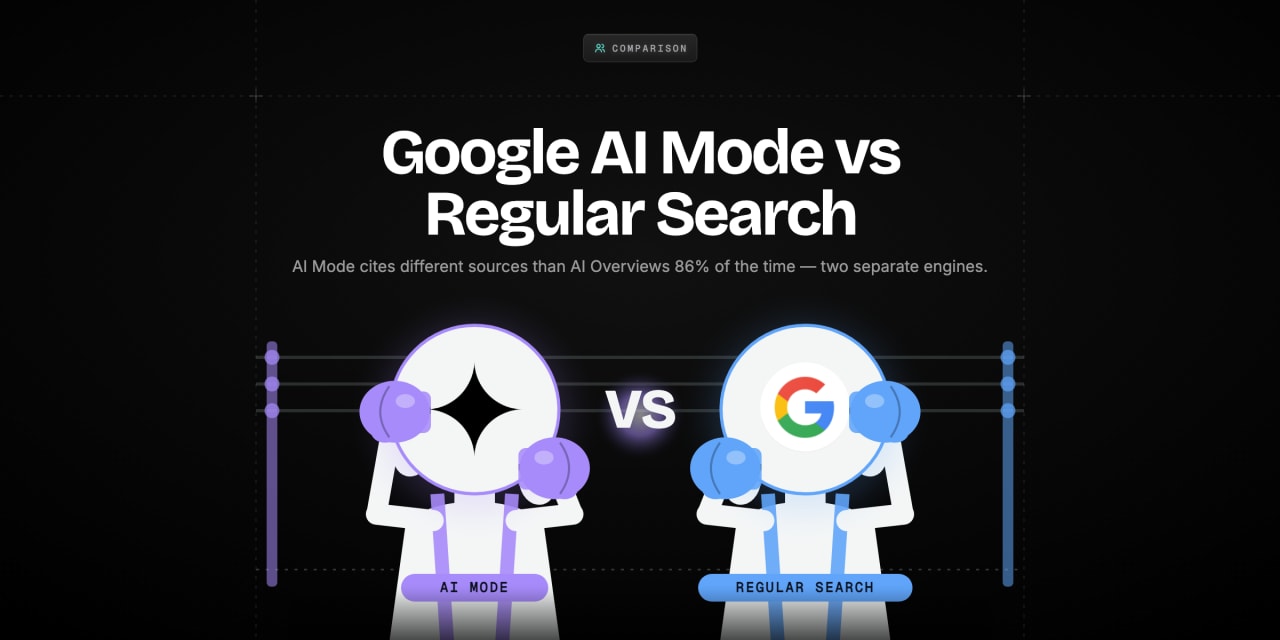
- A Google AI Mode review of citation data shows it cites different sources than AI Overviews 86% of the time, so the two surfaces behave like separate engines.
- Comparing AI search vs regular search, AI Mode responses run roughly four times longer and pull from nearly twice as many domains per query.
- Is Google AI Mode better than search depends entirely on intent: research and comparison queries favour AI Mode, transactional and local queries still favour the traditional results page.
- AI Mode is underrated largely because awareness is still catching up to capability, not because the answers are weak.
- Tracking Google AI Mode benefits separately from AI Overviews is now essential for anyone measuring AI search visibility.
A Reddit thread sparked a familiar argument recently: one user insisted that Google AI Mode gives noticeably better answers than the regular search results page, and that most people simply have not noticed yet. The replies split along predictable lines, some agreed it was a research powerhouse, others said it falls apart on simple shopping searches, and a few admitted they did not know it existed as a separate tab at all. That gap between capability and awareness is the real story here, and it is worth examining with actual data rather than vibes.
This piece breaks down what Google AI Mode actually is, when AI Mode vs regular search genuinely tilts in AI Mode's favour, where the old results page still wins, how AI Mode picks what it cites, and what any of this means if you publish content that wants to be found.
What is Google AI Mode and how is it different from standard search?
Google AI Mode is a dedicated, conversational search experience that sits inside Search as its own mode, separate from both the classic blue-links results page and the AI Overviews summary that sometimes appears above those links. Instead of returning ten ranked pages, it runs a technique Google calls query fan-out, breaking one question into several related searches behind the scenes, then synthesises everything into a single multi-part answer the user can keep questioning in follow-up turns.
It is easy to conflate AI Mode with AI Overviews because both run on Google's Gemini models and both sit inside the same product. They are not the same thing. AI Overviews are short, automatically triggered summaries that appear above standard results for a portion of queries. AI Mode is a full, user-selected conversational interface built for deeper exploration, and Google's own research shows the two surfaces frequently disagree on which sources to cite for the same question, even when they land on a near-identical answer.
That distinction matters more than it sounds. Ahrefs analysed roughly 730,000 paired responses and found AI Mode and AI Overviews cited the same URL only 13.7% of the time, even though the two answers were semantically similar 86% of the time. In plain terms: they usually agree on what to say, but they almost never agree on where they got it from. AI Mode responses also run about four times longer on average, pull from close to nine domains per query versus roughly 7.7 for AI Overviews, and lean noticeably harder on encyclopedic sources like Wikipedia, which shows up in close to 29% of AI Mode citations compared with about 18% in AI Overviews.
The adoption numbers explain why this conversation is happening now rather than a year ago. AI Mode launched in the United States in May 2025 and crossed 1 billion monthly active users roughly twelve months later, a pace that took Google Search itself years to reach. Queries inside AI Mode have more than doubled every quarter since launch, and as of the most recent figures it processes well over a billion queries a month across nearly 200 countries.
When is Google AI Mode better than regular Google Search?
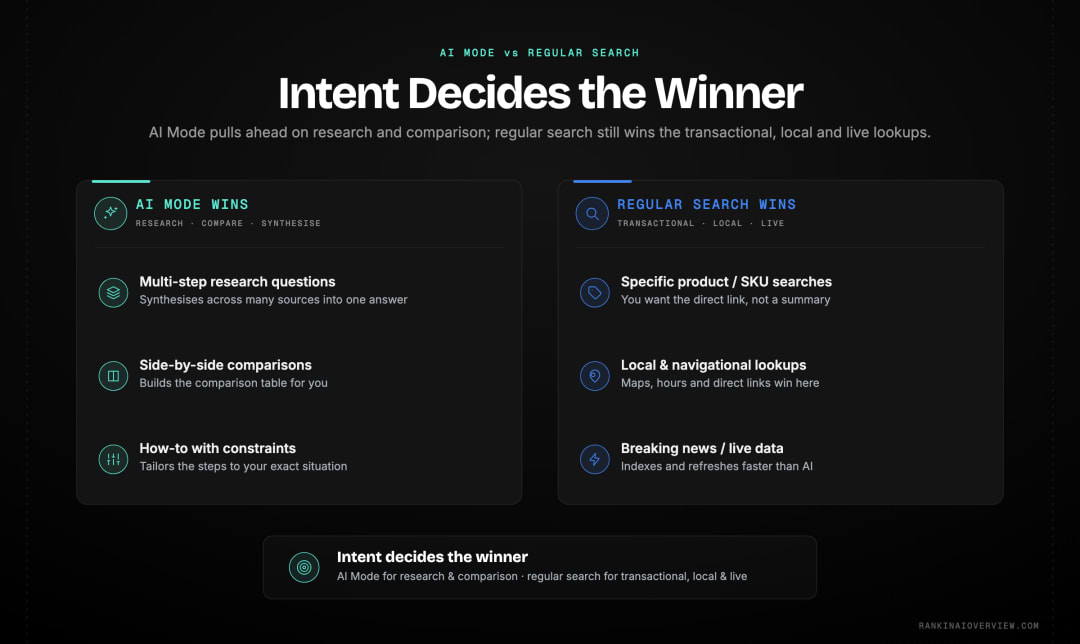
The honest answer to "is Google AI Mode better than search" is that it depends entirely on what the query is trying to accomplish. AI Mode pulls ahead decisively on a specific category of questions, and falls behind on others. The pattern is consistent enough to plan around.
Complex research queries
This is where the Google AI Mode benefits are most obvious. Ask a question that would normally require opening eight tabs, comparing notes across them, and stitching together a conclusion yourself, and AI Mode does that stitching for you. It draws on dozens of sources at once, keeps context across follow-up questions, and lets a user go several conversational turns deep without losing the thread. For someone researching a market, evaluating a medical condition, or trying to understand a policy change, that single synthesised answer with sources attached is a meaningfully faster path than scanning a results page and clicking through one link at a time.
Comparison and decision queries
Side-by-side comparisons are another category where AI Mode vs regular search clearly favours AI Mode. Ask it to compare three software tools, two neighbourhoods, or a handful of insurance plans across the same criteria, and it can assemble that comparison directly, sometimes as an interactive table built on the fly, rather than forcing the user to open multiple review sites and build the comparison themselves. Traditional search can answer these questions too, but only by handing the user the raw material and leaving the synthesis work to them.
How-to and step-by-step questions
Multi-step, conditional instructions are a strong fit as well. "How do I do X, given that I also have Y constraint" is exactly the kind of query where the regular results page returns a generic guide that ignores the constraint, while AI Mode can incorporate it directly into a tailored answer and adjust again if the user adds more context in a follow-up message.
When does regular Google Search still win?
AI Mode is not better across the board, and the agencies losing client trust right now are usually the ones pretending otherwise. Traditional search still wins clearly in a few situations.
Transactional and highly specific product queries are the clearest case. Searching for a specific SKU, a particular store's hours, or "buy [exact product name] near me" does not benefit much from synthesis. The user already knows what they want; they need a direct path to it, and a ranked list of relevant pages, maps, and shopping results does that job efficiently. Local and navigational queries behave similarly. Looking for a specific business's website or a single named location rarely needs a multi-paragraph synthesised answer.
Speed-sensitive lookups are another exception. A quick fact check, a single number, or a one-word answer is often faster to get from a result snippet than from a conversational interface that has to generate a fuller response. And queries where freshness matters down to the hour, breaking news, live scores, real-time prices, still tend to be served more reliably by the standard results page, which indexes and refreshes faster than a generated synthesis can always keep pace with.
The table below summarises the split.
| Query type | Better surface | Why |
|---|---|---|
| Multi-step research questions | AI Mode | Synthesises many sources into one coherent answer |
| Side-by-side comparisons | AI Mode | Builds the comparison directly instead of leaving it to the user |
| Specific product or SKU search | Regular search | User already knows the target; a direct link wins |
| Local business or navigational search | Regular search | Maps and direct links outperform synthesis |
| Breaking news or live data | Regular search | Indexing refreshes faster than generated answers |
How does Google AI Mode select its cited sources?
Citation selection inside AI Mode does not work the way classic Google ranking works, and it does not work identically to AI Overviews either, which is the part most people optimising for visibility get wrong. Google's own documentation describes query fan-out as the mechanism: one question becomes several parallel searches, the results get narrowed down, and only a subset earns a citation in the final synthesised answer.
Two things make AI Mode distinctive in this process. First, it is far more reliably attributive than AI Overviews. Roughly 97% of AI Mode responses include a citation, compared with about 89% of AI Overviews responses, meaning AI Overviews go uncited more than three times as often. Second, AI Mode favours depth over speed in its source preferences. Where AI Overviews lean toward video content and community platforms, AI Mode leans harder on encyclopedic, well-structured, comprehensive references, the kind of content that can support a long, multi-part answer rather than a single concise summary.
Organic ranking still plays a role, but a smaller one than most people assume. Research on AI Overview citation patterns found the cited URL matches the position-one organic result only about 43% of the time, and a meaningful share of cited pages rank well outside the top three. Ranking helps a page enter the candidate pool that AI Mode draws from, but it does not guarantee a citation once that pool gets narrowed down. Clear structure, direct early answers, and verifiable specifics matter more at that narrowing stage than raw ranking position does.
This is also where the low overlap between AI Mode and AI Overviews becomes a practical problem rather than a trivia fact. A page that earns strong citation share in AI Overviews has, per Ahrefs' data, roughly a 61% chance of also appearing in AI Mode's longer response, but that is far from guaranteed, and AI Mode introduces additional competitors into the mix that did not make the shorter AI Overviews cut. Treating the two as one surface, rather than monitoring them separately, is the single most common mistake teams make when trying to track AI search visibility across Google's ecosystem.
What does Google AI Mode mean for SEO and content visibility?
For anyone publishing content, the practical implication of this comparison is straightforward: optimising for regular Google rankings and optimising for AI Mode citations are related but distinct jobs now, and treating them as identical is exactly how a page ends up invisible in one surface while it performs fine in the other.
The content traits that earn AI Mode citations specifically are worth naming directly. Because AI Mode favours depth, long, well-structured, comprehensively sourced pages tend to outperform short, surface-level posts that might still rank fine in classic search. Because it leans on encyclopedic-style references, content that reads like a reliable, neutral, well-organised reference, with clear headings, specific numbers, and named sources, performs better than promotional copy. And because attribution is more consistent in AI Mode than in AI Overviews, getting cited once tends to compound, since AI Mode's longer responses simply have more room to include additional sources alongside the first one it trusts.
A useful starting point for anyone building this into an actual content strategy is a breakdown of the broader AI ranking factors shaping visibility in 2026, which lays out the priority order most teams should be working through before they get lost optimising for the wrong signal first. For teams specifically trying to separate Google's AI Overviews from the regular results page in their reporting, a focused comparison of AI content versus traditional SEO performance is also worth reading, since the metrics that matter for each surface genuinely diverge once you start tracking them separately rather than lumping all of "Google traffic" into one number.
It is also worth connecting this back to the underlying technical question of how content earns a citation at all, since the mechanics described in a deeper look at diagnosing AI citation gaps apply just as much to AI Mode's query fan-out process as they do to AI Overviews. The agencies and content teams treating AI Mode as a future consideration rather than a current one are, based on the adoption curve, already behind a surface that just crossed a billion monthly users in its first year.
Conclusion
Google AI Mode vs regular search is not really a competition with one winner. AI Mode genuinely outperforms the traditional results page on research-heavy, comparison-heavy, multi-step queries, and the user who started this conversation by calling it underrated has the adoption data on their side: a billion monthly users in roughly a year is not a niche feature anyone can keep ignoring much longer. Regular search still wins cleanly on transactional, local, and time-sensitive lookups, and is likely to keep doing so for a while yet. The practical takeaway, for users and for anyone publishing content, is the same either way: stop treating Google as one search engine. It is increasingly three separate surfaces with three separate sets of rules, and the people paying attention to all three are the ones who will not be caught off guard by the next shift.
Frequently asked questions
Is Google AI Mode the same as AI Overviews?+
No. AI Overviews are short automatic summaries that appear above some standard search results. AI Mode is a separate, fuller conversational experience accessed through its own tab, and the two surfaces cite different sources roughly 86% of the time even when they reach a similar conclusion.
Why is Google AI Mode underrated?+
Mainly because awareness has not caught up with adoption. It launched as a separate tab rather than a default experience, so many users simply have not tried it, even though usage has grown faster than almost any Google product in the company's history.
Does Google AI Mode replace regular search?+
Not entirely. It outperforms regular search clearly on research, comparison, and multi-step questions, but transactional, local, and time-sensitive queries are still often served better by the traditional results page.
How does Google AI Mode choose what to cite?+
It uses a query fan-out process that breaks a question into multiple parallel searches, then narrows the results down to a smaller cited set. It favours clear, comprehensive, well-structured sources and is more consistently attributive than AI Overviews.
Should content creators optimise for AI Mode separately from AI Overviews?+
Yes. The low citation overlap between the two surfaces means strong visibility in one does not guarantee visibility in the other, so they need to be tracked and optimised for independently rather than treated as a single channel.
What does a fair Google AI Mode review actually conclude?+
A fair Google AI Mode review lands somewhere between the two extremes of online debate. It is not a gimmick, and it is not a wholesale replacement for the search box either. The honest conclusion is that it is a genuinely strong tool for a specific category of queries that most people have not yet built into their habits, which is exactly why it keeps getting called underrated.
Explore with AI
Share this