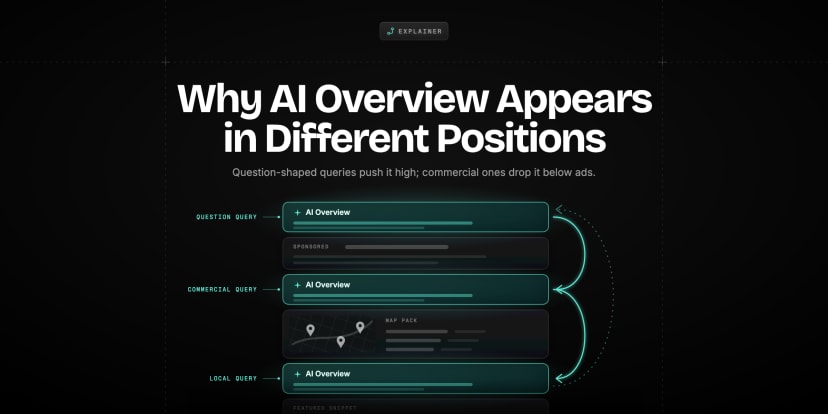
Why Your Website Ranks on Page 1 But Still Does Not Appear in AI Overviews
Ranking on page 1 doesn't guarantee AI Overview inclusion. Here's why, how to diagnose AI overview exclusion reasons, and what fixes it.
Key Highlights
-
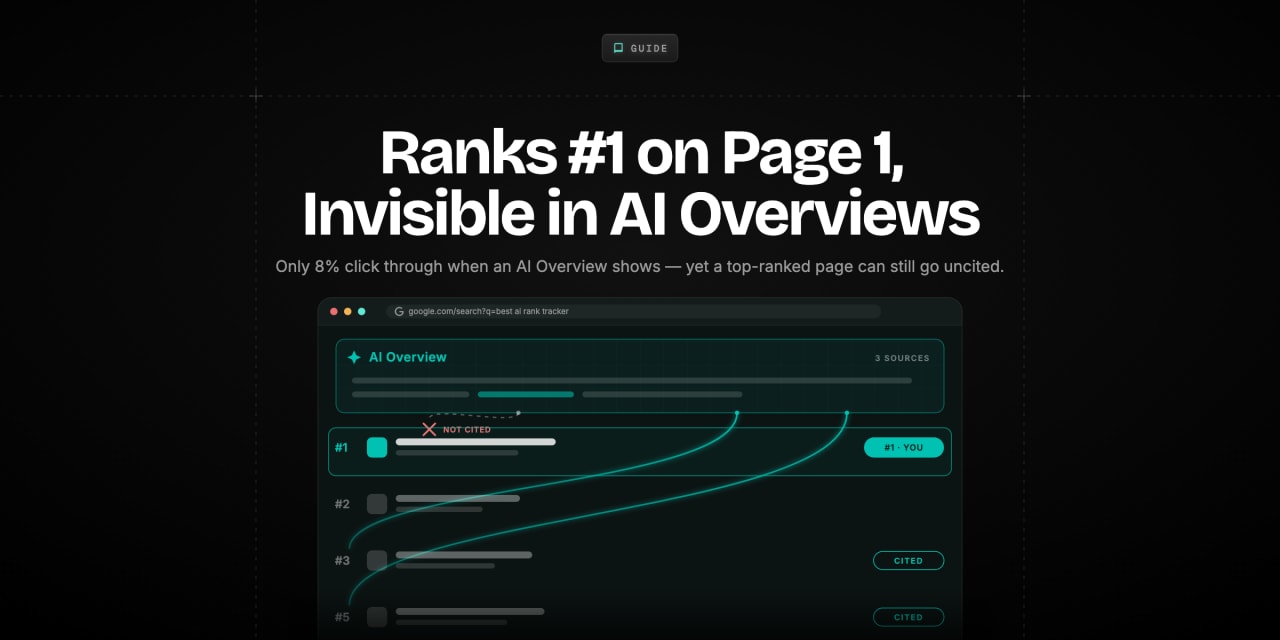
A page can rank \#1 on Google and still never be cited in the AI Overview for the same query.
-
This is a retrieval and extraction problem, not a ranking problem, and the two are judged separately.
-
Buried answers, opaque structure and missing content-level E-E-A-T are the most common AI overview exclusion reasons.
-
YMYL categories like finance and health behave differently, leaning more heavily on already-trusted, top-ranking sources.
-
Search Console and manual query checks together remain the most reliable way to diagnose the gap.
-
Fixing this rarely requires new tools, mostly rewritten intros, restructured headings, and visible expertise signals.
SEOs keep discovering that traditional ranking success does not guarantee AI Overview inclusion, and it creates real confusion about what actually drives AI visibility. According to Pew Research Center, only 8% of people who see an AI Overview go on to click a traditional search result, compared with 15% when no overview appears.
That makes the gap between ranking and citation more than an academic curiosity. A page sitting on page one but missing from the AI Overview above it is losing exactly the clicks that overview now intercepts. Watching a competitor get cited from a lower position while your own well-ranked page sits unused is genuinely frustrating, and the instinct to blame the ranking itself is usually wrong.
This article works through why that happens, using a documented pattern several site owners have independently reported comparing notes on this exact problem, alongside published research on the ranking-citation gap, so the diagnosis here is grounded rather than guessed at.
Is it possible to rank #1 but never appear in an AI Overview?
YMYL plays by stricter rules.
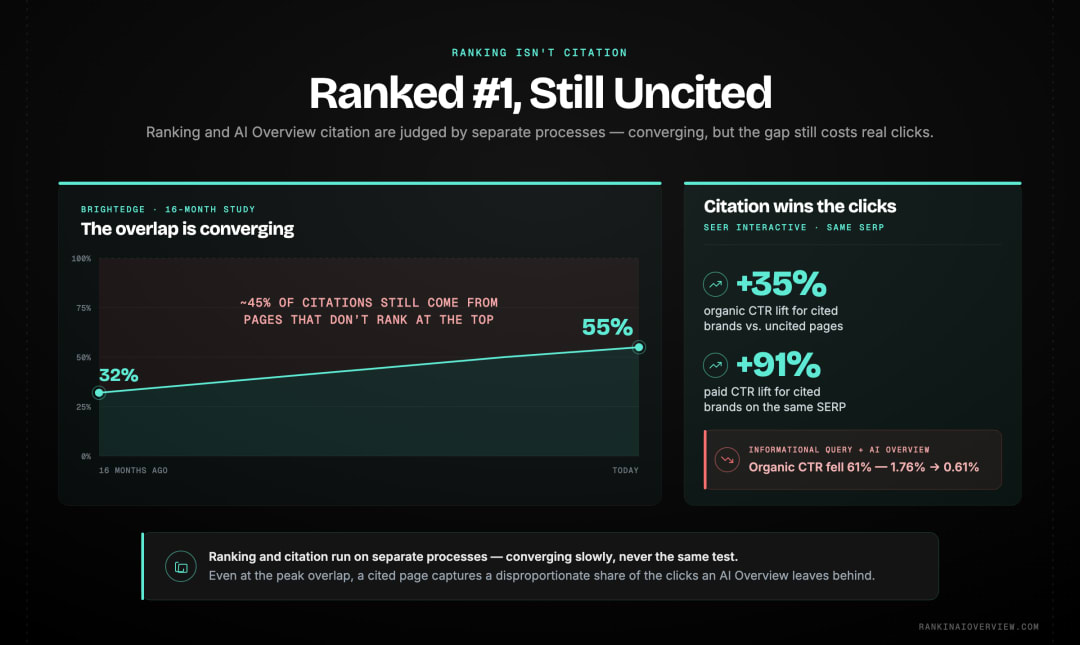
Ranking and citation are converging — but the gap still costs clicks.
Yes. A page can rank \#1 and still never be cited in the corresponding AI Overview, because ranking and citation are evaluated by separate processes that don't always agree.
Research tracking this gap found the overlap between AI Overview citations and organic rankings grew from roughly 32% to 55% over a 16-month period, according to BrightEdge data. That's real convergence, but it also means even at its highest point, close to half of all AI Overview citations still come from pages that aren't sitting at the top of organic results.
The pattern isn't even across categories. Ecommerce queries showed almost no change in overlap over the same period, while YMYL categories like healthcare, insurance and education showed a notably higher overlap, in the high 60s to mid-70s percentage range. That's a meaningful clue: in higher-risk categories, Google leans more heavily on already-trusted, top-ranking sources rather than the looser, retrieval-based selection used elsewhere.
One site owner's experience matches this exactly: ranking \#2 for a competitive keyword while the AI Overview pulled from a page ranking \#7. Content structure, not position, was the deciding factor in that specific case.
Why do YMYL topics behave differently?
In finance specifically, BrightEdge data shows educational queries like “what is an IRA” trigger an AI Overview around 91% of the time, while real-time queries like stock ticker prices trigger one only about 7% of the time. Google appears to deliberately exclude AI synthesis where live accuracy matters most.
In healthcare, the same research found the top 10 cited domains capture roughly 40% of all citations, a tighter concentration than less sensitive categories show. That's consistent with the higher ranking-to-citation overlap seen across YMYL topics generally: Google sticks closer to sources it already trusts rather than opening selection up to a wider, retrieval-based pool.
Why does this gap matter beyond pride?
Citation inside an AI Overview carries a measurable click advantage over simply ranking nearby. Research from Seer Interactive found that brands cited inside an AI Overview saw 35% higher organic click-through rate and 91% higher paid click-through rate compared with similar pages that weren't cited, even when both were visible on the same results page.
Meanwhile, the same research found organic click-through rates for informational queries with an AI Overview present dropped 61% overall, from 1.76% to 0.61%. The full traffic-volume comparison between Google #1 and AI citation breaks this CTR drop down by scenario. Ranking without citation increasingly means competing for a shrinking slice of attention, while citation captures a disproportionate share of what's left.
This is why the diagnosis matters more than it might seem from the outside. Two pages can show identical traditional ranking reports while one quietly earns most of the remaining clicks and the other slowly loses traffic to a feature it never appears in.
What is the difference between Google ranking signals and AI Overview selection signals?
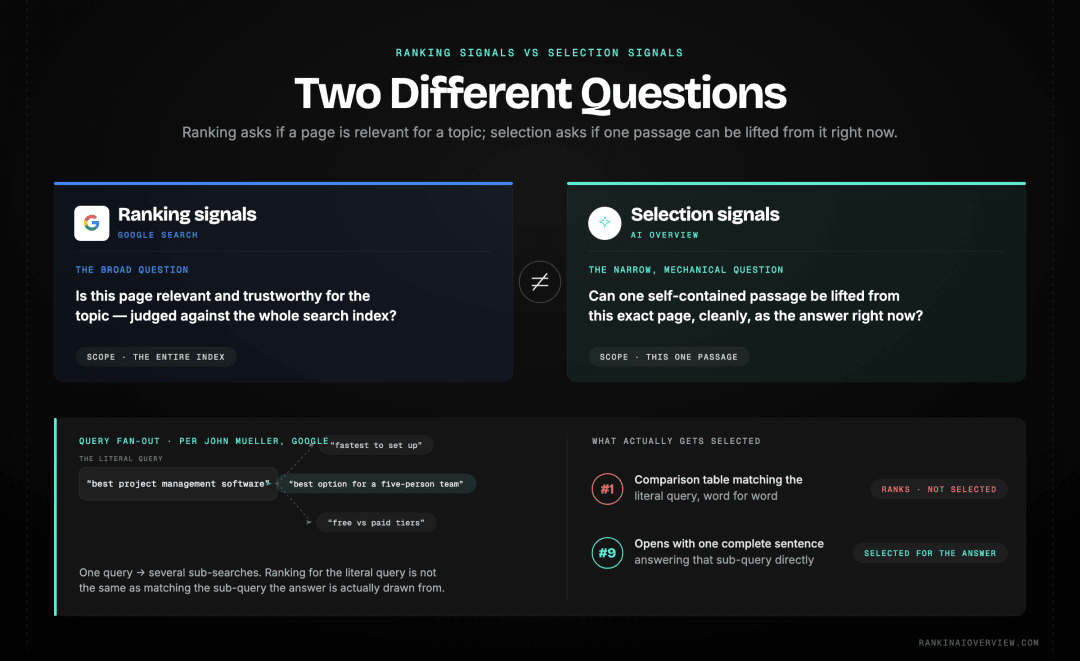
Two different questions, two different signals.
Google ranking signals evaluate a page's relevance and authority against the whole search index. AI Overview selection signals evaluate something narrower: whether a specific passage on that page can be extracted cleanly and used as a self-contained answer.
This distinction matters more than most coverage of the topic admits. RANK IN AI OVERVIEW's breakdown of what ‘ranking’ means in AI search goes into this in more depth: there's no ranked list inside an AI Overview, so the page that ranks best and the passage that gets extracted best can genuinely be two different things on two different pages.
“ A whole bunch of searches for you. John Mueller Search Advocate, Google Source: https://searchengineland.com/google-danny-sullivan-seo-for-ai-is-still-seo-466368
Mueller's description of query fan-out captures part of why this split happens: Google's AI features run several related searches behind the scenes for one user query, so a page ranking well for the literal query can still miss every fan-out sub-query the AI Overview actually draws its answer from.
Put another way: ranking signals ask “is this page relevant and trustworthy for this topic, broadly?” Selection signals ask a narrower, more mechanical question: “can I lift one specific, self-contained answer from this exact page right now?” A page can pass the first test comfortably and fail the second one entirely.
A concrete version of this: a page ranking \#1 for “best project management software” with a thorough, well-linked comparison table can still lose the AI Overview citation to a page ranking \#9 that opens with a single, complete sentence directly answering the implied sub-question “what's the best option for a five-person team.” Both pages are good. Only one is easy to extract from for that specific framing.
Why does AI ignore high-ranking pages?
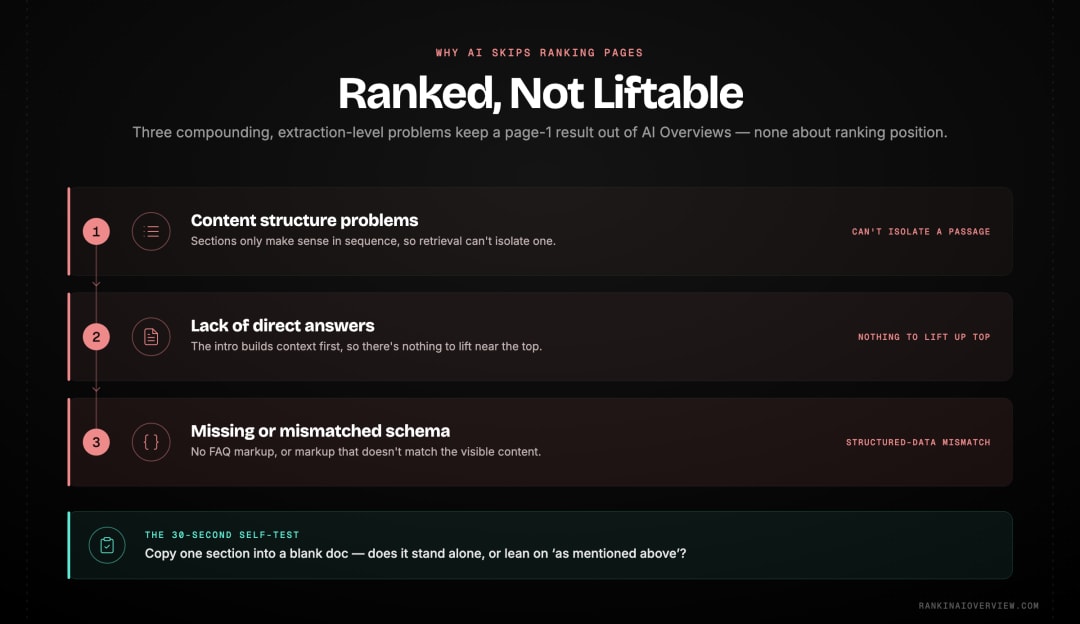
Three compounding reasons AI skips a ranking page.
AI Overviews skip high-ranking pages most often because of three compounding issues: content structure that's hard to extract from, answers buried too deep in the page, and missing schema that would otherwise clarify the content's format.
Content structure problems
Long-form pages built around comprehensive coverage, written for readers who scroll and skim, are often harder for retrieval systems to parse than shorter, clearly segmented content. A 3,000-word guide covering every angle of a topic can bury its best answer in the middle of paragraph four.
Each heading needs to introduce a section that fully answers the question posed in that heading on its own, without depending on the paragraph before or after it. Content written as one continuous narrative forces the retrieval system to guess where one idea ends and the next begins.
This doesn't mean abandoning depth. A long, comprehensive guide can still work well, provided each section within it is internally complete. The problem isn't length; it's sections that only make sense as part of a sequence rather than standing on their own.
A simple way to test this without any tooling: copy just one section, headed and all, into a blank document. If a reader with no other context could understand and trust that section completely on its own, it's likely structured well enough for extraction. If it references “as mentioned above” or assumes prior setup, it probably isn't yet.
Lack of direct answers
If an introduction spends several sentences building context, restating the question, or easing into the topic before answering it, the retrieval system has nothing to extract near the top of the page and frequently moves on to a page that answers faster.
One contributor who tested this directly reported success after a specific change: rewriting introductions to lead with the answer first, then expand afterward. That site started appearing in AI Overviews within two weeks of making the change, with no other structural rework involved.
A useful test: read just the first two sentences under any heading on a page, with nothing else visible. If those two sentences alone don't answer the question the heading asks, a retrieval system is likely to skip past that section too.
Missing schema markup
FAQ schema in particular gets reported often as a fast, low-effort fix, with pages carrying it pulled into AI Overviews noticeably more often in practitioner experience. It isn't a guaranteed trigger on its own, but it removes ambiguity about which parts of a page are formatted as direct answers.
Schema works best as confirmation of structure that already exists visually on the page, not as a substitute for it. Markup wrapped around a page with no real question-and-answer formatting underneath rarely produces the same result.
Worth checking specifically: whether existing schema actually matches the visible content. Markup left over from a template, listing questions the page doesn't clearly answer, can do more harm than having no schema at all, since it signals a mismatch between structure and substance.
A short audit covers this quickly: pull every page with FAQ schema, and for each one, confirm the marked-up questions match a real, visible heading on the page, with a real answer directly beneath it. Mismatches are common on older pages where content has been edited since the schema was first added.
How to diagnose why your page is excluded from AI Overviews
Diagnosing AI overview exclusion reasons works best as an ordered checklist, since several of these issues can look identical from the outside but need different fixes.
Resist the urge to change several things at once. Structure, schema and expertise signals each produce a different kind of result, and changing all three simultaneously makes it impossible to tell which fix actually mattered if and when a page does start appearing.
Keep a simple log alongside this checklist: the date of each change, which item from the list it addressed, and whether the target query was re-checked afterward. Without that record, it's easy to credit the wrong fix for a result that actually came from something else changing on the page, or on a competitor's page, around the same time.
-
Confirm the target query actually triggers an AI Overview at all, by searching it directly in an incognito window.
-
If it does, check whether the introduction of your page answers the question within the first one or two sentences.
-
Review heading structure: does each section stand alone as a complete answer, or does it depend on surrounding context?
-
Validate any existing schema markup against the visible content, and add FAQ schema to genuine question-and-answer sections if missing.
-
Check whether the topic falls into a YMYL category, since AI Overviews behave more conservatively there regardless of content quality.
-
Look for visible expertise signals on the page itself: named authors, credentials, original data, or first-hand detail, not just domain-level authority.
That last point is worth taking seriously on its own. RANK IN AI OVERVIEW's research on trust versus rankings found that a strong domain track record counts for less than expected if the individual page itself carries no visible credibility signals, since a retrieval system evaluating one page in isolation has no access to your site's overall reputation.
Work through this list in order rather than jumping to whichever fix sounds most appealing. A page with buried answers and missing schema needs the buried answer fixed first; adding schema to a page that still doesn't answer its own headings directly tends to produce little change on its own.
What changes will get a ranking page into AI Overviews?
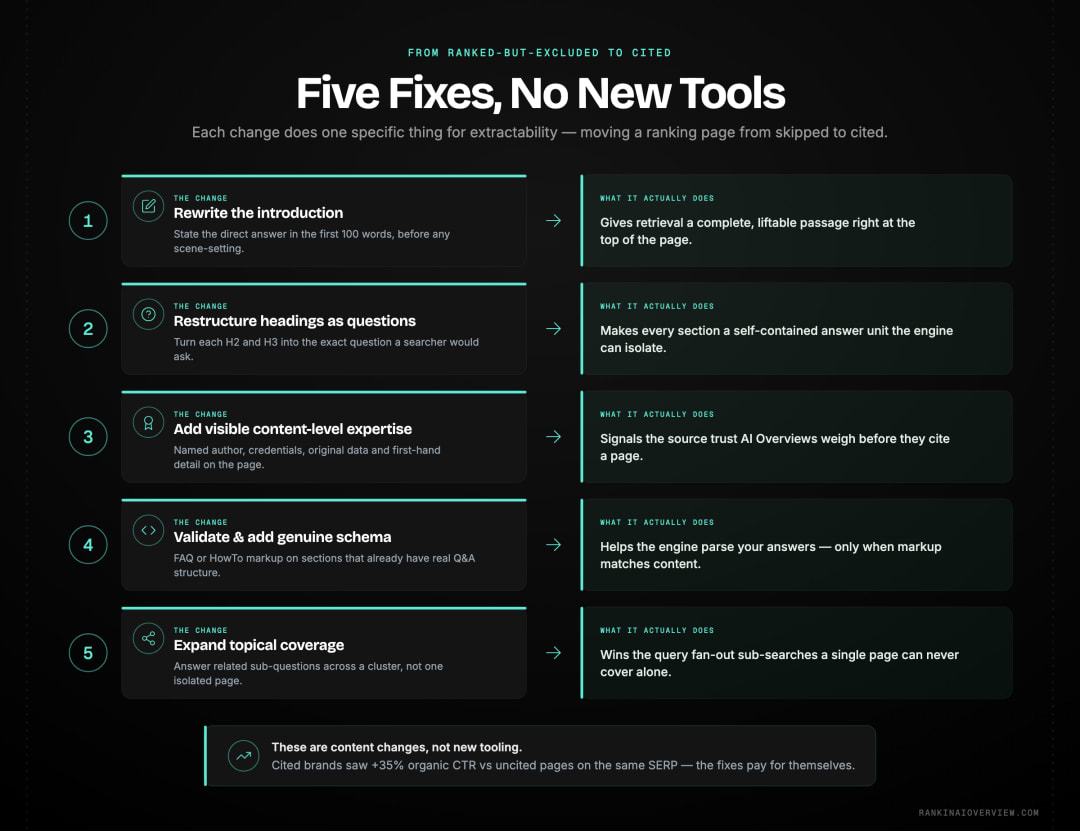
Five fixes that close the gap (no new tools needed).
The fixes that move a page from ranked-but-excluded to cited are concrete and don't require new tooling: rewritten intros, restructured headings, visible expertise signals, and broader topical coverage.
Change | What it actually does |
|---|---|
Rewrite the introduction | State the direct answer in the first 100 words, before any context or scene-setting. |
Restructure headings as questions | Each section becomes a self-contained answer unit that doesn't depend on what comes before it. |
Add visible, content-level expertise signals | Named author, credentials, original data or first-hand detail, placed in the content itself. |
Validate and add schema where genuine | FAQ or HowTo schema on sections that already have real question-and-answer structure. |
Expand topical coverage | Answer several related sub-questions on the same site rather than relying on one isolated page. |
That last row is where individual page fixes run into a ceiling. RANK IN AI OVERVIEW's guide to building a GEO and AI Overview content cluster covers how to build that broader coverage deliberately, rather than one rewritten page at a time.
Sequencing matters here too. Audit which of your target queries actually trigger an AI Overview before rewriting anything, since pages targeting query types that rarely generate an overview at all won't show improvement no matter how well-structured they become.
“ That chance is a coin flip at best. Si Quan Ong Senior Content Marketer, Ahrefs Source: https://ahrefs.com/blog/does-ranking-higher-on-google-mean-youll-get-cited-in-ai-overviews/
That line is worth holding onto as a calibration check. Even after every fix above, ranking well only raises the odds of citation. None of these changes convert a near-miss into a guarantee, and treating them that way sets up disappointment that isn't really about the fixes failing.
Conclusion
The same disconnect shows up across engines — here is why your #1 Google ranking gets ignored by AI search, and how to fix it.
Once you know why you are excluded, here is the fix side — how to get your pages featured in Google AI Overviews.
Ranking on page one and appearing in an AI Overview are related but separate outcomes, decided by separate processes. A page can do everything right by traditional SEO standards and still miss the extraction bar an AI Overview applies.
The fixes are concrete and mostly familiar: answer first, structure clearly, make expertise visible on the page itself, and build topical depth rather than relying on one isolated page. None of it guarantees citation, but together it closes most of the gap that ranking alone leaves open.
Start the diagnostic checklist on the single page most likely to already be close: a page ranking in the top five for a query confirmed to trigger an AI Overview. That page will show whether structure or something else entirely is the actual blocker, before rewriting an entire site's worth of content.
Treat this as an ongoing check rather than a one-time fix. Query triggers, competitor structure, and AI Overview behaviour for a given topic can all shift, so a page that earns a citation today is worth re-checking periodically rather than assumed permanently settled.
That volatility is quantified in our analysis of AI search citation consistency over time.
For ongoing research on AI overview exclusion reasons and what closes the gap, RANK IN AI OVERVIEW covers this space across its content library.
Frequently asked questions
Can a page rank \#1 and still never appear in an AI Overview?+
Yes. Ranking and AI Overview citation are evaluated separately. A page can hold the top organic position while a differently structured page lower down gets cited instead, because the citation decision is about extractability, not position.
Does schema markup guarantee AI Overview inclusion?+
No. FAQ schema is frequently associated with faster inclusion in practitioner reports, but it works by clarifying structure that should already exist on the page. It isn't a guaranteed trigger by itself.
Why are finance and health pages skipped more often in AI Overviews?+
These are YMYL categories, where Google applies more conservative selection and leans more heavily on already-established, top-ranking sources. Educational finance content still triggers overviews often; real-time data like stock prices is largely excluded from AI synthesis altogether.
Does a higher-ranking competitor always win the citation?+
No. Citation depends more on extractable structure than on relative rank. A page ranking several positions lower with a clearer, self-contained answer can be cited ahead of a higher-ranking page that buries its answer in dense prose.
How long does it take for content changes to show up in AI Overviews?+
It varies, but several documented cases show visible changes within one to three weeks of a genuine structural rewrite. Cosmetic edits without real changes to answer placement or structure tend not to produce the same result.
Should every page on a ranking site be rewritten for this?+
No. Prioritise pages that already rank well for queries known to trigger AI Overviews. Rewriting pages for queries that rarely or never trigger an overview in the first place wastes effort on a goal that isn't reachable for that query type.
Explore with AI
Share this