Are SEO Agencies Losing Clients to AI Search?
A clear look at why SEO agencies lose clients when they fail on AI search adaptation, what clients expect now, and how agencies are pivoting to GEO and AEO.

Key Highlights
-
Roughly six in ten US adults now read AI-generated summaries in their search results, and that is reshaping what clients expect from any SEO agency AI search adaptation plan.
-
Slow adaptation to AI search is now a named reason behind agencies losing clients AI search has reached, alongside reporting that does not tie to revenue.
-
Clients increasingly judge results by AI visibility and citations, not page-one rankings alone.
-
Agencies completing a genuine SEO agency AI pivot are growing retainers instead of losing them.
-
Technical SEO, content structure, and digital PR remain the foundation every GEO and AEO service is built on.
-
Plain-language reporting on the AI search impact on agencies and their clients is one of the strongest retention levers available.
-
The future of SEO agencies looks less like a ranking report and more like an AI visibility dashboard tied to revenue.
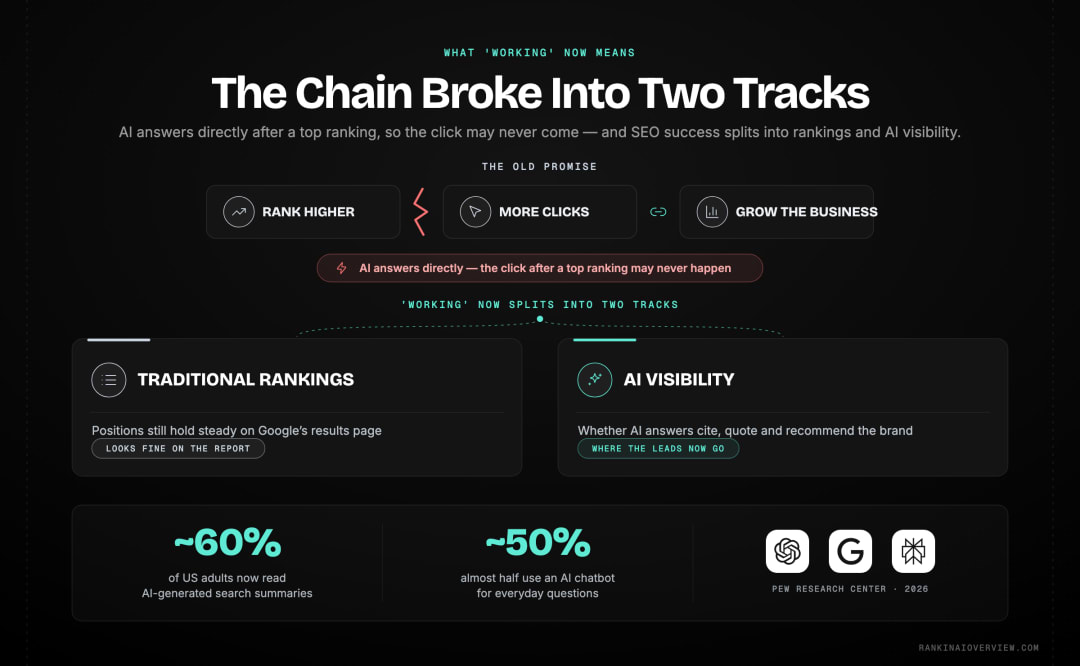
A client opens a monthly SEO report, sees rankings holding steady, and still asks why leads have dropped. That conversation is becoming common across the industry, and it explains why so many business owners are quietly thinking about SEO agencies AI search adaptation instead of simply renewing a retainer. According to Pew Research Center, roughly six in ten US adults now read AI-generated summaries in their search results, and almost half use an AI chatbot for everyday questions. When buyers start their research inside ChatGPT or Google AI Overviews instead of a list of blue links, a "good ranking" stops meaning what it used to.
If you run a business and feel like your SEO agency is repeating the same playbook from three years ago, that frustration is fair. You are paying for visibility, and visibility now lives in more places than a search results page. Watching a competitor get named by ChatGPT while your own rank-one page goes unmentioned feels personal, even when nobody on either team has done anything wrong. It is simply a new set of rules nobody fully explained to you, and it is reasonable to want a straight answer about whether your agency has a plan for it.
This guide breaks down exactly how AI search adoption is reshaping client expectations, what an honest SEO agency AI pivot actually looks like in practice, and which questions separate agencies that are growing through this shift from the agencies losing clients AI search has already caught up with.
How has AI search changed what clients expect from SEO agencies?
AI search has shifted client expectations from page-one rankings to AI visibility: whether ChatGPT, Perplexity, and Google AI Overviews mention, cite, or recommend a brand. Clients now expect agencies to track citation frequency and AI-referred traffic alongside traditional rankings, not instead of them.
For two decades, an SEO agency’s core promise was simple: rank higher, get more clicks, grow the business. AI search breaks that chain at the first link. When ChatGPT or an AI Overview answers a question directly, the click that used to follow a top ranking may never happen at all. Clients feel this before they can name it. They see steady or even improving rankings sitting next to falling lead volume, and they conclude, often correctly, that something about their agency’s SEO agency AI search adaptation is behind schedule.
Industry research puts annual client churn for SEO agencies in the high thirties percentage range, and slow adaptation to AI search is now named as a leading driver of that churn, sitting alongside vague reporting and misaligned expectations set during the original sales process. None of this means SEO is dying. It means the definition of "working" has split into two tracks: traditional rankings and AI visibility. Clients who understand that split start asking different questions in quarterly reviews, and agencies that cannot answer those questions are the ones quietly added to the agencies losing clients AI search adoption is creating across the industry.
The agencies handling this well treat the AI search impact on agencies as a service expansion rather than a threat to their existing book of business. They keep the technical SEO, content, and link-building fundamentals that already work, then layer structured data, clearer answer formatting, and citation tracking on top, instead of throwing out a working strategy and starting over. A useful resource on exactly how the two tracks reinforce each other instead of competing for the same budget line is a dual strategy guide for ranking on Google while also showing up in AI answers, which most agencies should be reading before their next client renewal conversation.
This is also where client trust either holds or breaks. A client who hears “AI search is just a fad” from their agency in 2024 and is still hearing it in 2026, while a competitor gets named by Perplexity every time a buyer asks for a recommendation, will not stay quiet about it. The future of SEO agencies is being decided in exactly these moments, one renewal conversation at a time, long before any annual contract review.
It is worth being specific about what genuine SEO agencies AI search adaptation looks like inside a single account, because the phrase gets used loosely in pitch decks. It means the agency can name, in plain language, which AI platforms a client’s buyers actually use, what those platforms currently say about the client, and what changed last month because of it. An agency that cannot answer those three questions on the spot has not adapted yet, whatever its proposal deck claims.
None of this is exotic. Most of the work behind a credible SEO agency AI pivot, fixing crawl access, structuring content into clear answers, building real third-party citations, was already best practice in traditional SEO long before anyone coined the term GEO. What changed is the audience for that work. A page used to need to satisfy a search engine’s crawler and a human reader. It now also needs to satisfy a language model deciding, in a fraction of a second, whether the page is trustworthy enough to summarise and attribute correctly.
What are clients actually measuring now — rankings or visibility?
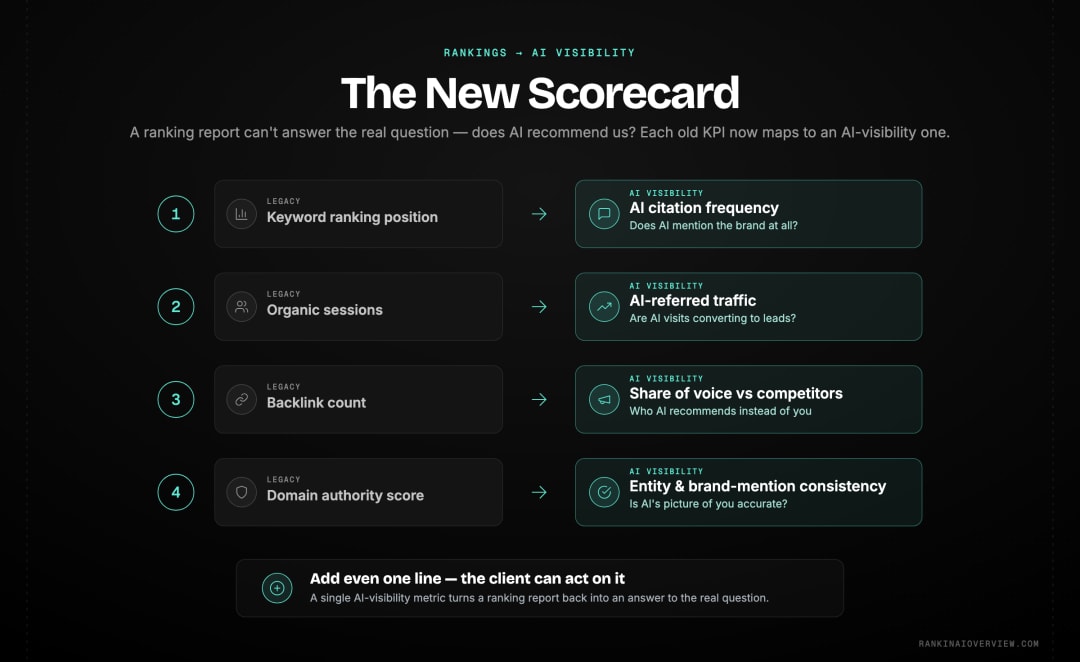
Clients are increasingly measuring AI citation frequency, share of voice across AI platforms, and AI-referred traffic, in addition to keyword rankings and organic sessions. A ranking report alone no longer answers the question a client actually wants answered: does AI recommend us?
Rankings still matter. A page generally has to be found and trusted before it can be cited, and most AI Overviews still draw heavily from pages that already rank well in Google. But rankings answer a narrower question than they used to. They tell a client where a page sits in a list of links; they say nothing about whether ChatGPT, Gemini, or Perplexity actually names the brand when a buyer asks for a recommendation. That gap is exactly where the future of SEO agencies is being decided right now, and it is also exactly where clients are starting to push back hardest on legacy reporting formats.
The table below summarises the shift agencies are reporting on, side by side with what each metric actually tells a client.
| Old KPI | New KPI | What it tells the client |
|---|---|---|
| Keyword ranking position | AI citation frequency | Whether AI platforms mention the brand at all |
| Organic sessions | AI-referred traffic | Whether AI-driven visits are converting into leads |
| Backlink count | Share of voice vs competitors | Who AI recommends instead of the client |
| Domain authority score | Entity and brand-mention consistency | Whether AI has a clear, accurate picture of the brand |
Agencies that have only ever reported the left-hand column are the ones most exposed to the AI search impact on agencies playing out across 2026. A practical starting point for any agency or client auditing this gap is a dedicated breakdown of metrics for measuring AI search visibility, which turns “are we visible in AI search” into something that can actually be tracked month over month instead of guessed at over coffee during a quarterly review.
This shift in measurement is also where a genuine SEO agency AI pivot becomes visible to a client for the first time. The agency that adds even one new line to a report, citation share or AI-referred sessions, is signalling something the client can act on. The agency that keeps the report exactly as it looked in 2022 is signalling something too, just not the message it intends to send.
Clients comparing proposals from a new agency against their current one are increasingly using this exact test: ask each agency to pull up a live AI platform and show what it currently says about the brand. Agencies that hesitate or change the subject are, functionally, telling the client they belong on the list of agencies losing clients AI search adoption is steadily growing. Agencies that pull it up without flinching are showing a client exactly why the future of SEO agencies favours the ones who treated this as core work rather than an optional extra.
Which SEO agencies are growing despite the AI shift?
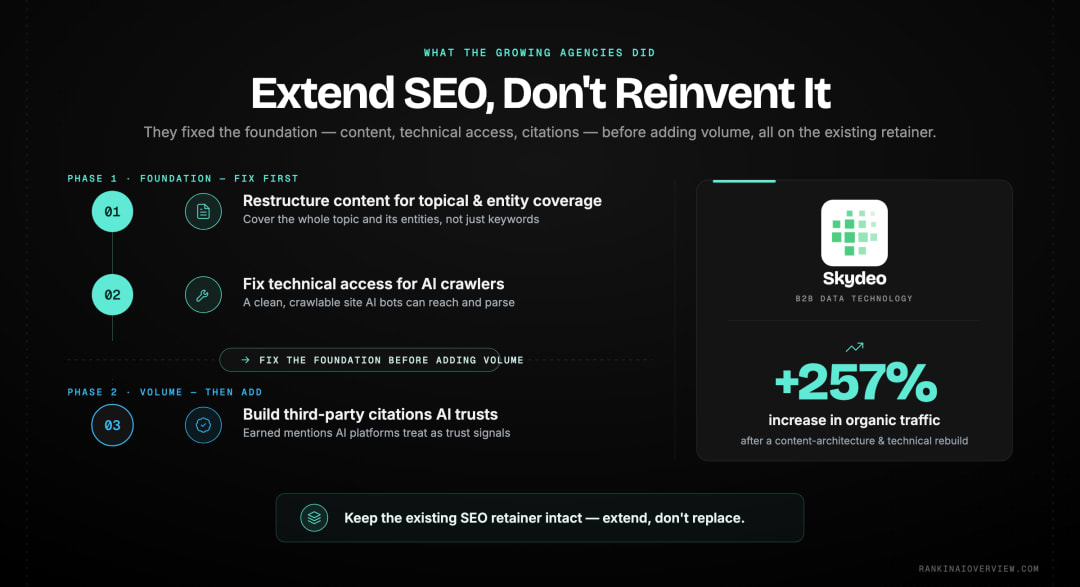
Not every agency is losing ground. Agencies that added AI visibility audits, GEO content restructuring, and AI-referral reporting to existing retainers are documenting traffic and revenue growth, often within the same client relationships that were at risk of churning a year earlier.
It is tempting to assume AI search is purely a threat to agency revenue, but the data does not support that as a blanket conclusion. A meaningful share of SEO agencies report raising retainers in 2026 rather than discounting them, and a large majority say they have already changed how they measure success because of AI search. The agencies losing clients AI search has displaced are disproportionately the ones that changed nothing at all, not the ones that experimented and got some of it wrong along the way.
Early movers on GEO
Agencies that moved into generative engine optimisation early, before clients were asking for it by name, are the ones with case studies to show for it now. The pattern repeats across the agencies that publish results: restructure content around topical and entity coverage, fix technical access for AI crawlers, and build third-party citations that AI platforms treat as trust signals, all while keeping the existing SEO retainer intact rather than selling it as a confusing new line item.
Skydeo, a B2B data technology company, is one documented example. Its agency restructured content architecture, improved technical foundations, and realigned keyword targeting around actual B2B buyer behaviour. The engagement produced a 257% increase in organic traffic in a technical vertical where most agencies struggle to move the needle at all.
"We’re connecting the dots between content, expertise, and reputation."
— Adam Collins, Founder, Ignite SEO (source)
A useful primer for agencies building this muscle is a complete GEO and AIO guide for 2026, which walks through where generative engine optimisation and classic SEO share a foundation and where the two genuinely diverge into separate tactics.
What makes the Skydeo result worth studying is not the headline percentage on its own, but where the gains came from. The agency did not simply publish more content. It restructured what already existed so that AI systems could parse it accurately, then built the entity signals that let those systems trust the brand enough to cite it. That sequencing, fix the foundation before adding volume, shows up across nearly every agency case study that survives scrutiny.
Agencies offering AI visibility audits
The AI visibility audit has become the most common entry point for agencies adding AI search work to an existing account. It benchmarks where a brand currently appears across ChatGPT, Perplexity, Gemini, and Google AI Overviews, flags the gaps against named competitors, and gives the agency a concrete, data-backed reason to open a budget conversation instead of asking for more spend on faith alone. Agencies running these audits report that the deliverable itself often becomes the foundation for an expanded retainer, because it gives both sides a shared, dated baseline to measure progress against quarter over quarter.
The agencies pulling this off well are not the ones with the flashiest pitch deck. They are the ones who can show a client, in a single screen, exactly which AI platforms mention them today and which platforms mention a competitor instead. That single screen does more to justify a budget increase than a year of traditional ranking reports ever did, and it is rapidly becoming standard practice across agencies serious about an SEO agency AI pivot.
For agencies and clients deciding which tracking tool actually supports this kind of audit, a comparison of the best AI rank trackers reviewed for 2026 is a reasonable starting point before committing to a monthly platform fee.
A word of caution belongs here too. An AI visibility audit is only as useful as the prompt list behind it. Agencies that run twenty generic, top-of-funnel questions and call it an audit are producing a vanity report, not a strategic one. The audits that actually move budget conversations test the specific, high-intent questions a client’s real buyers ask, comparison phrasing, pricing questions, and “best X for Y” style prompts, because those are the queries where AI platforms are most decisive about who they name and who they leave out.
What services should agencies add to stay relevant?
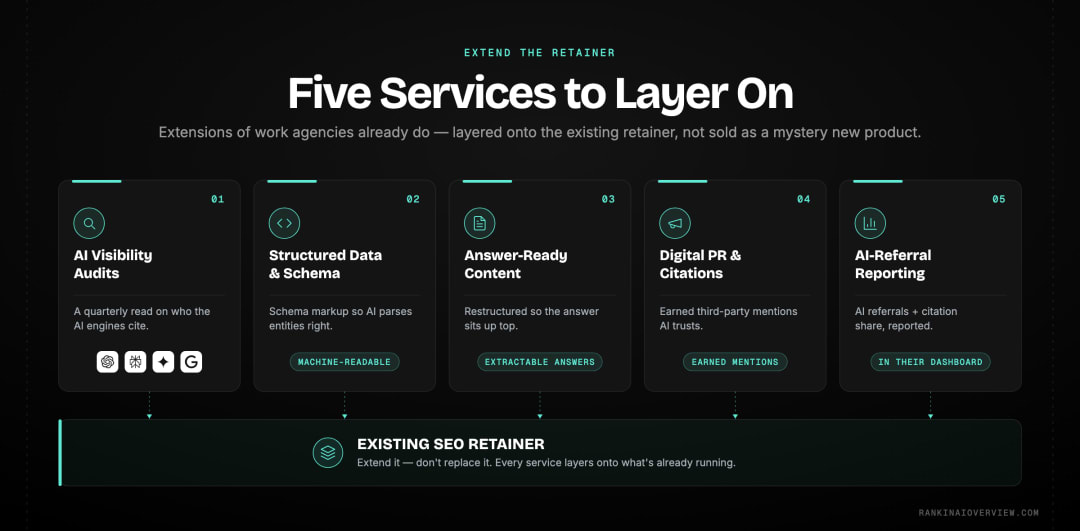
Agencies staying relevant are adding AI visibility audits, structured data and schema implementation, AI-ready content restructuring, digital PR for citation-worthy mentions, and AI-referral reporting, layered onto existing SEO retainers rather than sold as an unrelated new product.
The services worth adding are extensions of work most agencies already do, not a wholesale rebuild of the agency’s entire service catalogue:
-
AI visibility audits across ChatGPT, Perplexity, Gemini, and Google AI Overviews, run quarterly at minimum
-
Structured data and schema markup, using the vocabulary published at Schema.org, so AI systems can parse a page’s entities accurately
-
Content restructured for direct, extractable answers near the top of each section, rather than long preambles before the useful part
-
Digital PR and third-party citation building, since AI platforms weight earned mentions in credible publications heavily when deciding what to cite
-
AI-referral and citation-share reporting, connected to the same dashboard clients already use for traditional SEO metrics
Some agencies are also experimenting with agentic workflows to keep this work affordable at scale without adding headcount for every new client; a practical look at AI agents in SEO workflows covers where automation genuinely saves time versus where a human still needs to review the output before it reaches a client.
This is the substance of a real SEO agency AI pivot: the same disciplines an agency already practises, extended to a second discovery surface, reported in language a client without an SEO background can actually understand without a glossary. Agencies that frame the work this way rarely lose the account over AI search impact on agencies; the ones that frame it as an entirely new, separately billed mystery service are the ones clients start to question.
None of these five additions require an agency to rebuild its team overnight. Most can start with the people already running technical audits and writing content, supplemented by one new monthly tracking step and one new section in the client report. The agencies that wait for a perfect, fully-staffed AI search department before starting tend to lose the account to a smaller competitor willing to ship an imperfect version of the same work this quarter.
How should agencies talk to clients about AI search changes?
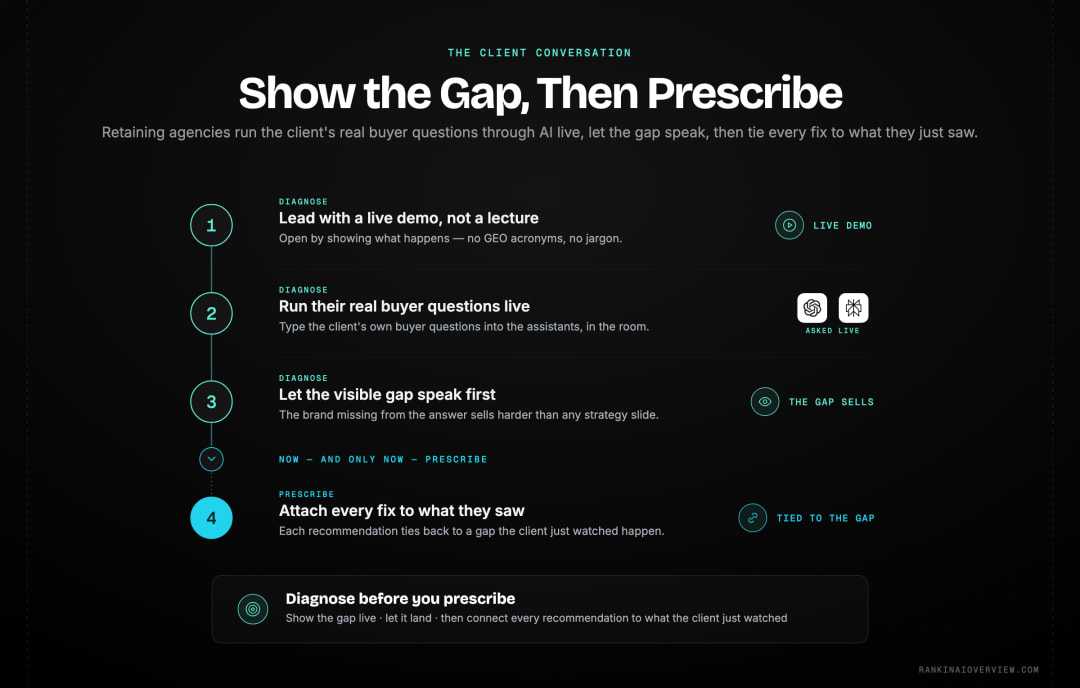
Agencies retaining clients through this shift lead with plain-language education before selling a new service: showing a client exactly what ChatGPT or an AI Overview says about their brand today, then framing the work as closing a measurable gap rather than reacting to a vague industry trend.
Most clients do not want a lecture on generative engine optimisation. They want to know whether their business shows up when a buyer asks an AI assistant for a recommendation, and what happens if it does not. The agencies handling this conversation well open with a live demonstration: run the client’s most valuable buyer questions through ChatGPT and Perplexity in the meeting, show what comes back, and let the gap speak for itself before presenting a single slide of strategy.
"We’re trying to fit a baseball bat through a keyhole."
— Britney Muller, AI Educator and Consultant (source)
That kind of demonstration does more for retention than any written report. It reframes the AI search impact on agencies away from an abstract industry trend and into a specific, visible problem the client can see for themselves on a shared screen. The conversation also works in reverse: agencies that can show a client they are already winning citations against a named competitor turn a routine account review into the strongest renewal pitch they have.
A simple framework agencies use is to diagnose before they prescribe. Before recommending a single tactic, show the client where they stand today across the platforms that matter most to their buyers, then attach every recommendation that follows to something the client just watched happen on screen rather than a general claim about where the industry is heading.
Conclusion
SEO agencies are not losing clients because SEO itself stopped working. They are losing clients when reporting, strategy, and communication fail to keep pace with where buyers actually start their research now. The agencies pulling ahead through this shift are not reinventing their craft from scratch; they are extending it to a second discovery surface, measuring it honestly, and explaining the gap in language a client can act on immediately.
If there is one practical takeaway for a business owner reading this rather than an agency owner, it is this: the question to ask in your next account review is not “are we ranking well,” it is “what does ChatGPT say about us right now, and what changed last quarter because of it.” That single question, asked consistently, tells you more about whether your agency has actually adapted than any slide deck or case study link ever will.
The honest answer to the question this article opened with is that SEO agencies AI search adaptation is now a dividing line, not a nice-to-have. Agencies on the right side of it are growing retainers and fielding fewer uncomfortable renewal conversations. Agencies on the wrong side of it make up most of the agencies losing clients AI search has already reshaped the expectations of, and the future of SEO agencies belongs to whichever group an agency chooses to join next quarter. For deeper research on how AI search visibility is measured and built over time, RANK IN AI OVERVIEW covers this space across its content library.
Frequently asked questions
Are SEO agencies actually losing clients to AI search?+
Some are. Slow adaptation to AI search is now a named driver of agency churn, alongside vague reporting and misaligned expectations. Agencies adding AI visibility work to existing retainers are generally retaining clients better than agencies still reporting only keyword rankings each month.
What is the difference between SEO and AI search optimisation for agencies?+
Traditional SEO targets rankings and clicks on search engine results pages. AI search optimisation, often called GEO or AEO, targets whether AI platforms mention, cite, or recommend a brand. Most of the underlying technical and content work overlaps closely between the two disciplines.
Should I worry if my agency has never mentioned AI Overviews?+
It is a reasonable question to raise directly with your account manager. Ask whether AI visibility is being tracked at all, and request a simple, live demonstration of what AI platforms currently say about your brand before deciding whether to change agencies entirely.
How long does AI search optimisation take to show results?+
Early signals such as citation changes can appear within a few weeks of structural fixes like schema and content restructuring. Measurable AI-referred traffic and revenue typically take longer to build, broadly similar to the timeline most businesses already expect from traditional SEO work.
Do agencies usually charge extra for GEO or AEO services?+
Many agencies bundle AI search work into existing retainers since it draws on the same technical and content foundation as traditional SEO. Others price it as a separate add-on. Either approach is reasonable as long as reporting clearly separates what each part is actually achieving.
What should I ask my SEO agency about their AI search plan?+
Ask how they track AI citation frequency, what changed in the content or technical strategy last quarter specifically because of AI search, and whether they can show you, live, what ChatGPT or Perplexity currently says about your brand and your closest competitor.
Explore with AI
Share this