Decoding How Google AI Rankings Actually Work in 2026
Measurement of 55,393 queries shows AI Overview source selection is not just a re-ranking of page one. Here is what the data supports.

Key Highlights
- AI Overviews appear on a minority of searches overall but on the clear majority of question-form queries, which tells you exactly where the opportunity is concentrated.
- Nearly a third of cited domains do not appear in the first-page results shown alongside the answer, so source selection is measurably not a simple re-ranking of the top ten.
- A meaningful share of the claims in AI Overviews are not supported by the pages cited, usually through omission, which means being cited is not the same as being represented accurately.
- Leading with a complete, self-contained answer is the change with the strongest supporting evidence, and it works from outside the top positions.
- Two widely repeated "signals", schema as a citation lever and engagement metrics like bounce rate, are far weaker than the advice around them suggests.
- Because Overviews vary and need a recrawl to reflect edits, anything measured from a single check is noise rather than a result.
Google will not publish the mechanism, so the field fills the gap with inference. For a long time that meant practitioner testing and shared anecdote, which is better than nothing but produces confident claims that nobody can check. What has changed in 2026 is that AI Overviews are now large enough, and stable enough, to be measured properly at scale by researchers with no product to sell.
According to a longitudinal measurement study of AI Overviews published on arXiv, researchers issued 55,393 trending queries across 19 topical categories over a 40-day window and found that overall activation sits at 13.7%, rising to 64.7% for question-form queries, while nearly 30% of the domains cited in those answers did not appear in the first-page results displayed alongside them. That last number is the one worth sitting with, because it contradicts the most common assumption about how citation is decided.
This guide works through what the measurement supports and what it does not. It covers whether AI ranking is really a separate system, how often Overviews appear at all, what appears to decide selection, whether a page can be cited without ranking, what Google itself states, which popular "signals" the evidence does not back, and how to track any of this without fooling yourself. Our explainer on how Google reveals its AI Overview source selection covers the sourcing mechanics in more depth.
Is Google AI Ranking a Separate System From Search Ranking?
Partly. Google states that AI Overviews are built on its core ranking systems, and that is a reasonable description of the foundation. Measurement complicates it: if selection were simply a re-ranking of the results shown, cited domains would come from those results, and roughly a third of them do not.
The two accounts are less contradictory than they first appear, and the distinction matters for what you do next. Google's core systems plausibly determine the pool of pages considered, which is why conventional search performance still matters enormously. What the measurement shows is that the step from that pool to the handful of cited sources follows criteria of its own, and those criteria are not the ordering you see on page one.
"AIO-cited domains are more credible than co-displayed first-page results, yet nearly 30% do not appear in those results at all, indicating a source selection mechanism distinct from Google's ranking algorithm." Haofei Xu, Umar Iqbal and Jacob M. Montgomery, authors, Measuring Google AI Overviews: Activation, Source Quality, Claim Fidelity, and Publisher Impact. Source: arXiv
Note the first half of that sentence as well as the second, because it is easy to read only the exciting part. Cited domains were found to be more credible on average than the first-page results beside them. So selection is not indifferent to quality, and this is not an invitation to assume the system is arbitrary or gameable. It is applying a standard, and that standard is not identical to ranking position.
The practical consequence is that "get to the top of page one and citation follows" is not a sound plan, and neither is abandoning search fundamentals to chase an AI-specific trick. Ranking well contributes to being in the pool. Being clearly the best answer to the specific question decides what happens next, and those are two different pieces of work.
This also explains the experience that puzzles most teams, where a page holds a strong position for a query and never appears in the Overview above it while a less prominent competitor does. That is not a malfunction. It is the second stage operating on criteria the first stage never measured.
How Often Do AI Overviews Actually Appear?

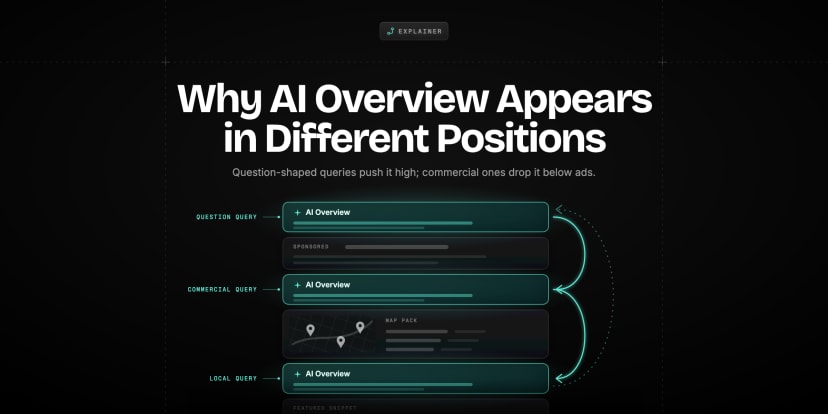
Overviews triggered on 13.7% of the trending queries measured, but on 64.7% of question-form queries. The gap is the single most useful planning number available, because it says the exposure is concentrated almost entirely in questions rather than in keyword-style searches.
That concentration should shape where you spend effort. If roughly two thirds of question-form searches produce an Overview and only a small minority of searches overall do, then content built around the questions people actually ask is exposed to this surface far more often than content built around short commercial phrases. The targeting decision follows directly from the activation rate.
It also gives you a way to prioritise honestly rather than uniformly. Take the questions that matter commercially in your category, phrased as real questions, and treat those as the surface where Overview visibility is worth pursuing. For queries that rarely trigger an Overview, conventional ranking work remains the sensible investment, and pretending otherwise wastes budget.
There is a caveat worth stating so the numbers are not over-applied. The study sampled trending queries over a defined window, and activation varies by topic, with politically sensitive subjects triggering markedly less often. Your own category could sit meaningfully above or below the headline figure, which is an argument for measuring your own question set rather than adopting a global average as though it were local truth.
Also read: Google AI Mode versus regular search, which covers how the different Google surfaces behave and where each one draws from.
Can a Page Be Cited Without Ranking on Page One?

Yes, and this is now measured rather than merely observed. Nearly 30% of domains cited in AI Overviews did not appear in the first-page results shown with them, which means citation is regularly awarded to sources that were not among the visible top results for that query.
This is the finding with the most strategic value in the whole study, particularly for sites that cannot realistically win the most competitive positions. It establishes that ranking is not a gate. A page that answers a specific question more directly and more completely than the prominent results can be selected without occupying one of those positions.
It should not be over-read into a promise. Those cited domains were assessed as more credible on average than the first-page results, so this is not a route by which weak sites bypass quality. The honest summary is that the selection step rewards being the best available answer to that precise question, judged on credibility and substance rather than on where you sit in a list.
For smaller and more specialised sites, that combination is genuinely encouraging, because depth on a narrow subject is achievable in a way that outranking a major publisher across a broad head term is not. The route in is precision: pages that address one specific question thoroughly, from a source with a real claim to know the answer.
The corollary is a diagnostic you can run today. If competitors are cited for questions where you are not, the useful thing to determine is whether your page is genuinely a more complete answer to that exact question, not whether it ranks higher, because the second measure was never the one being applied. This is the pattern examined in why page-one pages miss AI Overviews.
What Does Google Say About How Its AI Selects Content?
Google's position is that AI Overviews rest on its existing core ranking systems and that the same people-first quality guidance applies, with no separate AI-only optimisation to pursue. Its published documentation describes the ranking systems in general terms rather than the selection step specifically.
The Search Central documentation on ranking systems is worth reading directly rather than through summaries, because it is the only first-party account available and it is more restrained than most commentary about it. It describes the core systems that inform ranking generally. It does not document how the citation step chooses among candidates, which is precisely the gap independent measurement is now filling.
Taking Google at its word on the foundation is reasonable. The guidance to write genuinely helpful, well-sourced content is not a deflection, and the alternative theories tend to assume a hidden lever that nobody has ever demonstrated. Where the official account is simply silent is on the second stage, and silence is not evidence of equivalence with ranking.
That is why both sources belong in your model. Use Google's documentation for the fundamentals that determine whether you are considered at all, and use independent measurement for what happens after, since that is the part the documentation does not address and the part where the surprising behaviour lives.
Which Popular AI Ranking "Signals" Does the Evidence Not Support?
Two in particular. Schema markup is routinely described as a direct citation lever, and controlled testing indicates formatting-level changes do little on their own. Engagement metrics such as bounce rate and time on page are widely cited as AI ranking signals despite Google repeatedly stating it does not use them that way.
Take schema first, because the advice is so widespread. Structured data genuinely helps systems parse and understand a page, which supports being indexed and considered, and that is a real benefit worth having. What it does not appear to be is the thing that decides which candidate gets cited. Controlled comparison of content factors found formatting-only differences had little measured effect on citation, while topical relevance dominated. Add schema where it genuinely applies, then spend the remaining effort on relevance and substance.
The engagement claim is weaker still and deserves retiring. Google has stated for years that it does not use bounce rate or dwell time from analytics as ranking signals, and no independent measurement of AI Overviews has established them as citation factors either. The belief persists because the correlation is real and the causation is backwards: pages that answer well tend to hold attention, rather than held attention causing selection.
This matters beyond tidiness, because both myths are expensive. They direct effort toward measurable-feeling tasks that produce dashboards and no citations, and they are especially attractive to teams under pressure to show activity. The uncomfortable truth is that the highest-leverage work, narrowing a page's focus and answering one question completely, looks less like optimisation and more like writing.
Also read: What actually affects AI search visibility, which separates the claims with evidence behind them from the ones that merely circulate widely.
How Accurate Are AI Overviews, and Why Should You Care?

Decomposing Overview responses into 98,020 atomic claims, researchers found 11.0% were not supported by the pages cited, with omission the dominant failure mode. Source quality and claim fidelity were largely independent, so citing good sources did not prevent the answer from misstating them.
The reason this belongs in a guide about ranking is that it changes what a citation is worth to you. Being cited does not guarantee you are represented accurately, and the dominant failure being omission means the most likely distortion is a claim of yours reproduced without the condition or qualification that made it true. Your carefully hedged statement can arrive in front of a reader as a flat assertion.
There is a defensive implication and a constructive one. Defensively, if your category involves anything where a missing qualifier matters, such as pricing, eligibility, safety or compliance, monitoring how you are described is not a vanity exercise. Constructively, writing so that the important qualification sits inside the same sentence as the claim, rather than in a following sentence, makes your material harder to strip of context when a passage is lifted.
The finding that source quality and claim fidelity are largely independent also punctures a comfortable assumption. Being a high-quality source does not protect you from being summarised badly. That is a limitation of the system rather than a failure of your page, and the only practical mitigation is writing passages that survive extraction intact.
What Does Citation Actually Deliver When the Click Disappears?
Often less than it appears to, and this is measured too. Well over half of the cited pages in the study carried display advertising, so when an Overview answers the question and suppresses the click, the publisher loses the revenue that visit would have produced, while Google's own sponsored ads keep appearing on the same results page.
This reframes citation as a mixed outcome rather than an unambiguous prize, and it is worth being clear-eyed about it. A citation buys you influence and a named mention inside the answer. It frequently does not buy you the visit, and for any business whose model depends on that visit converting, the two are not interchangeable. Treating a rise in citations as if it were a rise in traffic is a category error that will not survive contact with your analytics.
The practical response is to separate the two goals and value each honestly. If your objective is brand presence and being the source of record in your category, citation without a click still delivers real value, because you are shaping what the reader is told. If your objective is measured in sessions and conversions, you have to weigh Overview visibility against the click it may be replacing, and decide where each page sits on that spectrum.
It also argues for making the on-page destination worth the minority of clicks that do arrive. When an Overview cites you, the readers who click through are, by definition, the ones the summary did not fully satisfy, which means they arrive with a more specific need. A page built to answer the follow-up, not merely repeat the summary, converts that narrower traffic better than one that simply restates what the Overview already said.
What Is the Most Effective Strategy Given the Evidence?
Target question-form queries where activation is highest, make each page the most complete answer to one specific question, ensure the qualifications travel with the claims, and keep the conventional search fundamentals that get you into the candidate pool in the first place.
Start with the question set, because activation data makes this the highest-yield targeting decision available. Identify the real questions in your category, phrased as people ask them, and prioritise the ones that precede a commercial decision. Those are the searches where an Overview is most likely to appear, and therefore where citation is worth competing for at all.
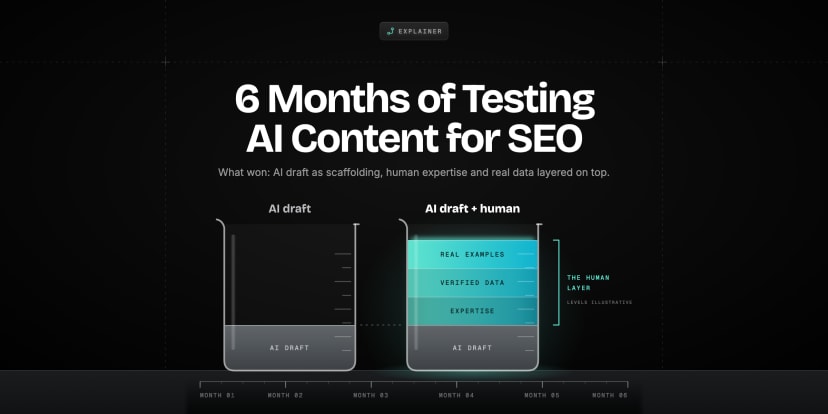
Then make the page unambiguously about that question. The recurring evidence across studies points the same way: precision of topical match matters more than presentation. A page covering a subject broadly is moderately relevant to many questions and precisely relevant to none, and precision is what the selection step rewards.
Write the answer to survive extraction. The opening passage under each heading should answer the heading completely and make sense on its own, with any necessary condition stated inside the same sentence rather than after it. That single habit serves both selection and the fidelity problem, which is unusual for a piece of writing advice.
Keep the fundamentals running underneath all of it. Crawlability, indexation and genuine topical depth determine whether you are in the pool, and no amount of answer-shaping helps a page that was never considered. Our guide to AI ranking factors in 2026 covers that base layer, and how to get pages featured in Google AI Overviews covers the answer-shaping work in practice.
What this adds up to is less exotic than most AI visibility advice. Be genuinely the best answer to a specific question, from a source with a credible claim to know, and be structured so that the answer can be lifted without breaking. There is no evidence of a lever that substitutes for that.
How Do You Track Whether Any of This Is Working?

Fix a set of question-form queries, record for each whether an Overview appeared, whether you were cited, and which domains were, then re-check on a schedule. Because Overviews vary between runs and need a recrawl to reflect edits, only repeated measurement over weeks means anything.
Record the activation state, not just your presence. Whether an Overview appeared at all is information: a query that rarely triggers one is not a failure of your content and should not be treated as a target. Mixing those two cases together is the fastest way to draw wrong conclusions about which pages are underperforming.
Track the competing domains alongside yourself, because that column tells you what standard is actually being applied to your query. If the cited domains are consistently more specialised or more thorough than your page, that is a clearer instruction than any ranking report, and it usually points to depth rather than presentation.
Track clicks and citations as separate lines rather than collapsing them into one number. Because a cited answer frequently satisfies the reader without a visit, citation share and referral traffic can move in opposite directions, and a report that blends them hides exactly the trade-off you need to see. Watching them side by side tells you whether a page is winning presence, winning visits, or winning one at the expense of the other, which is the distinction that should drive whether you optimise it for the answer box or for the click.
Give changes time to register and keep a log of what you changed and when. Edits need recrawling before they can affect selection, so a check run days after a rewrite measures the old page. Without a change log, any movement you eventually see cannot be attributed to anything, which quietly makes the whole exercise unfalsifiable.
Use first-party data for the retrieval side. Google Search Console tells you whether the pages you are optimising are indexed and appearing for the queries at all, which is the precondition everything else depends on. If a page is not indexed, no amount of answer-shaping will place it in an Overview. If you would rather begin from a prepared baseline than assemble one, Rank in AI Overview provides a free AI visibility check showing which of your questions currently cite you.
Conclusion
Google AI rankings are less mysterious in 2026 than they were, mostly because they can now be measured rather than only inferred. Overviews appear on a minority of searches but on most question-form ones. Selection draws on credible sources yet regularly reaches past the visible first page. Answers built from those sources drop supporting qualifications more often than anyone would like. None of that is folklore now; it is documented behaviour.
The strategy that follows is unglamorous and durable. Compete on the questions where Overviews actually appear, make each page the most complete answer to one of them, keep the qualifications attached to the claims, maintain the search fundamentals that put you in the pool, and measure a fixed question set over weeks instead of reacting to single checks. Skip the levers that sound technical and lack evidence, because their main effect is on your calendar.
Rank in AI Overview tracks how answer engines choose, cite and represent the sources they draw on, with an AI visibility tool arriving shortly. To see which questions currently name you in an Overview and which name a competitor, begin with a free AI visibility audit.
Frequently asked questions
Does ranking first on Google guarantee an AI Overview citation?+
No. Measurement found nearly 30% of cited domains did not appear in the first-page results shown alongside the Overview, so selection is not a re-ranking of the visible top results and position alone does not decide it.
Are AI Overviews a completely separate algorithm?+
Not completely. Google describes them as built on its core ranking systems, which likely determine the candidate pool. Independent measurement indicates the step that chooses which candidates get cited applies criteria distinct from ranking order.
How often do AI Overviews actually appear?+
In a large study of trending queries, they appeared on 13.7% of searches overall but 64.7% of question-form queries. Activation varies considerably by topic, so measuring your own category matters more than the average.
Does schema markup improve AI Overview citation?+
It helps systems understand and index your content, which supports being considered. Controlled testing of content factors found formatting-level changes had little direct effect on which candidate gets cited, so treat schema as groundwork rather than strategy.
Do bounce rate and time on page affect AI rankings?+
There is no good evidence that they do. Google has repeatedly stated it does not use those analytics metrics as ranking signals, and the apparent link is better explained by good answers holding attention rather than attention causing selection.
Can AI Overviews misrepresent my content?+
Yes. Researchers found 11.0% of atomic claims were unsupported by the cited pages, with omission the most common failure, meaning qualifications can be dropped. Keeping conditions inside the same sentence as the claim reduces the risk.
Explore with AI
Share this