Why Is My Traffic Dropping as People Use AI Instead of Google?
Stable rankings but falling clicks? Why AI search drains traffic, whether it is gone for good, and how to recover with a citation-first plan.

Key Highlights
- Traffic can fall while rankings hold, because AI answers resolve the query before anyone clicks through to your page.
- The honest research picture is messier than the headlines: gains from AI-visibility tactics are real but narrow, and durable traffic effects are not yet proven.
- Zero-click behaviour is the mechanism draining informational visits, not a penalty or a broken tag on your site.
- The traffic AI does forward tends to arrive later in the buying journey, so it converts better than a raw session count suggests.
- Recovery means being the source AI engines quote, not out-shouting the answer box.
- New scoreboards matter now: citation share, AI referral quality, and branded search growth sit beside classic organic clicks.
You open your analytics, and the trend line keeps sinking. Positions look steady, nothing technical has broken, yet organic visits keep leaking away week after week. It is unsettling, because the familiar SEO explanations simply do not fit the evidence in front of you. According to a 2026 critical survey of Generative Engine Optimization published on arXiv, researchers reviewed 45 studies and concluded that no reviewed technique yet shows a stable, longitudinal, cross-platform causal effect on organic discoverability. In plain terms, the ground under search is moving faster than anyone has cleanly measured.
That uncertainty is precisely why your dashboard feels so confusing. A larger slice of searches now ends inside an AI answer, whether that is a Google AI Overview or a chat with ChatGPT. People collect what they need and never travel to the source, which quietly erodes the visits that steady rankings used to guarantee. You are not imagining the drop, and you are not being penalised. You are watching a behavioural shift reshape an entire channel.
This guide walks through what is actually causing the decline and what to do about it. It covers why rankings and clicks have decoupled, how AI is rewriting search behaviour, what the research really supports, whether your lost traffic is recoverable, a practical plan to adapt, and how to measure progress when the old metrics mislead. For the wider strategic context, our companion piece on why Google ranking is becoming less decisive pairs well with the tactics below.
Why Is My Website Traffic Dropping Even Though My Rankings Have Not Changed?
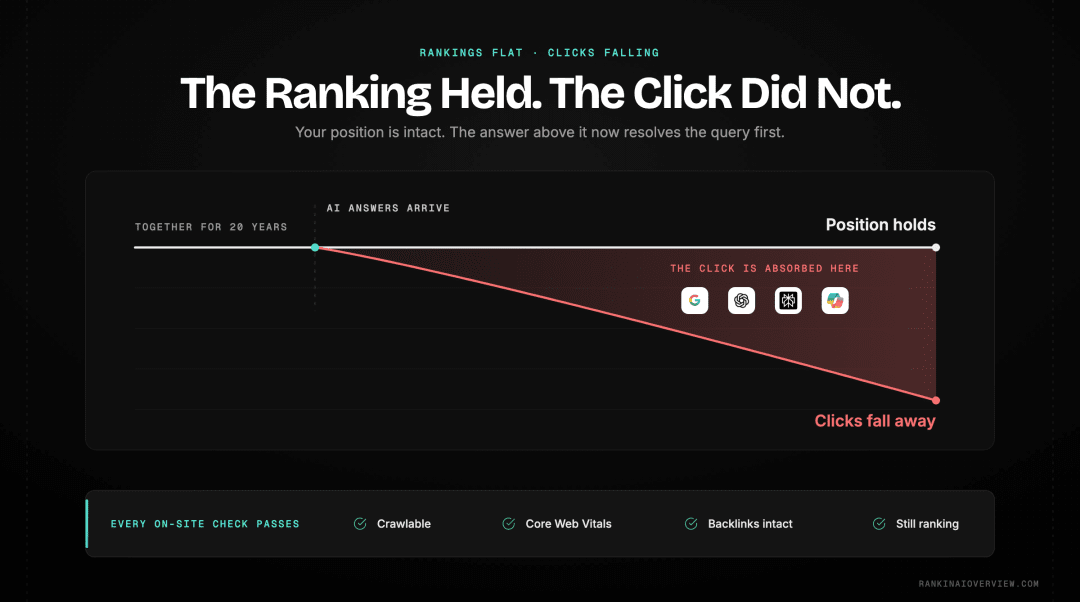
Your traffic is dropping because a ranking no longer reliably produces a click. AI answers now resolve many queries on the results page or inside a chatbot, so users get their answer without visiting any site. Your position can hold perfectly while the click it once earned quietly disappears.
For two decades, the logic of search was simple. Rank near the top, and a predictable share of searchers would click. That relationship is what SEO reporting was built on. AI has broken the link between the two. The position is still yours, but the outcome it used to buy, a visit, is increasingly absorbed before it reaches you.
This is why the fall feels so mysterious. Every classic diagnostic comes back clean. Crawlability is fine, Core Web Vitals are green, backlinks are intact, and the keyword still ranks. The problem lives outside your site entirely. It sits in the gap between appearing in results and earning the click, a gap that AI answers now fill.
Informational content is hit hardest. Definitions, how-to explainers, and simple comparisons are exactly what an AI Overview can summarise in a sentence or two. If a reader can get the whole answer without leaving the results, most will. Pages that once pulled steady top-of-funnel traffic are the first to feel the drain, which is why the decline often looks concentrated rather than uniform.
How Is AI Changing the Way People Actually Search?
AI is changing search by delivering direct answers instead of a list of links. Tools like Google AI Overviews, ChatGPT, and Perplexity read the query, synthesise a response, and present it immediately. The search now ends in a conversation or a summary, so the click becomes optional rather than the default next step.
The behavioural shift runs deeper than one feature. Searchers are learning a new habit. Instead of scanning ten blue links, they ask a question in natural language and expect a composed answer. A follow-up question refines it. The whole task can finish inside Perplexity or ChatGPT without a single visit to a traditional website.
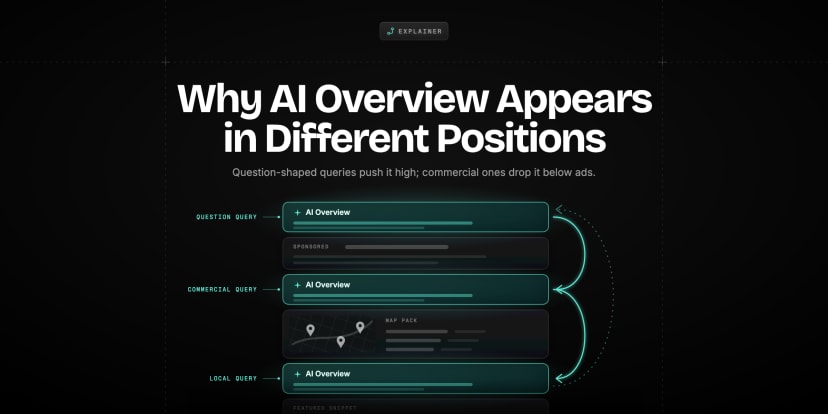
Google has folded the same pattern into its own results. When a Google AI Overview appears, the summary sits above the organic listings and answers the query first. The links still exist below, but they now compete with an answer that has already satisfied most readers. That reordering of attention is the quiet engine behind falling click-through.
Microsoft has pushed in the same direction through Copilot, which threads AI answers through Bing and Windows. Across all these surfaces the message to publishers is consistent. Being retrievable and quotable by the model now matters as much as ranking, because the model, not the reader, decides which sources make it into the answer. Our overview of AI visibility versus traditional SEO explores how that changes day-to-day priorities.
There is a second-order effect worth naming. Because the model chooses sources, a page can be read, summarised, and paraphrased without ever being clicked or credited visibly. Your content can shape an answer while sending you no visit at all. That is a genuinely new relationship between content and traffic, and it explains why effort and reward feel disconnected right now.
What Does the Research Really Say About AI and Lost Clicks?
The research says the effect is real but not as clean as the headlines suggest. Studies consistently find that AI answers absorb clicks, especially for informational queries. Yet the same body of work warns that visibility tactics show narrow, inconsistent, and often short-lived effects, so nobody has cleanly proven durable traffic recovery.
This is where careful reading matters. It is tempting to grab a single dramatic percentage and treat it as settled science. The evidence does not support that confidence. The arXiv survey above examined 45 studies and found that the widely cited early gains from optimisation were valid only within their specific experimental setups, conditional on a source already sitting inside a fixed context.
"The foundational paper's widely cited gains are valid within its experimental setting but conditional on a source already being present in a fixed context; they establish neither organic discoverability nor durable traffic effects." Olivier Martinez, author, Critical Survey of Generative Engine Optimization. Source: arXiv
Read that carefully, because it reframes the whole problem. Getting quoted once, in one test, is not the same as reliably earning discovery and durable traffic across platforms over time. The survey also notes that generic optimisation heuristics transfer poorly between engines, that competition can erode any individual gain, and that citation-focused rewrites can even harm retrieval. There is no universal lever you can pull.
The practical takeaway is liberating rather than gloomy. If the experts cannot yet promise a repeatable formula, you are not failing by lacking one. The sensible response is to test, measure, and hold sources loosely, not to chase whatever tactic went viral last week. The most reproducible levers the survey identifies, topical relevance and strong context positioning, happen to be the fundamentals good publishers already understand.
So if your informational pages have shed traffic while keeping their rankings, this decoupling is almost certainly the cause. It is a structural change in how answers reach people, not a fault in your work. Naming the real mechanism lets you respond to the actual problem instead of auditing a healthy site for issues that were never there.
How Do I Confirm AI Search Is the Real Cause and Not Something Else?
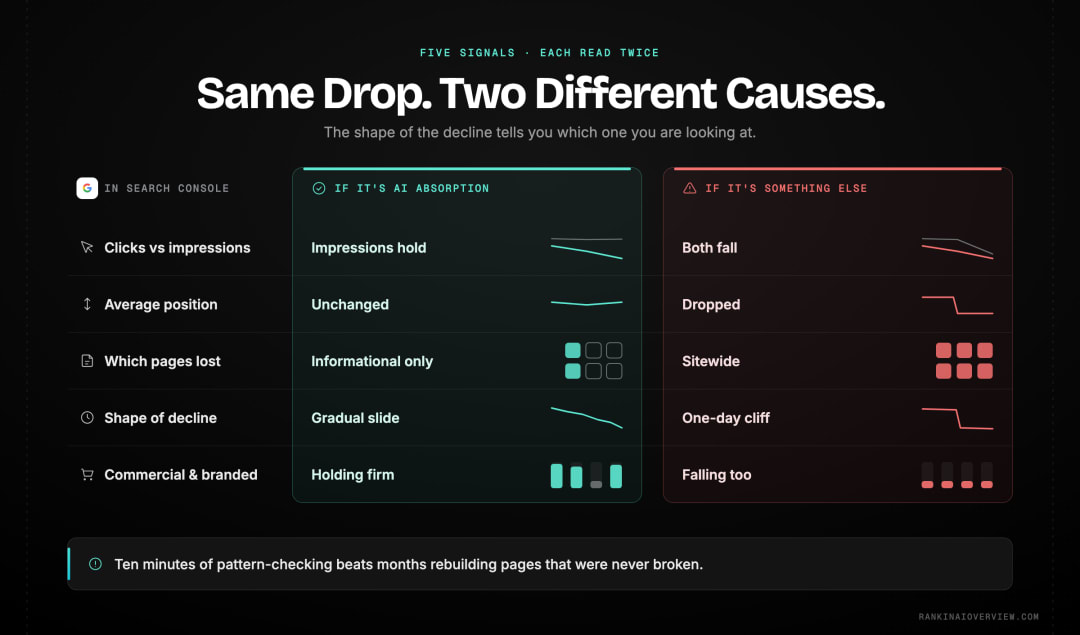
Confirm it by studying the shape of the decline, not just its size. AI absorption leaves a distinct fingerprint: impressions hold steady, average position stays flat, and clicks fall anyway. A core update, a technical fault, or plain seasonality each marks your data differently, so compare patterns before you rebuild anything.
This step matters because the wrong diagnosis wastes months. Teams often respond to an AI-driven decline by rewriting healthy pages or chasing links they do not need. Others blame AI when a genuine technical regression is quietly blocking crawlers. Ten minutes of pattern-checking in Google Search Console protects you from both mistakes.
Start with the impressions-to-clicks relationship. If impressions are stable or rising while clicks fall, your content is still being served to searchers who no longer click. That divergence is the clearest single signal of answer absorption. If impressions fell alongside clicks, something changed in your visibility instead, and you should look at updates, indexing, or lost coverage.
| What you observe | Points to AI absorption | Points to a different cause |
|---|---|---|
| Impressions steady, clicks falling | Strong signal | Weak signal |
| Average position unchanged | Strong signal | A position drop suggests an update or lost links |
| Losses concentrated in informational pages | Strong signal | Sitewide losses suggest technical or quality issues |
| Gradual slide across weeks or months | Strong signal | A sharp single-day cliff suggests an update or outage |
| Commercial and branded pages holding firm | Strong signal | Uniform loss across all intents suggests a site-level fault |
Next, check the timing and the spread. Algorithmic updates tend to produce sudden, dated cliffs that align with a known rollout. AI absorption behaves more like erosion, a steady monthly slide that never quite stops. If your drop is concentrated in explainer content while product and comparison pages hold firm, that intent-shaped pattern points squarely at answer engines rather than a penalty.
Finally, rule out the boring explanations before accepting the interesting one. Verify that tracking scripts still fire, that no robots directive changed, that a migration did not break redirects, and that the period you are comparing is not distorted by seasonality. Once those are clean and the fingerprint above still matches, you can act on the AI hypothesis with genuine confidence.
Is the Traffic I Have Lost to AI Search Gone for Good?
Not entirely. Some purely informational click traffic is permanently absorbed by AI answers and will not return in its old form. But you can recover real value by becoming the cited source inside those answers and by capturing the smaller, higher-intent stream of visits AI still forwards. The channel is relocating, not vanishing.
Two things are true at the same moment, and holding both is the key to a calm strategy. The old model, where a strong ranking reliably minted a click, is fading for many query types. Meanwhile a new model is forming, where being quoted in AI answers builds awareness and sends fewer but more committed visitors. Adapting means moving effort from the fading model toward the emerging one.
The quality of AI-referred traffic is the encouraging part of the story. When someone arrives from an AI conversation, they have often already done their research inside the chat. They understand the category, they have compared options, and they land on your page closer to a decision. Fewer visits, but warmer ones, which changes how you should judge success. Our guide to AI visibility metrics sets out how to track that shift properly.
It also helps to separate query types honestly. Thin informational lookups, the "what is" and "how to" fragments, are the visits most likely gone for good, because an AI answer serves them perfectly. Commercial and comparison queries are different. There, users still want to click, evaluate, and buy, so those visits remain valuable and worth defending. Sorting your pages along this line tells you where to stop grieving and where to double down.
Also read: Why AI search does not have rankings like Google, which explains why a simple "get to position one" mindset no longer maps to how answers are assembled.
How Do I Recover Traffic When AI Answers Absorb the Click?
You recover by optimising to be the source AI engines quote, shifting some focus from raw click volume to citation and brand presence, and leaning into the high-intent visits AI still sends. In short, you adapt content and measurement for a world where being inside the answer matters as much as ranking above it.
None of this means abandoning SEO. Strong fundamentals still decide whether a model can find, trust, and retrieve you in the first place. The shift is additive. You keep doing the technical and editorial work that earns rankings, and you layer on the practices that make your content easy to quote. Think of it as widening the goal, not swapping goals.
How Do I Become a Source That AI Engines Actually Cite?
You become citable by making your key claims easy to extract and trust. Lead sections with a direct, self-contained answer. Support it with clear structure, specific figures, named entities, and visible sourcing. Models favour content they can lift cleanly and stand behind, so clarity and evidence beat clever phrasing.
A few concrete moves consistently help, and they align with the reproducible levers the research actually supports:
- Answer first, then expand. Open each section with a tight, quotable statement before you elaborate, so a model can lift it without stripping context.
- Strengthen topical depth. Cover a subject thoroughly rather than thinly, since topical relevance is one of the few levers that transfers across engines.
- Add unambiguous evidence. Attach specific numbers, dates, and named sources to your claims, because verifiable statements are safer for a model to cite.
- Build entity clarity. Make sure your brand, authors, and products are consistently named and described, so engines can recognise and attribute you.
- Keep answers current. Refresh figures and examples, since stale content is quietly demoted when newer, cleaner sources exist.
Technical accessibility underpins all of it. A model can only quote what it can fetch and parse, so content hidden behind heavy client-side rendering, aggressive interstitials, or login walls is effectively invisible no matter how good it is. Clean server-rendered HTML, sensible headings, and accurate structured data give retrieval systems a clear path through your page. The guidance in Google Search Central remains the sane baseline here, because the fundamentals that help a crawler also help a model.
Set expectations on timing as well. Citation behaviour shifts slowly and unevenly, so improvements rarely show up within days. Give changes a full measurement cycle before judging them, and expect results to differ between engines rather than moving together. Patience is not passivity here, it is the only way to read genuinely noisy data without overreacting to it.
Which Pages Should I Prioritise First?
Prioritise pages that either still earn valuable clicks or shape high-stakes decisions. Protect your commercial and comparison content first, because those visits convert and are least likely to be fully absorbed. Then reinforce the informational pages that establish your authority and feed your brand into AI answers.
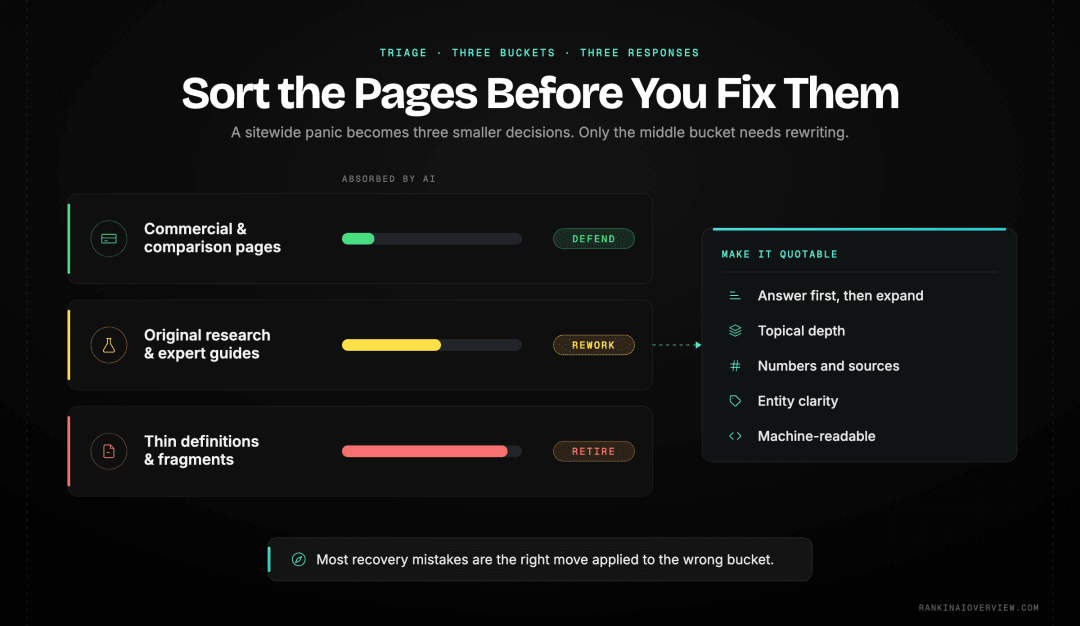
A simple triage keeps the work focused. Start by tagging pages into three buckets, then treat each bucket differently rather than applying one blanket strategy across the site.
| Page type | Example | What AI does to it | Your move |
|---|---|---|---|
| High-intent commercial | Pricing, comparisons, product pages | Rarely fully absorbed, users still click to evaluate | Defend and deepen, protect conversion paths |
| Authority-building informational | Original research, expert guides, data studies | Frequently quoted, feeds brand into answers | Rework to be maximally quotable and citable |
| Thin informational | Short definitions, basic how-to fragments | Almost entirely absorbed by the answer box | Consolidate, or stop investing further |
Defend and deepen the first, rework the second to be maximally quotable, and stop pouring effort into the third if an AI answer already serves that need better than a full article ever could. Consolidating several thin pages into one substantial resource often works better than maintaining them separately, because depth is what earns citation. This is repositioning toward where attention is genuinely moving, not a defensive retreat. To see how visible you already are in the answers absorbing your clicks, Rank in AI Overview offers a free AI-visibility check that maps your current citation footprint.
What Mistakes Make an AI-Driven Traffic Drop Worse?
The costliest mistakes are panic-driven. Publishers delete or rewrite healthy pages, chase every new tactic without measuring, block AI crawlers on impulse, or judge the whole strategy on session counts alone. Each response treats a structural change as an emergency, and each one usually deepens the decline it was meant to reverse.
Knowing what to avoid is as valuable as knowing what to do, because a falling graph creates pressure to act quickly. These are the patterns that reliably backfire:
- Rewriting pages that are still performing. If a page holds its position and still earns commercial clicks, large rewrites risk the rankings you kept. Change presentation and structure before you touch substance.
- Blocking AI crawlers reflexively. Shutting out AI bots stops your content being absorbed, but it also removes you from the answers that build awareness. Weigh that trade honestly rather than treating it as an obvious win.
- Chasing tactics with no baseline. Without a recorded starting point, you cannot separate a genuine improvement from ordinary run-to-run variance. The research repeatedly warns how noisy these measurements are.
- Publishing more thin content faster. Volume was a workable answer to ranking pressure. It is a poor answer to citation pressure, where depth and verifiable evidence decide whether a model quotes you.
- Reporting sessions alone to leadership. A sessions-only narrative frames a channel shift as a failure, invites budget cuts, and removes the resources needed to adapt.
There is also a subtler error worth naming: treating AI visibility as a separate project bolted onto SEO. The two share the same foundations, since a model can only quote content it can crawl, parse, and trust. Teams that run them as rival programmes duplicate effort and send mixed signals, while teams that treat citation as an extension of quality tend to progress faster on both fronts.
Also read: AI visibility metrics worth tracking, which breaks down how to build that baseline before you start changing pages.
How Should I Measure Success When Clicks Fall but Value Rises?
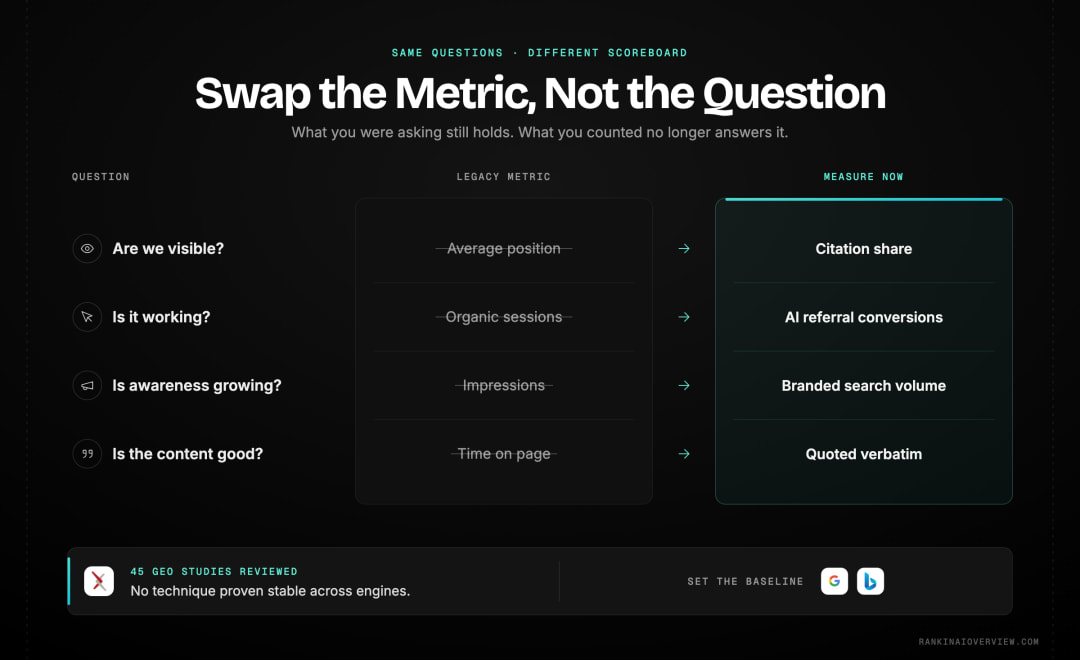
Measure success by tracking citation share, AI referral traffic and its conversion rate, and branded search growth, alongside your traditional organic numbers. As zero-click answers rise, raw sessions tell a shrinking part of the story. Presence inside answers, plus the quality of the visitors you do receive, carry more meaning now.
The old scoreboard of sessions and average position now hides as much as it reveals. A page can lose informational clicks while gaining awareness and high-intent visits through AI citation. A sessions-only view reads that as pure decline, when the underlying business result may be flat or improving. Adding citation and conversion measures restores the missing half of the picture.
Practical instrumentation is becoming easier as the platforms respond. Microsoft's Bing Webmaster Tools has begun surfacing AI-related performance signals, giving publishers an early, first-party window into how their content shows up in AI-assisted results. Pairing that kind of source with your own analytics, and with guidance from Google Search Central, lets you separate AI referral behaviour from ordinary organic traffic rather than lumping it all together.
Reframe your reporting around outcomes, not raw counts. Ask three questions each period. Are you being quoted on the queries that matter to your business? Is the AI referral traffic you receive converting at a healthy rate? And is branded search rising as more people encounter your name inside answers? Those questions capture value that a sessions chart alone will always miss.
It helps to put the old and new scoreboards side by side, so nobody mistakes a changing metric for a failing strategy:
| Question | Legacy metric | Metric that matters now |
|---|---|---|
| Are we visible? | Average position | Citation share across answer engines |
| Is visibility working? | Organic sessions | AI referral visits and their conversion rate |
| Is awareness growing? | Impressions | Branded search volume over time |
| Is the content good enough? | Time on page | How often the content is quoted verbatim |
| Are we losing ground? | Traffic decline | Decline in citations relative to competitors |
Set a baseline before you change anything, because the value of these measures comes from the trend rather than a single reading. Record where you stand today across a defined set of priority queries, then re-measure on a fixed cadence. Without that baseline, you cannot tell recovery from noise, and the run-to-run variability that researchers repeatedly flag will make every reading look dramatic.
There is a cultural shift buried in this too. Teams that report only on traffic volume will keep sounding alarms about a decline that may not reflect lost revenue. Teams that report on presence, intent, and conversion can show where they are winning even as one metric falls. Choosing the right scoreboard protects both your strategy and your credibility with stakeholders.
Conclusion
If your traffic is sliding while your rankings hold, the most likely cause is the migration of search into AI answers. Google AI Overviews and chatbots resolve queries directly, absorbing the clicks that once flowed to your pages. The research confirms the effect is real, even as it warns against tidy formulas, and it is an industry-wide change rather than a fault on your end.
The wise response is not to fight the current but to move with it. Become the source AI engines quote, measure citation and referral quality rather than raw sessions alone, and value the warmer visitors AI forwards. Search is not disappearing. It is relocating into answers, and your task is to make sure your brand is inside them.
Rank in AI Overview publishes in-depth research on how AI engines weigh and cite brand authority, and is building an AI visibility tool that is coming soon. Curious where you stand today? Get your free AI visibility audit and see how the answer engines currently represent you.
Frequently asked questions
Why is my website traffic dropping even though my rankings are stable?+
Because a ranking no longer guarantees a click. AI Overviews and chatbots answer many queries directly, so users get what they need without visiting. Your position holds, but the click it once earned is absorbed at the source.
Do AI Overviews and chatbots really reduce website traffic?+
Yes, particularly for informational queries an AI answer can fully resolve. Research confirms clicks are absorbed when answers appear, though studies caution the size of the effect varies by query, platform, and how the measurement was done.
Is traffic lost to AI search gone permanently?+
Some thin informational click traffic is effectively gone, because an AI answer serves it better than a page. You can still recover value by being the cited source and by capturing the higher-intent visits AI continues to forward.
Does AI referral traffic convert better than normal organic traffic?+
Often yes. Visitors who arrive from an AI conversation have usually researched the topic already, so they land closer to a decision. You receive fewer sessions, but the intent behind each one tends to be noticeably stronger.
How do I recover traffic lost to AI search?+
Optimise to be quoted by AI engines, track citation and AI referral traffic beside clicks, protect high-intent commercial pages, and build clear brand and entity signals. Adapt your goals to a world where being in the answer matters.
Should I stop caring about Google rankings altogether?+
No. Rankings still decide whether a model can find and trust you, and they still feed AI Overviews. Broaden the goal instead, adding citation share and AI visibility so you are measured on presence in answers, not position alone.
Explore with AI
Share this