How to Get Your Website Cited in ChatGPT Answers
Controlled experiments show what actually earns a ChatGPT citation, and it is not what most guides claim. Here is what the evidence supports.

Key Highlights
- Controlled testing shows topical relevance and position in the retrieved set dominate citation choice, while formatting-only changes contribute very little on their own.
- Being retrieved and being cited are two separate battles, and most advice collapses them into one, which is why so much citation work produces no result.
- Explicit specifics inside the page, such as concrete figures and a recent date, measurably improve the odds of being the source named first.
- Off-site presence still matters, but as the route into the retrieved set, not as a direct lever on which retrieved page gets quoted.
- Schema and clean structure are worth doing for retrievability, but treating them as the citation strategy is the most common expensive mistake in 2026.
- You cannot manage this without a fixed question set tracked over time, because single checks are unreliable in both directions.
ChatGPT now answers the research questions that used to begin in a search box, and when it browses it names a small number of sources. If your site is never among them, you are absent from a moment where the reader is actively deciding, and absent in a way your analytics will not show you. That invisibility is the problem. The deeper problem is that almost nobody can tell you why it happens, so teams optimise on folklore.
According to a controlled study of competitive generative engine optimisation published on arXiv, researchers ran 252,000 paired trials across six large language models, varying 18 content factors one at a time to isolate what makes one retrieved source get cited ahead of another. Their finding is blunt and inconvenient: topical relevance and position in the retrieved set are the biggest drivers, explicit figures and a recent timestamp help consistently, and formatting-only edits have little impact. A great deal of published citation advice is aimed squarely at that last category.
This guide works through what the evidence actually supports. It covers when ChatGPT browses and when it does not, what decides which retrieved source gets named, which changes to your pages are worth making and which are close to decorative, what off-site presence really contributes, how citation differs from ranking, and how to track any of it honestly. Our data-backed look at how often ChatGPT cites sources is a useful companion to what follows.
Does ChatGPT Actually Browse the Web for Answers?
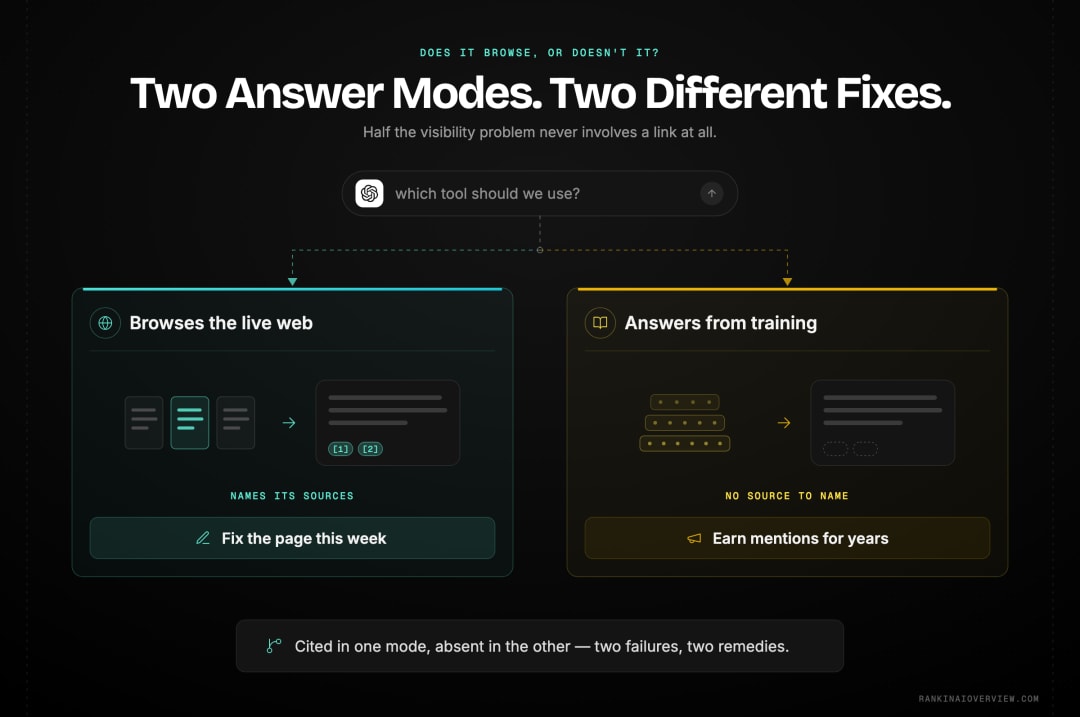
Sometimes. ChatGPT answers many questions from what the model already learned during training and browses the live web for others, typically when a question is current, specific or clearly beyond its training. Only browsed answers produce citations, which means half the visibility problem never involves a link at all.
That split matters more than it first appears, because the two modes reward completely different work. In a browsed answer, you are competing to be retrieved and then quoted, which is a content and retrievability problem you can act on this week. In a non-browsed answer, there is nothing to retrieve. What surfaces is whatever the model absorbed about your category during training, and your brand either features in that or it does not.
The second mode is slower and considerably less controllable, which is why most practical guidance quietly ignores it. It is still worth understanding, because it explains a pattern that frustrates a lot of teams: a brand can be cited reliably when the engine browses and be entirely absent from answers where it does not, or the reverse. Those are two different failures with two different remedies, and treating them as one produces confused strategy.
A useful way to hold this is that browsing rewards the page while training rewards the reputation. You improve the first by making a specific page the best available answer to a specific question. You improve the second only by being written about, referenced and described consistently across the web over a long period, which no on-page change can shortcut.
For the rest of this guide the focus is browsed answers, because that is where the mechanism is now measurable and where changes you make have observable effects within a reasonable timeframe.
What Actually Decides Which Source Gets Cited?
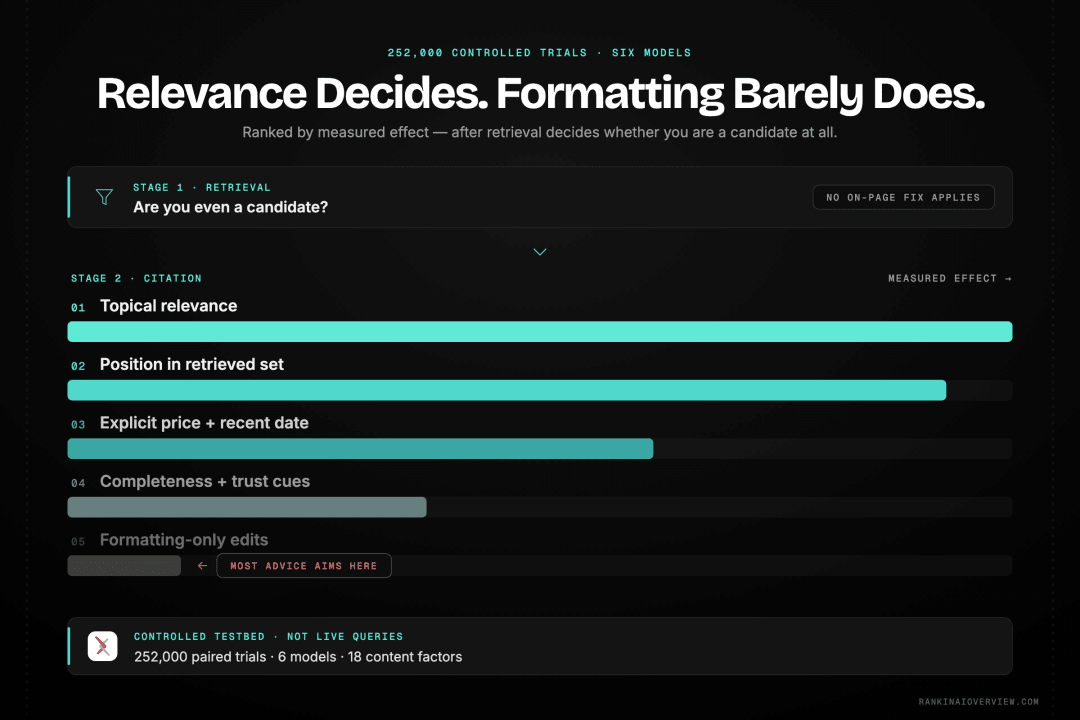
Two things dominate: how closely the page matches the specific question, and where it sits in the set of pages retrieved for that question. Everything else, including trust cues and completeness, contributes smaller gains, and purely cosmetic formatting changes contribute close to nothing.
The study behind this is worth understanding because of how it was built. Rather than observing live answers and guessing at causes, the researchers constructed a controlled environment that injected exactly two candidate sources into the model's context, varied them in precisely one factor at a time, anonymised brands and counterbalanced the order to separate genuine content effects from simple position bias. That design is what allows a causal claim rather than a correlation.
"Mixed-effects models show that topical relevance and list position are the biggest drivers of being cited first. Including explicit price information and a recent timestamp also helps consistently. Completeness and trust cues add smaller gains, while formatting-only edits have little impact." Rahul Vishwakarma, Shushant Kumar and Ratnesh Jamidar, authors, What Gets Cited: Competitive GEO in AI Answer Engines. Source: arXiv
Read that ordering carefully, because it inverts how most teams spend their time. Topical relevance sits at the top, which means the highest-leverage change is usually not a new schema block but narrowing what a page is about until it matches one question precisely. A page trying to serve five related questions is less relevant to each of them than a page serving one.
The finding about explicit specifics is the most immediately actionable. Concrete figures and a visible recent date consistently improved the chance of being cited first. This is a small, cheap edit with a measured effect, and it points at a broader principle: pages that state things definitely are easier to quote than pages that hedge. An engine assembling an answer needs something it can assert, and vague prose gives it nothing to lift.
One honest caveat belongs here, because the study earns it. This was a controlled two-document testbed, not a live observation of ChatGPT answering real users, and list position is partly a property of the retrieval system rather than of your page. So treat the factor ranking as a well-evidenced guide to where effort pays, not as a promise about any individual query. The direction is solid; the magnitude in your niche is yours to measure.
Why Are Retrieval and Citation Two Separate Problems?
Because being retrieved and being quoted are decided at different stages. Retrieval determines whether your page is in the candidate set at all, which depends on crawlability, indexation and topical coverage. Citation then decides which of those candidates gets named, which depends mainly on relevance and specificity.
Almost every ineffective citation strategy comes from collapsing these two stages into one. A team adds structured data, tidies its headings, and sees nothing change, then concludes that AI visibility is arbitrary. Often the real situation is that the page was never retrieved for the question in the first place, so no amount of on-page polish could have mattered. The work was aimed at the second stage while the failure was at the first.
The diagnostic question is therefore not "why was I not cited" but "was I ever a candidate". If your page does not appear in conventional search results for the question, is not indexed, or is not genuinely about that question, the citation stage never gets to consider you.
| Stage | What decides it | What to change |
|---|---|---|
| Retrieval | Crawlability, indexation, topical coverage, general web presence | Technical access, genuine topical depth, off-site presence |
| Citation | Topical relevance to the exact question, position in candidate set, explicit specifics | Narrow the page's focus, lead with the answer, add concrete figures and dates |
| Absorption | How quotable and self-contained the passage is | Self-contained passages, definite statements, clear structure |
Separating the stages also tells you which failure you are looking at. If competitors are cited for questions where you are not even in the search results, that is a retrieval problem and no amount of rewriting will fix it. If you rank well but are never quoted, that is a citation problem, and the levers in the previous section are the right ones.
Also read: Page ranks on Google but not in AI? Fix these five things first, which walks through the diagnostic order when the two stages disagree.
Which Kinds of Sources Does ChatGPT Cite Most Often?
Official pages, established publications and specialist vertical sites make up the large majority of citations across answer engines. Source identity works mainly as an entry condition, deciding who gets considered, rather than as a guarantee of being quoted once several credible candidates are in the running.
That distinction between entry and outcome is the useful part. Being a recognised source in your category gets you into the candidate set consistently, which is genuinely valuable and takes time to build. It does not mean you will be the source quoted, because at that point the comparison is between credible candidates and the deciding factors become relevance and specificity again.
Community discussion and reference platforms feature heavily, and the usual conclusion drawn from this is that you should go and post on them. That is worth doing only in the honest version, where you participate because you know the subject and your answers help. The reason those sources perform well is not the platform, it is that their content answers narrow questions directly, in specific terms, from apparent experience. That property is transferable to your own site, which is where you actually control it.
Encyclopedic and reference material shows a further wrinkle worth knowing. Measurement work on citation influence has found that news media, despite being cited often, tends to contribute less to the substance of the final answer than reference pages do. Appearing in an answer and shaping an answer are not the same achievement, and a strategy aimed only at appearing can succeed on its own terms while changing nothing about what readers are told.
The practical reading is to stop sorting sources by prestige and start sorting them by function. What earns consistent citation is being the kind of page that answers a specific question definitively, published somewhere credible enough to be considered in the first place.
Which On-Page Changes Are Genuinely Worth Making?
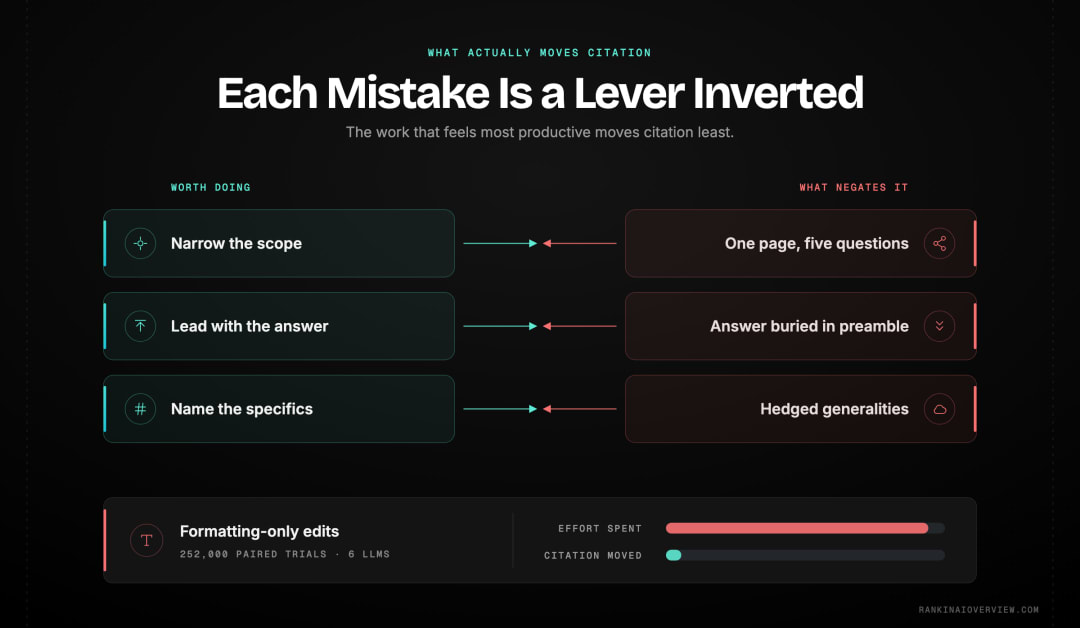
Focus each page on one question, lead with a direct and complete answer, and include concrete specifics such as figures and a recent date. Structural work like clean headings and schema is worth doing for retrievability and readers, but the evidence indicates formatting alone does not win citations.
This deserves stating plainly because it contradicts a lot of confident advice, including the earlier version of this very guide. Schema markup is frequently sold as a citation lever. In controlled comparison, formatting-only differences had little effect on which source got cited. Schema helps machines understand and index your content, which supports the retrieval stage, and that is a real benefit. It is not a mechanism for winning the citation once you are already a candidate.
The change that does the most work is narrowing scope. If a page covers a topic broadly, it is moderately relevant to many questions and precisely relevant to none, and precision is what the comparison rewards. Splitting a sprawling page into several tightly focused ones, each aimed at one real question, usually beats making the sprawling page more beautiful.
Leading with the answer is the second lever and the cheapest. Under each heading, the first passage should answer the heading completely, in a way that would still make sense if someone extracted it and read it with no surrounding context. That is the unit an engine takes. Anything requiring three paragraphs of build-up is expensive to use and tends to lose to a competitor's cleaner statement.
Adding explicit specifics is the third, and it is the one most people skip because it feels like detail work. Name the actual number. State the price if there is one. Show a visible, accurate date. Say which version, which region, which conditions. Every hedge you remove gives the engine something firmer to assert, and the study found these concrete signals helped consistently rather than marginally.
None of this works on a page that is not genuinely knowledgeable, and it is worth being honest that no formatting trick substitutes for having something specific to say. The pages that earn repeated citation are the ones written by someone who knows the answer and states it without padding.
What Does Off-Site Presence Actually Contribute?
Off-site presence mainly determines whether you enter the candidate set, by making your site a recognised source in its category. It has far less influence over which retrieved candidate gets quoted, so treat it as the entry ticket rather than as the mechanism that wins the citation.
Framed that way, off-site work becomes easier to prioritise sensibly. Credible mentions, consistent descriptions of your brand across the web, and coverage in places your category takes seriously all raise the chance that you are considered at all. That is a slow, compounding investment and it is genuinely necessary, particularly for newer sites that no engine has reason to treat as a source yet.
Being the origin of something is the strongest version of this. When you publish original data, run your own research, or document a method nobody else has, other people reference it, and referencing accumulates into recognition. It also solves the specificity problem at the same time, because original work contains exactly the concrete figures that improve citation odds.
Consistency is the unglamorous part that quietly matters. If your organisation is described differently across your site, your profiles and third-party coverage, you are harder to recognise as a single coherent entity, and that recognition is part of what makes you a candidate. This connects directly to why brands that rank on Google can still be invisible to AI, which is usually an entity recognition failure rather than a content failure.
What off-site work will not do is rescue a page that is vague. Authority gets you considered; specificity gets you quoted. Teams that invest heavily in one and neglect the other tend to plateau, and which half they neglected is usually obvious from whether they appear in search results for the question at all.
How Is a ChatGPT Citation Different From a Google Ranking?
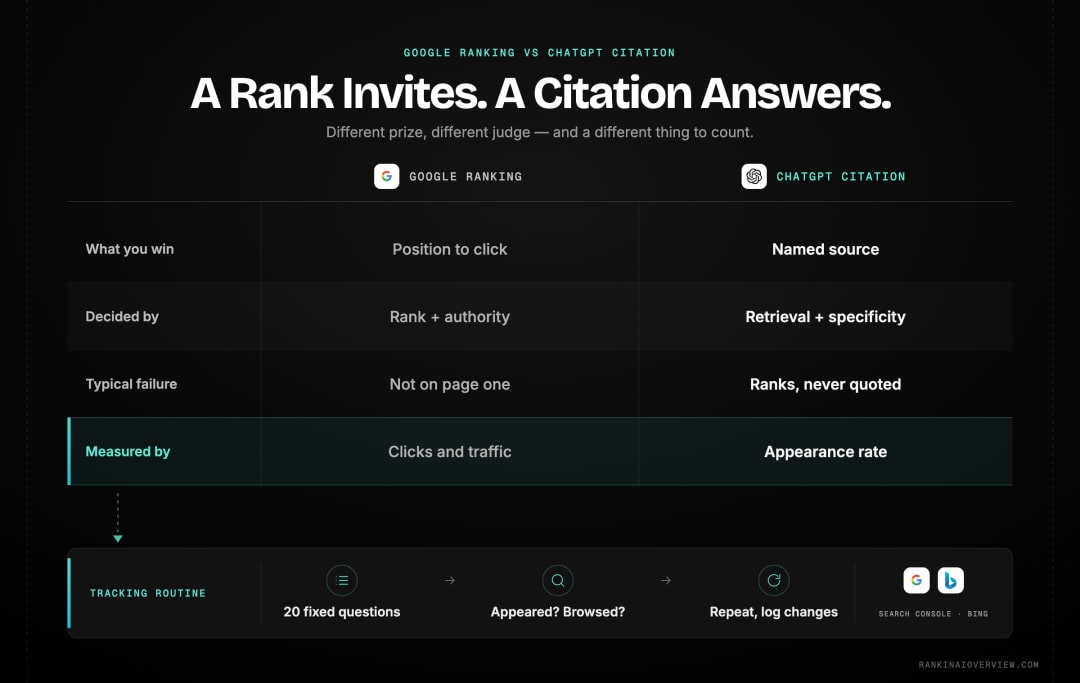
A ranking is a position in a list the reader chooses from. A citation is your source being named inside an answer the reader may accept without clicking. Ranking well makes retrieval likelier but does not decide citation, which is why strong Google performance and AI invisibility routinely coexist.
The most important practical difference is what happens after. A ranking is an invitation to click, and its value is realised through the visit. A citation frequently delivers no visit at all, because the answer already served the need. Its value is in influence: being the source the answer is built from, and being named while it happens.
That changes what counts as success and how you should measure it. Judging AI visibility by traffic will show you almost nothing, since the mechanism largely operates without traffic. The meaningful questions are whether you appear, on which questions, and alongside which competitors.
| Google ranking | ChatGPT citation | |
|---|---|---|
| What you win | A position to be clicked | A named source inside the answer |
| Decided by | Ranking systems and page authority | Retrieval, then relevance and specificity |
| Reader behaviour | Chooses from options | Often accepts the answer as given |
| Measured by | Position, clicks, traffic | Appearance rate across a fixed question set |
| Typical failure | Not on page one | Ranks well, never quoted |
The two are also not in competition, which is worth saying because the framing often implies otherwise. Ranking well contributes to being retrieved, so conventional search performance remains useful infrastructure. It simply stops being the finish line, and ranking on Google while also showing up in AI answers is the realistic goal rather than choosing between them.
How Do You Track Whether ChatGPT Is Citing You?
Run a fixed set of your most commercially important questions through the engine on a schedule, and record for each one whether you are cited, which competitors are, and whether the answer browsed at all. Keep the question set stable, because a changing list produces numbers that cannot be compared.
Build the question list first and phrase the questions the way a person would actually ask them, in full sentences rather than keywords. Choose questions that precede a real decision in your category. Twenty well-chosen questions tracked properly are worth far more than two hundred tracked once and abandoned.
Record three things per question rather than one. Whether you appeared, which other sources appeared, and whether the engine browsed for that answer. The third is the one people omit, and it is diagnostic: if an answer never browses, your on-page work cannot influence it, and repeated non-browsing on a question tells you that question is being answered from training rather than from the live web.
Repeat on a schedule and accept that these systems vary between runs. The same question asked twice can return different sources, so a single check is unreliable in both directions. Checking monthly on a stable list will show you a trend; checking whenever you feel curious will show you noise and tempt you to react to it.
Cross-check against first-party data where it exists. Google Search Console and Bing Webmaster Tools give you the retrieval-side picture of whether your pages are even accessible and indexed, which is exactly the first stage this guide separated out. If a page is not indexed, stop optimising its prose and fix that instead.
Finally, write down what you changed and when. Without a change log, any movement in citation share is uninterpretable, and you will end up attributing results to whichever edit you happen to remember. If you would rather start from a baseline than build one, Rank in AI Overview runs a free AI visibility check that shows which of your questions currently name you and which name someone else.
Also read: Why AI engines cite pages that do not rank on Google, which covers what it means when the two systems disagree about your site.
What Mistakes Keep Sites Out of ChatGPT Answers?
The recurring mistakes are optimising formatting while ignoring relevance, burying the answer beneath preamble, writing in hedged generalities that offer nothing quotable, and assuming a page was considered and rejected when it was never retrieved at all.
Formatting as strategy is the costly one, because it feels productive. Adding markup and tidying headings produces visible output and a sense of progress, and the controlled evidence says formatting-only changes move citation very little. Do that work for retrievability and for readers, then spend the remaining effort on what the comparison actually rewards.
Burying the answer remains the most common on-page error. If the direct response to a heading arrives in the fourth paragraph, a competitor's first paragraph will usually be quoted instead. This is often a habit imported from writing that was designed to hold attention rather than to be extracted, and it is quick to fix once noticed.
Hedging is the subtler version of the same failure. Copy that carefully avoids committing to anything, because committing feels risky, leaves an engine with nothing to assert. Specific claims, real numbers and stated conditions are what get lifted, and pages that refuse to be definite are effectively opting out.
The last mistake is misdiagnosis, and it wastes the most time. Before concluding that your content lost the citation, check whether it was ever a candidate: is the page indexed, does it appear in conventional results for that question, is it genuinely about that question. Teams that skip this step rewrite pages that were never in the running, and one team's account of getting a brand to rank first on ChatGPT is largely a story of fixing candidacy before polish.
Conclusion
The honest version of ChatGPT citation is less mysterious and less flattering than the usual advice. Controlled comparison points at topical relevance and position as the dominant factors, concrete specifics such as figures and recent dates as consistent smaller wins, and formatting-only work as close to inert. Much of what circulates as citation strategy is aimed at the part that measurably matters least.
Which makes the priority order clear. Establish whether you are being retrieved at all before touching anything else, narrow pages until each answers one real question precisely, lead with a complete answer that survives being extracted on its own, replace hedged phrasing with specific claims, and keep building the off-site recognition that gets you into the candidate set in the first place. Then track a fixed question list over time, because everything above is only a hypothesis until your own data agrees.
Rank in AI Overview studies how answer engines choose and quote the sources they rely on, and is building an AI visibility tool launching soon. To see which questions name you today and which name a competitor, start with a free AI visibility audit.
Frequently asked questions
Does ChatGPT show sources for every answer?+
No. It cites sources when it browses the live web, which it does for some questions and not others. Answers drawn purely from training data usually name no sources, so brand presence still matters independently.
Does schema markup help me get cited?+
It helps your content be understood and indexed, which supports retrieval. Controlled testing found formatting-only differences had little effect on which retrieved source gets cited, so schema is worth doing but should not be your citation strategy.
What is the single fastest improvement I can make?+
Narrow a page to one question and answer it completely in the opening passage, with concrete figures and a visible recent date. Relevance and explicit specifics carry more measured weight than any presentational change.
How long does it take to see results?+
On-page changes can affect browsed answers within weeks once recrawled. Building the recognition that gets you into the candidate set consistently takes months, because it depends on accumulated references rather than edits you control.
Can a small site get cited by ChatGPT?+
Yes, particularly on narrow questions where few credible pages compete. Small sites struggle on broad commercial questions where established sources dominate the candidate set, so specificity is the practical route in.
Why do I rank on Google but never get cited?+
Usually because your page is broadly relevant rather than precisely relevant, or because the answer sits too far down to be extracted cleanly. Ranking gets you retrieved; being quoted depends on relevance and quotability.
Explore with AI
Share this