If AI Answers Replace Search Results, Do Google Rankings Still Matter?
As AI-generated answers increasingly replace the traditional SERP, is optimising for Google rankings still worth it? Here is what the shift actually means for your strategy in 2026.

SummaryRankings are not dying their role is shifting from traffic driver to retrieval eligibility signal. AI systems retrieve from the same ranked index, making SEO the prerequisite for AI citation.
Read moreShow less
Google AI Mode. ChatGPT Search. Perplexity. AI Overviews. The list of AI interfaces that intercept queries before a user reaches a traditional blue link is growing fast. According to Gartner's February 2024 press release, traditional search engine volume is projected to drop 25% by 2026 due to AI chatbots and virtual agents. That prediction has created a genuine strategic question that marketing directors and CMOs are asking: if AI answers vs search results is becoming the dominant discovery interface, do Google rankings still matter?
The frustration behind this question is real. You have invested years building organic rankings. You have the traffic data, the ranking reports, and the content programme to show for it. Now your AI Overviews are providing answers before users click anywhere. Your zero-click rate is rising. Your click-through rates are declining even when rankings hold. The metrics that used to validate your investment are telling a different story.
The honest answer is more optimistic for SEOs than the headlines suggest. Rankings are not dying. Their role is changing in a way that is subtle but strategically significant. This article makes the case for exactly what has changed, what has not, and what a future-proof strategy looks like for the SEO future 2026 2027 landscape. By the end, you will have a clear mental model and a practical framework for where to invest.
What Does AI Answer Adoption Actually Look Like Right Now?
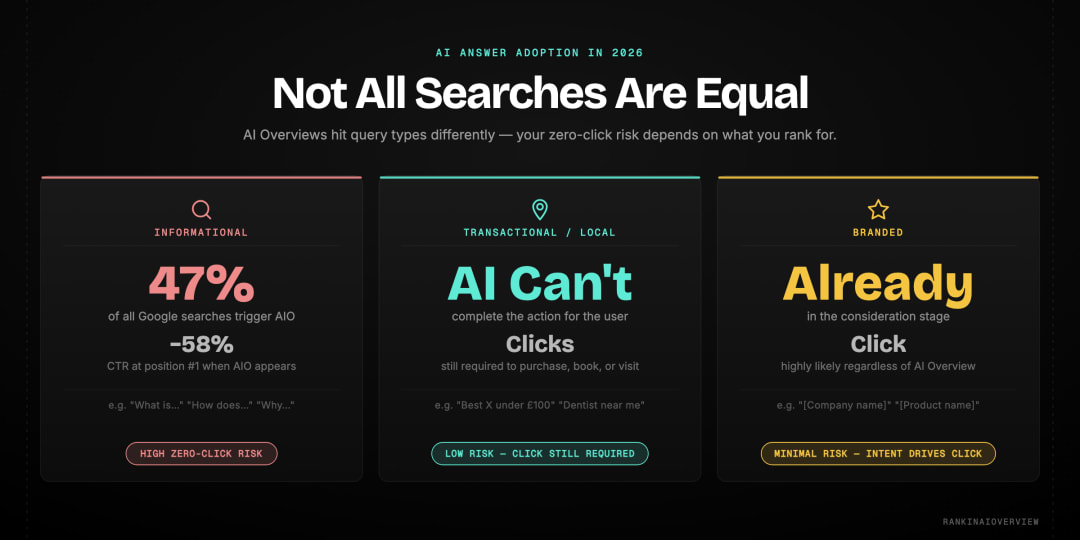
AI answer adoption in 2026 is significant and uneven by query type. AI Overviews appear in up to 47% of all Google searches. Informational and definitional queries are most affected. Transactional, local, and branded queries remain click-driven because AI cannot complete a purchase, provide a service, or guarantee proximity. The question of whether AI answers vs search results replaces the traditional SERP depends almost entirely on query type. |
|---|
AI Overviews now appear in up to 47% of all Google searches, with the highest concentration on informational queries: definitions, how-to explanations, comparisons, and research-oriented questions. For these query types, the search results page itself has become the destination. The answer appears above the fold. A significant share of users read it and leave without clicking. Organic click-through rates for position one drop by up to 58% when an AI Overview appears for the same query.
The picture is different for transactional and local queries. A user searching for "best running shoes under £100" or "dentist near me open Saturday" still needs to visit a specific page to make a decision or book an appointment. AI cannot complete a transaction or guarantee that a local business has availability. These queries still drive meaningful click-through even when AI generates an introductory answer. Future of SEO rankings for these query types is more stable than for informational content.
Branded queries present a third pattern. When a user searches your company name, they are already in the consideration stage. The click is highly likely regardless of whether an AI Overview appears. Rankings for branded terms remain important for directing that intent to the right page on your site. The zero-click concern is primarily an informational query problem, not a branded or transactional one.
Why Do Google Rankings Still Matter in 2026?
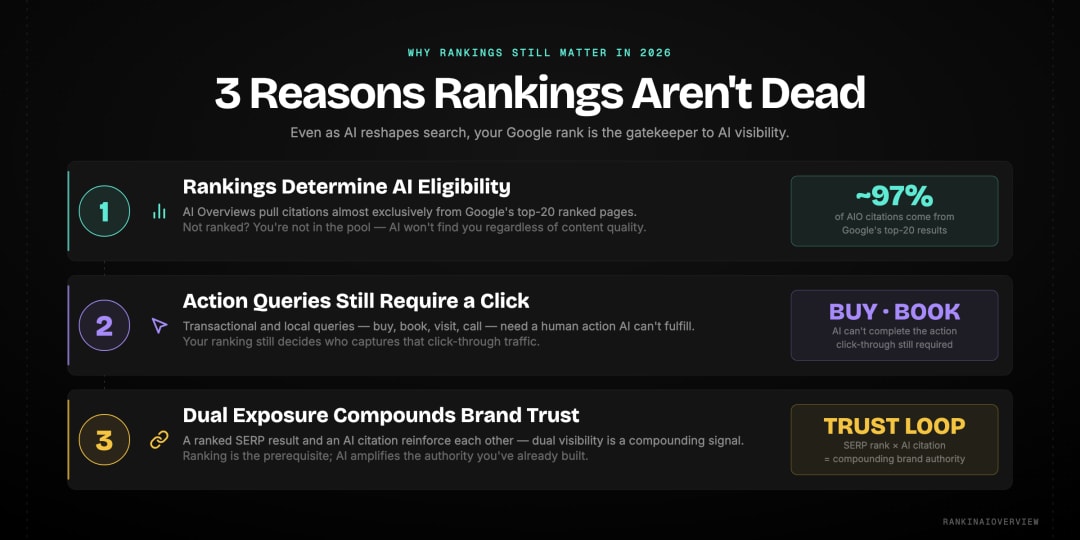
Three specific mechanisms keep Google rankings relevant even as AI answers intercept more searches. Rankings are the primary eligibility criterion for Google AI Overview citations. Transactional and local queries still drive clicks regardless of AI presence. And citation in AI and ranking on Google reinforce each other through shared trust signals, creating a compounding advantage for brands that invest in both. |
|---|
AI Retrieves From Ranked Pages
The clearest reason do Google rankings still matter in 2026 is structural: AI engines retrieve from the same index that powers traditional ranking. Google's own AI Overviews documentation confirms that AI-generated answers pull from the same index that powers organic search. Approximately 97% of AI Overview citations come from pages ranking in Google's top 20\. If your page is not indexed and ranking well, it is not in the retrieval pool that Google AI considers. Rankings are not the prize. They are the ticket.
This means that abandoning traditional SEO in favour of AI-only optimisation produces a self-defeating outcome. The on-page signals, backlink authority, and technical health that drive Google rankings are the same signals that determine AI Overview retrieval eligibility. Letting rankings decline removes you from the AI citation pool simultaneously. There is no route to Google AI Overview visibility that bypasses the traditional ranking foundation.
Transactional and Local Queries Still Drive Clicks
Will rankings become obsolete for high-intent commercial queries? The data says no. For queries with purchase intent, comparison intent, or local service intent, users consistently click through to evaluate specific options. AI cannot select a product size, complete a checkout, verify a clinic's availability, or read a restaurant's menu. These completion requirements force users through the click, regardless of what the AI Overview says above the fold.
For e-commerce and local businesses, future of SEO rankings therefore remains as commercially important as ever. A restaurant ranking in Google's local pack and a software tool ranking for a comparison keyword are both still generating clicks from AI-augmented SERPs. The AI answer provides orientation. The ranked result provides the destination for the action.
Trust Builds Across Both Channels Simultaneously
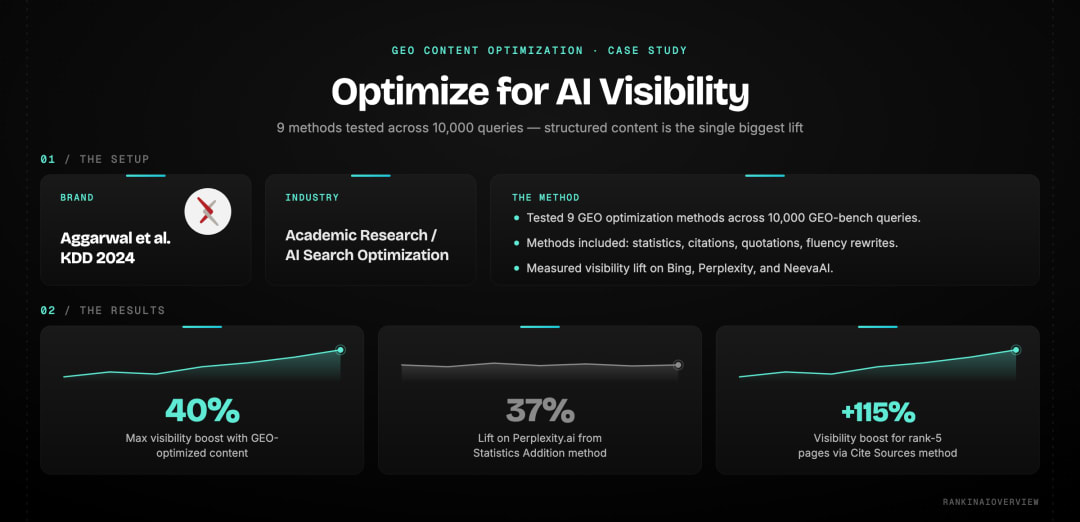
Brands that appear in AI answers and rank well on Google create a compounding trust effect. When a user encounters a brand in a ChatGPT or Perplexity answer and then sees the same brand ranking in their subsequent Google search, the dual exposure reinforces credibility in a way that neither channel achieves alone. Research from Princeton and Georgia Tech found that optimised content improves AI citation probability by 30 to 40 percent. The same content quality signals that produce AI citations also strengthen the E-E-A-T signals that sustain Google rankings. Both channels are fed by the same investments.
Where Are Rankings Becoming Less Central?
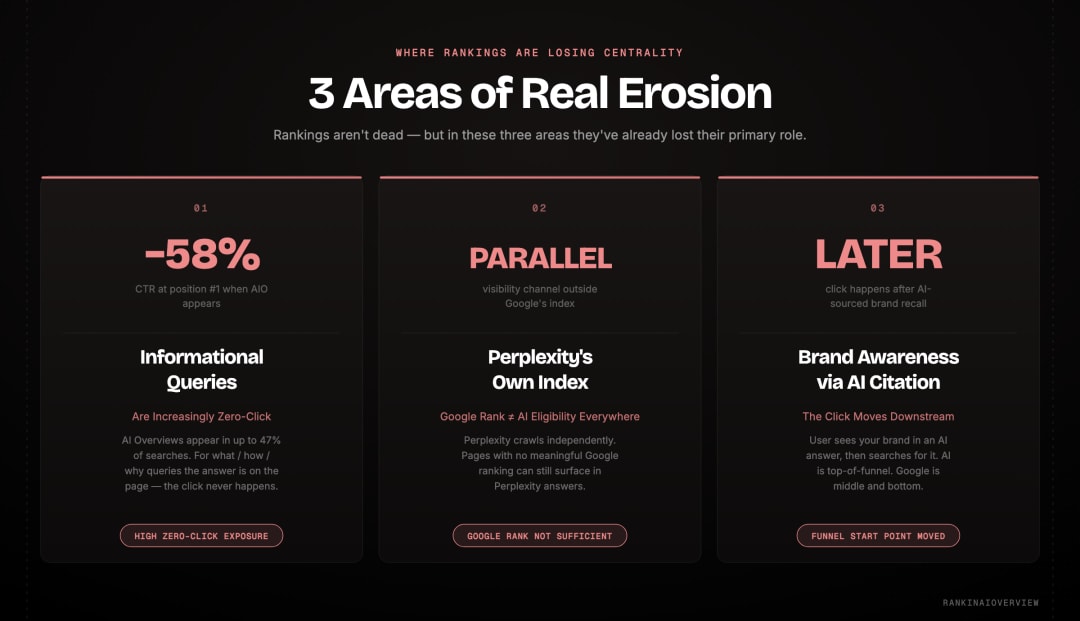
Three specific areas show clear ranking erosion as a primary success metric. Informational queries are increasingly resolved on the search results page without a click. Perplexity and other independent AI platforms build their own indexes that bypass Google ranking entirely. And AI citation is replacing direct traffic as the top-of-funnel brand awareness mechanism, changing where the buyer journey begins. |
|---|
Informational Queries Are Increasingly Zero-Click
For queries that begin with "what is," "how does," or "why does," the search results page has effectively become the document. AI Overviews provide comprehensive definitional and explanatory answers directly. A user asking what generative engine optimisation means does not need to click a result to find out. The answer is on the page. This is the clearest evidence that do Google rankings still matter as a traffic driver is a query-type-dependent question.
The practical implication for content strategy is not to stop publishing informational content. It is to accept that informational content earns AI citation value, brand trust, and topical authority even when it does not earn a click. A brand cited in 20 AI Overviews for informational queries builds category authority that converts to branded searches later. The funnel starting point has moved. The conversion still happens. It just takes a different path.
Perplexity and Independent AI Engines Build Their Own Indexes
AI answers vs search results is not a binary choice in all markets. Perplexity maintains its own independent crawler and index. Pages with no meaningful Google ranking can appear in Perplexity answers if their content is structurally extractable and semantically relevant. This creates a parallel visibility channel that operates independently of Google's ranking algorithm. For brands whose buyers use Perplexity for research, optimising for this independent index is a meaningful additional investment.
The existence of Perplexity's independent index is the clearest evidence that will rankings become obsolete is the wrong question. A more accurate question is: will Google rankings be the only eligibility criterion for AI visibility? The answer to that is already no. Brands building AI visibility in 2026 invest in Google ranking for AI Overview eligibility and off-site entity signals for Perplexity and ChatGPT citation independently.
Brand Awareness Through AI Citation Replaces Direct Traffic
The buyer journey in AI search is different from traditional search. In traditional SEO, a user searches, ranks appear, the user clicks, and the brand interaction begins. In AI search, a user asks a question, the AI cites your brand in its answer, the user absorbs the brand name as part of the answer, and later conducts a branded search. The click happens downstream rather than immediately.
For B2B companies and professional services specifically, this pattern is already measurable. Brands with strong AI citation rates are seeing rising branded search volume even when organic click-through from informational queries is declining. The awareness stage has moved into AI. The intent stage still happens on Google. This is what the SEO future 2026 2027 looks like for research-heavy buyer categories: AI is the top of funnel, Google is the middle and bottom.
“ Rankings are becoming eligibility criteria, not the prize itself. The prize is AI citation and brand recall. Rankings are what get you into the candidate pool for that prize. SEO community practitioner r/AISEOExplained, Reddit, 2026 Source: Reddit: If AI Answers Replace Search Results, Do Rankings Even Matter? |
|---|
What Is the New Mental Model for Rankings in an AI Search World?
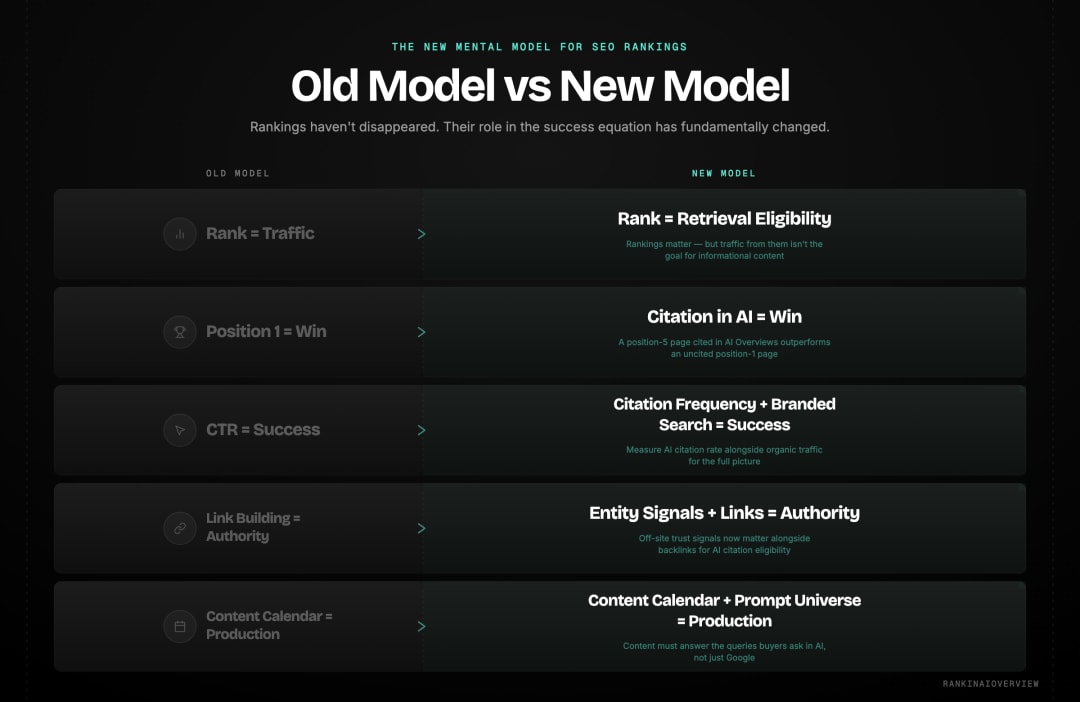
The old model was linear: rank, get clicked, generate traffic, produce revenue. The new model is layered: rank for retrieval eligibility, get cited in AI answers for brand awareness, earn branded searches from AI-aware buyers, generate qualified traffic from intent-driven clicks. Rankings are the first layer, not the whole system. This reframe changes how you allocate investment and how you report success. |
|---|
In the old model, ranking number one for a high-volume keyword was both the input and the output of an SEO programme. High ranking correlated with high traffic, and high traffic correlated with revenue. The metric was legible to every stakeholder. Position one meant winning.
In the SEO future 2026 2027 model, ranking number one is table stakes for eligibility, not evidence of victory. A brand that holds position one but is not cited in AI Overviews for the same query has a ranking without a citation. A brand that ranks position five but is cited in 70% of AI Overview responses for its category has a citation advantage that the position-one brand lacks. The ranking and the AI citation are two different success conditions that happen to share a foundational infrastructure.
Old Model | New Model | Strategic Implication |
|---|---|---|
Rank \= Traffic | Rank \= Retrieval eligibility | Rankings matter, but traffic from them is not the primary goal for informational content |
Position 1 \= Win | Citation in AI \= Win | A position 5 page cited in AI Overviews outperforms a position 1 page that is not |
Click-through rate \= Success | Citation frequency \+ branded search \= Success | Measure AI citation rate alongside organic traffic to see the full picture |
Link building \= Authority | Entity signals \+ links \= Authority | Off-site trust signals now matter alongside backlinks for AI citation eligibility |
Content calendar \= Production | Content calendar \+ prompt universe \= Production | Content must answer the queries your buyers ask in AI, not just Google |
This mental model change is the core answer to do Google rankings still matter. They matter as the prerequisite condition for the new success metric, not as the success metric itself. Future of SEO rankings is therefore not about whether to invest in them. It is about what you invest in them for.
What Does a Future-Proof SEO Strategy Look Like for 2026 and 2027?

A future-proof strategy in 2026 builds on four sequential investments. First, maintain strong organic rankings for retrieval eligibility. Second, build entity and off-site trust signals for AI citation authority. Third, diversify visibility across AI platforms beyond Google AI Overviews. Fourth, measure citation frequency alongside organic traffic to track the full funnel. The strategy is layered, not either/or. |
|---|
Maintaining strong organic rankings remains the foundation. Technical health, backlink authority, topical depth, and E-E-A-T signals all serve both channels. Using Ahrefs or Semrush to monitor ranking position and flag significant drops protects your AI Overview eligibility before the citation rate has time to decline. Rankings as eligibility criteria still require the same investment they always have. The difference is what you measure as the outcome of that investment.
Building entity and off-site trust signals is the AI-specific layer. Reddit and community mentions, G2 and Capterra review profiles, Wikipedia and Wikidata entries, and consistent NAP across directories all tell AI engines that your brand is a verified, trusted entity. These signals are what determine whether you get cited from the retrieval pool that your ranking has made you eligible for. Both investments are required for full AI citation performance.
Diversifying visibility across AI platforms means investing in Perplexity citation alongside Google AI Overview citation. The strategies diverge at the off-site level: Google AI Overviews require strong Google rankings; Perplexity citation requires strong content structure and community platform presence on Reddit and Quora. Using a tool like Rankscale or Peec AI to measure citation frequency across both platforms gives you the data to invest proportionally across both channels.
Measuring AI citation rate alongside organic traffic closes the loop. A practitioner who reports only on ranking position and click-through rate is missing the brand awareness value being generated through AI citation. Tracking weekly citation frequency and branded search volume growth together produces a complete picture of how the full AI-influenced buyer journey is performing. SEO future 2026 2027 reporting requires both metrics.
Conclusion
Rankings are not dying. They are evolving from the finish line to the starting gate. Do Google rankings still matter in 2026? Yes, as the prerequisite condition for AI citation eligibility. Will rankings become obsolete? Not for commercial, local, or branded queries. For informational content, their value as a traffic driver is already declining, but their value as an AI citation input is increasing simultaneously.
The SEO future 2026 2027 belongs to practitioners who hold both truths at once. Rankings earn retrieval eligibility. AI citation earns brand awareness. Branded search earns intent-driven traffic. All three stages of the buyer journey are still intact. What has changed is the interface at the top of the funnel. Build the foundation with SEO, layer the AI visibility signals on top, and measure success across both channels. RANK IN AI OVERVIEW covers the full landscape of AI citation signals and what drives visibility in depth across its content library.
This connects to a blunter debate — is Google ranking actually becoming less important in 2026?
Frequently asked questions
Will SEO die if AI replaces search?+
No. SEO will not die because AI retrieves from the same index that SEO builds. If AI answers fully replaced traditional search results while still requiring a retrieval index, the demand for technical SEO, content quality, and backlink authority would continue unchanged. The delivery format of the answer changes. The signals that determine which sources are trusted to provide that answer do not.
How long until AI answers dominate the majority of searches?+
AI answers already intercept a significant share of informational searches. AI Overviews appear in up to 47% of all Google queries. For transactional, local, and branded queries, traditional results remain dominant. The timeline for AI answers to reach majority adoption across all query types is likely three to five years.
Should I invest in SEO or AEO/GEO first?+
Invest in SEO first, then layer AEO and GEO on top. Without strong Google rankings, you lose AI Overview citation eligibility simultaneously. The shared infrastructure makes SEO the prerequisite. Once your technical foundation is solid, add the AI-specific layer: FAQPage schema, answer-first formatting, off-site entity building, and AI citation monitoring.
Explore with AI
Share this