How to Get Your Pages Featured in Google AI Overviews: A Practical Guide
A practical, tested approach to getting featured in Google AI Overviews: content structure, schema, freshness and domain authority, explained.

Key Highlights
-
Getting featured in Google AI Overviews starts with content structured for direct extraction, not just good rankings.
-
FAQ schema, clear H2 questions and short definition boxes are the most consistently reported wins from real site owners.
-
Content freshness can trigger AI Overview inclusion within days, according to several independently tested cases.
-
Domain authority still tilts the odds, even when competing content is similarly well structured.
-
Generative engine optimization and traditional AI search optimization overlap more than most guides admit.
-
Tracking AI Overview appearances needs a different process to standard rank tracking.
Most content creators and SEOs do not know which specific on-page changes trigger AI Overview inclusion. According to Google Search Central's AI features documentation, a page must already be indexed and snippet-eligible before it can ever be considered, which rules out half the usual advice before it even starts.
That leaves a narrower, more practical question: once a page is eligible, what actually tips it into being featured? Generic checklists rarely answer this, since most either repeat standard SEO advice or make sweeping claims with no worked example behind them.
This guide works through that question, cross-checked against published research on schema, freshness and domain authority, so the tactics here are grounded rather than guessed at. Each tactic below is presented alongside what independent research says about it, including where the evidence is mixed.
What does it actually mean to appear in a Google AI Overview?
Appearing in a Google AI Overview means a page is shown as one of the supporting links beneath an AI-generated summary at the top of a search result. The page does not need to rank first organically, but it must already be indexed and eligible to appear with a normal snippet.
This distinction matters for AI Overview optimisation. A page can rank reasonably well in classic search and still never get featured, because ranking and being selected as a citation source are judged differently. Getting featured in Google AI Overviews is therefore a separate, additional goal sitting on top of ordinary SEO, not a replacement for it.
What counts as snippet-eligible?
A page is snippet-eligible when Google can already show a short text excerpt for it in normal search results, without any blocking meta tag or technical restriction in place. This is a baseline technical check, not a content quality judgment.
Practically, that means confirming the page is indexed, isn't blocked by a noindex tag or robots directive, and returns a normal snippet when searched directly. Pages that fail this check have no realistic path into an AI Overview regardless of how well the content itself is written.
AI Mode works on the same underlying eligibility rules as AI Overviews, just with a fuller, more conversational results page rather than a short summary. Anything that helps a page get featured in a standard AI Overview applies equally to AI Mode.
What types of content does Google AI Overview prefer?
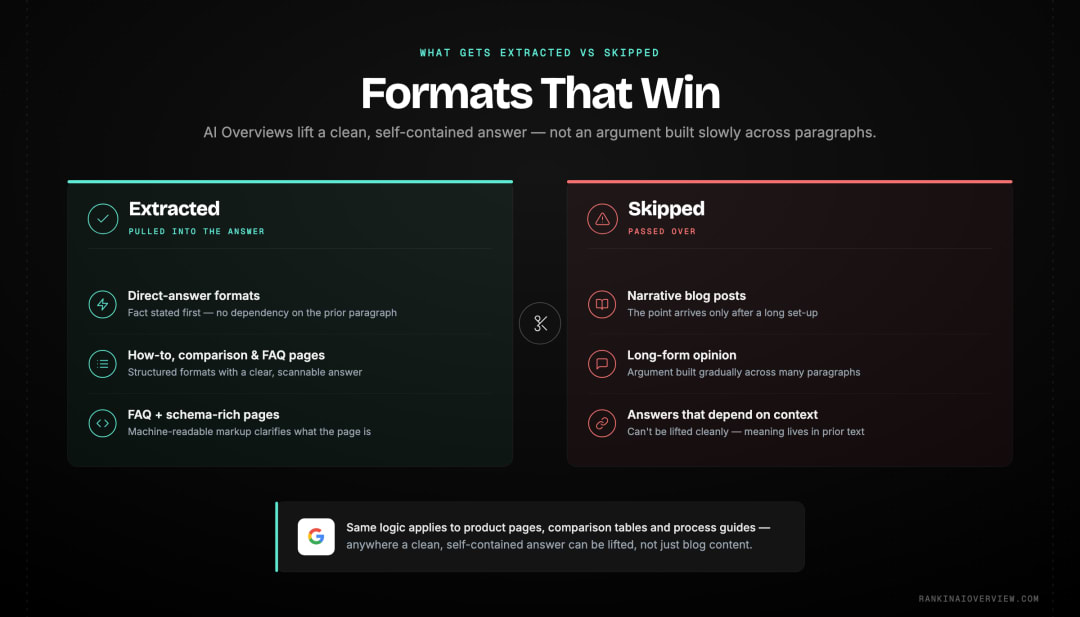
Google AI Overview prefers content that answers a specific question cleanly, in a short, self-contained block, rather than content that builds an argument gradually across several paragraphs.
This preference shows up consistently across formats: how-to guides, comparison content, and FAQ pages all tend to outperform narrative blog posts and long-form opinion pieces for this specific goal, even when the underlying information is comparable in quality.
Direct answer formats
A direct answer format states the core fact in the first one or two sentences after a heading, with no dependency on the paragraph before it. One site owner who tracked this closely noticed that pages with clear H2 definitions and direct answers got pulled into AI Overviews far more often, and specifically that the AI tends to draw from roughly the first 100 words after a heading.
That observation lines up with how these systems are generally understood to work: they lift short, quotable passages rather than reading an entire page top to bottom. Writing the answer first, and the supporting explanation second, gives the model less to discard.
A weak version reads: “There are several factors to consider when choosing a CRM. Let's look at them below.” A direct-answer version states the fact outright: “A good CRM for a small team combines contact management, deal tracking and email automation in one tool, typically costing between $20 and $50 per user monthly.” The second version survives extraction; the first one does not, since it has no fact to lift.
The same logic applies to product pages, comparison tables and process guides, not just blog content. Anywhere a reader currently has to read three sentences to find one usable fact, that fact can usually move to the front.
FAQ and schema-rich pages
FAQ-formatted sections, paired with FAQ schema, were the single change one site owner credited most directly. After adding FAQ schema to two existing pages, both began appearing in AI Overviews within three weeks, without any other structural change to the page.
Independent research gives a more cautious picture. A widely cited study found no consistent correlation between schema coverage and citation rates across a larger sample of sites, meaning schema alone does not reliably explain citation outcomes. The honest summary: schema clarifies what a page is about and can support inclusion, but it is not a guaranteed trigger on its own.
Two platforms have been explicit about using it, though. Google's own search team has confirmed structured data gives content an advantage in AI search results, and Microsoft's Bing team has separately confirmed schema markup helps its AI systems understand content for Copilot. For other AI platforms, there is no public confirmation either way, which is one reason results from adding schema can feel inconsistent from one site to the next.
The practical takeaway for ai search optimization: treat schema as supporting infrastructure rather than a primary lever. It reduces ambiguity about what a page is and who wrote it, which helps once everything else is already in reasonable shape, but it will not rescue thin or poorly structured content on its own.
What on-page changes increase your AI Overview chances?
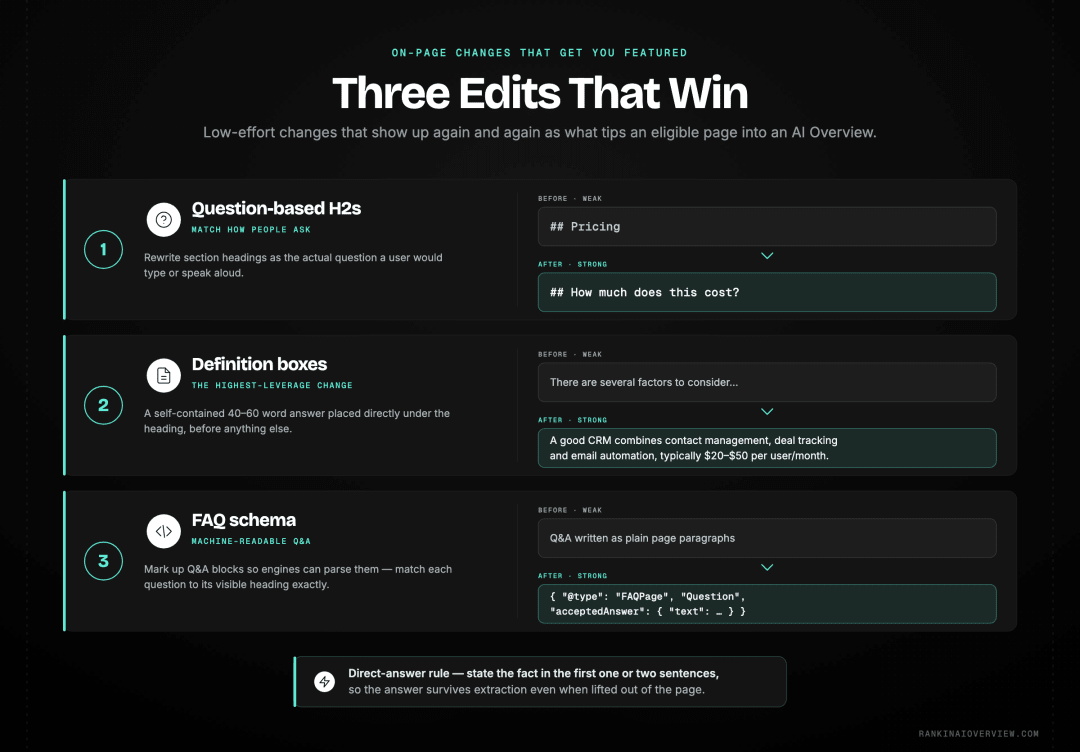
Three specific on-page changes show up repeatedly in both first-hand reports and published research: question-based H2s, definition boxes immediately after headings, and FAQ schema.
Structuring your H2s as questions
Phrasing headings as questions matches how people actually search, and increasingly how they talk to voice assistants. One site owner specifically credited matching the exact phrasing of conversational, voice-search-style questions as a factor that helped get featured in Google AI Overviews, since AI systems appear to favour content whose structure mirrors the query itself.
This is a small rewrite for most existing content. “Pricing” becomes “How much does this cost?”, and “Setup” becomes “How do I set this up?”, with no change to the underlying information.
This works best when the question matches a real, common phrasing rather than an invented one. Checking the actual queries a page already gets impressions for, before rewriting headings, keeps the rewrite grounded in real search behaviour instead of guesswork.
Writing definition boxes after headings
A definition box is a short, 40 to 60 word answer placed directly under a heading, written so it makes sense even if nothing else on the page were read. This is the single highest-leverage change for ai overview optimisation, because it is exactly the unit AI Overviews tend to lift.
Three habits make a definition box work: state the subject by name rather than “this” or “it”, include one concrete number or fact rather than a vague claim, and avoid referencing any other part of the page. A box that says “see the table below for pricing” fails this test immediately, since it depends on content the model may never see.
Google's own Danny Sullivan has summed up this overlap between classic SEO and generative engine optimization plainly.
“ Good SEO is good GEO. Danny Sullivan Director, Google Search (former Search Liaison) Source: https://searchengineland.com/google-danny-sullivan-good-seo-good-geo-461464
RANK IN AI OVERVIEW's guide to building a GEO and AI Overview content cluster covers how to apply this kind of definition-first structure across an entire topic cluster rather than one page at a time.
Adding FAQ schema
FAQ schema marks up a question-and-answer block so it is explicitly machine-readable, not just visually clear to a person reading the page. It is one of the cheapest, fastest changes available, and the one most frequently credited with a fast result in practice.
Implementation is simple: list each question as its own entry, keep each answer self-contained, and validate the markup before publishing. Pages that already use an FAQ-style layout visually are usually only a short step away from having this in place properly.
Validation matters more than it sounds. Markup that doesn't match the visible text on the page, or that uses placeholder questions never actually answered in the content, risks being ignored or, in more serious cases, treated as a quality signal problem rather than a help.
A minimal, valid FAQ entry needs three things: the question text, matched exactly to the visible heading; the answer text, matched to the visible paragraph beneath it; and the FAQPage type wrapping the whole block. Tools that auto-generate this markup from existing headings remove most of the manual effort, but the output should still be checked against what a reader actually sees on the page.
Does domain authority affect AI Overview inclusion?

Domain authority appears to influence AI Overview inclusion, but it does not override content structure on its own. One site owner reported that higher-authority pages got picked first even when competing content was similarly structured, suggesting authority acts as a tie-breaker rather than a hard requirement.
This tracks with how RANK IN AI OVERVIEW's breakdown of what ‘ranking’ means in AI search frames the shift: there is no ranked list inside an AI Overview the way there is in classic search, so authority works less like a position and more like a weight applied during selection.
Independent confirmation exists too. Google's own search team has stated that structured content and existing search signals together inform AI feature eligibility, and Microsoft's Bing team has separately confirmed that schema markup supports its AI systems' understanding of content. Neither claims authority alone is sufficient, which matches the site owner's experience of structure and authority working together rather than either one working alone.
The practical implication: a brand-new, low-authority page with perfect structure may still lose out to a higher-authority page that is merely adequately structured. Building authority and fixing structure are both worth doing, rather than treating either as a shortcut around the other.
This also explains why the same structural changes can produce different results on different sites. A site with years of accumulated backlinks and consistent topical coverage will often see a definition-box rewrite pay off faster than the same rewrite on a six-month-old domain, simply because the authority side of the equation is already in place on one and not the other.
For newer or lower-authority sites, the realistic path is usually patience plus structure rather than structure alone. Earning a handful of genuine mentions from other relevant sites, alongside the on-page changes above, tends to move the needle faster than continuing to refine the same page's formatting indefinitely.
How long does it take to appear in AI Overviews?
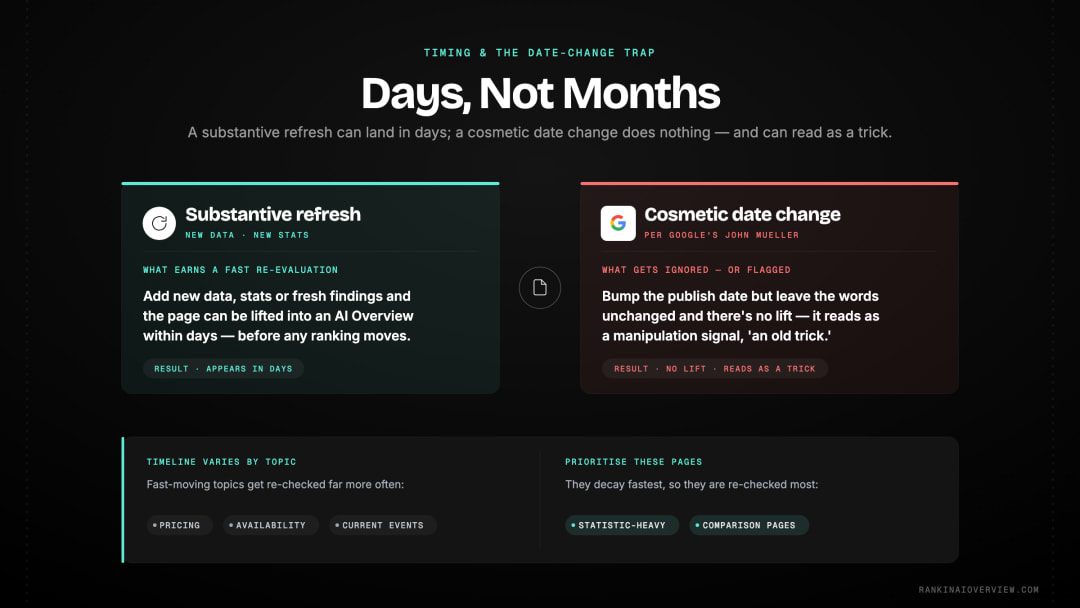
Appearing in AI Overviews can happen faster than traditional ranking improvements, sometimes within days, though timelines vary by topic and how often the underlying query gets re-evaluated.
One documented case involved updating a post originally published in 2022 with new statistics. That refreshed page was pulled into an AI Overview within days of the update, well before any meaningful shift in the page's traditional ranking position.
“ That technique is an old trick. John Mueller Search Advocate, Google Source: https://discoveredlabs.com/blog/content-freshness-update-signals-keeping-ai-systems-aware-of-your-latest-information
That quote is a useful caution alongside the freshness finding above: Mueller was specifically warning against changing a publish date without changing the substance of the page. Real, substantive updates appear to help. Cosmetic date changes with no new information do not, and may be treated as a manipulation signal rather than a freshness signal.
Does the timeline vary by topic?
Yes. Fast-moving topics, such as pricing, product availability or anything tied to current events, get re-evaluated more often, so updates on those pages can show up in AI Overviews sooner. Stable reference content tends to move more slowly, since there is less reason for the underlying query to be re-checked frequently.
A reasonable working assumption: treat statistic-heavy and comparison pages as the priority for frequent updates, since they both decay fastest and tend to be the pages AI systems re-check most often.
How to track if your pages appear in AI Overviews
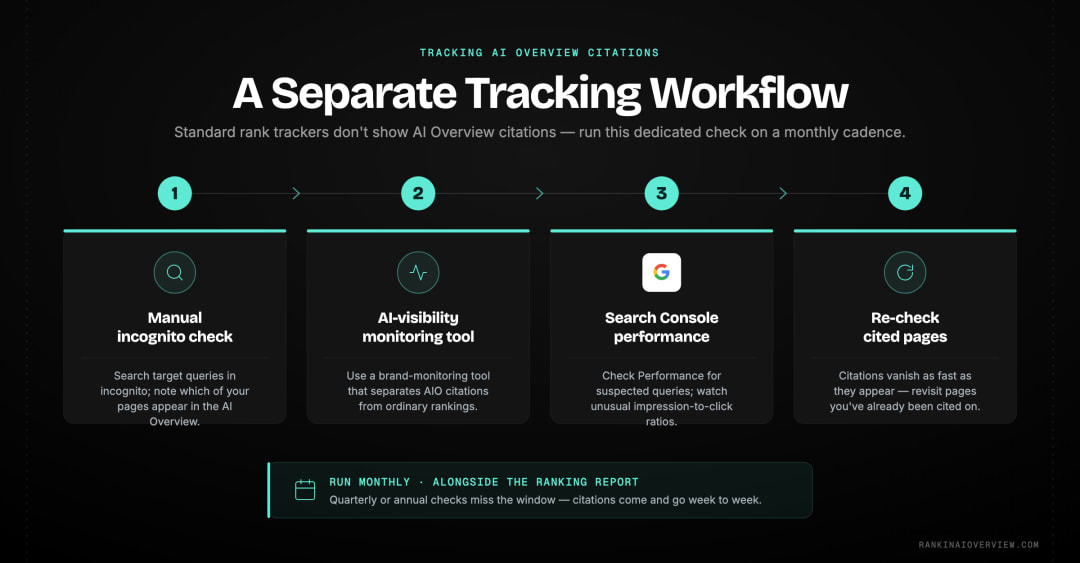
Standard rank trackers do not show AI Overview citations directly, so tracking this requires either manual checks or a tool built specifically for AI visibility.
-
Search target queries manually, in an incognito window, and record which of your pages appear inside the AI Overview itself.
-
Use a dedicated AI visibility or brand monitoring tool that separates AI Overview citations from ordinary ranking data.
-
Check Search Console's Performance report for the queries you suspect trigger an AI Overview, and watch for unusual impression-to-click ratios.
-
Re-check previously cited pages periodically, since AI Overview citations can disappear as quickly as they appeared.
Standard analytics tools were not built with this in mind either. Referral traffic from AI platforms typically needs a custom segment or filter on the source and medium fields, since it otherwise gets grouped under generic referral traffic and becomes invisible in standard reports.
A monthly review cadence, checked alongside the usual ranking report rather than as a separate exercise, tends to catch changes early enough to act on. AI Overview citation behaviour moves faster than traditional rankings, so a quarterly or annual review risks missing the window entirely.
Trust signals influence this too, not just structure. RANK IN AI OVERVIEW's research on trust versus rankings found that pages with promotional content or unnamed editorial teams get skipped by AI Overviews even at high ranking positions, which is worth checking if a well-structured page still isn't appearing.
Conclusion
Getting featured in Google AI Overviews comes down to a short list of changes that repeat across both documented experience and published research: direct-answer structure, FAQ schema, question-based headings, and genuine content freshness.
Domain authority still tilts the outcome, so structure and authority are both worth building rather than treating either as a substitute for the other. None of this requires abandoning standard SEO; it requires applying it more precisely.
Start with the page most likely to already be close: reasonably well-ranked, topically relevant, but missing a definition box or FAQ schema. That page will show results fastest, and the lessons from it transfer directly to the rest of the site.
Treat the whole approach as iterative rather than a one-off project. Re-check eligibility after major site changes, revisit definition boxes whenever new data becomes available, and keep an eye on which pages quietly drop out of an AI Overview after a competitor updates theirs.
For deeper, ongoing research on AI Overview optimisation and generative engine optimization, RANK IN AI OVERVIEW covers this space across its content library.
Frequently asked questions
Why is my website not appearing in AI Overview?+
Usually because the page isn't indexed and snippet-eligible yet, lacks a direct-answer structure, or sits on a low-authority domain competing against better-structured pages. Checking eligibility first avoids wasted effort on formatting changes that won't matter yet.
Does adding FAQ schema guarantee AI Overview inclusion?+
No. It improves the odds and has produced fast results in documented cases, but independent research found no consistent correlation between schema coverage and citation rates across a wider sample of sites.
How fresh does content need to be to get cited?+
There's no fixed rule, but substantive updates with new data or statistics have produced citations within days in documented cases. Changing only the publish date without real changes does not appear to help.
Is matching voice-search phrasing necessary for AI Overview inclusion?+
Not strictly necessary, but it helps. Content phrased the way people actually ask questions, including conversational phrasing, tends to match how AI systems parse and select sources more closely than formal, keyword-stuffed headings.
Can a single page get added to and dropped from an AI Overview repeatedly?+
Yes. Citations are re-evaluated each time the underlying query is processed, so a page can appear, disappear, and reappear as competing content changes. This is one reason periodic re-checking matters more here than with traditional rankings.
What is generative engine optimization, in plain terms?+
Generative engine optimization is the practice of structuring content so AI systems can extract and cite it confidently, covering direct answers, schema, freshness and authority together rather than any single tactic in isolation.
Should every page on a site get this treatment at once?+
No. Prioritise pages that already rank reasonably well and answer a clear question, since those are closest to qualifying already. Spreading effort thinly across an entire site usually produces slower, less visible results than focusing on a handful of strong candidates first.
Explore with AI
Share this