Google #1 Ranking vs. AI Answer Box: Which Drives More Traffic in 2026?
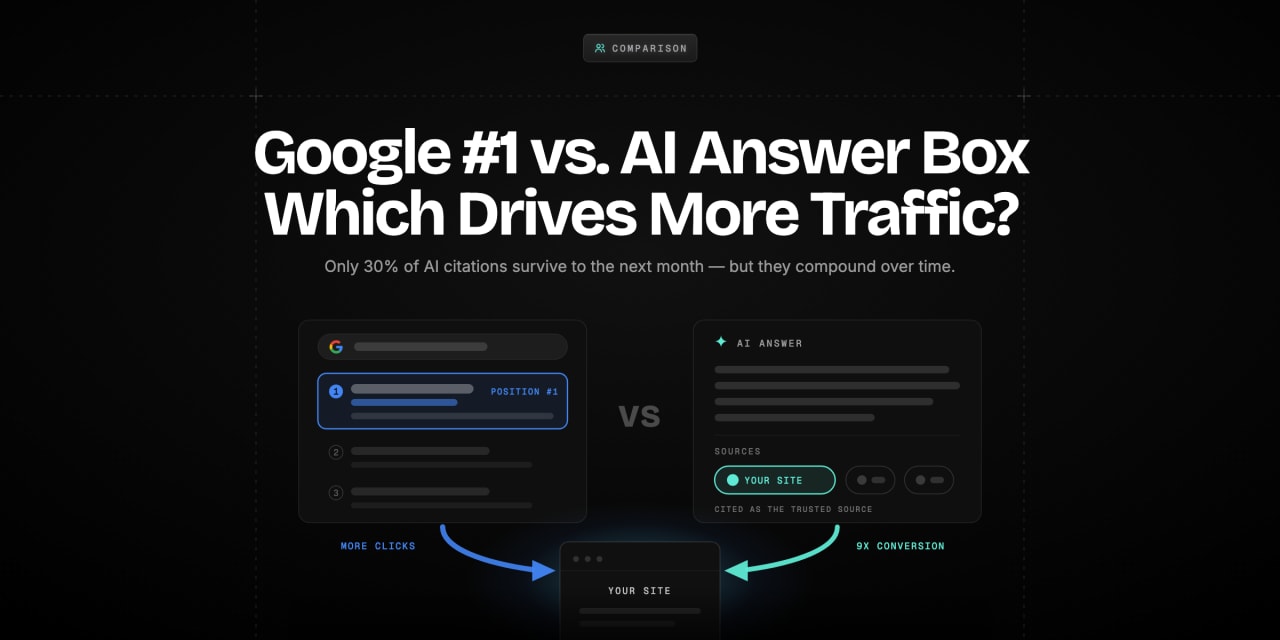
Is it better to rank number one on Google or be featured in an AI answer box? We compare real traffic, conversion, and brand impact data to help you decide where to focus.
Key Highlights
-
Google rank 1 vs AI answer traffic: Google number one wins on direct click volume. AI answer boxes win on conversion quality and brand awareness. They are genuinely different value types requiring different measurement frameworks
-
AI citation traffic impact: users arriving via AI citations have already encountered a synthesised answer about your brand and arrive further along the research journey. Lower volume but measurably higher intent
-
Clicks from AI overview: when an AI Overview is present, position one Google CTR drops from approximately 28 to 34% to 15 to 20%. The AI answer intercepts users who would have clicked through to your page
-
Clicks from AI overview citations are lower in volume but higher in intent than standard organic clicks. Users who click a cited source have already read the AI answer and want more detail
-
Clicks from AI overview benefit the cited source in two ways: direct referral traffic and brand association with the trusted answer that produces future branded searches
-
Measuring clicks from AI overview requires Google Search Console AI Overview filter for Google AIO, and UTM-tagged links plus GA4 segmentation for independent AI platforms
-
Rank 1 vs AI overview CTR: position one plus AI Overview citation is the strongest combined visibility position. Position one without citation is second. AI citation without position one is third
-
The rank 1 vs AI overview CTR gap narrows as AI Overviews expand across more query types. Teams tracking position one impressions should separately track the AI Overview prevalence rate for those queries
-
Rank 1 vs AI overview CTR analysis shows that for queries where AIO is absent, position one retains its historical 28-34% rate. Tracking AIO prevalence by query is now a prerequisite for accurate CTR forecasting
-
AI search traffic vs organic: independent AI engines like Perplexity and ChatGPT send lower-volume but higher-converting referral traffic. Seer Interactive documented AI-referred conversion rates at 15.9% versus 1.76% for standard organic
-
AI search traffic vs organic traffic differs fundamentally in user intent stage. Organic users begin research on Google. AI search users have already received a synthesised answer and arrive with more specific intent
-
AI search traffic vs organic should be segmented separately in GA4. Without this segmentation, the quality premium of AI-referred traffic is averaged out and becomes invisible in reporting
-
Only 30% of brands cited in AI answers retain that citation in the following month. AI citation is less stable than Google ranking but compounds over time as entity recognition strengthens
-
The strategic recommendation for most businesses: achieve Google top-20 ranking first as the retrieval eligibility baseline, then build AI citation signals on top for the quality and brand uplift layer
For the first time in SEO history, there are two distinct visibility prizes: the number one Google ranking and the AI answer box. According to Gartner's February 2024 press release, which projected a 25% drop in traditional search volume by 2026, the two prizes are becoming increasingly distinct in both the investment required and the results they deliver. Google rank 1 vs AI answer traffic is not a question of better or worse. It is a question of which business outcome you are optimising for in each quarter.
The confusion in the market is understandable. A page can hold position one on Google and be invisible in AI answers for the same query. A page can be cited consistently in AI answers for a query where it ranks on page three. The two visibility types have different prerequisites, different mechanisms, and different outcomes. Treating them as interchangeable produces misallocated investment.
This guide provides the data comparison you need to make an informed decision. We compare Google number one and AI answer box citation across five dimensions: traffic volume, traffic quality and conversion, brand impact, stability, and investment required. For each dimension, we show the available data and name the winner. By the end, you will have a clear framework for deciding where to focus and a recommended strategy that accounts for what most businesses actually need.
How Does Each Visibility Type Work?

Infographic showcasing how a Google number-one ranking (position-based) and an AI answer-box citation (selection-based) work through fundamentally different mechanisms
Google number one ranking and AI answer box citation operate through fundamentally different mechanisms. Google ranking is position-based: you hold a consistent slot in an ordered list and users who see that list can click your result. AI citation is selection-based: an AI engine chooses your content as a source for a generated answer, and users who see that answer may or may not click through to your page. The value proposition of each depends on how the user interacts with each format.
RANK IN AI OVERVIEW breaks this distinction down further in what 'ranking' actually means in AI search.
Google Number One Ranking
A number one Google ranking gives your page the highest visible position in the traditional SERP. Users see your title, meta description, and URL above all other results. They can click, skim, or scroll past. Historical click-through rate data shows position one delivering approximately 28 to 34% CTR for queries where no AI Overview is present. Google Search Console provides consistent impression and click data for every query your site ranks for. The measurement is transparent and stable. Ranking positions can be held through consistent SEO investment. Ranking changes are logged and attributable.
AI Answer Box Citation
AI answer box citation, whether in Google AI Overviews or in ChatGPT, Perplexity, or Gemini, works differently. The AI engine generates a synthesised answer from retrieved sources and may cite your page as one of those sources. Some users click through to cited sources. Many do not. The visibility value is partly in the click and partly in the brand impression: users see your brand name as a trusted source for the AI's answer, even if they do not click.
AI citations are dynamic. They can appear and disappear across query runs for the same page. They are not stable in the way a ranking position is stable. Research consistently finds that only 30% of brands cited in AI answers retain that citation in the following month. The non-deterministic nature of AI output means that a page cited today may not be cited tomorrow, even if no changes have been made to the content.
Which Drives More Traffic Volume?
Google number one ranking drives more direct click volume than AI citation alone in virtually all measured scenarios. The exception is the increasingly common situation where an AI Overview is present for the same query: in that case, position one CTR drops significantly because the AI answer intercepts a substantial share of users who would otherwise have clicked the top organic result. The clicks from AI overview in this scenario represent a meaningful traffic reduction from the historic baseline.
The traffic volume data is clear. Google position one without an AI Overview delivers approximately 28 to 34% click-through rate for informational queries and higher for navigational queries. When an AI Overview is present for the same query, position one CTR drops to approximately 15 to 20%. This is a direct impact of the AI answer intercepting users who received their answer from the AI Overview and did not need to click.
AI citation alone, where a brand is cited in an AI Overview or independent AI platform but does not hold a top Google ranking, delivers lower direct click volume than position one. Studies of AI-referred traffic find that approximately 8% of users click through to a cited source when an AI answer is present, compared to 15% without an AI answer. On an absolute basis, a page ranking position one for a 10,000 monthly search query generates far more direct clicks than a page cited in the AI answer for the same query.
The caveat that changes this calculation is query trajectory. For queries where AI Overviews are not yet prevalent, position one retains its full historic CTR. For queries where AI Overviews appear consistently, the effective CTR of position one is already significantly reduced. Google rank 1 vs AI answer traffic analysis therefore depends on which queries you are targeting and whether those queries currently trigger AI Overviews.
Which Delivers Higher Conversion Quality?
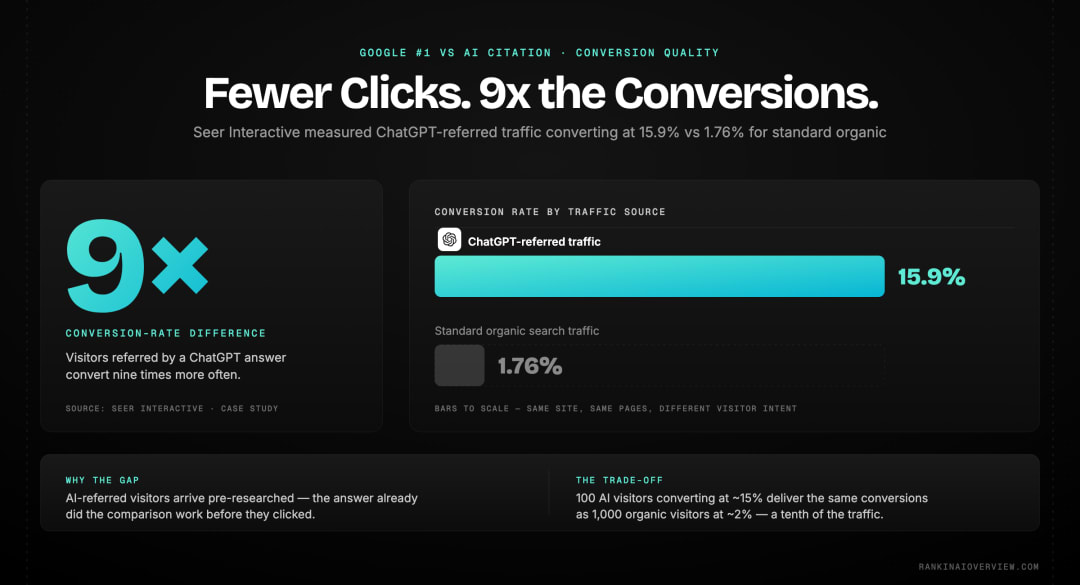
Infographic showcasing the conversion-quality premium of AI-referred traffic, with Seer Interactive's documented 15.9 percent versus 1.76 percent organic conversion
AI citation delivers measurably higher conversion quality than standard organic traffic. Users who click through from an AI citation have already received a synthesised answer about the topic, product, or service they are researching. They arrive on your page with a higher level of prior knowledge and a more specific intent than the average organic visitor. This produces higher conversion rates, longer session durations, and lower bounce rates on AI-referred traffic.
The most specific documented evidence comes from Seer Interactive's documented case study: ChatGPT-referred traffic converted at 15.9% compared to 1.76% for standard organic traffic from Google. That is a 9x conversion rate difference. The mechanism is the research journey compression: a user who found your brand through an AI citation has already processed a synthesised explanation of your category and your brand's role in it. They arrive on your website further along the consideration journey than a user who found you through an organic click.
For businesses with high-consideration products or services, this conversion quality premium is significant. An AI citation that produces 100 monthly visitors at a 15% conversion rate is more valuable than an organic ranking that produces 1,000 monthly visitors at a 2% conversion rate. Both produce 15 to 20 conversions, but the AI citation achieves this with 10 times less traffic and correspondingly less server load, content overhead, and support burden.
The AI search traffic vs organic comparison is most favourable for AI citation in high-intent research categories: B2B software, professional services, financial products, and health decisions. For these categories, users who arrive via AI citations are often buyers who are close to a decision. For lower-consideration categories, the conversion quality premium is smaller because the purchase journey is shorter and less research-intensive.
“ Rank 1 still wins for clicks. AI citations win for brand awareness. Different value types. Our AI-cited page gets 35% fewer clicks than the same page ranked number one without AIO. But the clicks we do get from AI citations convert at roughly twice the rate. SEO community practitioner r/SEO\\_Marketing\\_Offers, Reddit 2026 Source: Reddit: Google Rank 1 vs Top AI Answer: Which Brings More Traffic?
Which Delivers Greater Brand Impact?
AI citation delivers greater brand impact per impression than Google position one, for a specific and structural reason: an AI citation places your brand name inside a trusted, synthesised answer. The user does not just see a blue link. They see your brand as the source for a verified, contextualised statement. This builds brand association with authority in a way that a ranked result listing cannot replicate.
The brand impact of AI citation operates on two timescales. In the short term, users who encounter your brand in an AI answer are exposed to it in the context of a trusted recommendation rather than a search result that they know is ranked by an algorithm. This produces stronger brand recall. This trust-first mechanism is explored in more depth in why AI search rewards trust signals over rankings.
Research consistently finds that brands cited in AI answers experience significantly higher branded search volume growth in subsequent months, as users who encountered the brand in an AI answer later conduct branded Google searches.
In the longer term, AI citation compounds through the training data and retrieval systems that AI engines update continuously. A brand that is consistently cited in AI answers builds entity recognition across AI training corpora, which further increases future citation probability. This compounding effect makes AI citation a brand asset that appreciates over time, similar to how backlinks from authoritative sources compound Google ranking strength.
AI citation traffic impact on brand is also measurable through the downstream branded search proxy. If branded search volume in Google Search Console is increasing over a period when AI citation frequency is also increasing, the correlation provides evidence that AI citations are creating brand awareness that converts to direct search intent. This is the most accessible brand impact metric for teams that do not have enterprise attribution systems.
Which Is More Stable Over Time?
Google number one ranking is significantly more stable than AI citation. A page that achieves position one through consistent SEO investment can hold that position for months or years with maintenance effort. AI citations are dynamic: they change with every model update, index update, and query variation. Research finds that only 30% of brands cited in AI answers retain that citation in the following month. For teams whose business model depends on predictable traffic, this instability is a meaningful risk.
For a deeper look at exactly how volatile that citation frequency is month to month, see is it possible to rank consistently in AI search.
The stability difference reflects the underlying architecture of each system. Google ranking is based on a relatively stable algorithm that changes gradually and with documented major updates. Positions that are earned through genuine authority tend to hold unless a significant algorithm change or competitive event occurs. Rank 1 vs AI overview CTR comparisons are affected by AI Overview prevalence changes, but the ranking position itself is not.
AI citation instability is a function of how AI engines generate answers: probabilistically, with variation across query runs and model versions. A brand cited in 70% of runs for a given query may drop to 40% citation frequency after a model update without any change to the content or off-site signals. This does not mean AI citation is not worth pursuing. It means that AI citation frequency, not AI citation presence, is the right measurement metric, and that citation frequency needs to be tracked as a rolling average with a dedicated AI rank tracker rather than a snapshot.
What Does the Latest Pew Research Data Show?
Pew Research Center's 2025 study of 68,879 real Google searches found organic click-through rates fall from 15% to 8% when an AI Overview appears. That is close to a 47% relative drop. Only 1% of visits click a source cited inside the summary itself.
The study tracked 900 US adults over one month. It is the most rigorous public dataset on this question to date, since it measured actual browsing behaviour rather than estimated impressions.
The finding matters here because it separates two different outcomes. Ranking #1 on Google measures position. Being cited inside an AI Overview measures selection. RANK IN AI OVERVIEW covers exactly what "ranking" now means across AI search platforms in more depth, since the word no longer means one thing.
Several 2026 industry studies report even steeper CTR drops, some as high as 58 to 61% at position one. Methodologies vary widely between these studies, so treat them as directional rather than definitive. Pew's figure is the one with the most transparent methodology behind it.
The practical takeaway is simple. A page ranking #1 but absent from the AI Overview is now competing for an 8% pool of clicks, not a 15% pool. If you want to track this gap for your own pages rather than rely on published averages, these are the metrics worth measuring instead of raw rank position.
Which Requires More Investment?
Both visibility types require significant investment but through different channels. Google number one ranking requires traditional SEO: technical health, backlink acquisition, and keyword-optimised content. This is a twenty-five-year-old playbook with established competitive benchmarks and known costs. AI citation requires a different investment: content structure optimisation, entity building, off-site community presence, and schema implementation. These are newer, less competitive, and currently less expensive than equivalent Google ranking investment.
The investment comparison favours AI citation for early movers. The competitive field for AI citation signals is significantly less developed than the field for Google ranking. Achieving consistent AI citation for a category query in 2026 requires building the trust and entity signals described elsewhere in this series. The same category position on Google number one might require years of link building and significant editorial investment. AI citation currently provides a faster path to category visibility for brands that invest early.
The investment that serves both simultaneously is the most efficient allocation. Content structured for direct-answer extraction improves Google featured snippet eligibility alongside AI citation probability. FAQPage schema implementation improves Google rich results alongside AIO extraction. Off-site entity building improves Google E-E-A-T signals alongside AI trust signals. Princeton and Georgia Tech's GEO research found that structured content interventions improved AI citation by 30 to 40 percent with changes that also serve traditional SEO goals. The shared investment layer is where the best ROI per pound of marketing spend currently sits.
For the full breakdown of which metrics to track instead of raw ranking position, see 6 metrics that actually matter for AI search visibility.
What Is the Comprehensive Side-by-Side Comparison?

Infographic showcasing the head-to-head scorecard of Google number-one ranking versus AI citation across traffic volume, brand impact, stability, and investment with a winner per dimension
The five-dimension comparison below provides the complete picture for strategic decision-making. No single answer is right for every business. The recommendation depends on your business model, your current visibility position, and your primary marketing objective for the next twelve months.
Dimension | Google Number One | AI Citation | Winner |
|---|---|---|---|
Direct click volume | 28-34% CTR without AIO. 15-20% with AIO present | Lower. Approximately 8% of users click cited sources | Google Number One (volume) |
Traffic quality | Mixed intent. Wider funnel. Variable conversion rate | High intent. Users pre-researched by AI. Higher conversion rate. Seer Interactive documented 15.9% vs 1.76% organic | AI Citation (quality) |
Brand impact | Brand visible in ranked list. Associated with relevance | Brand cited as trusted source in AI answer. Associated with authority | AI Citation (stronger association) |
Stability | Stable with maintenance. Positions hold for months to years | Dynamic. Only 30% of brands retain citation month-to-month | Google Number One (stability) |
Investment | Established playbook. Competitive. Higher cost for top positions | Emerging playbook. Less competitive currently. Shares infrastructure with SEO | AI Citation (early mover advantage) |
Measurability | Transparent via GSC. Impressions, clicks, position all tracked | Requires manual testing or dedicated tracking tool. Indirect via branded search proxy | Google Number One (transparency) |
Future trajectory | Stable but AI Overview prevalence reducing effective CTR | Growing audience and channel. Compounding brand effect | AI Citation (forward-looking) |
What Is the Strategic Recommendation?
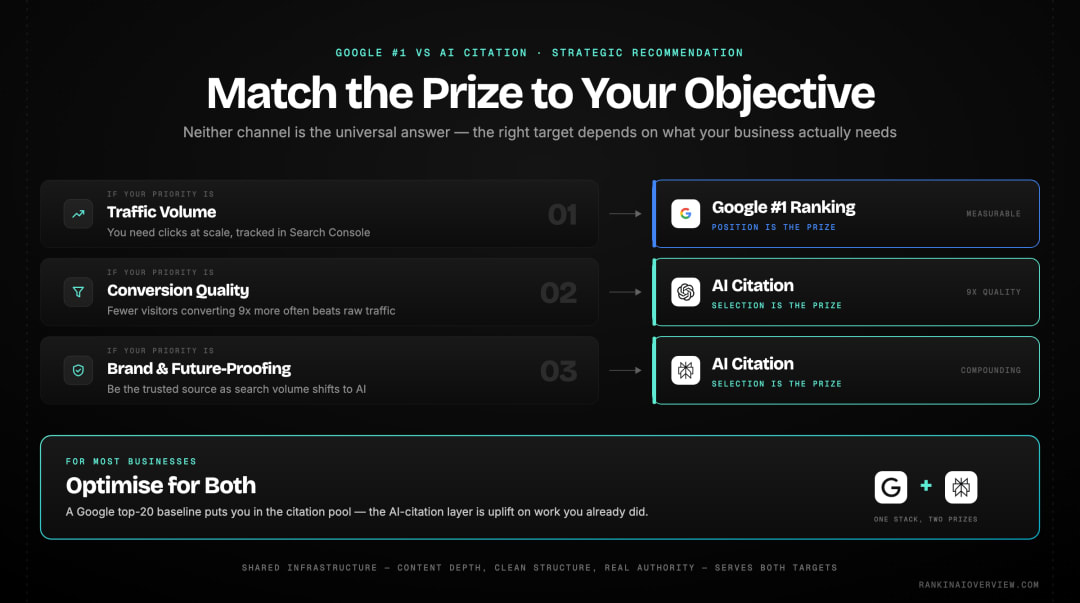
Infographic showcasing the strategic recommendation - match Google ranking or AI citation to your primary objective, and pursue both with ranking as the baseline
For traffic volume: prioritise Google number one ranking. For conversion quality: invest in AI citation. For brand building and future-proofing: AI citation is clearly superior. For most businesses in 2026: pursue both, using Google ranking as the retrieval eligibility baseline for AI Overviews and building AI citation signals as the quality and brand uplift layer on top.
The business model determines the weighting. A publisher or content site that monetises through advertising revenue needs traffic volume and should prioritise Google ranking. An e-commerce brand with high-consideration products should heavily weight AI citation for the conversion quality premium. The AI citation traffic impact on revenue is most visible in high-consideration B2B categories where the conversion rate premium more than compensates for the lower traffic volume.
The most efficient position is Google top-20 ranking plus consistent AI citation for the same queries. Google top-20 is the prerequisite for Google AI Overview citation: approximately 97% of AIO citations come from this pool. Achieving this combined position delivers the most stable traffic baseline plus the AI-driven conversion quality uplift simultaneously. The investment required to achieve both is lower than it might appear because the underlying content quality and trust signals serve both channels through shared infrastructure.
Conclusion
Both visibility types matter and serve different business goals. Google number one delivers volume and stability. AI citation delivers quality, brand impact, and future-proofing. The Google rank 1 vs AI answer traffic question does not have a universal answer. It has a business-model-specific answer that changes depending on whether your primary objective is click volume, conversion quality, or brand building.
For most businesses in 2026, the right answer is to pursue both. Google ranking as the foundation for retrieval eligibility and stable click volume. AI citation as the quality layer that converts less traffic into more revenue and builds the brand equity that compounds into future organic performance. The AI citation traffic impact is real, measurable, and growing. RANK IN AI OVERVIEW covers how AI engines evaluate brand authority and what drives citation across all major platforms in depth across its content library.
Frequently asked questions
Does being cited in AI hurt your Google ranking CTR?+
Yes, when an AI Overview is present for the same query. Research finds that Google position one CTR drops from approximately 28 to 34% to approximately 15 to 20% when an AI Overview appears for the query. This CTR reduction applies to position one regardless of whether your page is cited in the AI Overview. Being cited in the AI Overview partially compensates for this by ensuring that users who do not click organic results have still encountered your brand. Pages cited in AI Overviews earn more organic clicks over time than uncited peers because the AI citation builds brand familiarity that converts to future branded searches.
Is AI citation or Google ranking harder to achieve?+
Google number one ranking is harder to achieve for most queries in most categories because the competitive field is more developed and link acquisition costs are significant. AI citation is currently less competitive because most teams are not yet systematically investing in the entity signals, content structure, and off-site presence that AI engines evaluate. The window for early-mover advantage in AI citation is closing as more teams recognise and act on this gap. For most businesses in 2026, AI citation represents a relatively less competitive path to category visibility than Google number one for the same queries.
Can you track the revenue impact of AI search citations?+
Directly, no, for most teams. AI citations do not always produce trackable referral clicks. The practical measurement approach is the branded search proxy: track branded search volume in Google Search Console over a period where AI citation frequency is improving. Rising branded search impressions correlate with AI citation-driven brand awareness. For teams with more sophisticated attribution, segmenting GA4 traffic by source and comparing conversion rates between AI-referred sessions and standard organic sessions produces the most direct evidence of AI citation revenue impact.
Explore with AI
Share this