How to Use Rank Trackers in 2026: A Practical Guide
How to operate a rank tracker well: build the prompt set, configure measurement, read the data, cover AI search, and turn tracking into decisions.
Key Highlights
- A rank tracker is only as good as two operator choices: the prompt set you point it at, and how robustly it decides whether you were actually cited.
- The tool has changed. A 2026 tracker follows AI answer visibility alongside classic Google positions, because the two move independently.
- Most of a tracker's value goes unused, because teams watch the dashboard instead of running a workflow that turns movement into decisions.
- A lot of the variation you see can be an artefact of crude measurement rather than a real change, so how you configure and read the tool matters as much as the tool itself.
- The discipline that separates a useful tracker from an anxiety dashboard is closing the loop: read the trend, act on it, then re-measure to confirm.
Plenty of teams buy a rank tracker, connect it, and then simply watch. Positions and citations wiggle, someone glances at the dashboard each morning, and nothing actually changes. A tracker is only as valuable as the decisions it drives, and most of that value goes unclaimed because there is no workflow sitting behind the data, only a habit of looking at it.
The tool itself has also moved on. A rank tracker in 2026 is no longer just about Google positions. The better ones now follow AI answer visibility too, because a growing share of your audience gets its answers from engines that have no numbered ranking at all. Operating a tracker well means using both halves competently and understanding why they so often disagree, rather than treating the AI view as a novelty bolted onto the familiar one.
According to a 2025 study that evaluated seven LLMs across six benchmarks and twelve prompt templates, much of the apparent sensitivity to how a prompt is worded turned out to be an artefact of crude evaluation methods rather than a real property of the models, and switching to a semantic judge sharply reduced the measured variance. That result is quietly important for anyone operating a tracker, because it means how you phrase and measure your tracked prompts can manufacture volatility that was never really there. This guide is a practical walkthrough: what a tracker does, how to build the prompt set and configure it, how to read the data without drowning, how to cover AI search, the common mistakes, and how to turn tracking into action. For choosing a tool in the first place, our roundup of the best AI rank trackers is the place to start.
What Does a Rank Tracker Actually Do?
A rank tracker turns one-off position checks into an ongoing record. It monitors where you appear for a chosen set of queries across search engines over time, and modern tools also record whether AI engines cite or mention your brand. The output is a trend, a competitor comparison, and a map of which pages earn visibility for what.
The core job is the shift from snapshot to series. A single check tells you almost nothing, because you cannot tell a good position from a lucky one or a real slip from ordinary movement. Tracked consistently over weeks, the same queries reveal whether your work is helping, holding, or slipping, and that direction of travel is the difference between raw data and something you can actually decide from. Everything else the tool offers is in service of making that series trustworthy and readable.
Modern trackers extend the same idea to AI visibility, logging citations and mentions in AI answers beside the classic rankings. This matters because the two signals move independently: you can hold a strong Google position and be entirely absent from the AI answer for the same query, or be cited by an AI engine on a query where you rank poorly. Seeing both in one place is what surfaces those gaps, and whether a given tool does this credibly is exactly the question our assessment of whether AI rank tracker tools actually work sets out to answer.
It is worth being clear-eyed about what a tracker cannot do, because that shapes how you should lean on it. It does not tell you why you moved, only that you did; the diagnosis is still your job. It does not improve anything by being watched; the value is entirely in the decisions it prompts. And on the AI side especially, it is measuring a moving, probabilistic target rather than a stable ledger, so its readings carry more inherent uncertainty than the tidy position numbers marketers are used to. Treating the tool as an instrument that points you toward questions, rather than an oracle that hands you answers, is the mindset that gets the most out of it. Our look at whether Google rankings are still the most important SEO metric makes a related case for holding any single tracked number lightly.
How Do You Build the Right Prompt Set?
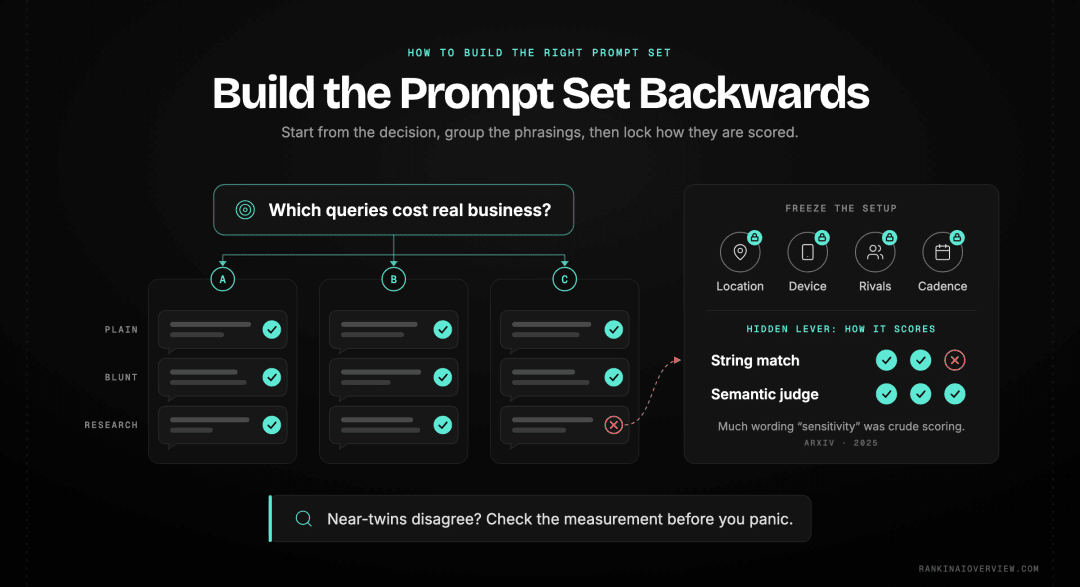
Build the prompt set by choosing the queries that genuinely matter to your business, phrased the way real users actually ask them, and then freezing that list. The prompt set is the single most important operator decision, because everything the tracker reports is downstream of what you told it to watch, and a careless list produces careless data.
This is where the research above earns its place. Because the exact wording of a query can change which sources an engine reaches for, the phrasings you choose are not a neutral technicality, they are part of the measurement. If you track a stiff, keyword-style phrase that no human would type, you may be monitoring a query your buyers never actually ask, and optimising toward an answer nobody sees. The fix is to populate your prompt set with the natural-language questions real people put to AI engines, in the various ways they phrase them, so the tracker reflects the reality you care about rather than an artificial one.
The same research carries a second, subtler lesson: not every difference you see between phrasings is real. A large part of measured prompt sensitivity turned out to be an artefact of how outputs were judged, not a true property of the system. For an operator, that means you should include a few genuine paraphrases of your most important queries and watch whether they behave consistently, treating wild divergence between near-identical phrasings as a prompt to check your measurement rather than as an instant strategic emergency. Keep the whole set focused, because a bloated list you cannot maintain faithfully is worse than a short one you track with discipline, and group it by topic or funnel stage from the start so movement across a cluster tells a story a flat list never could.
A practical way to build the set is to work backwards from decisions rather than forwards from keywords. Start with the questions whose answers would actually change what you do: which queries, if you were absent from them, would cost you real business. Those belong in the set first. Then add the same questions in the register your buyers use, the blunt commercial version and the more exploratory research version, because a single intent often surfaces as several phrasings and you want the tracker to see the whole shape of it. Resist the temptation to pad the list with every term your keyword tool suggests, since each addition is another prompt you must measure faithfully forever, and a query you cannot commit to tracking properly is one you should not add at all. A deliberately small set, chosen for decision value and phrased like a human, will teach you more than a sprawling one assembled for the comfort of completeness.
It also pays to revisit the set on a slow, deliberate schedule rather than never or constantly. Language shifts, your priorities move, and new competitors enter, so a set frozen forever will slowly drift out of touch with reality. But because every change breaks comparability, treat additions and removals as considered events, logged with a date, rather than quiet edits. The goal is a prompt set that stays representative without ever becoming a moving target you can no longer trend against.
"Prompt sensitivity may be more an artifact of evaluation than a flaw in the models."
Andong Hua and colleagues, Flaw or Artifact? Rethinking Prompt Sensitivity in Evaluating LLMs (arXiv, 2025)
How Do You Configure the Tool So the Numbers Mean Something?
Configure the tracker to reflect your real audience and to judge results robustly. Set the correct locations and devices, add your genuine competitors, choose a sensible cadence, and pay attention to how the tool decides whether you were cited, because a crude matching rule will manufacture volatility that a semantic one would not.
Most setup guidance stops at the obvious levers, and they do matter. Track the locations and devices your audience actually uses, since results personalise heavily by both. Add your real competitors so every reading comes with the context that turns a bare number into share of voice. Pick a cadence you can sustain, weekly for most sites, and hold it fixed so periods stay comparable. Group your queries so reports stay legible. None of this is difficult, but skipping it quietly corrupts everything the tool reports afterwards.
The less obvious lever, and the one the study points straight at, is how the tool judges a citation. Deciding whether an AI answer really cited you is not always clear-cut, and a tool that uses rigid string matching can miss a genuine citation phrased slightly differently, or count a passing reference as a full citation. That crude judgement is precisely the kind of thing the research showed can inflate apparent sensitivity and volatility. You cannot always see inside a vendor's method, but you can ask about it, and you can sanity-check it: when the tool reports a dramatic change, look at the underlying answers yourself and confirm the change is real rather than a matching quirk. Preferring tools that judge citations semantically, and that let you inspect the evidence, is one of the highest-leverage configuration choices you can make.
How Do You Read Rank Tracker Data Without Drowning in It?
Read the data by focusing on trends and groups rather than the daily twitching of individual queries. Watch direction over weeks, read your movement beside competitors, and look for patterns across whole topic clusters. Day-to-day wiggles are mostly noise; sustained movement in one direction across a cluster is the signal worth your attention.
The trap is reacting to every small change, which turns a decision tool into a source of anxiety. Positions and citations fluctuate constantly for reasons that have nothing to do with you, so chasing each movement produces stress rather than insight. Zoom out to weekly and monthly views, where the genuine patterns separate themselves from the churn, and where a real trend has time to distinguish itself from a one-off blip. A rolling view of the last several readings is far more honest than the raw jump between the two most recent ones.
Two habits make the reading reliable. Read by cluster, because movement across a whole topic area carries far more meaning than a single query wobbling alone, which could easily be chance or a measurement artefact. And always read your numbers next to competitors, since a decline everyone shares points to a platform-side change and needs no panic, whereas a decline that is yours alone is a genuine competitive signal. Reading these signals well is a skill in itself, and our guide to whether AI search does not have rankings like Google explains why the AI half of the dashboard especially rewards patience over reflex.
How Do You Use a Rank Tracker for AI Search Visibility?
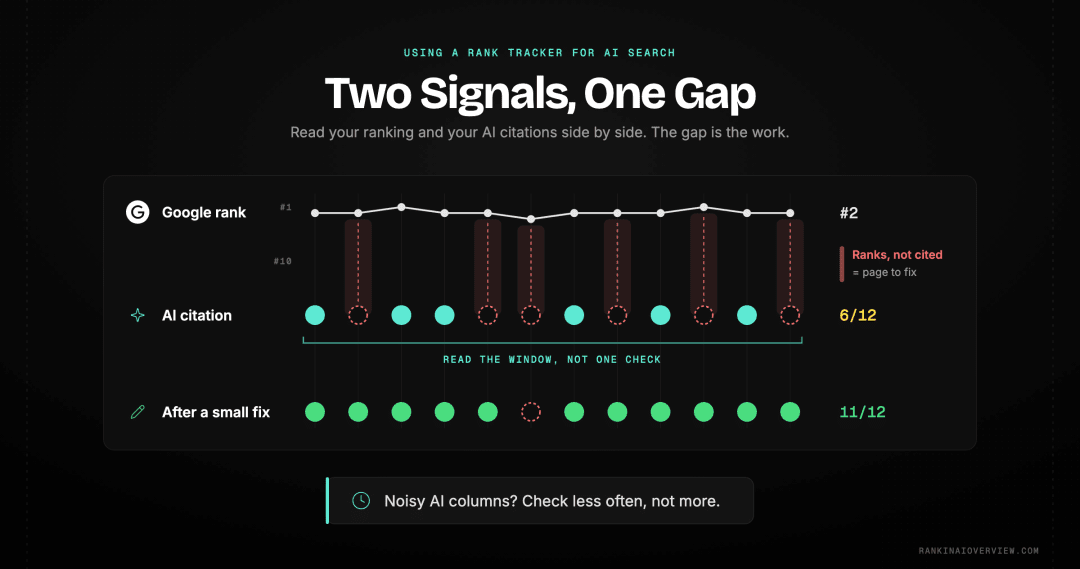
Use the tracker for AI search by following whether AI engines cite or mention your brand for your key prompts, alongside the traditional positions, and by reading the two as distinct signals. Modern trackers record AI citations next to Google rankings, so you can see exactly where the two diverge, and those divergences are usually where the opportunity lives.
The central insight is that AI visibility and classic rankings often part company. You can rank at the top of Google and be missing from the AI answer, or be cited by an AI engine while sitting well down the organic results. A tracker that shows both together makes those gaps visible, and a gap between a strong ranking and a missing citation is one of the most actionable findings you can get, because it points to a page that is already trusted enough to rank but is not being written or structured in a way the AI reaches for.
There is a reason to operate the AI half with even more patience than the Google half. AI answers are probabilistic and reshuffle their sources far more readily than organic positions move, so the AI columns of your dashboard will look noisier, and a naive operator will mistake that extra churn for extra drama. The correct response is not to check the AI view more often, which only amplifies the noise, but to read it over a longer window and to lean on the paraphrase and evidence checks described earlier. When an AI citation appears and disappears across consecutive readings, that flicker is usually the engine resampling rather than a real loss, and the queries where you flicker are often the ones where a modest content improvement can tip you from occasional to reliable citation. Treat the AI half as a slower, noisier instrument that rewards patience, and it becomes a genuine source of edge rather than a source of false alarms.
Weight your AI tracking toward citations rather than mere mentions, and toward buyer-intent prompts rather than idle ones, because that is where visibility turns into value. Our guide to the AI visibility metrics that matter covers which of these signals to prioritise and why the raw counts mislead. To add a dedicated AI view alongside a traditional tracker, a free AI-visibility audit from Rank in AI Overview will show you where your rankings and your AI citations diverge, which is often the fastest way to find your next content priority.
What Are the Common Rank Tracker Mistakes to Avoid?
The common mistakes are tracking too many queries, reacting to daily noise, ignoring competitors, trusting a dramatic reading without checking it, and never turning data into action. Each one either corrupts the signal or wastes it, leaving you with an expensive dashboard that informs nothing and changes nothing.
Some of these are familiar. A bloated, unfocused query list produces noise nobody acts on. Panicking over daily fluctuation produces stress rather than strategy. Ignoring competitors strips your numbers of the context that gives them meaning. Tracking only Google, and missing the AI half entirely, leaves you blind to a channel that is quietly reshaping how people find you. And collecting data you never act on is the cardinal waste, because the tool cannot improve your visibility, only the decisions you make from it can. Each of these mistakes shares a root cause: mistaking the act of measuring for the act of improving, when only the second one actually moves anything.
There is one more mistake that the research makes newly visible, and it deserves its own line: taking every sharp movement at face value. Because a meaningful share of apparent volatility can be an artefact of how a tool measures rather than a real change in the world, an operator who reacts to every dramatic swing will spend a lot of effort chasing phantoms. The habit that guards against this is simple. When the tool reports something startling, look at the underlying answers before you act, and confirm the change is real. That one check, applied consistently, is the difference between a tracker that sharpens your judgement and one that jerks you around.
How Do You Turn Tracking Into Action?
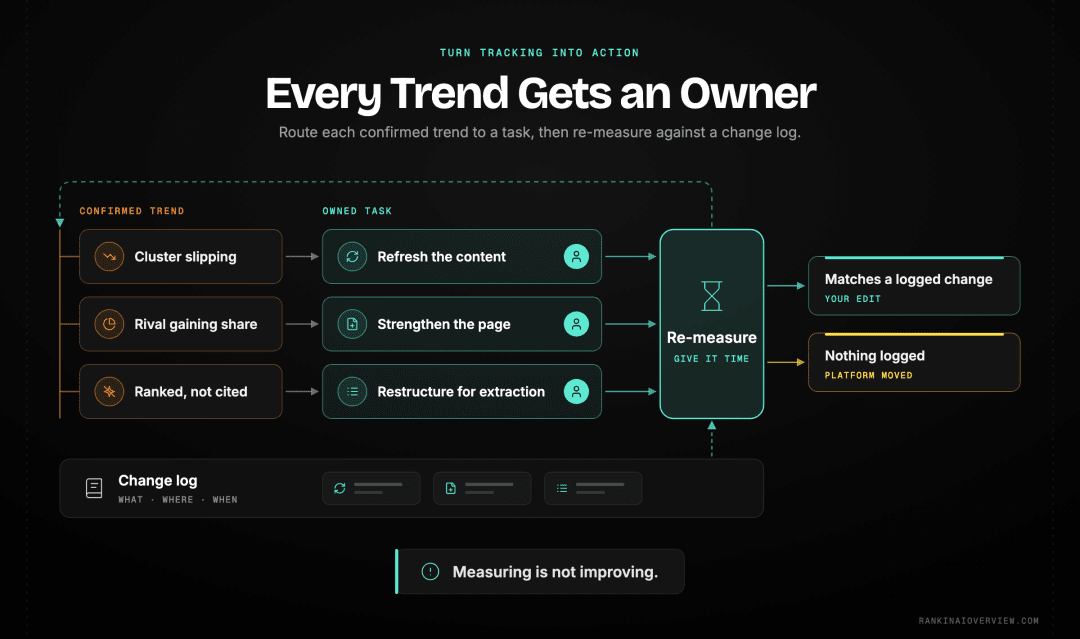
Turn tracking into action by treating every confirmed trend as a trigger for a specific task. A slipping cluster signals content to refresh, a competitor gaining share signals a page to strengthen, and a gap between a strong ranking and a missing AI citation signals a page to restructure for extraction. Then re-measure to confirm the change actually worked.
The habit that separates a useful tracker from a vanity dashboard is this follow-through. Every meaningful movement should become a task with an owner, not merely a note someone reads and forgets. When a page loses ground, you improve it; when a rival overtakes you on a valuable query, you close the gap; when the AI answer ignores a page that ranks well, you rework how that page presents its answer. The tracker's job is to point; yours is to move.
Then close the loop deliberately, and give it time, because a single reading after a change cannot tell your improvement apart from the ordinary noise. Watch several readings and look for a sustained shift on the affected queries before you claim the win. Tracking without action is monitoring; tracking with disciplined action and honest re-measurement is optimisation.
It helps to keep a lightweight change log alongside the tracker, recording what you changed, on which pages, and when. This small habit pays off twice. First, it lets you line up a movement in the data against the action that might have caused it, so you can actually learn what works rather than guessing. Second, it protects you from crediting your own edits for lifts that were really the platform moving, because a change log plus the competitor comparison together let you separate a genuine result from a coincidence. Over a few months that log becomes the most valuable artefact you own, a record of which interventions actually shifted your visibility and which merely felt productive. Our tool comparisons, including the AI Rank Lab review, can help you pick a tracker that surfaces the trends worth acting on and shows you the evidence behind them.
Conclusion
A rank tracker is a decision tool, not a scoreboard, and operating one well is a skill rather than a purchase. Its value comes from a disciplined workflow: build a focused, realistic prompt set, configure the tool to judge results robustly, read trends instead of daily noise, benchmark against competitors, and turn every confirmed movement into a specific task.
In 2026 that also means using the AI half of the dashboard as seriously as the Google half, because the two move independently and the gaps between them are where opportunity hides. And it means staying alert to the fact that not every dramatic reading is real, since how you phrase and measure your prompts can create volatility that was never there. Set it up with focus, read it with patience, check the surprises before you act on them, and close the loop every time. Do that consistently and the tracker stops being a number you watch and becomes an instrument that genuinely sharpens your judgement.
Want to add a clear, evidence-backed AI visibility view to your tracking? Rank in AI Overview offers a free AI-visibility audit that shows where your rankings and your AI citations diverge, so you can point the tool at the gaps that matter most.
Frequently asked questions
What is a rank tracker actually for?+
A rank tracker turns one-off checks into an ongoing record of where you appear for chosen queries, and in modern tools whether AI engines cite you. It reveals trends, competitor movement, and content gaps, so it informs decisions rather than just displaying numbers.
How do I choose which queries to track?+
Pick the queries that genuinely matter to your business, phrased the way real users ask them, and keep the list focused. The prompt set is your most important choice, because everything the tracker reports depends on what you told it to watch.
How often should I check my rank tracker?+
Focus on weekly and monthly trends rather than daily checks. Positions and citations fluctuate constantly, so sustained direction over several readings gives far clearer, more actionable insight than reacting to any single day's movement.
Why do near-identical queries give different results?+
Partly because wording can change which sources an engine reaches for, and partly because some of that difference is a measurement artefact rather than a real change. Track a few paraphrases of key queries and check big divergences before treating them as real.
Can rank trackers really track AI search visibility?+
Yes. Modern trackers increasingly record whether AI engines cite or mention your brand alongside traditional positions, so you can see Google rankings and AI visibility together and spot the gaps where the two signals diverge.
What is the biggest way people waste a rank tracker?+
Watching it without acting on it. A tracker cannot improve your visibility on its own; only the decisions you make from its trends can. Collecting data and never turning it into a task is the most common and costly mistake, and it is easy to fall into because watching feels like work.
Explore with AI
Share this