Nightwatch Review 2026: A Unified SEO and AI Tracker?
What Nightwatch tracks across search and AI engines, exact pricing, strengths and weaknesses, so you can decide if it fits your workflow.

Key Highlights
- Nightwatch tracks traditional search rankings and AI citations together, across Google, Bing and engines like ChatGPT, Claude, Gemini and Perplexity.
- Its standout is Citation Intelligence, which connects your search rankings to your AI citations in one view.
- SERP snapshot audits store raw HTML, giving verifiable proof behind its accuracy rather than just a number.
- Pricing is transparent: Starter at 79 euros a month up to Agency at 399 euros, with a 14-day free trial and no card required.
- Strengths are the unified search-plus-AI view, local tracking depth, and agency features; limits are euro pricing and breadth some solo users will not need.
- It suits SEO professionals and agencies who want one tool for both classic and AI search, less so a brand wanting AI tracking alone.
AI answers sound authoritative even when they are wrong, which is exactly why proof matters. According to an audit of a multimodal AI search system by Erfan Samieyan Sahneh and Luca Maria Aiello, across 11,943 claim-source pairs between 3.7% and 18.7% of claims were not supported by their cited sources, with the failures being confident but ungrounded rather than obvious errors. If AI systems project more confidence than their citations justify, an SEO tool that stores verifiable evidence of what actually ranked and got cited is genuinely useful. Nightwatch is built around that kind of proof, storing the evidence rather than asking you to take a number on faith.
The wider appeal is that Nightwatch does not treat AI search as a separate world. Most tools pick a lane, tracking either classic Google rankings or AI citations. Nightwatch tracks both in one place, which fits how SEO teams actually work now, watching their position on Google and their presence in AI answers at the same time. That combined perspective is increasingly what clients and managers ask for, because they want to know the whole visibility picture, not half of it.
This Nightwatch review covers what it tracks across search and AI, its features, exact pricing, where it excels, and where it falls short. It also shows clearly how it compares to alternatives, so you can decide whether a unified tracker fits your workflow or whether a specialist tool suits you better.
What is Nightwatch and what does it do?
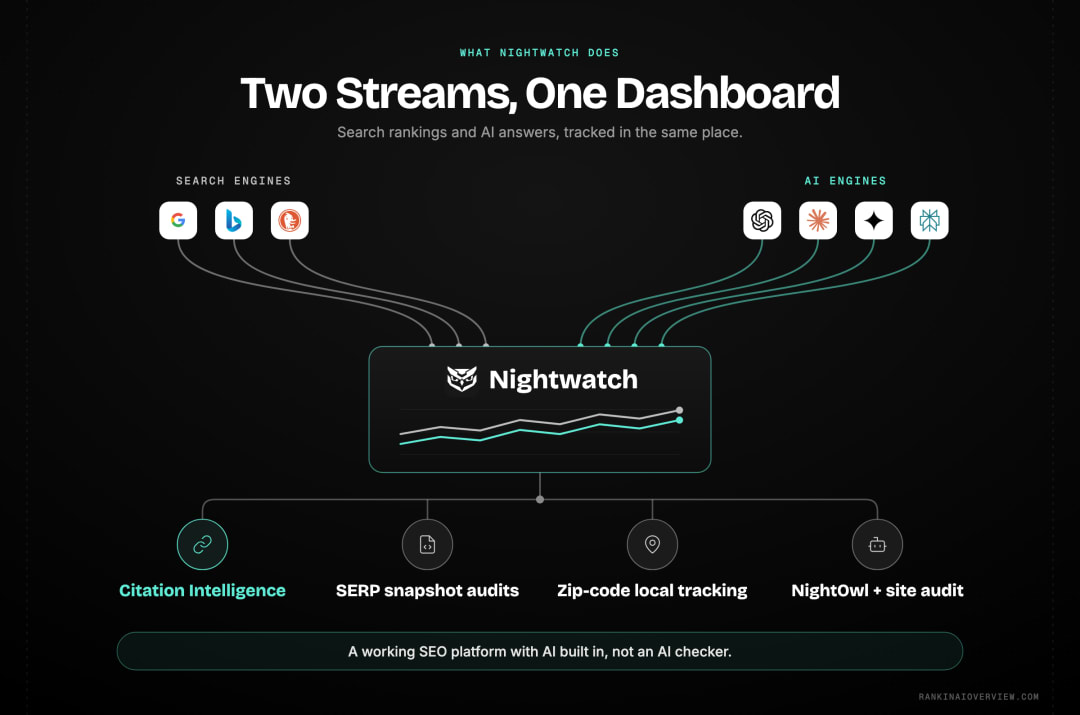
Nightwatch is a unified search and AI visibility platform that tracks keyword rankings across search engines while monitoring brand citations in AI models. It follows your positions on Google, Bing, Yahoo and DuckDuckGo, and your presence across ChatGPT, Claude, Gemini, Perplexity and Google AI Overviews, in one platform.
The defining idea is unification. Rather than making you run one tool for rankings and another for AI, Nightwatch brings both into a single dashboard, so you see how your traditional and generative visibility move together. For teams managing the shift from search to AI answers, that combined view is the whole point of the tool.
It is aimed squarely at practitioners. Nightwatch reports over 10,000 SEO teams using it, a 4.8 rating on G2, and features built for professional work, from deep local tracking to agency reporting. That positioning is closer to a working SEO platform than a lightweight AI checker, and it fits teams who want to rank on Google and in AI answers together rather than treat them separately.
"These findings characterize the current trustworthiness of video-based generative search and highlight the gap between the confidence these systems project and the fidelity of their outputs." Erfan Samieyan Sahneh and Luca Maria Aiello, authors, "Auditing the Reliability of Multimodal Generative Search". Source: arXiv
What does Nightwatch track and what are its main features?
Nightwatch tracks rankings and AI citations together, and adds Citation Intelligence, SERP snapshot audits, deep local tracking, and an automated SEO agent. Its feature set spans both classic SEO and AI visibility, which is what makes it a unified tool rather than a single-purpose one. Each capability supports that combined view.
Here is how its main capabilities fit together.
- Citation Intelligence: connects your search rankings to your AI citations, so you see the relationship between the two.
- Rank tracking: positions across Google, Bing, Yahoo, DuckDuckGo, YouTube and Google Maps.
- AI visibility monitoring: presence across ChatGPT, Claude, Gemini, Perplexity and AI Overviews.
- SERP snapshot audits: stores raw HTML of results, giving verifiable evidence behind the data.
- Deep local tracking: coverage across a very large set of locations with zip-code precision.
- NightOwl agent and site audit: automated SEO analysis plus technical site checks.
The SERP snapshot feature is more important than it first sounds. By storing the raw HTML behind a ranking or citation, Nightwatch lets you verify what it reports rather than trust a number, which supports its claim of high accuracy. Given how confidently AI systems present unsupported claims, that verifiability is a real strength, and it connects to understanding how often ChatGPT cites its sources in the first place.
Citation Intelligence is the other headline. Linking your Google position to your AI citations in one view helps you see whether ranking well still earns you a place in AI answers, a question at the heart of the current SEO shift and one that decides where you should spend your effort next.
How does Nightwatch's Citation Intelligence and verifiable data work?
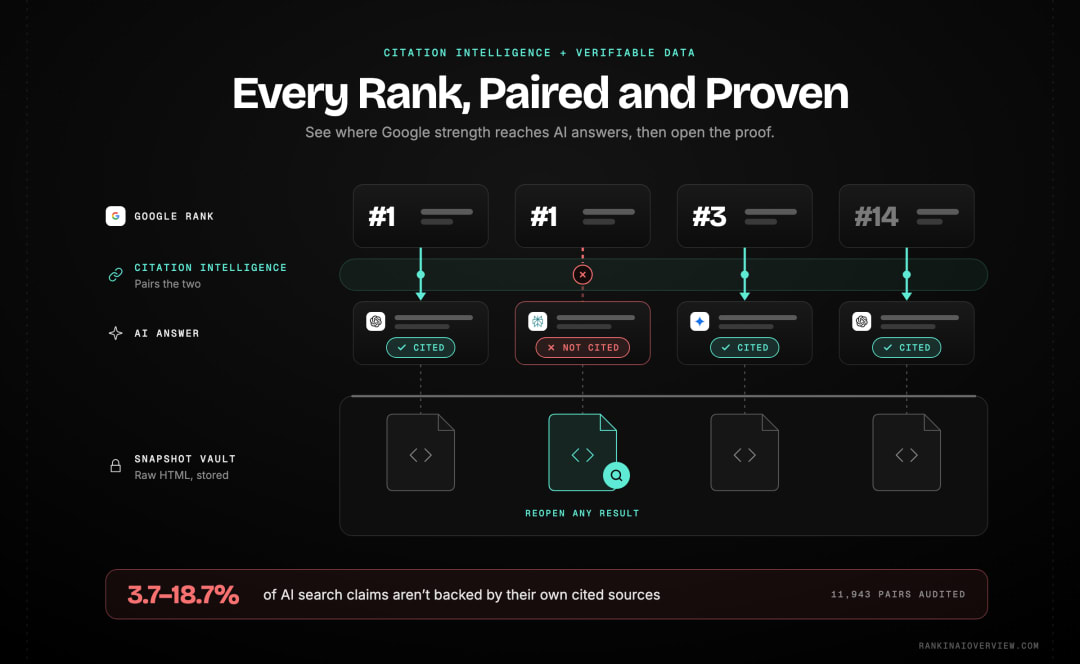
Nightwatch's Citation Intelligence links your search rankings to your AI citations, while its SERP snapshots store the raw HTML behind every result so you can verify it. Together they let you see the relationship between classic and AI visibility and trust the numbers behind it. These two features define what makes Nightwatch different from a simple checker.
Citation Intelligence exists because ranking and being cited are no longer the same thing. A page can sit at the top of Google and still be absent from AI answers, or the reverse. By connecting the two data sets, Nightwatch shows you where your Google strength does and does not translate into AI citations, which is precisely the gap most SEO teams are trying to understand right now. Instead of guessing whether your rankings still matter for AI, you can watch the correlation directly.
The verifiable snapshots address a quieter problem: trust in the data itself. Many trackers report a number and ask you to believe it. By storing the raw HTML of a result, Nightwatch lets you open the evidence and confirm what actually appeared, which underpins its accuracy claim. In a field where AI answers routinely project more confidence than their sources support, being able to prove what was really shown is a meaningful advantage. It also makes client reporting more defensible, because you can back a claim with the stored result rather than a screenshot that could be questioned.
How much does Nightwatch cost?
Nightwatch uses transparent tiered pricing from 79 euros a month on Starter up to 399 euros on Agency, plus a custom Enterprise plan, all with a 14-day free trial and no card required. Prices are in euros, and paying annually is available. The tiers scale by keywords tracked, AI prompts, and websites.
The tiers are laid out below.
| Plan | Price (monthly) | Keywords | AI prompts | Websites |
|---|---|---|---|---|
| Starter | 79 euros | 500 | 50 | 5 |
| Professional | 159 euros | 2,500 | 150 | 25 |
| Agency | 399 euros | 7,500 | 500 | 100 |
| Enterprise | Custom | 20,000+ | Unlimited | Unlimited |
The plans scale sensibly with need. Starter suits a small site or solo consultant, Professional adds Looker Studio, white-label reports and API access for growing teams, and Agency raises the limits and adds a dedicated account manager for client work at scale. The 14-day full-feature trial with no card required makes testing genuinely low-risk, which is a welcome contrast to the demo-only pricing of some enterprise rivals.
What does Nightwatch do well?
Nightwatch's strengths are its unified search-and-AI view, its verifiable accuracy, its deep local tracking, and its agency features. Few tools combine classic rank tracking with AI citation monitoring this cleanly, and fewer still back their data with stored evidence. For SEO teams straddling both worlds, that combination is the draw.
The unification is the headline advantage. Seeing your Google rankings and your AI citations side by side, linked through Citation Intelligence, saves running two tools and helps you spot when ranking success does or does not carry into AI answers. That single view matches how modern SEO actually works.
- Verifiable data: stored raw HTML snapshots let you check what was reported, supporting a high accuracy claim.
- Local depth: coverage across a very large set of locations with zip-code precision suits multi-location brands.
- Agency-ready: white-label reports, unlimited seats, API access and a dedicated manager on higher tiers.
- Transparent, low-risk trial: clear pricing and a 14-day no-card trial make it easy to evaluate.
The scale of adoption also reassures. With more than 10,000 SEO teams reported as users and a strong G2 rating, Nightwatch has a track record that many newer AI-only tools cannot match, which matters when you are trusting a platform with ongoing reporting.
There is also a workflow benefit that is easy to overlook. Because Nightwatch already handles traditional rank tracking, teams that adopt it for AI visibility do not have to add a separate tool or learn a second interface. The AI features sit alongside the rankings work they already do, which lowers the barrier to actually using them. A tool that fits into an existing routine tends to get used, whereas a standalone AI tracker can end up ignored after the initial novelty, no matter how good it is on paper.
Where does Nightwatch fall short?
Nightwatch's weaknesses are its euro-denominated pricing, its breadth for users who only want AI tracking, and the learning curve of a full SEO platform. If you want a simple, AI-only checker, much of its classic-search power is capacity you do not need. Its depth is a strength for practitioners and a mismatch for casual users.
The euro pricing is a minor but real friction for buyers who budget in dollars or pounds, since the exact cost shifts with exchange rates. It is a small point, but worth noting when comparing tiers against dollar-priced rivals, because a plan that looks cheaper on paper can move against you between billing cycles. For most teams this is a rounding-error concern rather than a dealbreaker, yet it is the kind of detail worth checking before you sign up rather than discovering later.
Breadth is the larger caveat. Nightwatch is a full search platform with AI visibility built in, so a brand that only cares about AI citations will pay for and navigate rank-tracking features it will not use. And like every tool in the category, its AI metrics inherit the run-to-run variability of AI answers, so no tracker delivers perfectly stable numbers, a limit worth keeping in mind before reading any single figure as final. The verifiable snapshots help here, but they cannot remove the underlying variability of the engines themselves. This is a general truth of the category, and it is why whether AI rank tracker tools actually work depends as much on how you read the data as on the tool itself.
How does Nightwatch compare to alternatives?
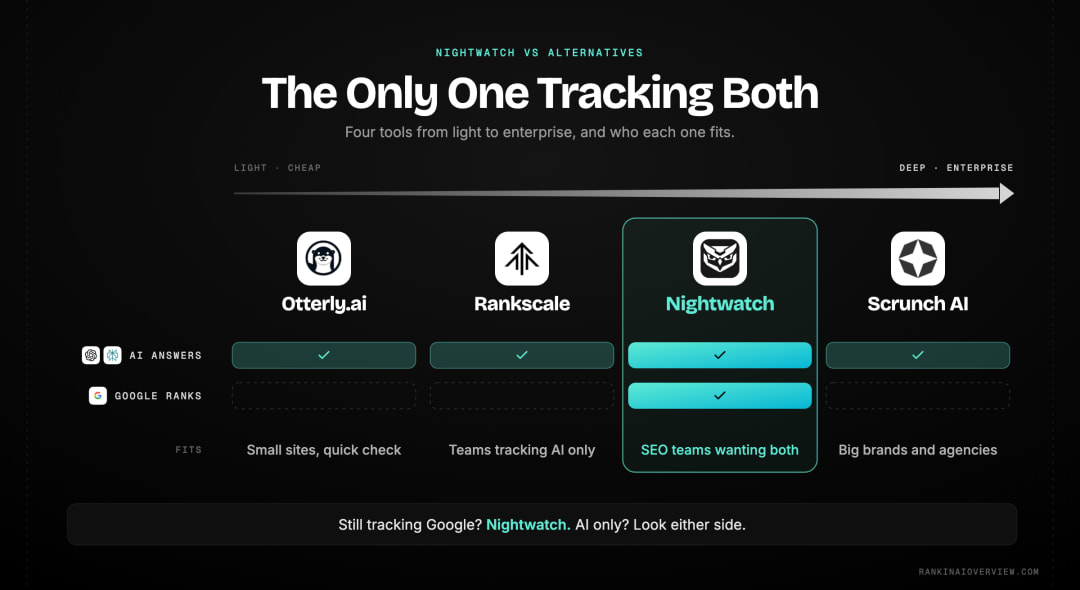
Nightwatch sits in the mid-market as a unified SEO-and-AI tracker, broader than AI-only tools and more affordable than enterprise platforms. Its trade-off against rivals is combined search-and-AI coverage with transparent pricing, versus either specialist AI tools or heavier enterprise suites. The right pick depends on whether you want one tool for both jobs.
Here is how it stacks up against the usual alternatives.
| Tool | Positioning | Best for |
|---|---|---|
| Nightwatch | Unified SEO plus AI, transparent pricing | SEO teams wanting both in one tool |
| Rankscale | AI-visibility focused, broad engines | Teams focused on AI tracking |
| Scrunch AI | Enterprise, AI-visibility depth | Large brands and agencies |
| Otterly.ai | Budget, AI-only, simple | Small sites wanting a quick check |
Against AI-only tools like Rankscale, Nightwatch adds full traditional rank tracking, which is valuable if you still care about Google positions, but less relevant if you only want AI citations. Against enterprise platforms, it is more affordable and transparent, though it offers less enterprise-specific depth. Our roundup of the best AI rank trackers sets the wider field in context, and benchmarking SEO against AI visibility explains why a unified view can be worth the breadth.
The decision often comes down to a single question: have you fully left classic search behind? Most brands have not. Google still drives real traffic, and AI answers are a growing addition rather than a total replacement, which is exactly the situation Nightwatch is designed for. A team that has genuinely moved all its attention to AI answers might prefer a leaner specialist, but that team is still rare. For the majority who live in both worlds, the unified approach removes a real headache rather than adding one.
Who should use Nightwatch, and who should choose a different tool?
Nightwatch suits SEO professionals and agencies who want one platform for both traditional rankings and AI citations, and it is less suited to brands wanting AI tracking alone. If you still manage Google rankings and want AI visibility in the same tool, it is a strong, transparent fit. If you have moved entirely to AI and ignore classic search, a specialist may serve you better.
Choose Nightwatch if you value the unified view, want verifiable data, and need agency features like white-label reporting. Its transparent pricing and no-card trial make it easy to test, and its scale gives confidence for ongoing work. It is especially practical for agencies reporting on both search and AI to clients, where showing progress across both channels in one report is far cleaner than stitching two tools together. Pairing it with a clear view of which metrics actually matter for AI visibility helps you turn its data into decisions rather than dashboards.
Look elsewhere if you only want AI citation tracking and would rather not pay for rank-tracking breadth, or if you need enterprise-specific depth and security. A focused AI tool will be leaner for pure AI monitoring, while a large enterprise may want a heavier platform. As always, matching the tool to how you actually work matters more than any single feature.
Conclusion
Nightwatch is one of the strongest unified trackers in 2026, pairing full traditional rank tracking with AI citation monitoring through its Citation Intelligence view, and backing its data with verifiable SERP snapshots. Its pricing is transparent, its trial is genuinely low-risk, and its scale and agency features make it a practical choice for professional SEO work. The trade-offs are euro-denominated pricing and a breadth that pure AI users will simply not need.
For SEO teams and agencies bridging classic and AI search, it earns a place on the shortlist, and the no-card trial makes testing easy. Rank in AI Overview publishes independent research on how AI engines choose and cite sources, and is building an AI visibility tool that is coming soon. Run a free AI visibility audit to see how the engines describe your brand right now, whatever tool you land on.
Frequently asked questions
Is Nightwatch worth it?+
For SEO teams and agencies wanting one tool for both traditional rankings and AI citations, Nightwatch is worth trialling. Its unified view and verifiable data justify the price for practitioners. For a brand wanting AI tracking alone, a focused tool may be better value.
Does Nightwatch track AI search engines?+
Yes. Nightwatch monitors brand citations across ChatGPT, Claude, Gemini, Perplexity and Google AI Overviews, alongside traditional rankings on Google, Bing, Yahoo and others. Its Citation Intelligence links your search rankings to your AI citations in a single view.
Does Nightwatch offer a free trial?+
Yes. Nightwatch offers a 14-day full-feature free trial with no credit card required. This lets you test both its rank tracking and AI visibility monitoring before paying. Its pricing is transparent, so you can also see the tiers upfront.
How much does Nightwatch cost?+
Nightwatch starts at 79 euros a month for Starter, rising to 159 euros for Professional and 399 euros for Agency, with a custom Enterprise tier. Plans scale by keywords, AI prompts and websites. A 14-day free trial with no card is included.
Is Nightwatch good for agencies?+
Yes. Its Professional and Agency tiers add white-label reports, unlimited seats, API access and, higher up, a dedicated account manager. Combined with deep local tracking and a unified search-and-AI view, this makes Nightwatch well suited to agencies reporting to multiple clients across both search and AI channels.
Is Nightwatch better than an AI-only tracker?+
It depends on your needs. Nightwatch is better if you want both traditional rankings and AI citations in one place. An AI-only tracker may well be leaner and a little cheaper if you have abandoned classic search entirely and only care about AI visibility.
Explore with AI
Share this