How to Identify What Content AI Answer Engines Actually Cite
A repeatable audit method to identify the exact content types and domains that ChatGPT, Perplexity and Google AI Overviews cite in your niche.

Key Highlights
- Generic advice like "write authoritative content" is not a plan, because citation patterns differ by niche and by engine.
- AI citations concentrate among a small, identifiable set of sources, which means the pattern is real and worth auditing.
- A citation audit reverse engineers what answer engines actually cite for your specific queries, not for the web in general.
- The method is simple: build a real query set, capture the citations across engines, then classify them by content type and domain.
- Content-type patterns tell you what to write, and domain patterns tell you where you must earn a presence.
- Re-run the audit on a fixed cadence, because AI answers vary run to run and one snapshot misleads.
Every guide tells you to create "citable" content, then stops short of the useful part. According to an analysis of more than 366,000 citations across over 24,000 AI search conversations by researcher Kai-Cheng Yang, citations concentrate heavily among a small number of sources, while models from different providers cite distinct sources yet share consistent patterns. Concentration means the behaviour is not random. There is a pattern to identify, and once you can see it, you can build for it.
The problem is that nobody hands you that pattern for your niche. You are told to be authoritative, to add structure, to publish original data. All reasonable, none specific. What content type wins for your queries? Which domains keep appearing? Are the citations dominated by documentation, listicles, forums, or original research? Without answers, you are optimising blind, hoping generic advice happens to match your corner of the web.
That blind spot is expensive. A content team can spend a quarter producing polished pages in a format the engines never cite for that topic, then wonder why nothing appears in AI answers. The work was not bad. It simply targeted the wrong pattern. The only way to know the right one is to look at what the engines are actually citing for the questions your buyers ask, right now, in your space.
This guide fixes that with a repeatable audit. You will learn how to identify the exact content types and domains that ChatGPT, Perplexity and Google AI Overviews cite for the questions your buyers ask. It is a method, not a list, so it keeps working as engines change. Run it once and you replace guesswork with a map of what actually gets cited.
Why should you identify what content AI engines cite?
You should identify what AI engines cite because citation is concentrated and patterned, so the winners are predictable once you measure them. Guessing wastes months producing content that no engine picks up. An audit shows you the real content types and domains that get cited for your queries, so every piece you write afterwards targets a proven pattern.
Concentration is the reason this works. If every query returned a random source, auditing would be pointless. But citations cluster around a small set of sources, and that clustering is a signal you can read. The sources that keep appearing are telling you what the engine trusts for that topic, and that trust is the thing you are trying to earn.
There is also a per-engine reason. Different providers cite differently, so a single view misleads. What Perplexity rewards is not identical to what ChatGPT rewards, and Google AI Overviews differ again. Only a structured look across engines separates a universal pattern from a quirk of one system.
Finally, an audit gives you a baseline you can defend. When someone asks why you are producing a certain content type or pitching a certain publication, you can point to counts from real answers rather than opinion. That evidence makes your AI search strategy easier to fund and easier to defend when priorities are questioned.
Our own study of what actually gets cited across 500 AI answers found the same thing at smaller scale: the cited set is narrow and repetitive. That repetition is exactly what an audit is built to capture.
"While models from different providers cite distinct news sources, they exhibit shared patterns in citation behavior." Kai-Cheng Yang, author, "News Source Citing Patterns in AI Search Systems". Source: arXiv
What do AI answer engines actually cite most?
AI answer engines most often cite clear, well-structured pages from recognised domains that directly answer the question asked. Definitions, how-to steps, original data, and official documentation recur, while vague marketing pages rarely appear. The exact mix shifts by topic and engine, which is why you must measure your own niche rather than trust a general list.
Some patterns hold broadly. Pages that lead with a direct answer get lifted more than pages that bury it. Sources with a strong entity reputation win citation slots even when smaller sites supply the same fact. Original data and first-hand specifics get credited because no other source can provide them.
But the details vary enough that a general answer is not actionable. In one niche, community forums dominate. In another, it is vendor documentation or academic papers. A health query and a software query pull from completely different source types. This is why our guide on what type of content ranks in AI search is a starting point, not a substitute for measuring your own queries.
Treat any "top content types" list, including ours, as a hypothesis. The audit below is how you confirm which parts of it are true for you.
How do you run a citation audit for your own niche?
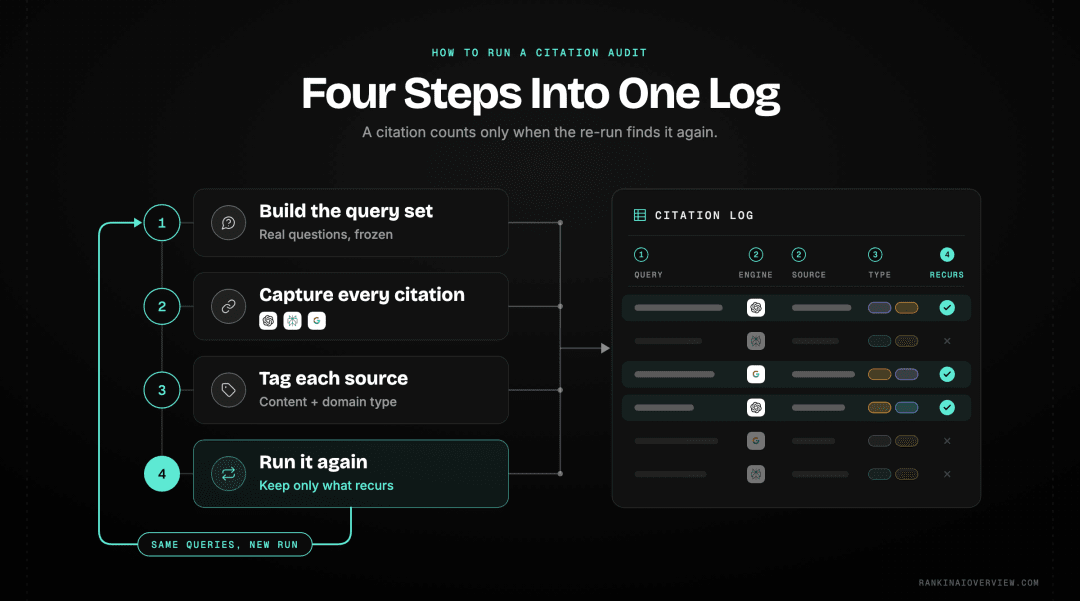
You run a citation audit by collecting the real questions your audience asks, capturing how each engine answers them, and recording every source cited. Then you classify those citations by content type and domain and look for what repeats. The whole method takes a few hours and turns opinion into evidence.
The steps below are deliberately manual. You can add tools later, but doing it by hand once teaches you to read the pattern.
Build a query set that mirrors real prompts
Start with 20 to 40 questions phrased the way people actually ask AI, not as short keywords. Pull them from your sales calls, your support inbox, your search data, and the "People also ask" style questions around your topic. Long, natural, conversational prompts are what users type into answer engines, so your query set must match.
- Include a mix of intents: definitions, comparisons, how-to, and buying questions.
- Phrase each as a full question a person would type or speak.
- Keep the set fixed, so you can re-run it later and compare like with like.
Capture the answers and their citations across engines
Run every query through the engines that matter to you, at minimum ChatGPT, Perplexity, and Google AI Overviews. For each answer, record the full list of cited sources, the URL, and the domain. Save the answer text too, because you will want to see which claims the citations support.
Do this in a simple spreadsheet. One row per citation, with columns for the query, the engine, the domain, the URL, and the content type you will fill in next. The goal is a raw log you can sort and count. Record the date of each run as well, so later re-audits line up cleanly against this first one and you can see what changed.
Classify each citation by content type and domain
Now label every citation. Give each one a content type, such as definition page, listicle, original study, documentation, forum thread, news article, or product page. Then tag the domain type, such as owned, earned, editorial, community, or official. This classification is where the pattern becomes visible.
Be consistent with your labels. A shared vocabulary is what lets you count. If two people audit the same set, they should tag it the same way.
Keep the label list short at first. Five or six content types and four domain types are enough to reveal the pattern without drowning you in categories. You can always split a busy category later. Starting simple means you finish the audit and act on it, rather than stalling on a perfect taxonomy that never ships.
Repeat to separate signal from run-to-run noise
AI answers are not deterministic, so a single pass can mislead. Run the query set two or three times over a week or two. Citations that appear every time are the real pattern. Citations that appear once are noise. Only trust what repeats, and note how much the results move between runs, because that volatility is itself useful to know.
Also read: How Google revealed the way it picks sources for AI Overviews
How do you spot content-type patterns in the citations?
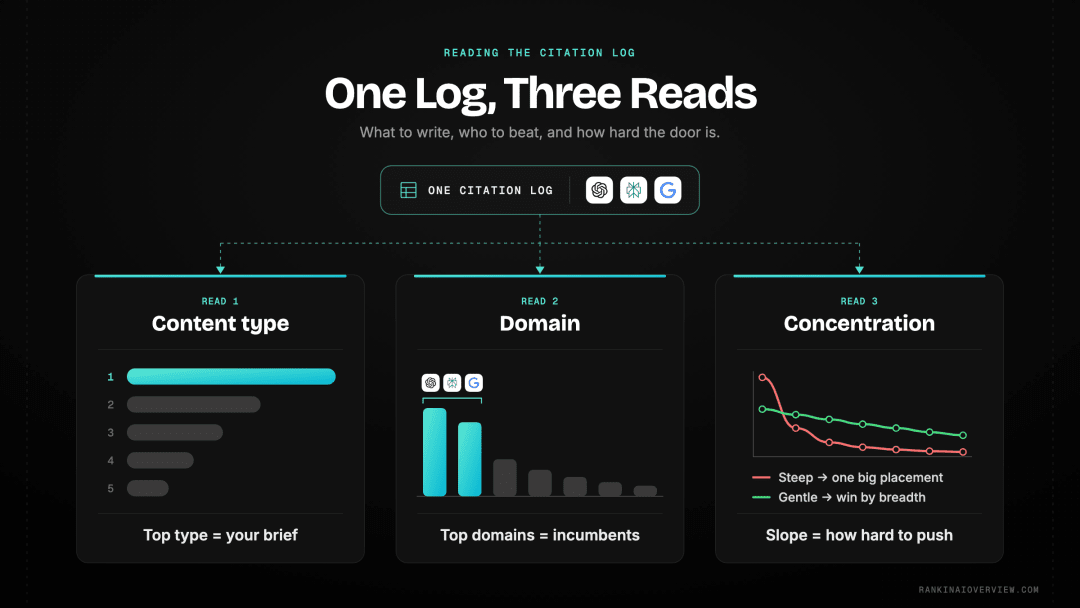
You spot content-type patterns by counting how often each content type appears in your classified log and ranking them. The types at the top are what the engines reward for your queries. If original studies and definition pages dominate, that is your content brief. If forums lead, the lesson is different again.
Look for the shape of the distribution, not just the winner. A niche where one content type takes most citations calls for a focused strategy. A niche where citations spread across many types calls for range. Both are useful to know before you commit a content budget.
Cross-reference type against intent. Definitions may win informational queries while comparison tables win buying queries. That split tells you which format to use for which page, rather than applying one template everywhere. Our breakdown of the blog content AI actually wants to cite pairs well with this step, because it gives you named types to test against your own counts.
Look too at what the winning pages have in common beyond their type. Often the cited pages in a niche share traits the label does not capture: a direct opening answer, a specific number in the first lines, a clean question-shaped heading. Note those shared traits, because they are the reusable ingredients you can build into every page, whatever its format.
The output of this step is a ranked list of content types that earn citations in your niche, plus a short list of the traits those pages share. That combination is worth more than any generic best-practice article, because you measured it against real answers rather than assuming it.
How do you spot domain patterns in the citations?
You spot domain patterns by counting which domains recur across your citation log and grouping them by type. A small set of domains usually accounts for most citations, and that concentration is your competitive map. It shows which sites you are up against and which third parties you may need on your side.
Sort your log by domain and count. The domains at the top are the incumbents the engines trust for your topic. Note whether they are owned media, editorial publications, community platforms, or official sources. That mix tells you where influence actually lives in your niche.
This is where the earned-versus-owned question gets answered with data. If most citations go to editorial and community sources rather than brand sites, then off-page presence matters more than your own blog, and your plan should reflect it. If official documentation dominates, then accuracy and completeness on your own docs is the lever.
Watch for domains that appear across multiple engines. A source cited by ChatGPT, Perplexity, and Google AI Overviews alike is a structural incumbent, not an accident. Getting mentioned or featured on those cross-engine domains is often the single highest-value move the audit reveals.
How do you read citation concentration in your results?
You read citation concentration by looking at how few domains account for most of the citations. If a handful of sources take the bulk, the niche is concentrated and hard to break into head-on. If citations spread across a long tail of sources, there is room for a newer site to earn a place with the right content.
Sort your domains by citation count and look at the shape. A steep drop after the top few means a small group of incumbents owns the answer space. A gentle slope means citations are shared widely, which is good news for a challenger. The steepness of that curve decides how aggressive your off-page plan needs to be.
Concentration also tells you where influence is worth buying. In a highly concentrated niche, one placement on a dominant domain can move you into answers across many queries at once. In a long-tail niche, breadth matters more, and you win by appearing on many smaller sources rather than chasing one giant. Reading the curve first stops you spending outreach effort in the wrong shape.
How do you compare your own site against the cited set?
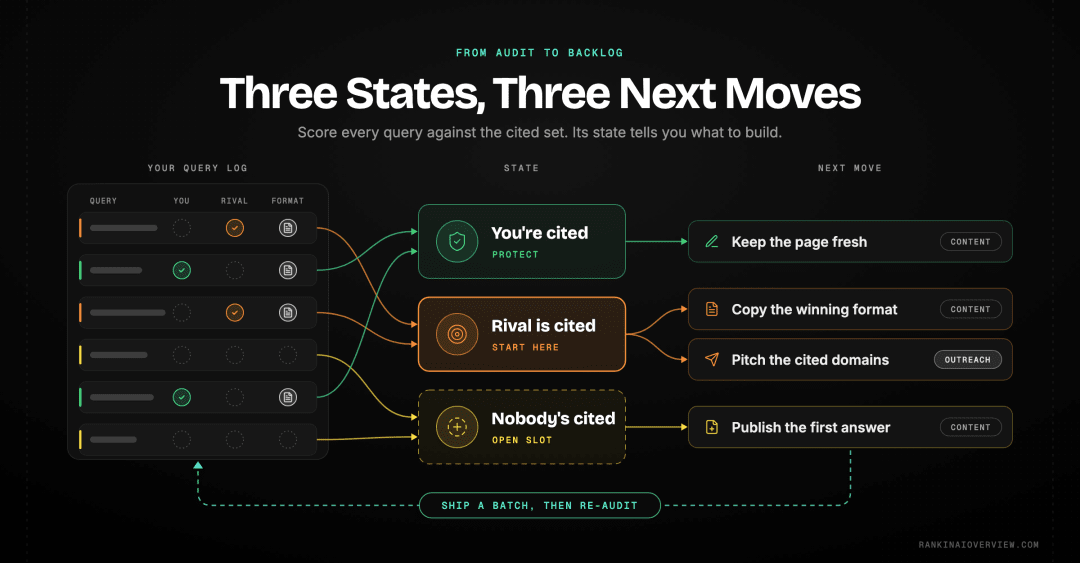
You compare your site against the cited set by checking, query by query, whether you appear, a competitor appears, or neither does. This gap analysis turns the audit into a scoreboard. It shows precisely where you are already cited, where a rival owns the answer, and where the slot is open for whoever moves first.
Add three columns to your log: are you cited, is a named competitor cited, and what content type won the citation. Sorting by these reveals your real position fast. The queries where a competitor is cited and you are absent are your clearest targets, because the engine has shown it will cite that content type for that question.
- You are cited: protect it. Note what content type earned it and keep that page fresh.
- A competitor is cited, you are not: study their page, then produce a better, more specific version.
- Nobody is clearly cited: an open slot, often the fastest win for a newer site.
The open slots deserve special attention. When no strong incumbent owns a query, a well-structured, specific page can claim it quickly, because the engine has no entrenched favourite to displace. Reviewing how often engines actually cite any source helps you judge which open slots are genuinely winnable and which simply rarely trigger a citation at all.
How do you turn the audit into a content plan?
You turn the audit into a plan by matching your findings to actions: write the content types that win, and earn presence on the domains that recur. Each pattern maps to a concrete task. The audit stops being an interesting chart and becomes a backlog you can execute this quarter.
Translate the two patterns directly. The content-type ranking becomes your editorial brief, telling you what formats to produce and for which queries. The domain ranking becomes your outreach and partnerships list, telling you which third-party sites to pitch, contribute to, or get reviewed on.
- For each top content type, plan pages that answer your priority queries in that exact format.
- For each recurring earned domain, plan a pitch, a contribution, or a listing so your brand appears there.
- For every query where a competitor is cited and you are not, note the gap and prioritise it.
Prioritise by overlap. A content type that wins and a query with commercial value together make the strongest first project. Use the audit to sequence work, so you start where citations and revenue meet. Pair this with the metrics that show where your content is cited so you can confirm the plan is working after you ship.
Keep the plan small and testable. Ship a first batch aimed at your top few patterns, then re-audit to see whether your pages start appearing. This tight loop of audit, build, and re-audit is what compounds. Each cycle sharpens your read of the niche and moves more of your pages from absent to cited.
What mistakes make a citation audit misleading?
The most common audit mistakes are testing too few queries, running each query once, and using keyword-style prompts instead of natural questions. Each one bakes in noise or bias, so the pattern you read is not the real one. Avoiding them costs nothing and is the difference between evidence and a false lead.
A thin query set is the biggest trap. Ten queries cannot represent a niche, and a single odd result can skew the whole picture. Aim for breadth across intents so no one topic dominates by accident. The queries are the foundation, and a weak foundation makes every later count unreliable.
Single-run auditing is the next trap. Because answers vary, one pass captures as much randomness as signal. Always repeat the set and trust only what recurs. Treating a one-off snapshot as the truth is how teams end up chasing a citation that was never a stable pattern.
- Keyword prompts: do not audit with short keywords. Users ask full questions, and the citations differ, so keyword prompts measure the wrong behaviour.
- One engine only: a single engine gives a partial view. Sources that dominate one system can be absent in another.
- Inconsistent labels: if your content-type tags drift, your counts mean nothing. Fix a vocabulary before you start.
- Ignoring the misses: the queries where you are absent teach you more than the ones where you appear. Do not filter them out.
Guard against these and your audit reflects reality. Skip the guardrails and you will optimise confidently towards a pattern that does not exist. The discipline is boring, and it is exactly what makes the findings trustworthy.
What tools help you identify AI citations?
You can identify AI citations with a spreadsheet and manual runs, or with monitoring tools that log citations across engines automatically. Manual auditing is best for learning the pattern and for small query sets. Automated monitoring is better for scale and for tracking change over time once you know what to watch.
Start manual. The hand method teaches you to classify citations and read distributions, which no dashboard does for you. It also costs nothing and works for any niche today. For a first audit, a spreadsheet and a couple of focused hours beat any tool.
Add automation once the query set is stable and you want to track drift. Monitoring tools that capture citations across ChatGPT, Perplexity and Google AI Overviews save the repeated manual runs and make trend reading easier. An AI visibility tool from Rank in AI Overview is being built to make this citation tracking simpler, and free audits are available now to get you started.
Whatever you use, keep the same classification vocabulary. The value is in consistent labels over time, not in the specific software. A tidy manual log beats a messy automated one every time.
Conclusion
You cannot optimise for what you cannot see. Generic advice about citable content fails because citation patterns are specific: they differ by niche and by engine, and they concentrate among a small set of sources that only measurement reveals. A citation audit turns that hidden pattern into a plain map of what to write and where to earn a presence.
The method is within reach of anyone with a spreadsheet and a few hours. Build a real query set, capture the citations across engines, classify them by content type and domain, and act on what repeats. For teams that want to go deeper, Rank in AI Overview studies how answer engines select and credit their sources, with a citation-tracking tool on the way. Run a free AI visibility audit to see which content and domains already show up for your questions.
Frequently asked questions
Do all AI engines cite the same sources?+
No. Different providers cite distinct sources even for the same query, though they share broad patterns. This is why a citation audit must run across several engines. A source that wins in one system can be absent in another.
How many queries do you need for a reliable citation audit?+
Around 20 to 40 well-chosen questions gives a usable pattern for most niches. Fewer than that and noise dominates. The queries matter more than the count, so make sure they mirror how real users actually ask about your topic.
Can you see the sources behind a Google AI Overview?+
You can see the sources it displays, but not the full pool it drew from. The visible citations are a selective slice. Auditing what is shown across many queries still reveals reliable domain and content-type patterns worth acting on.
Does the content type matter more than the domain?+
Neither wins universally. In some niches the content type drives citations, in others the domain reputation dominates. The audit tells you which lever matters for you, which is exactly why measuring beats assuming.
How often should you re-run a citation audit?+
Re-run it quarterly, or sooner if an engine ships a major change. AI answers shift over time, so a stale audit slowly stops matching reality. A fixed query set makes each re-run fast and directly comparable to the last.
Do AI engines cite forums and user-generated content?+
Sometimes heavily, depending on the topic. Community sources dominate citations in some niches and are nearly absent in others. Your audit will show whether forums are a real citation channel for your queries or a distraction to ignore.
Explore with AI
Share this