What Is AI Search Visibility? A Complete 2026 Guide
AI search visibility is how often AI engines mention and cite your brand. Here is what it means, why it matters, and how to build it.

Key Highlights
- AI search visibility is how often, and how accurately, AI answer engines mention and cite your brand in their responses.
- It is not the same as SEO ranking, because AI answers name and cite sources rather than list ten blue links to choose from.
- It matters now because AI answers absorb attention that used to flow to your website as clicks.
- It has clear components: presence, citation, accuracy, and share of voice against competitors.
- You can rank number one on Google and still have almost no AI search visibility, and the reverse is also true.
- You build it with clear, specific content, a consistent brand entity, and a presence that extends beyond your own site.
Search is changing shape, and most brands have not caught up. According to a preregistered field experiment with 1,100 users by Stephanie Wang and colleagues, removing AI Overviews and AI Mode from Google increased click-through rates to publishers, while an AI-only experience reduced them. In plain terms, when AI answers the question, fewer people click through to websites. The visibility that mattered for twenty years, a link on a results page, is quietly being replaced by a mention inside an answer.
That shift creates a new kind of visibility that few people can define. You can still rank number one on Google and watch AI engines describe your category without ever naming you. You can also be barely visible in classic search yet quoted confidently by ChatGPT. These outcomes feel contradictory only because we are still using search-era language for an answer-era world, where the question is no longer where you rank but whether you are in the answer at all.
This guide defines that new world clearly. It explains what AI search visibility actually is, how it differs from SEO, why it matters right now, what it is made of, and how you build it. By the end you will know exactly what the term means and where your brand stands, rather than treating AI search as a mystery you cannot measure.
What is AI search visibility?
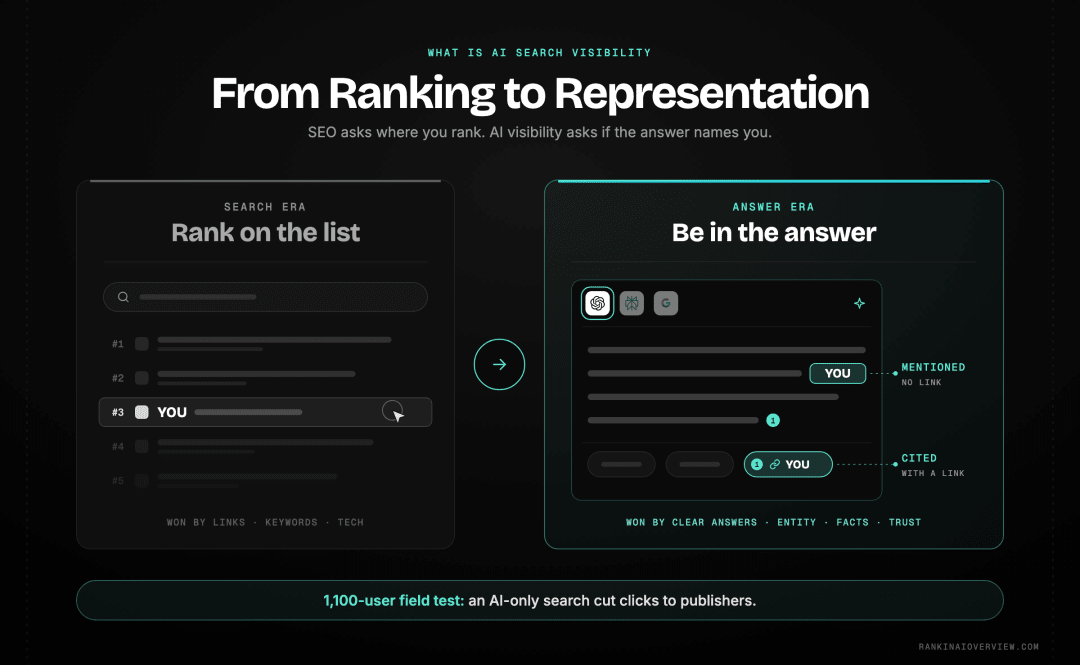
AI search visibility is the degree to which AI answer engines mention, cite, and accurately describe your brand when they respond to questions in your category. It measures your presence inside generated answers on tools like ChatGPT, Perplexity and Google AI Overviews, rather than your position on a page of links.
The core idea is a move from ranking to representation. Classic search visibility is about where you sit on a list a user then chooses from. AI search visibility is about whether you are part of the single answer the user reads, and whether that answer treats you correctly. The user often never sees a list at all.
That makes it a broader idea than a rank. It includes being named, being cited with a link, being described accurately, and being framed positively against rivals. A brand can score well on one of these and poorly on another, which is why AI search visibility is best understood as a set of related signals rather than a single number.
It also spans two ways of being seen. One is being cited, where your link appears as a source the user can click. The other is being mentioned or paraphrased, where the answer uses your facts or names you without a link. Both count as AI search visibility, because both shape what the user learns and believes, even though only one sends a click.
It is also engine-specific. Your visibility on Perplexity can look nothing like your visibility on ChatGPT, because the engines retrieve and reason differently. A complete view of your AI search visibility always spans several engines, never just one.
How is AI search visibility different from SEO?
AI search visibility differs from SEO because SEO optimises for a ranked list of links, while AI search visibility optimises for inclusion in a synthesised answer. SEO asks where your page sits on the results page. AI search visibility asks whether the answer names you, cites you, and describes you correctly. The two overlap but are not the same thing.
The unit of success changes. In SEO, the prize is a high position and the click it earns. In AI search, the prize is being the source an answer is built from, whether or not that produces a click. This is why traditional ranking success does not automatically transfer, a gap we cover in why ranking number one on Google does not guarantee AI answers.
The signals differ too. SEO leans heavily on links, keywords, and technical health. AI search visibility leans on clear extractable answers, a strong brand entity, accurate and consistent information across the web, and reputation that engines can trust. Some SEO fundamentals still help, but the emphasis shifts from position to presence and trust.
Crucially, the two can diverge. You can rank on page one and be invisible to AI, or barely rank yet be cited often. Understanding why AI search is a different game from SEO is the mental shift that makes everything else make sense.
Why does AI search visibility matter now?
AI search visibility matters now because AI answers are absorbing the attention that used to reach your website as clicks. When an engine answers a question directly, the user often stops there, so a brand missing from that answer loses the chance to be seen at all. The exposure moved from the link to the answer.
The economics are already shifting. Field evidence shows that AI answers reduce click-through to publishers, which means the traffic model many businesses relied on is weakening. If fewer people click, being inside the answer is no longer a nice extra, it is where the visibility now lives.
"Integrating generative AI into web search reshapes online attention, with economic consequences for the online publishers that sustain both search platforms and the overall information ecosystem." Stephanie T. Wang, Jeffrey Gleason, Yakov Bart and Danaé Metaxa, authors, "AI in Search Reduces Publisher Referrals Without Improving User Experience". Source: arXiv
Buyer behaviour reinforces the point. People increasingly open an AI tool first for research, comparisons, and recommendations, the exact moments where being named shapes a decision. If the answer recommends a competitor and skips you, you have lost influence before a visit ever happens.
This is especially sharp for considered purchases. When someone asks an engine to compare options or suggest a shortlist, the answer often becomes the shortlist. A brand left out of that answer is not just lower on a list, it is absent from the consideration set entirely, which is a far worse position than ranking on page two of a search result the buyer can still scroll.
There is a timing advantage too. AI search is new enough that many niches have no clear incumbent inside the answers yet. Brands that build AI search visibility now can claim ground that will be far harder to take once competitors wake up to the same shift.
It also compounds. Each accurate mention strengthens how confidently an engine describes you, which makes the next mention more likely, which builds the reputation that earns citations. Starting early does not just win today's answers, it lowers the cost of winning tomorrow's. Waiting does the opposite, letting a rival become the default the engines reach for.
Who needs to care most depends on where buyers research. If your customers use AI to compare options, shortlist vendors, or check facts about a category, your AI search visibility is already shaping decisions you cannot see. For those brands this is not a future concern, it is a present one that is simply hard to observe without looking.
What are the components of AI search visibility?
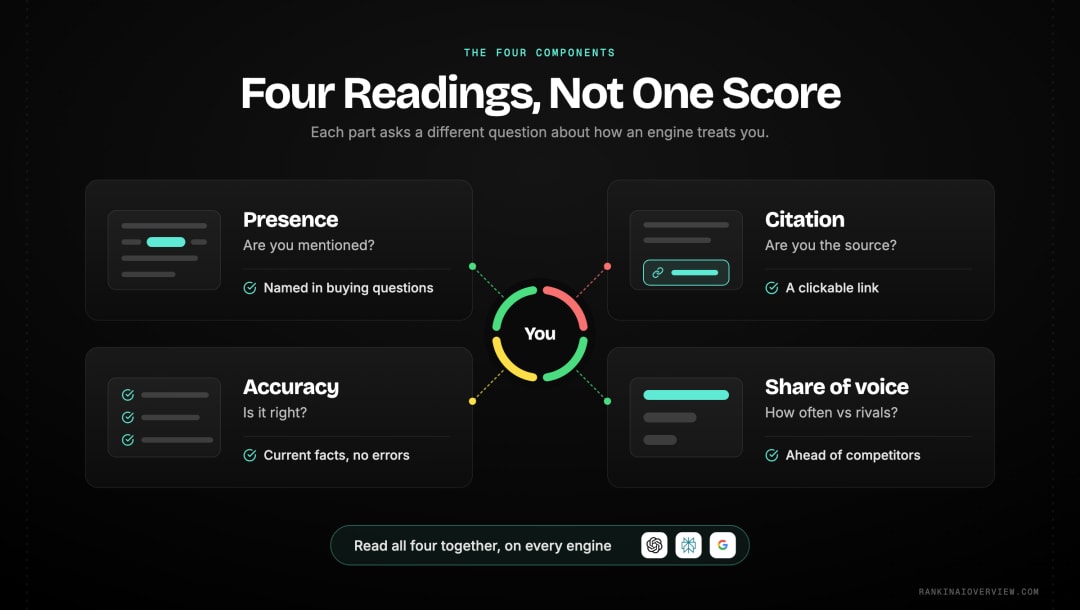
AI search visibility is made of four components: presence, citation, accuracy, and share of voice. Presence is whether you appear at all, citation is whether you are credited with a link, accuracy is whether the description is correct, and share of voice is how often you appear against competitors. Together they describe not just if you are seen, but how well.
Each component answers a different question about how an engine treats you.
- Presence: does the answer mention your brand, named or unnamed?
- Citation: is your website shown as a clickable source, or only referenced in passing?
- Accuracy: does the answer get your facts, products, and positioning right and up to date?
- Share of voice: how often do you appear relative to your main competitors?
Presence and citation are easy to confuse but worth separating. You can influence an answer without being cited, which is real visibility with no clickable credit. You can also be cited with little descriptive detail. Tracking them apart tells you whether your gap is being unknown or being uncredited, a distinction explored in why AI engines cite pages that do not rank on Google.
Accuracy and share of voice are where the strategic value sits. A confident but wrong description harms you more than absence, and a lone mention against a rival who appears constantly is a losing position dressed as a win. A complete picture of AI search visibility always weighs all four together.
Also read: How to measure AI search visibility with six metrics
What does good AI search visibility look like?
Good AI search visibility means you appear in the answers to your important category questions, are cited or clearly named, are described accurately, and hold a strong share of voice against competitors. It is not about appearing everywhere. It is about owning the answers that matter to your buyers.
The goal is quality of presence, not raw frequency. Being mentioned in a hundred trivial answers is worth less than being the cited, accurate recommendation on the ten questions that precede a purchase. Strong visibility concentrates where intent is highest.
Consistency across engines is the other marker. A brand with good AI search visibility is represented similarly on ChatGPT, Perplexity and Google AI Overviews, rather than strong on one and invisible on the rest. That evenness signals a solid entity and reputation, not a lucky fit with one system. A brand that is strong on a single engine has usually matched that engine's quirks, whereas a brand strong across all of them has built the kind of trust that travels.
A useful test is to ask a buying question in your category and read the answer as a customer would. If your brand appears, is described correctly, and sounds like a natural choice, your AI search visibility is working. If a competitor owns that moment, you have found your next priority. Run that same test across a few engines and a few phrasings, and the pattern of where you win and lose becomes your roadmap for what to fix first.
What hurts your AI search visibility?
AI search visibility is hurt by vague content, inconsistent brand information, blocked crawlers, and a thin presence beyond your own site. Each one makes it harder for an engine to find you, trust you, or describe you correctly. Most invisibility traces back to these avoidable causes rather than anything exotic.
Vague content is the quiet killer. Pages with no specific facts, figures, or clear answers get averaged into the consensus and forgotten, because there is nothing distinctive for an engine to lift or credit. Precision is what earns a place in an answer.
Inconsistency is the next problem. When your name, category, or core facts differ across pages and profiles, engines cannot store you as a stable entity, so they hedge, omit, or restate a competitor instead. Conflicting information about you actively cancels itself out.
- Blocked or slow pages: if crawlers cannot fetch you, retrieval-based engines cannot cite you at all.
- Buried answers: hiding the response deep in a page hands the citation to a cleaner source.
- No off-page footprint: with few third-party mentions, training-based answers never learn your brand exists.
- Outdated facts: stale pages teach engines to describe a version of you that no longer exists.
Clear these and you remove the common blocks to visibility. Leave them in place and even excellent products stay invisible, because the engine never gets a clean, trustworthy version of you to work with.
How do AI engines decide what to show?
AI engines decide what to show by combining live retrieval with knowledge stored from training, then synthesising a single answer and displaying a few sources. Some answers come from fetching pages in real time, others from what the model already learned. Both paths shape your visibility, and each rewards different work.
Retrieval is the path you can influence with on-page work. When an engine like Perplexity fetches live, it favours pages it can crawl, parse, and trust, so clear structure and clean sourcing matter. Miss retrieval and you are absent regardless of how good your content is. The fixes here are concrete and technical: be crawlable, load quickly, and present a clean answer the engine can extract without guesswork.
Training-based answers are shaped over a longer horizon. When an engine answers from stored knowledge, it draws on how your brand is described across the whole web, not one page. Consistent, widely repeated facts about you become part of that stored knowledge and surface without any live fetch. This is why reputation and presence beyond your own domain carry so much weight, and why a brand mentioned often and consistently across trusted sites tends to be described well even when no page is fetched.
Most real answers blend both. That is why AI search visibility rewards a combination of strong on-page content and a broad, consistent off-page footprint, rather than either one alone.
The blend also explains why quick fixes disappoint. A single optimised page can win a retrieval-based citation, but it does little for the training-based answers that draw on your whole web presence. Durable AI search visibility comes from working both paths over time, so your brand is both fetchable today and familiar to the model tomorrow. Treating it as a one-off task misreads how the engines actually build their answers.
How does AI search visibility relate to GEO and AEO?
AI search visibility is the outcome, while GEO and AEO are the practices that produce it. Generative engine optimisation and answer engine optimisation are the disciplines of shaping content so AI engines cite and use it. AI search visibility is what you get when those practices work: a measurable place inside the answers.
The relationship mirrors SEO and search rankings. SEO is the practice, a ranking is the result. In the same way, GEO and AEO are the how, and AI search visibility is the what. You do the optimisation work, and visibility is how you tell whether it landed.
Keeping the terms straight helps you set goals. You cannot directly control an engine's answer, but you can control your content, structure, entity, and off-page presence, which are the levers GEO and AEO pull. Visibility is the scoreboard that tells you those levers are moving the right way. Our guide to ranking in both GEO and Google AI Overviews shows how the practice and the outcome connect in detail.
In short, do not chase visibility as an abstract goal. Do the GEO and AEO work well, measure the visibility it produces, and let the score guide where you push next.
How do you measure your AI search visibility?
You measure AI search visibility by testing a fixed set of category questions across engines and recording your presence, citation, accuracy, and share of voice for each answer. Done repeatedly, this turns a vague sense of how AI sees you into a score you can track over time. The method needs nothing more than a spreadsheet to start.
Begin with the questions your buyers actually ask, phrased naturally rather than as keywords. Run them through the engines that matter to your audience, and log what each answer says about you and your competitors. Because answers vary between runs, repeat the set and trust what recurs.
From that log you can build a simple score and a competitive benchmark. Counting how often you appear, get cited, and are described correctly gives you a baseline, and comparing it to rivals shows whether you are winning or merely present. This is the heart of an AI visibility audit, and it is how you convert the concept into something you manage rather than guess at.
The value of measuring is that it makes the invisible visible. Without a check, AI search visibility is a feeling, and feelings do not guide a content budget. With even a rough monthly measure, you can see which questions you own, which a competitor owns, and whether your work is moving the numbers. That is the difference between reacting to AI search and managing your place in it.
How do you improve your AI search visibility?
You improve AI search visibility by publishing clear, specific content, keeping your brand entity consistent everywhere, structuring pages so answers are easy to extract, and building presence beyond your own site. These levers match how engines both retrieve and remember, so they lift visibility on every path at once.
Content and structure win the retrieval path. Lead each page with a direct, self-contained answer to the exact question, back it with specific facts, and keep the structure clean so an engine can lift it. Vague, buried content gets averaged into the consensus and skipped. Write each answer so it stands alone, because an engine lifts passages out of context and needs them to make sense on their own.
- Own specific, checkable facts so your version of a claim is the one worth using.
- Keep your brand name, category, and core facts consistent across your site, profiles, and third-party mentions.
- Earn presence on the sites AI already trusts, since off-page mentions teach engines your brand exists.
- Fix inaccuracies at the source, because engines restate what your pages and the wider web say about you.
Reputation and consistency win the training path. When your brand is described the same way across many trusted places, engines store you accurately and recommend you with confidence. That accumulated trust is what turns an occasional mention into reliable AI search visibility, and it is the same principle behind why AI engines rank reputation, not keywords.
Conclusion
AI search visibility is the answer-era successor to the search ranking: how often, and how well, AI engines mention, cite, and describe your brand when they answer questions in your category. It is not SEO, it is not guaranteed by a top ranking, and it is measured by presence, citation, accuracy, and share of voice across engines rather than by a single position. As AI answers absorb more of the attention that once became clicks, this is where being seen increasingly happens.
The encouraging part is that it is buildable and measurable. Clear content, a consistent brand entity, extractable structure, and a presence beyond your own site all move it, and a simple audit tells you where you stand. Rank in AI Overview researches how AI engines represent and credit brands, and is building an AI visibility tool that is coming soon. Get your free AI visibility audit to see how visible you already are.
Frequently asked questions
Is AI search visibility the same as SEO?+
No. SEO improves your position on a page of search results, while AI search visibility improves whether AI answers mention and cite you. They share some fundamentals, but one targets ranked links and the other targets inclusion in a generated answer.
Can you have AI search visibility without ranking on Google?+
Yes. AI engines often cite or mention pages that do not rank highly on Google, and sometimes answer from training data with no live ranking involved at all. Strong AI search visibility can exist even where classic rankings are modest.
Which engines matter for AI search visibility?+
The engines your audience uses, at minimum ChatGPT, Perplexity, and Google AI Overviews, with Gemini added for many markets. Because representation varies so much between them, meaningful AI search visibility is measured across several engines, not just one.
How do you check your AI search visibility?+
Run a fixed set of category questions through the main engines and record whether you appear, are cited, and are described accurately, plus which competitors show up. Repeat over time to track the trend. A spreadsheet is enough to begin.
Does AI search visibility drive traffic?+
Sometimes directly through citations, and often indirectly by shaping which brands a buyer trusts before they search. As AI answers reduce clicks overall, the value of being named inside the answer grows even when it sends no immediate click.
Is AI search visibility worth investing in for a small business?+
Yes. AI search is still new enough that many niches lack a clear incumbent inside the answers, so a focused small business can claim visibility early. The work also compounds, making later gains cheaper than they will be once competitors act.
Explore with AI
Share this