
How Poor Page Structure Hurts Your AI Citation Potential
Poor structure keeps excellent content out of AI answers. See which structural faults cost citations, and how to fix them without a full rewrite.
Key Highlights
- AI answer engines cite content they can extract, so the way a page is built often decides whether a strong answer is ever lifted into a response.
- Research shows document-level structure is a genuine lever, but isolated surface edits such as lone formatting tweaks do not reliably help and can even backfire.
- The structural faults that cost citations most are buried answers, weak heading hierarchy, wall-of-text passages, and sections that lack the context an engine needs to lift them cleanly.
- Fixing structure is one of the faster visibility wins, because it improves extractability without a full content rewrite.
- Schema and formatting support machine readability, but they are eligibility aids, not a switch that forces a citation.
According to a 2026 study of generative answer engines, restructuring a page at the document level raised its citation visibility by as much as 96% across three AI engines, while isolated text-level edits failed to improve it reliably and in some cases dragged it below the untouched original. That single result reframes a common assumption. AI does not simply reward the best answer in the abstract; it rewards the answer it can locate, isolate and lift, and structure is what makes that possible.
This is the quiet, frustrating truth about AI citation. You can publish the most thorough answer on a topic and still never appear, purely because of how the page is built. Teams pour effort into research and writing, then wrap it in a format that makes extraction hard: the answer is buried, the headings are vague, and each passage carries no context on its own. The information is present but unreachable, which makes the problem especially maddening to diagnose, because nothing looks obviously wrong with the content itself.
This guide explains how poor page structure hurts AI citation and, just as importantly, what the evidence says structure can and cannot do. It covers the extraction mechanic, the specific structural faults that cost you citations, how to tell whether structure is your bottleneck, how to fix it without rewriting everything, and the genuine but limited role of schema. For the content side of the same problem, our guide to optimising content for AI search pairs closely with what follows.
Why Does Page Structure Decide Whether AI Cites You?
Page structure decides citation because AI answer engines extract self-contained passages rather than reading whole pages. Clear structure lets an engine locate and lift a clean answer to the query. Poor structure hides that answer, so the engine cites a page it can extract from more easily, whatever the relative quality of the content on either side.
The core mechanic is extraction, not ranking. When an answer engine composes a response, it retrieves candidate passages, judges which one responds to the query, and lifts it into the answer with a citation attached. Nothing about that process rewards depth that is hard to reach. If your strongest sentence sits four paragraphs into a dense block, the engine has to work to find it, and it will usually settle for a competitor that put the same point up front and made it trivial to quote.
Think of structure as the interface between your content and the model. The model never experiences your page the way a human reader does, scrolling patiently from top to bottom. It works with fragments: a heading, the passage beneath it, the surrounding context that tells it what the passage is about. When those fragments are clean and self-explanatory, your content becomes a candidate. When they are tangled, the same content is effectively invisible at the exact moment a citation is being decided.
That is why two pages with near-identical information can see wildly different citation outcomes. The difference is rarely the facts. It is whether the facts were packaged so a machine could recognise, in a fraction of a second, that a given passage answers a given question. Good structure lowers the cost of extraction. Poor structure raises it, and raised cost is the same as invisibility when a faster option exists. The engine is not judging your effort or your intent; it is picking whichever candidate passage lets it answer the user most cleanly, and structure is what decides whether yours is even in that shortlist.
What Does the Research Actually Say About Structure Versus Surface Tweaks?

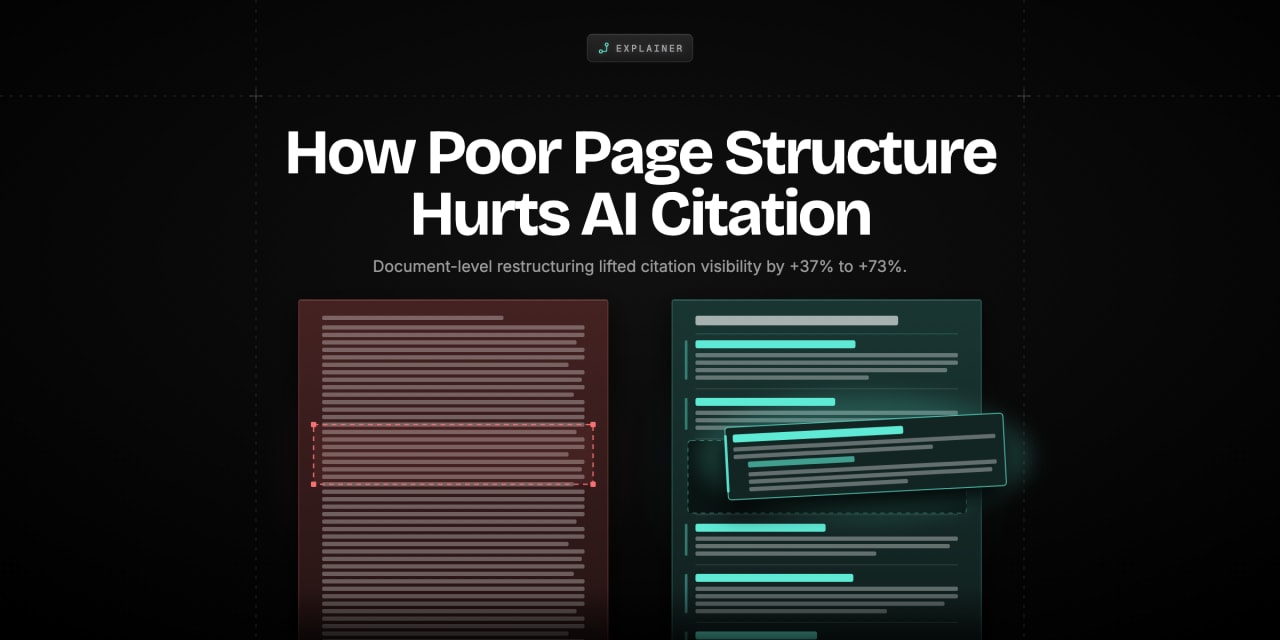
Research suggests structure works at the document level, not the cosmetic level. A 2026 optimisation study found that abstracting pages into structural, content and linguistic properties, then improving those, lifted citation visibility substantially, whereas isolated lexical rewrites did not. Document-level organisation helps; scattered surface edits do not reliably move the needle.
This distinction matters because it separates useful structural work from wishful thinking. In the study, a feature-level framework that reshaped documents around interpretable structural and content properties improved citation visibility by roughly +37% on one engine, +73% on another and +96% on a third. Token-level approaches, the kind that tinker with individual words and phrases, often failed to beat the unmodified page and sometimes performed worse than doing nothing at all.
The authors were direct about the reason, and it is worth sitting with the implication for how you approach your own pages.
"isolated text-level modifications are insufficient to reliably increase citation visibility and may even disrupt the natural writing patterns that LLMs prefer to cite."
Zikang Liu and Peilan Xu, authors of the FeatGEO generative-engine optimisation study
Two lessons follow. First, structure is real leverage, so the effort is not wasted: reorganising how a page presents its answers can genuinely change whether it gets cited. Second, the leverage lives at the level of how the whole document is built, not in surface fiddling. This aligns with a wider pattern in generative-engine research, where controlled experiments repeatedly find that topical relevance and how findable an answer is dominate, while formatting-only changes contribute little on their own. We unpack more of that evidence in our look at what actually affects AI search visibility.
So the honest framing is not "poor structure never matters" and it is not "add schema and you will get cited". It is narrower and more useful: build the whole page so its answers are easy to locate and lift, and you improve your odds; scatter cosmetic tweaks across otherwise buried content, and you mostly waste effort.
Which Structural Problems Actually Reduce Your Citation Odds?

The structural problems that reduce citation odds are buried answers, weak or missing heading hierarchy, wall-of-text passages, and sections that cannot stand on their own without surrounding context. Each raises the cost of extraction, so an engine is likelier to lift a clean, self-contained answer from a competitor instead of yours.
Not every formatting habit is a real problem, so it helps to name the faults that genuinely hurt extraction rather than chase every cosmetic ideal. The list below focuses on the structural issues that consistently make content harder for an answer engine to use.
Buried Answers
This is the most damaging and the most common fault. When the direct answer to a section's implied question sits several paragraphs down, after preamble and context-setting, the engine has to dig for it. Pages that lead with the answer, then support it, are far easier to extract. Burying the payoff is the structural equivalent of hiding your best point in a footnote that most readers, and most engines, will never reach.
Weak or Missing Heading Hierarchy
Headings are how a model maps a page to a query. Clear, question-style headings tell the engine exactly what each section resolves. Vague headings ("Overview", "More", "Details") or a jumbled hierarchy that skips levels leave the model guessing about what belongs to what. A clean H1 to H2 to H3 progression is not decoration; it is the outline the machine reads first.
Wall-of-Text Passages
Long, undivided blocks of prose fuse many points into one lump. Even when the right answer is somewhere inside, the engine struggles to isolate it from everything around it. Shorter, focused passages let a single answer be lifted cleanly. The goal is not artificially choppy writing; it is making sure each idea is separable rather than welded to five others.
Context-Starved Sections
A passage that only makes sense after reading the three paragraphs above it is hard to extract, because extraction strips it from that setup. Sections that name their subject, state their answer, and hold together on their own are far more citable. If a passage relies on "as mentioned above" or an unexplained "it", the engine cannot lift it without losing the meaning.
Unclear Scope Per Section
When one section tries to cover several loosely related questions, the engine cannot tell which query it answers. Sections built around a single, specific question give the model an unambiguous match. Sprawling, multi-topic sections dilute that signal and make your content a weaker candidate than a rival page that answered the one question directly.
How Can You Tell If Structure Is What Is Holding Your Pages Back?
You can tell structure is the issue when your content is strong and relevant yet consistently uncited, while the pages that do get cited lead with clear answers and clean formatting. Comparing your page against the cited sources for the same query usually reveals whether extraction, rather than content, is the barrier.
Run the comparison deliberately. Take a query where you are absent from the AI answer, then look closely at the page the engine did cite. Ask whether its answer appears up front, whether its headings phrase the actual question, and whether its passages read cleanly on their own. If the cited page does all three while yours buries the answer under context, you have found your bottleneck, and it is not your research.
Watch for the quality-versus-visibility mismatch as a diagnostic in its own right. When you are genuinely confident that your content is more complete and more accurate than what gets cited, yet you remain invisible, the problem is rarely the substance. It is almost always the packaging: the answer exists but is not reachable in the form an engine needs. Our walkthrough of the most common causes, the five things to fix when a page ranks but is not cited, maps closely onto this pattern.
A second, cheaper check is to read your own page the way a machine would. Skim only the headings, then read only the first sentence under each. If that skeleton already answers the likely questions, your structure is doing its job. If the skeleton is vague and the real answers only surface deep in the prose, you have confirmed the fault without any tooling at all. Doing this across a handful of important pages usually shows a pattern rather than a one-off, and that pattern is your priority list for fixes.
How Do You Restructure a Page So AI Can Extract It?

Restructure a page by leading each section with its direct answer, using specific question-style headings, keeping passages short and self-contained, and holding a clean heading hierarchy. These changes improve extractability quickly and usually without altering your underlying content, because you are reorganising what you already have rather than rewriting it.
Start with the answer-first move, because it delivers the most improvement for the least work. For every section, identify the question a reader (or an engine) is really asking, then make sure the first sentence answers it plainly and completely. Everything else, the nuance, the caveats, the examples, can follow. You are not dumbing the content down; you are making sure the payoff is reachable before the reader or the model gives up.
Next, rewrite headings as the specific questions people ask, not as topic labels. "Overview of AI citation" tells a machine almost nothing. "Why do pages with strong content still get skipped by AI?" tells it exactly which query this section resolves. Specific, interrogative headings do double duty: they guide human readers and they hand the model a clean map from question to answer.
Then attend to passage shape. Break dense blocks so that each distinct answer occupies its own short passage, and make sure that passage can be understood if it were quoted with nothing around it. Name the subject inside the passage rather than relying on an earlier mention. Replace vague pronouns with the actual noun where a lifted quote would otherwise lose its meaning. This is the single habit that most improves whether an engine can use your content verbatim.
Finally, tidy the hierarchy. Keep one clear H1, nest H2s beneath it for each major question, and reserve H3s for sub-points that genuinely belong under a parent. Do not skip levels for visual effect, and do not use headings as styling. A logical outline is what an engine reads to understand how your page is organised, and a clean one makes every passage beneath it easier to place. For a fuller picture of the formats engines tend to draw from, our guide to what type of content ranks in AI search is a useful companion.
What Is the Right Role for Schema and Formatting?
The right role for schema and formatting is support, not causation. Structured data and clean formatting help a machine parse and interpret your page, which keeps you eligible for extraction. They do not, on their own, force a citation. Treat them as hygiene that removes obstacles, not as a lever that guarantees inclusion.
This is where a lot of older advice goes wrong. The promise that "adding FAQ schema" or "marking up your content" will win citations overstates the evidence. Controlled studies of generative engines repeatedly find that formatting-only edits contribute little in isolation, and that surface-level changes can even disrupt the natural patterns models prefer to cite. Schema is genuinely useful for machine readability, but it is a supporting signal, not the deciding one.
So use schema where it fits the content honestly. Marking up an FAQ that really exists, a product with real attributes, or an article with a clear author and date helps engines understand what your page is. What schema cannot do is compensate for a buried answer or a context-starved passage. If the underlying structure makes extraction hard, no amount of markup rescues it, because the model still cannot find a clean passage to lift.
The practical takeaway is one of sequence. Fix the document-level structure first, because that is where the real leverage sits: answer-first sections, specific headings, self-contained passages, clean hierarchy. Then add schema and tidy formatting as the finishing layer that keeps your well-built page easy for machines to parse. Done in that order, each piece does the job it is actually good at, and you avoid pouring effort into markup on top of content an engine still cannot reach.
Does Fixing Structure Work If the Content Underneath Is Weak?
Fixing structure works only when there is a genuine answer to surface. Structure removes the obstacles between your content and an engine, but it cannot manufacture relevance or accuracy that is not there. On queries where your material is genuinely the best fit, structure often decides the citation; where it is not, structure alone will not rescue it.
It helps to think of structure and content quality as two gates rather than one. The first gate is relevance: does your page actually answer the query, and answer it well? The second gate is extractability: can an engine find and lift that answer cleanly? A page has to clear both. Perfect structure wrapped around a shallow or off-topic answer still loses, because the engine has nothing worth citing once it looks closely. Equally, a brilliant answer buried in poor structure loses at the second gate, because the engine never reaches it.
This two-gate view keeps expectations honest. It explains why the same structural fix produces a big jump on one page and nothing on another. On the page where you already had the stronger, more relevant answer, clearing the extractability gate finally lets that strength count, and citations follow. On the page where a rival simply answers the question better, improving your structure removes your own excuse but does not change the underlying verdict. The research pattern is consistent here: relevance and how findable an answer is tend to dominate, so structure earns its keep by making real quality reachable, not by substituting for it.
The practical rule that follows is to spend structural effort where the content deserves it. Audit your pages for the ones where you are confident the answer is genuinely competitive yet the page is not cited, and fix those first. That is where restructuring converts directly into visibility. Pages that are not cited because the answer itself is thin need content work before structure work, and reordering weak material only makes the weakness easier to find.
How Do You Keep New Content Structured for Extraction?
Keep new content extractable by building the pattern into your content template: lead each section with its answer, write headings as specific questions, keep passages short and self-contained, and add schema only where it fits. Making good structure the default prevents citation-killing formatting before it reaches publication.
The cheapest moment to get structure right is at creation, not in a later retrofit. When your template already assumes answer-first sections and a clean hierarchy, new pages tend to be extractable by default, and you stop generating the very problems this guide describes. Retrofitting works, but it is slower and less consistent across a growing library of content, so bake the pattern in where you can.
Pair the template with a short pre-publish check that anyone can run. Does each section lead with its answer? Does each heading phrase a real question? Could each key passage be quoted on its own and still make sense? Is the hierarchy clean, with no skipped levels or decorative headings? Five questions, a couple of minutes, and most structural faults are caught before they ever cost a citation.
Finally, treat structure as an ongoing standard rather than a one-off project. As you publish, periodically re-read older high-value pages the machine way, headings first, then first sentences, and fix any that have drifted. Structure is not a task you complete once; it is a habit that keeps strong content reachable as your site and the answer engines both continue to change.
Conclusion
Poor page structure quietly sabotages AI citation, even for genuinely excellent content. Because answer engines extract self-contained passages rather than reading whole pages, buried answers, weak hierarchy, dense blocks and context-starved sections all make your content hard to lift and easy to skip. The information is there; the engine simply cannot reach it at the moment a citation is decided.
The evidence also draws a useful line. Document-level structure is real leverage worth investing in, while scattered surface tweaks and schema-only fixes are not the switch they are often sold as. So surface your answers, phrase your headings as questions, break up your passages, keep your hierarchy clean, and add schema last as a finishing layer. Structure is the interface between your content and AI, and improving it is one of the quickest ways to turn strong content into cited content.
Want to know whether structure is holding your pages back? Run a free AI-visibility audit with Rank in AI Overview to see which pages need structural fixes and where extraction is failing.
Frequently asked questions
Does page structure really affect AI citations?+
Yes. AI answer engines extract self-contained passages rather than reading whole pages, so clear structure lets them find and lift a clean answer, while poor structure hides it and pushes them toward a page they can extract from more easily.
What structural problems hurt AI citation the most?+
Buried answers are the biggest fault, followed by weak or missing heading hierarchy, wall-of-text passages, and sections that cannot stand alone without surrounding context. Each raises the effort an engine needs to locate and lift a usable answer.
Can I improve AI citations without rewriting my content?+
Often yes. Leading with answers, clarifying headings, breaking up dense passages and tidying hierarchy improve extractability while leaving your underlying content intact. Because you are reorganising rather than rewriting, structural fixes are among the faster visibility wins available.
Does adding schema guarantee I will be cited?+
No. Schema supports machine readability and keeps you eligible for extraction, but it does not force a citation. Controlled studies find formatting-only changes contribute little in isolation. Fix document-level structure first, then add schema as a finishing layer.
How do I know if structure, not content, is my problem?+
Compare your page to the sources cited for the same query. If they lead with clear answers and clean formatting while yours buries the answer, and your content is otherwise strong, structure is very likely the barrier rather than substance.
What is the single most effective structural fix?+
Leading each section with its direct answer. It delivers the most improvement for the least effort, because it puts the passage an engine wants to lift at the top, where it is easy to locate and quote, instead of buried under preamble.
Explore with AI
Share this


