Rankscale vs Profound: Which AI Visibility Tool Is Right for You?
Rankscale vs Profound compared on engine coverage, features and pricing. See which fits a mid-market team and which suits enterprise.

Key Highlights
- Rankscale is a transparent, self-serve tracker priced from $20 to $780 a month; Profound is an enterprise platform with custom, contact-sales pricing.
- Rankscale advertises 17 or more engines; Profound covers eight major ones with deeper enterprise analysis and automation.
- Rankscale leans on tracking, citation and sentiment data, and page audits; Profound adds autonomous agents and answer-engine insights for large teams.
- Choose Rankscale for affordable, broad, self-serve multi-engine tracking with a free trial.
- Choose Profound if you are an enterprise needing automation, depth, and dedicated support, with the budget for custom pricing.
- Both track many engines, which matters because visibility on one engine does not guarantee visibility on another.
Most brands are invisible to AI, and they do not even know it. According to a census-based audit of four AI systems by researcher Vladimir Pitenin, 85.6% of venues were never recommended by any system, even 72.6% of the well-established ones. If most businesses are simply absent from AI answers, the first step is measuring where you stand. That is why AI visibility tools exist, and why choosing the right one matters more than most teams assume when they start looking.
Two names dominate the shortlist: Rankscale and Profound. They are often compared head to head, yet they sit at very different points in the market. One is a transparent, self-serve tracker built for breadth and value, aimed at teams that want to move fast. The other is an enterprise platform built for depth, automation, and scale, aimed at large organisations. Picking between them is less about which one is better in the abstract and more about which fits you, your team size, and the way you prefer to buy and run software.
This comparison puts Rankscale and Profound side by side on the things that actually decide the call: engine coverage, features, pricing, ease of setup, and who each one serves. By the end you will know which tool matches your team, your budget, and your goals.
Rankscale vs Profound: what is the quick verdict?
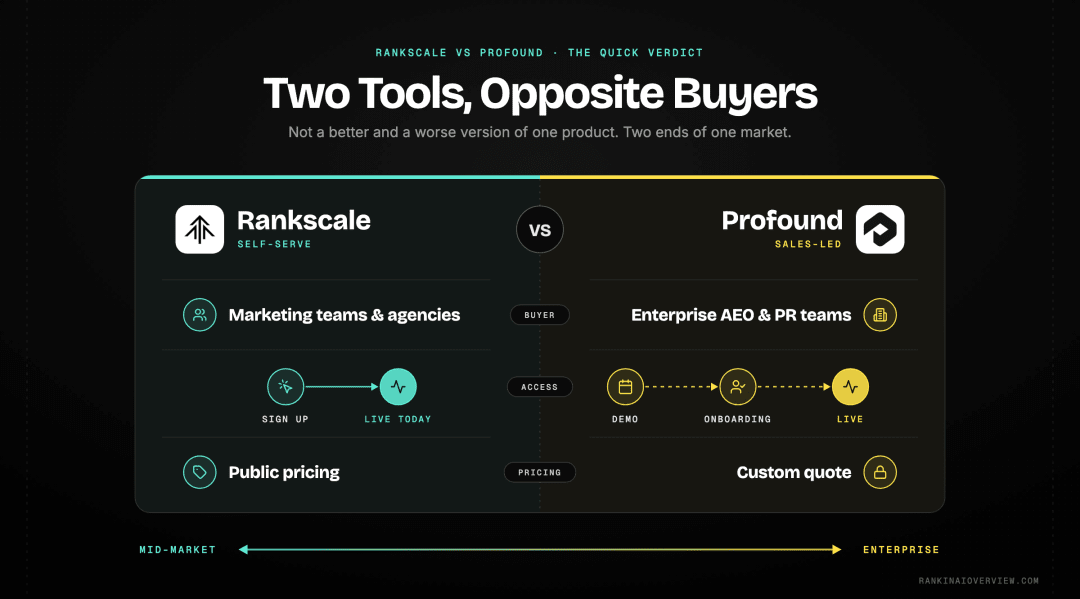
Rankscale is the better fit for mid-market teams and agencies that want affordable, broad, self-serve tracking, while Profound is the better fit for enterprises that need depth, automation, and dedicated support. The core split is transparent mid-market pricing versus custom enterprise pricing. Your scale, budget, and buying style usually decide it.
The table below sums up the differences at a glance.
| Factor | Rankscale | Profound |
|---|---|---|
| Positioning | Mid-market, self-serve | Enterprise, sales-led |
| Engine coverage | 17+ engines advertised | 8 major engines |
| Pricing | Transparent, $20 to $780/mo | Custom, contact sales |
| Free trial | 7-day trial on Pro | Demo only |
| Standout | Breadth plus page audits | Automation and agents |
| Best for | Agencies, mid-market brands | Large enterprise teams |
If you want to start today without a sales call, Rankscale wins on access alone. If you are a large organisation that needs automation and hands-on support and can budget for a custom quote, Profound earns its place. Neither is objectively best, and the rest of this comparison shows why. Keep your own context in mind as you read, because the same feature can be a decisive advantage for one team and irrelevant overhead for another.
What is Rankscale and what is Profound?
Rankscale is a self-serve AI visibility tracker that monitors your brand across generative engines and audits your pages, while Profound is an enterprise AI marketing platform that adds automation and deep answer-engine analysis. Both help you understand and improve how AI answers represent you, but they aim at different buyers.
Rankscale launched in mid-2025 and positions itself for marketing teams, agencies, and mid-market brands. It combines a visibility dashboard, an AI rank tracker, citation and sentiment analysis, page audits, and prompt research in one self-serve product you can sign up for and use immediately.
Profound targets enterprise AEO, SEO, content, and PR teams. Beyond monitoring, it offers autonomous marketing agents, answer-engine insights, prompt-volume analysis, and agent analytics that track how AI crawlers read your site. It is a broader, heavier platform sold through demos rather than instant sign-up. For a wider field of options, our roundup of the best AI rank trackers maps where both sit.
How do Rankscale and Profound compare on engine coverage?
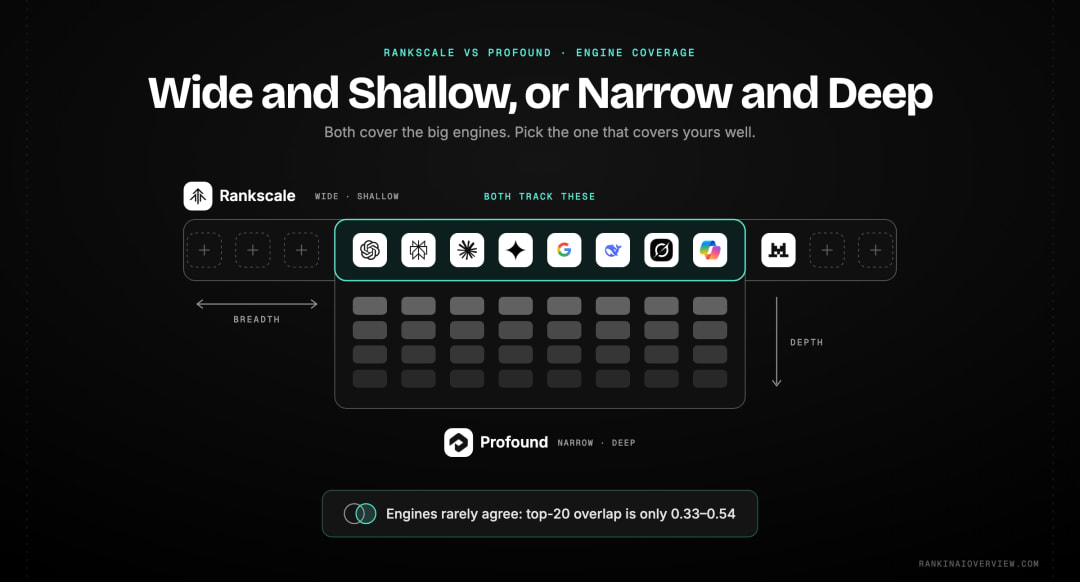
Rankscale advertises broader raw coverage at 17 or more engines, while Profound focuses on eight major ones with deeper analysis of each. Rankscale wins on breadth, Profound on depth. Which matters more depends on whether you value seeing every emerging engine or analysing the big ones thoroughly.
Rankscale's list includes ChatGPT, Perplexity, Claude, Gemini, Google AI Overviews, DeepSeek, Grok, Copilot, Mistral, and Google's AI Mode. That breadth suits brands wanting an early read on newer engines before they matter, so you are not caught flat-footed when an engine that seemed minor suddenly starts sending real traffic.
Profound concentrates on the eight it considers most consequential, including ChatGPT, Perplexity, Claude, Gemini, Grok, Copilot, DeepSeek, and Google AI Overviews, with richer enterprise reporting on each. Both approaches are valid, and both reflect the same truth: engines behave so differently that tracking several is essential rather than optional.
"Cross-system agreement is low (top-20 Jaccard 0.33-0.54)." Vladimir Pitenin, author, "Invisible to the Machine: Auditing AI Restaurant, Cafe, and Bar Recommendation Against a Complete Market Census". Source: arXiv
That low cross-engine agreement is the whole case for multi-engine tracking. Being cited by one engine tells you little about the others, so a tool that watches many is not a luxury, it is the point.
This is where the coverage difference becomes practical rather than a spec-sheet number. If your buyers use an engine that only one of the two tools tracks, that tool is the right pick regardless of anything else. Before choosing, list the engines your audience actually uses, then check which tool covers them well, since a tracker that misses your buyers' engine is blind exactly where it matters. Both tools are strong here, but they weight breadth and depth differently, and your engine mix should break the tie. It is also worth remembering that raw coverage only helps if the underlying tracking is reliable, a question we examine in whether AI rank tracker tools actually work.
How do Rankscale and Profound compare on features?
Rankscale focuses on tracking, citation and sentiment analysis, and page audits, while Profound adds autonomous agents, answer-engine insights, and crawler analytics for enterprise workflows. Rankscale gives you a strong self-serve toolkit; Profound gives you a deeper platform with automation built in. The gap is depth and hands-off scale.
Rankscale's feature set is built to diagnose and act: it tracks your visibility, shows which pages get cited and how you are described, and audits content against a large list of signals to suggest fixes. It is a complete workflow for a team doing the work themselves, and it links measurement directly to action, as we discuss in how to measure AI search visibility. For most teams, that direct line from a flagged problem to a concrete fix is exactly what they want from the tool.
Profound reaches further into automation. Its agents can carry out marketing tasks, its answer-engine insights analyse how you are represented in depth, and its agent analytics reveal how AI systems crawl and interpret your site. For a large team that wants the platform to do more of the work, that automation is the draw.
The agent analytics deserve a closer look, because they answer a question few tools address: how do AI crawlers actually read your site? Knowing which bots fetch which pages, and how often, helps an enterprise diagnose why it is or is not being surfaced. That is a level of technical insight aimed squarely at large teams with the resources to act on it, and it is a genuine point of difference from Rankscale's more content-and-tracking focus. For a smaller team, though, that same depth can be more than they will ever use.
| Capability | Rankscale | Profound |
|---|---|---|
| Visibility tracking | Yes | Yes |
| Citation and sentiment | Yes | Yes, deeper reporting |
| Page audits | Yes, 200+ signals | Focused on answer insights |
| Automation / agents | No | Yes, autonomous agents |
| Crawler analytics | Limited | Yes, agent analytics |
| Self-serve setup | Yes | Demo and onboarding |
How do Rankscale and Profound compare on pricing?
Rankscale uses transparent, published pricing from $20 to $780 a month with a free trial, while Profound uses custom, contact-sales pricing with no public prices. This is the clearest difference between them. Rankscale lets you see costs and start immediately; Profound requires a sales conversation and a quote.
Rankscale's four tiers are public: Essentials from $20, Pro at $99, Growth at $385, and Enterprise at $780 a month, all credit-based with a 7-day free trial on Pro. You can match a plan to your usage and budget before committing, which suits smaller teams and anyone wary of sales calls.
Profound does not publish prices. Access is arranged through a demo and a custom quote, which is typical for enterprise platforms but means higher and less predictable cost. That model fits large organisations with procurement processes and bigger budgets, and it usually places Profound well above Rankscale on price. If Profound's model feels too heavy, our guide to Profound alternatives covers other routes.
The pricing philosophies say a lot about each tool's intended buyer. Transparent, published tiers signal a product designed to be evaluated and bought without friction, which is how mid-market teams and agencies prefer to work. Custom, sales-led pricing signals a product designed to be tailored to large, complex deployments, where a flat price would rarely fit anyway. Neither approach is wrong, but they filter for different customers before a single feature is compared. If the idea of booking a demo just to learn a price frustrates you, that reaction alone points you toward Rankscale, and if you expect a bespoke rollout across a big team, Profound's model will feel normal.
How do Rankscale and Profound compare on ease of use and setup?
Rankscale is faster and simpler to start, because it is self-serve with a free trial, while Profound involves a demo, onboarding, and a sales process before you begin. If speed to first value matters, Rankscale wins. If you want guided setup and a partner to lean on, Profound's heavier process is a feature, not a flaw.
With Rankscale you sign up, start the trial, and see data the same day. That immediacy suits smaller teams and anyone who wants to evaluate a tool before talking to sales. The trade-off is that you also learn it yourself, and its breadth of features means the first sessions take some orientation.
Profound trades speed for support. A demo and onboarding mean you do not start instantly, but you also do not start alone, which large teams often prefer when rolling a tool out across departments. For an enterprise with many stakeholders, structured onboarding reduces the risk of a tool being bought and then ignored. The right model depends on whether your bottleneck is budget and time or coordination and scale.
Ease of use also interacts with who runs the tool. A single marketer will value Rankscale's instant access, while a cross-functional enterprise team spanning SEO, content, and PR often needs the shared onboarding and permissions that a platform like Profound is built around. Neither is simply easier; they are easier for different teams.
What are the pros and cons of each tool?
Rankscale's pros are affordability, breadth, and self-serve access; its cons are a learning curve and credit costs that climb with heavy use. Profound's pros are depth, automation, and enterprise support; its cons are opaque pricing and a heavier, sales-led setup. Each tool's strengths mirror its intended buyer.
Here is the balanced view.
- Rankscale pros: transparent pricing, a free trial, 17-plus engines, page audits, and instant self-serve setup.
- Rankscale cons: credit costs grow with usage, a learning curve, and a shorter track record as a 2025 product.
- Profound pros: deep enterprise analysis, autonomous agents, crawler analytics, and dedicated support.
- Profound cons: no public pricing, a sales-led buying process, and likely higher cost.
Neither list makes one tool the loser. They describe two products built for different scales, and the right pick is the one whose strengths match your situation and whose weaknesses you can live with. It also helps to understand why brands that rank on Google can still be invisible to AI, since both tools exist to close that exact gap.
Who should choose Rankscale, and who should choose Profound?
Choose Rankscale if you are a mid-market brand or agency wanting affordable, broad, self-serve tracking, and choose Profound if you are an enterprise needing automation, depth, and support with the budget for custom pricing. The decision comes down to scale, budget, and how hands-on you want to be.
Rankscale is the pragmatic choice for most teams. If you want to see pricing, start with a free trial, track many engines, and do the optimisation yourself, it fits cleanly. Its transparency and lower entry price remove the friction that stops smaller teams from starting at all. For an agency in particular, the white-label dashboards and API make it easy to fold client reporting into an existing workflow without a heavy platform commitment.
Profound is the choice for large organisations. If you have an enterprise budget, want automation and deep reporting, and value dedicated onboarding and support, it justifies its heavier model. For a global brand with a big team, that depth can be worth the custom price. Match the tool to your scale, and the decision usually makes itself.
A simple way to decide is to weigh three questions. First, can you justify custom enterprise pricing, or do you need to see costs up front? Second, do you want automation and hands-off scale, or a self-serve toolkit you drive yourself? Third, how many stakeholders will use the tool, one marketer or a cross-functional team? Answer those honestly and one tool will clearly fit better. Most teams that hesitate are actually a Rankscale fit talking themselves into enterprise features they will not use, while genuine enterprises rarely doubt they need Profound's depth. Being clear on what ranking even means in AI search also helps you judge which features are real value versus noise.
Conclusion
Rankscale and Profound solve the same problem for very different buyers. Rankscale is the transparent, self-serve, mid-market choice: broad engine coverage, page audits, published pricing from $20 to $780, and a free trial that lets you start today. Profound is the enterprise choice: deeper analysis, autonomous agents, crawler analytics, and dedicated support, sold through custom quotes for teams with the budget to match.
Decide on scale and budget, not on a feature checklist alone. Most mid-market teams will be happier and quicker to value with Rankscale, while large enterprises with automation needs will find Profound worth its price. Rank in AI Overview studies how answer engines pick and cite their sources, with a citation-tracking tool on the way. Run a free AI visibility audit to see how AI represents your brand before you commit to either platform.
Frequently asked questions
Is Rankscale or Profound better?+
Neither is universally better. Rankscale is better for mid-market teams wanting affordable, self-serve, broad tracking. Profound is better for enterprises needing automation, depth, and support. The right choice depends on your scale, budget, and how hands-on you want to be.
Is Rankscale cheaper than Profound?+
Almost certainly, yes. Rankscale publishes tiers from $20 to $780 a month, while Profound uses custom enterprise pricing arranged through sales, which is typically higher. For cost-conscious or smaller teams, Rankscale is the more affordable and predictable option.
Does Profound have a free trial?+
Profound does not advertise a self-serve free trial; access is arranged through a demo and custom quote. Rankscale, by contrast, offers a 7-day free trial on its Pro plan, letting you test it before paying. This is a key difference for buyers who want to try before committing.
Which tracks more AI engines, Rankscale or Profound?+
Rankscale advertises broader coverage at 17 or more engines, while Profound focuses on eight major ones with deeper analysis. Rankscale wins on raw breadth; Profound wins on depth per engine. Both cover the major engines that matter to most brands.
Can a small business use Profound?+
Profound is built for enterprise teams and uses custom pricing, so it is usually a poor fit for small businesses on budget or complexity grounds. A small business is generally better served by a transparent, self-serve tool like Rankscale or a lighter budget tracker.
Do Rankscale and Profound track the same AI engines?+
They overlap on the major ones, including ChatGPT, Perplexity, Claude, Gemini and Google AI Overviews. Rankscale advertises a longer list of 17 or more engines, while Profound focuses on eight with deeper analysis. Both cover the engines that matter to most brands.
Explore with AI
Share this