ChatGPT SEO Prompts: The Practical 2026 Prompt Library
A categorised library of ChatGPT SEO prompts for keyword research, briefs, on-page and technical work, plus AI search visibility gains.

Key Highlights
- Generic ChatGPT SEO prompts produce generic content, and the web is already flooded with it.
- Good prompts give ChatGPT a role, context, constraints, and an example, so the output is specific and usable.
- This library covers keyword research, briefs, on-page optimisation, technical SEO, and AI search visibility.
- The AI visibility prompts help you audit and improve how ChatGPT, Perplexity and Google AI Overviews represent you.
- ChatGPT is a drafting and analysis assistant, not a publish button, so every output needs human editing and fact-checking.
- Raw AI content rarely earns citations on its own, because it lacks the original substance engines reward.
Everyone is using ChatGPT for SEO, and that is exactly the problem. According to a study of the Internet Archive by Jonas Dolezal and colleagues, roughly 35% of newly published websites were AI-generated or AI-assisted by mid-2025, up from zero before ChatGPT launched in late 2022. When a third of new content comes from the same tools fed the same lazy prompts, the output blurs together. Generic prompts produce generic pages that rank for nothing and get cited by no one.
The fix is not to avoid ChatGPT SEO prompts. It is to write better ones. A vague request like "write an SEO article about running shoes" returns bland filler. A precise prompt that supplies a role, an audience, a goal, constraints, and an example returns something you can actually use. The gap between those two prompts is the gap between wasted time and real, repeatable leverage on your SEO work.
This guide is a working library of ChatGPT SEO prompts, grouped by task, from keyword research to technical SEO, plus a section on AI search visibility that most prompt lists ignore. Each prompt comes with a note on how to use it well. Copy them, adapt them to your brand, and treat the output as a first draft to refine, never a finished page to publish as is.
A quick note on how to read the library. The bracketed parts, like [keyword] or [paste], are where you drop in your own details, and the more real context you add, the better the result. Work through the categories in order for a full workflow, or jump to the one task you need right now. Either way, the prompts are templates to shape, not scripts to run blindly.
Why do ChatGPT SEO prompts need to be specific?
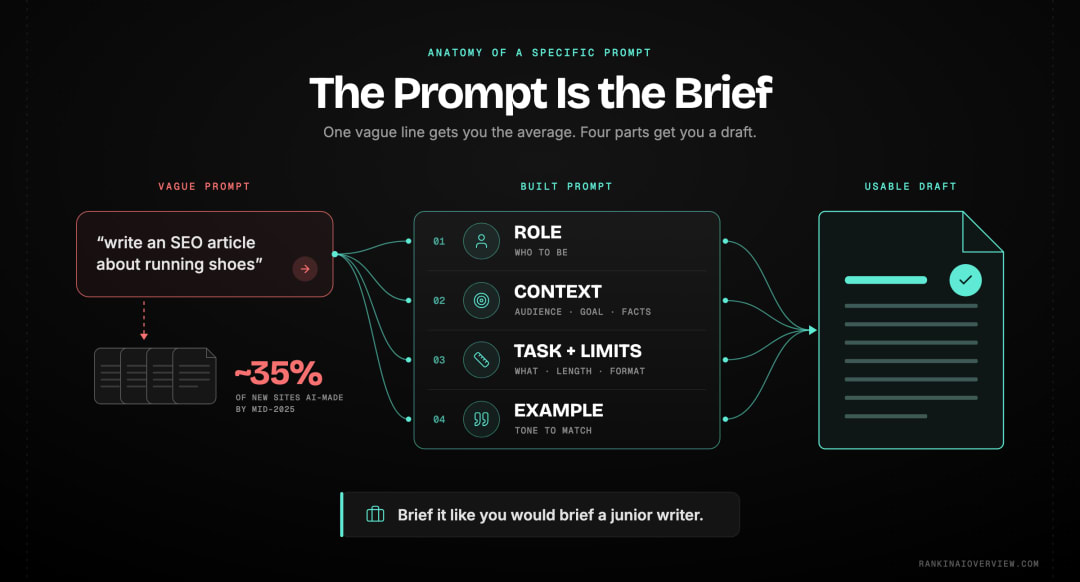
ChatGPT SEO prompts need to be specific because the model mirrors the quality of the request. A vague prompt returns average, interchangeable content, while a detailed prompt with role, context, and constraints returns something tailored and useful. Specificity is the single biggest lever on output quality, and it costs nothing but a few extra sentences.
The reason is the flood of sameness. With so much of the web now AI-generated, undifferentiated content simply disappears into the average, and search and AI engines have little reason to surface it.
"Increases in AI-generated text on the internet correlate negatively with semantic diversity and positively with the prevalence of positive sentiment." Jonas Dolezal, Sawood Alam, Mark Graham and Maty Bohacek, authors, "The Impact of AI-Generated Text on the Internet". Source: arXiv
A specific prompt fights that sameness. When you give ChatGPT your exact audience, your angle, a real example, and a clear constraint, it produces content that sounds like you rather than like everyone else. That distinctiveness is what earns rankings and citations, a point we expand on in how to optimise content for AI search.
Treat every prompt as a brief you would give a junior writer. The more context you would hand a person, the more you should hand the model. Skimp on the brief and you get exactly the forgettable output the study describes.
What are the best ChatGPT prompts for keyword research?
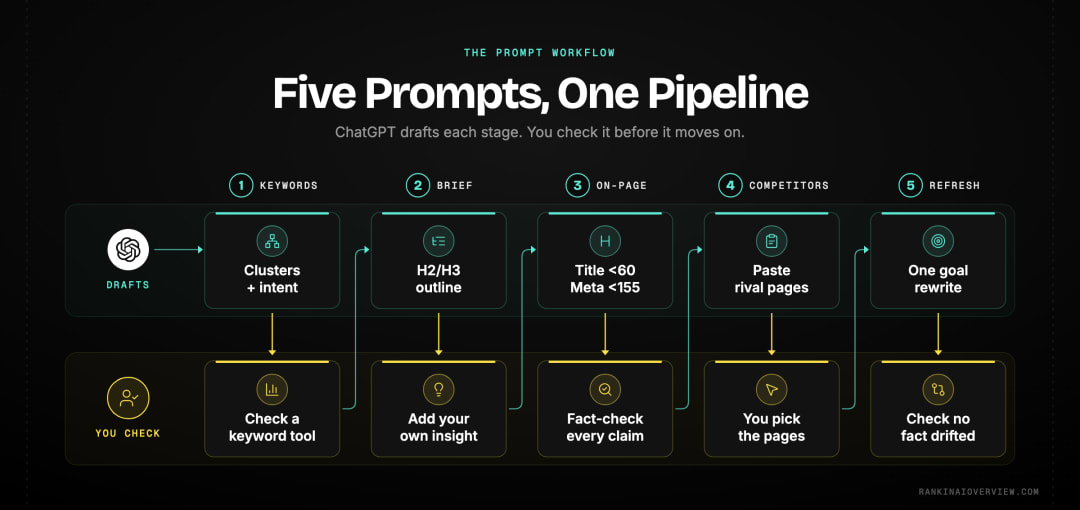
The best ChatGPT keyword research prompts ask for clusters and intent, not just lists. ChatGPT cannot pull live search volume, so use it to organise topics, map intent, and surface angles, then validate the numbers in a real keyword tool. Its strength is structure and ideas, not data.
Use these prompts as starting points and adapt the bracketed parts to your niche.
- "Act as an SEO strategist. For the topic [topic], generate 20 subtopics grouped into 4 clusters. For each, label the likely search intent as informational, commercial, or transactional, and suggest one content format."
- "List 15 long-tail questions a [target audience] would ask about [topic], phrased the way they would actually type or speak them into a search box."
- "Take this list of keywords: [paste]. Group them by search intent and by funnel stage, and flag any that likely belong on the same page to avoid cannibalisation."
- "Suggest 10 content angles for [keyword] that competitors are unlikely to have covered, based on gaps in typical coverage of this topic."
Always verify volume and difficulty in a dedicated tool afterwards. ChatGPT is guessing at popularity, so treat its numbers as hypotheses. Its real value here is speed of ideation and clean organisation, not measurement. A good workflow is to brainstorm and cluster with the model first, then take the shortlist into a keyword tool to confirm which terms are worth the effort.
What are the best ChatGPT prompts for content briefs and outlines?
The best briefing prompts give ChatGPT the target keyword, the audience, the intent, and the competing angle, then ask for a structured outline. A good brief prompt turns a blank page into a plan you can hand to a writer, or use yourself, in minutes. The key is loading it with context up front.
- "Create a content brief for an article targeting [keyword]. Include the search intent, a suggested title, an H2 and H3 outline, the questions the article must answer, and three points competitors usually miss."
- "Act as an editor. Here is my draft outline: [paste]. Identify gaps, redundant sections, and any questions a reader would still have after reading it."
- "Write a question-format outline for [topic] where every H2 is a real question a buyer asks, and each has a one-line note on the answer to give."
- "Given this transcript of a customer interview: [paste], extract the top five questions or objections worth turning into content sections."
Briefs are where ChatGPT shines, because organising known information is exactly what it does well. Feed it your research and let it structure the piece, then add the original insight and first-hand detail that a brief alone cannot supply. Our guide to the blog content AI actually wants to cite pairs well with this step for shaping the outline toward citable formats.
What are the best ChatGPT prompts for on-page optimisation?
The best on-page prompts ask ChatGPT to draft titles, meta descriptions, headings, and answer snippets against a clear constraint, such as length or keyword placement. On-page elements are small, rule-bound tasks, which is exactly where the model is fast and reliable. Give it the rules and it will iterate quickly.
-
"Write 10 title tag options for a page targeting [keyword], each under 60 characters, each leading with the keyword, and varied in angle."
-
"Write 5 meta descriptions for [page topic], each under 155 characters, each with a clear benefit and a soft call to action, no clickbait."
-
"Rewrite this section so it opens with a direct 40 to 60 word answer to the question [question], then expands. Keep the facts identical: [paste]."
-
"Suggest an H2 and H3 structure for this draft that uses question-format headings matching how people search: [paste]."
-
"Draft three variations of an opening answer for the question [question], each 40 to 60 words, each self-contained so it makes sense lifted out of context."
-
"Suggest internal link anchor text and target ideas for this draft, using descriptive phrases that already appear naturally in the text: [paste]."
The answer-snippet prompt is the most valuable for modern SEO. A tight, self-contained opening answer is what both featured snippets and AI engines lift. Use ChatGPT to draft those openings, then check every fact yourself before publishing. The best openings repeat the subject rather than leaning on words like "it," so the answer stands on its own when an engine quotes it.
What are the best ChatGPT prompts for competitor and SERP analysis?
The best competitor analysis prompts feed ChatGPT real competitor content and ask it to extract structure, gaps, and angles. The model cannot browse live results reliably, so paste in the material yourself, then use it to compare and find openings. Its value is fast synthesis of text you provide, not live research.
- "Here are three competing articles for [keyword]: [paste]. Summarise the structure each uses, the questions each answers, and the questions none of them answer."
- "Compare my page against this competitor page for [keyword]. List what they cover that I do not, and what I cover that they do not: [paste both]."
- "Based on these top-ranking pages, identify the shared content format and depth an article needs to compete for [keyword]: [paste]."
- "Read this competitor's page and list the specific claims or data points they use to sound authoritative: [paste]."
The gap analysis is the payoff. When you can see what every competitor answers and what none of them do, you have found the angle worth owning. Paste generously, because the model can only compare what you give it, and keep your own judgement in the loop on what actually matters to buyers. The unanswered questions are usually the most valuable, since they are where you can be the only good source rather than the tenth.
What are the best ChatGPT prompts for content refreshing and optimisation?
The best refresh prompts give ChatGPT an existing page and a clear goal, such as improving clarity, updating structure, or strengthening the opening answer. Refreshing beats rewriting from scratch, and the model is well suited to reworking text you already have. Supply the page and the target, and iterate.
- "Here is an existing article: [paste]. Rewrite the introduction to lead with a direct answer, tighten the structure, and keep every fact unchanged."
- "Review this page for clarity and readability. Shorten long sentences, break dense paragraphs, and flag anything vague, without adding new claims: [paste]."
- "Suggest five sections I could add to this article to make it more complete for the query [keyword], based on what a reader would still want to know: [paste]."
- "Turn the key points of this article into a concise summary box of six bullets suitable for the top of the page: [paste]."
Refreshing is one of the safest ways to use AI in SEO, because you are improving verified content rather than inventing new claims. Keep the model focused on clarity and structure, and confirm that no fact drifted during the rewrite, since even a careful rewrite can quietly change a number or soften a claim you meant to keep exact. Distinctive, well-structured pages are also what tend to rank and get cited, a link explored in which AI writing tools produce content that ranks.
What are the best ChatGPT prompts for AI search visibility and GEO?
The best AI visibility prompts use ChatGPT to test how it describes your brand and category, then to shape content that earns citations. Most prompt lists stop at classic SEO, but the same tool can help you audit and improve your presence inside AI answers. This is where prompting meets generative engine optimisation.
-
"Without searching, tell me what you know about [your brand], what it does, and who its main competitors are. Note anything you are unsure about."
-
"Answer this buyer question as you normally would: [category question]. Then list which sources or brands you drew on and why."
-
"Here is my page: [paste]. Identify the single strongest, most citable claim on it, and rewrite the section so that claim is clear, specific, and easy to quote."
-
"Suggest five original data points or first-hand angles I could add to [topic] that would make this page the natural source to cite rather than one of many."
-
"Compare how you would answer [category question] with and without my brand included. What would make my brand the obvious one to mention?"
-
"Read my page and rewrite its key facts as clean, quotable statements an AI answer could lift directly, keeping every fact accurate: [paste]."
The first two prompts are a quick self-audit. They show you how the model represents you from memory, which is a rough read on your training-based visibility. Treat the answers as signals, not proof, and confirm patterns by measuring your AI search visibility properly. The remaining prompts push your content toward the distinctiveness that earns citations rather than blends in. This is the section that turns a generic SEO workflow into one aimed at AI answers, which is where a growing share of discovery now happens.
What are the best ChatGPT prompts for technical SEO and schema?
The best technical SEO prompts ask ChatGPT to generate, explain, or debug structured data and configuration, which you then validate in official tools. The model is good at boilerplate like schema markup and regex, and at explaining errors in plain language. It is not a substitute for testing the output.
- "Generate valid FAQPage schema in JSON-LD for these questions and answers: [paste]. Output only the code."
- "Explain what this robots.txt rule does and whether it would block AI crawlers like GPTBot or PerplexityBot: [paste]."
- "Write a regex to find all URLs in this list that contain a date in the path: [paste]."
- "Here is a Search Console coverage error: [paste]. Explain the likely cause in plain English and the steps to fix it."
Always validate generated schema in a real testing tool and confirm crawler rules on your live site. ChatGPT can produce plausible code that is subtly wrong, so the model drafts and you verify. For more on tool-assisted workflows, see how to use AI tools to improve your Google rankings. One habit pays off here: ask the model to explain what its code does before you trust it, because an explanation you can follow is easier to sanity-check than raw markup, and it often surfaces the mistake on its own.
What are the best ChatGPT prompts for link building and outreach?
The best outreach prompts use ChatGPT to draft personalised pitches and find angles, not to blast identical emails. The model is good at rewording a solid template for a specific target and at spotting story hooks in your own content. The personalisation and the sending judgement stay with you.
- "Here is a roundup article that lists tools like mine: [paste or describe]. Draft a short, genuine pitch to be added, leading with a specific compliment about their list and a one-line reason my tool fits."
- "Turn this piece of original research into three story angles a journalist or newsletter writer in [niche] might want to cover: [paste]."
- "Rewrite this outreach email to sound less templated and more human, keeping it under 120 words: [paste]."
- "Suggest 10 types of sites or pages in [niche] that would be a natural, relevant home for a link to this resource: [paste]."
Keep outreach honest and specific. A pitch that shows you read the target beats a generic mass email every time, and the model is only helping you personalise faster, not replacing the judgement about who is genuinely worth contacting. Never automate spammy outreach, because relevance and genuine value are what actually earn links, and off-page presence is also how AI engines learn your brand exists.
How do you write your own effective ChatGPT SEO prompts?
You write effective ChatGPT SEO prompts by including four things: a role, context, a clear task with constraints, and an example of the output you want. This structure removes ambiguity and pushes the model past its generic default. Once you internalise the pattern, you can build any prompt on demand.
Break each prompt into those four parts.
- Role: tell it who to be, such as "act as a technical SEO specialist."
- Context: give the audience, the goal, and any brand facts it needs.
- Task and constraints: state exactly what to produce and the limits, such as length or format.
- Example: show one sample of the tone or structure you want, so it matches.
Then iterate. Your first output is a starting point, so refine with follow-ups like "make it more specific" or "cut the fluff and keep the facts." Because ChatGPT holds the thread of a conversation, each turn can sharpen the last. The best results come from a short dialogue, not a single perfect prompt.
Save the prompts that work. Once you find a phrasing that reliably produces good briefs or clean title tags, keep it in a document and reuse it, swapping only the bracketed details. A small personal library of proven prompts is far more valuable than hunting for a new one each time, and it keeps your output consistent across a team. Over a few weeks, that library becomes a quiet productivity system rather than a pile of one-off experiments.
What are the limits of using ChatGPT for SEO?
The limits of using ChatGPT for SEO are real: it invents facts, has no live search data by default, and cannot earn authority on its own. It is a powerful assistant for drafting and analysis, but publishing its raw output unedited is how thin, inaccurate content gets made. Treat it as a first draft engine, not a final authority.
Accuracy is the first limit. The model can state confident, wrong facts, so every claim, statistic, and citation it produces must be checked against a real source before it goes live. This matters even more for content you hope AI engines will cite, since a fabricated fact can quietly spread.
The deeper limit is that raw AI content rarely earns citations. Engines reward original data, first-hand experience, and genuine expertise, none of which the model has. Prompts can scaffold and speed up your work, but the substance that gets you cited has to come from you, as we cover in whether AI-generated content helps or hurts your SEO.
Used well, within these limits, ChatGPT SEO prompts save hours on structure, drafting, and analysis. Used as a shortcut to publish unedited output, they add to the flood of sameness that gets ignored. The tool is only ever as good as the prompts and the human editing around it.
Conclusion
ChatGPT SEO prompts are a genuine time-saver, but only when they are specific and only when a human stays in charge. With a third of new web content now AI-generated, generic prompts just add to the noise, while well-built prompts, backed by your own research and expertise, produce work that stands out and gets used. The prompt is the brief, and the brief decides the result.
Use this library as a starting kit, adapt every prompt to your brand, and always edit and verify before you publish. And remember that the substance which earns rankings and citations, the original data and first-hand insight, still has to come from you. Rank in AI Overview researches how AI engines choose and credit content, and is building an AI visibility tool that is coming soon. Get your free AI visibility audit to see how AI describes you today.
Frequently asked questions
Can ChatGPT do SEO for me?+
Not on its own. ChatGPT accelerates SEO tasks like research, briefs, drafting, and schema, but it cannot run a strategy, verify facts, or earn authority for you. Treat it as a fast assistant that still needs a human directing and checking the work.
Are ChatGPT SEO prompts safe to use for content?+
Yes, if you edit and fact-check the output. Prompts are a safe, efficient way to draft and structure content. The risk is publishing raw, unverified output, which can be inaccurate or generic. Human editing turns a draft into something trustworthy and distinctive.
What is the best ChatGPT prompt for SEO?+
There is no single best prompt. The most effective prompts share a structure: a role, context, a clear task with constraints, and an example. A well-built keyword-clustering or answer-snippet prompt tends to deliver the most immediate value for most sites.
Can ChatGPT help with AI search visibility?+
Yes. You can prompt ChatGPT to describe your brand from memory as a rough self-audit, and to sharpen your most citable claims. It helps shape content for AI answers, though you should confirm your real visibility by testing across several engines.
Do I need ChatGPT Plus for SEO prompts?+
No. The prompts in this library work on free and paid versions. Paid tiers add larger context windows and newer models, which help with long documents and complex tasks, but the core SEO prompting workflow does not require a subscription to be useful.
Will Google penalise content written with ChatGPT?+
Google penalises unhelpful, low-quality content, not AI use itself. Well-edited, accurate, genuinely useful content produced with ChatGPT is fine. Thin, mass-produced output made to game rankings is what risks trouble, whether a human or a model wrote it.
Explore with AI
Share this