Claude vs ChatGPT: Which AI Assistant Is Better in 2026?
Claude vs ChatGPT compared on writing, coding, features and pricing. See where each one wins and which assistant actually fits your work.

Key Highlights
- Claude and ChatGPT are close rivals, and user satisfaction between them is statistically hard to separate.
- Claude tends to win on writing quality, nuance, and sustained coding, while ChatGPT wins on features, ecosystem, and reach.
- ChatGPT offers image generation, voice, and a huge plugin ecosystem; Claude offers long context, strong reasoning, and clean writing.
- Pricing is similar at the consumer level: both have a free tier and a paid plan around $20 a month.
- Most people do not pick just one, since over 80% of active users run two or more assistants.
- The right choice depends on your main task: writing and coding lean Claude, all-round features and media lean ChatGPT.
The honest answer to "which is better" surprises people. According to a survey of 388 active AI users by Moiz Awan, Muhammad Haris Noor and Muhammad Salman Munaf, the top three assistants including ChatGPT and Claude received statistically indistinguishable satisfaction ratings, and over 80% of users run two or more platforms. In other words, there is no single winner, only a better fit for a given job. That reframes the whole comparison away from crowning a champion and toward finding your match.
So this is not a hunt for a knockout. Both Claude and ChatGPT are genuinely excellent, both are used daily by many millions of people, and both keep leapfrogging each other on capability. Declaring one universally superior would be marketing, not analysis. The useful question is narrower and more practical: which one suits your work, your budget, and the specific tasks you do most?
This comparison answers exactly that. It puts Claude and ChatGPT side by side on writing, coding, features, and price, then shows who each one serves best. By the end you will know which to reach for by default, and why running both is what most people actually end up doing.
Claude vs ChatGPT: what is the quick verdict?
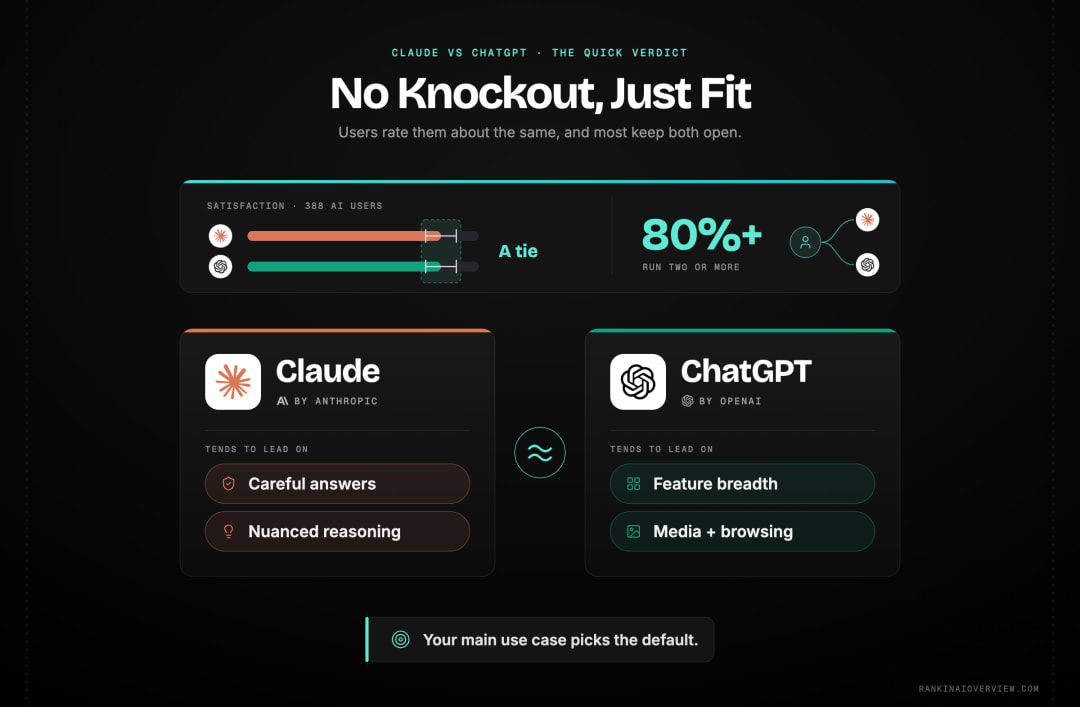
Claude is the stronger pick for writing quality, nuanced reasoning, and sustained coding, while ChatGPT is the stronger pick for features, media generation, and ecosystem breadth. Neither dominates outright. Your primary use case, not a benchmark table, should decide which one you make your default.
The table below sums up where each tends to lead.
| Factor | Claude | ChatGPT |
|---|---|---|
| Writing quality | Often preferred for tone and nuance | Strong, more generic by default |
| Coding | Excellent for sustained, multi-step work | Very strong, broad language support |
| Features | Long context, projects, clean interface | Image generation, voice, browsing, plugins |
| Ecosystem | Growing, developer-friendly | The largest, most integrated |
| Consumer price | Free tier, Pro around $20/mo | Free tier, Plus at $20/mo |
| Best for | Writers, developers, researchers | All-rounders wanting media and reach |
If your day is mostly writing, analysis, and coding, Claude is a natural default. If you want the widest feature set, image and voice tools, and the biggest ecosystem, ChatGPT fits better. The rest of this comparison explains why, area by area, so you can match the tool to your work rather than to the loudest headline. Keep your own top two or three tasks in mind as you read, because those, more than any benchmark, decide which assistant will serve you best day to day.
What are Claude and ChatGPT?
Claude is an AI assistant from Anthropic, and ChatGPT is an AI assistant from OpenAI, both built on large language models that answer questions, write, code, and analyse. They are the two most widely used general-purpose assistants, and they compete directly across almost every task. The differences are in emphasis, not category.
ChatGPT launched in late 2022 and became the fastest-growing consumer app in history, which gave it the largest user base and the deepest ecosystem of integrations, plugins, and custom versions. Its scale is a genuine advantage, since more tools and connections are built for it than for any rival, and its name has become shorthand for AI chat itself in a way no competitor has matched.
Claude arrived from Anthropic with a focus on helpful, careful, high-quality responses, and it earned a reputation for strong writing and reasoning. Its latest models are widely praised for coding and long, complex tasks. Both companies ship new models frequently, so any single "who is ahead" claim is a snapshot that can flip within weeks, a point we explore in asking the assistants to rank each other.
How do Claude and ChatGPT compare on writing and reasoning?
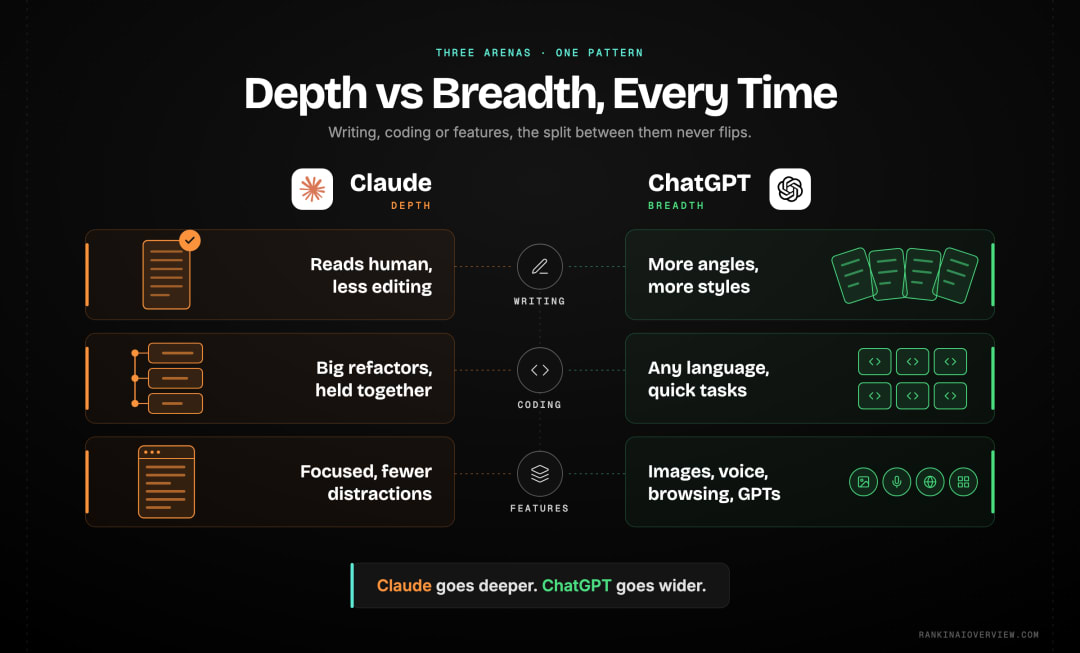
Claude is often preferred for writing quality and nuanced reasoning, producing prose that many users find more natural and less generic, while ChatGPT is highly capable and more flexible in style on request. For long-form writing, editing, and careful analysis, Claude tends to be the default choice. ChatGPT closes the gap when guided with detailed prompts.
The difference shows most in tone. Claude's default output often reads as more considered and human, which writers and editors value when polishing drafts. It also handles long documents well, holding context across lengthy inputs without losing the thread, which makes it a strong partner for editing book chapters, reports, or long transcripts in one pass.
ChatGPT is no slouch here and can match Claude's quality with strong prompting, but its default voice can feel more formulaic and a little safe. Its advantage is versatility: it will happily adopt a wide range of styles, tones, and formats on instruction. For reasoning, both are strong, and the leader shifts with each model release, so neither holds a permanent edge.
A practical way to see the difference is to give both the same messy brief and read the first drafts. Claude often needs less editing to sound human, which saves time on content work. ChatGPT often gives you more raw options and angles to choose from, which helps when you are still exploring what to say. Both behaviours are useful, just at different stages of a project, and neither is strictly better than the other.
How do Claude and ChatGPT compare on coding?
Claude has become a favourite for sustained, multi-step coding across large codebases, while ChatGPT remains excellent and broadly capable across many languages and quick tasks. Developers increasingly reach for Claude on complex engineering work, though ChatGPT's ecosystem and tooling keep it a strong all-round coding assistant. Both are genuinely useful daily.
Claude's strength is holding a complex problem together. Its ability to work across long context and reason through multi-file changes suits real engineering, not just snippets, and its coding-focused tools have built a loyal developer following.
ChatGPT counters with breadth and integration. It handles a huge range of languages and quick coding tasks well, and its wider ecosystem means more plugins, extensions, and workflows plug straight in. For many developers the practical answer is to use both, matching the tool to the task rather than committing to one.
The distinction often comes down to scope. For a quick script, a regex, or a bug explained in a sentence, either tool answers in seconds and the choice barely matters. For a large refactor, a feature spanning many files, or a task where the model must remember earlier decisions, Claude's steadiness across long context tends to pull ahead. Knowing which kind of job you are doing is a better guide than any leaderboard.
How do Claude and ChatGPT compare on features and ecosystem?
ChatGPT offers a broader feature set and the larger ecosystem, including image generation, voice mode, web browsing, and custom versions, while Claude focuses on long context, projects, and clean, capable text and code work. ChatGPT is the more media-rich, all-in-one tool; Claude is the more focused, writing-and-reasoning tool. Your feature needs decide the winner here.
ChatGPT's range is its headline advantage. Built-in image generation, a natural voice mode, web browsing, and a marketplace of custom versions make it a versatile hub for many kinds of work in one place. For users who want media and breadth, that all-in-one design is hard to beat.
Claude takes a more focused path. It emphasises long context windows, project organisation, and reliable text and code output rather than a sprawling feature list. That focus appeals to users who mainly want high-quality writing, analysis, and coding without extras they will not use. Understanding how each is used also matters for visibility, since how often ChatGPT cites its sources differs from how other engines behave.
The ecosystem gap is worth weighing honestly. ChatGPT's marketplace of custom versions and its many third-party integrations mean that for a lot of niche tasks, someone has already built a tool that fits. Claude's ecosystem is smaller but growing, and its clean design means fewer distractions for users who just want to get work done. Whether breadth or focus wins depends on your temperament as much as your tasks: some people thrive with a toolbox of options, others prefer a single sharp blade.
How much do Claude and ChatGPT cost?
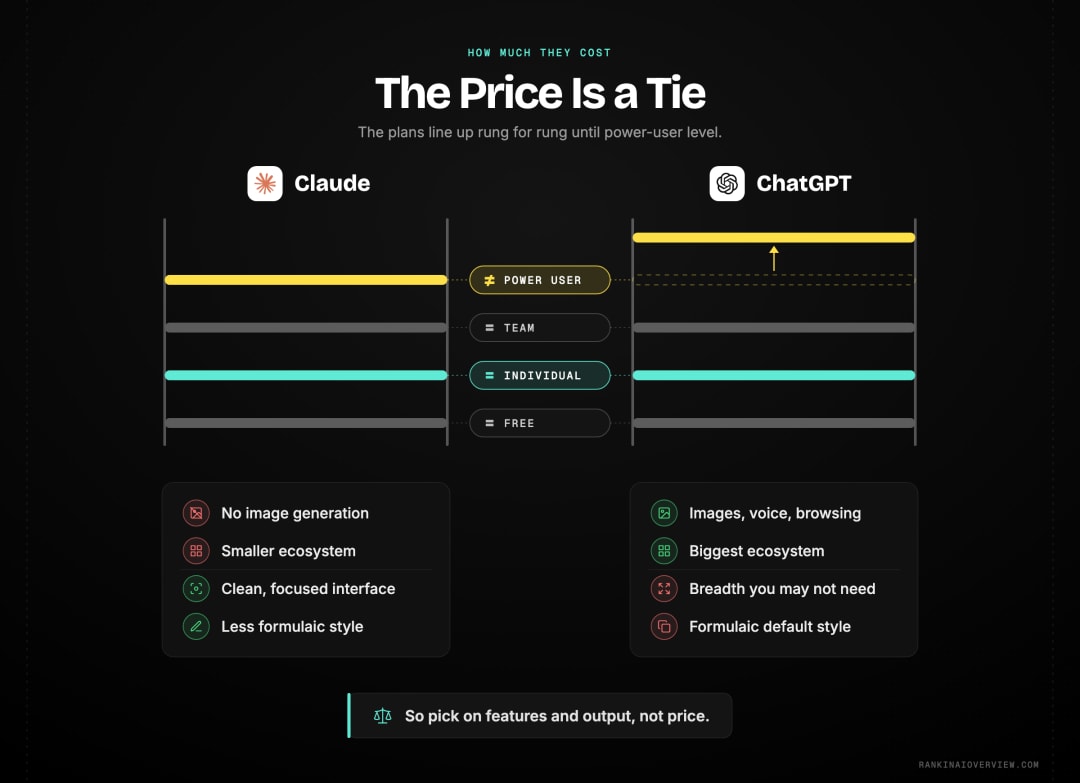
Claude and ChatGPT cost about the same at the consumer level: both offer a free tier and a paid plan around $20 a month, with higher power-user and team tiers above that. Price is rarely the deciding factor between them, since the core paid plans are closely matched. Heavy and team usage is where costs diverge.
The table below sets out the main plans.
| Plan level | Claude | ChatGPT |
|---|---|---|
| Free | Yes, generous free access | Yes, free access |
| Individual paid | Pro at $20/mo($17 annual) | Plus at $20/mo |
| Power user | Max from $100/mo | Pro at $200/mo |
| Team | From $20 to $25 per seat | Team plan per seat |
At the everyday level, the two are effectively tied at around $20 a month with comparable free tiers. The differences appear higher up: ChatGPT's Pro tier at $200 a month targets intensive users, while Claude's Max plans start at $100 a month for heavier usage. For most individuals, the paid plans are close enough that features and output quality, not price, should decide the choice.
The free tiers deserve a mention, because both are genuinely usable rather than a locked demo. If your needs are light, you can run both free accounts and switch based on the task, paying nothing. That low barrier is part of why so many people use more than one assistant: trying the alternative costs only the few minutes it takes to sign up. When you do pay, it is usually to lift usage limits or unlock power-user features, not to access a fundamentally better model than the free tier offers.
What are the pros and cons of Claude and ChatGPT?
Claude's pros are writing quality, reasoning, coding, and long context; its cons are fewer built-in media features and a smaller ecosystem. ChatGPT's pros are its feature breadth, media tools, and huge ecosystem; its cons are a sometimes more generic default voice. Each tool's strengths reflect its focus.
Here is the balanced view.
- Claude pros: strong writing and nuance, excellent sustained coding, long context, clean focused interface.
- Claude cons: fewer media features, a smaller ecosystem, no built-in image generation.
- ChatGPT pros: image generation, voice, browsing, the largest ecosystem, huge versatility.
- ChatGPT cons: a more formulaic default style, and a broad feature set some users will not need.
Neither list crowns a winner. They describe two tools optimised for different priorities, and the better one is whichever matches how you actually work. This is exactly why what actually affects AI search visibility matters more than chasing a single "best" label, for tools and for your own content.
Who should use Claude, and who should use ChatGPT?
Use Claude if your work centres on writing, analysis, and complex coding, and use ChatGPT if you want the widest features, media generation, and ecosystem. Writers, editors, developers, and researchers often prefer Claude; generalists, marketers, and anyone wanting an all-in-one tool often prefer ChatGPT. Many people sensibly use both.
Pick Claude when quality of text and depth of reasoning matter most. Its natural writing and strong coding make it the default for content, research, and engineering, especially on long or complex tasks where its context handling shines and where a cleaner first draft saves real editing time.
Pick ChatGPT when you want versatility and media in one place. Its image, voice, and browsing tools plus its vast ecosystem make it the more complete all-rounder for varied daily work. And because switching costs are low, trying both for a week on your real tasks is the surest way to learn which fits, rather than trusting any single verdict.
Teams face a slightly different calculus than individuals. When several people share a tool, the ecosystem, admin controls, and integrations often matter as much as raw output quality, which can tilt a team toward ChatGPT's breadth. A team of writers or engineers, though, may still prefer Claude for the quality of what it produces. The sensible move for many organisations is to let people use whichever assistant suits their role, since the tools are cheap enough and complementary enough that standardising on just one can cost more in lost fit than it saves in tidiness.
Which matters more for your AI search visibility?
Both matter, because being represented well in Claude and ChatGPT shapes how buyers who use each one perceive you. Neither is more important in the abstract; what counts is which your audience uses. If your customers research in ChatGPT, your visibility there is the priority, and the same holds for Claude.
Since users spread across assistants, your brand needs to be described accurately in both. An answer that misrepresents you in one engine reaches every buyer who favours it, regardless of how you look in the other. That is why tracking your presence across engines, not just one, is the sensible approach, and why content that ranks in AI search is built to be cited wherever buyers ask.
The practical takeaway mirrors the tools themselves: do not bet everything on one engine. Just as most users run both Claude and ChatGPT, your visibility work should aim to be present and accurate across the assistants your buyers actually use. Measuring how each one describes you, and where a competitor is named instead, turns this from a worry into a plan, which is the same logic behind ranking on Google and in AI answers together.
Conclusion
Claude versus ChatGPT has no single winner, and that is the honest, useful conclusion. Satisfaction between them is statistically close, most people use both, and each leads in different areas: Claude on writing quality, nuance, and sustained coding, ChatGPT on features, media, and ecosystem reach. Pricing is similar enough at the consumer level that capability, not cost, should guide you.
Choose by your main task, try both on your real work for a week or two, and let the actual results decide. And if your goal is being seen by the buyers who use these tools, remember that visibility inside their answers is its own discipline. Rank in AI Overview researches how AI engines represent and cite brands, and is building an AI visibility tool that is coming soon. Get your free AI visibility audit to see how Claude and ChatGPT describe you today.
Frequently asked questions
Is Claude better than ChatGPT?+
Not universally. Claude often leads on writing quality and sustained coding, while ChatGPT leads on features, media, and ecosystem. User satisfaction between them is statistically close, so the better tool depends entirely on your main tasks rather than a single ranking.
Is Claude or ChatGPT better for writing?+
Claude is frequently preferred for writing, as many users find its default tone more natural and nuanced. ChatGPT can match it with detailed prompting and offers more style flexibility. For polished long-form writing, Claude is the common default choice.
Is Claude or ChatGPT cheaper?+
They are closely matched. Both offer a free tier and a paid consumer plan around $20 a month. Differences appear at higher tiers, where ChatGPT's Pro is $200 a month and Claude's Max plans start at $100 a month for heavy users.
Can I use both Claude and ChatGPT?+
Yes, and most active users do. Over 80% of people use two or more AI assistants, since switching costs are low and each tool has different strengths. Using both lets you match the assistant to the task for the best results.
Which is better for coding, Claude or ChatGPT?+
Claude is increasingly favoured for complex, multi-step coding across large codebases, while ChatGPT is excellent for a broad range of languages and quick tasks. Many developers use both, choosing Claude for deep work and ChatGPT for speed and ecosystem.
Does Claude or ChatGPT have more users?+
ChatGPT has the larger user base by a wide margin, as the fastest-growing consumer app in history, which gives it the deeper ecosystem. Claude has a smaller but fast-growing and loyal following, especially among writers and developers who value its output quality.
Explore with AI
Share this