How to Run an AI Search Visibility Audit
An AI search visibility audit shows whether ChatGPT, Perplexity and AI Overviews cite your brand accurately. Here is the method to run it.

Key Highlights
- An AI search visibility audit checks whether and how AI engines mention, cite, and describe your brand across ChatGPT, Perplexity and Google AI Overviews.
- You cannot assume AI represents you accurately, because generative answers frequently contain unsupported statements and inaccurate citations.
- A good audit measures five things: presence, citation, accuracy, sentiment, and share of voice against competitors.
- The method is a repeatable loop: define brand prompts, test across engines, record what you find, benchmark rivals, and repeat to handle variability.
- Results sort into clear buckets: invisible, mentioned but not cited, cited, or misrepresented, each with a different fix.
- Run the audit quarterly, because AI answers drift and a stale audit slowly stops matching reality.
Most brands have no idea how AI describes them. You can check your Google rankings in seconds, but what does ChatGPT say when someone asks about your category? According to a Stanford audit of four generative search engines by Nelson Liu, Tianyi Zhang and Percy Liang, only 51.5% of generated sentences were fully supported by their citations, and just 74.5% of citations actually supported the statement they were attached to. If AI answers are that loosely grounded, you cannot assume yours are accurate. You have to look.
That blind spot is risky. An AI engine might skip your brand entirely, describe an old product you no longer sell, quote a competitor's framing of your category, or attach a confident claim to a source that never made it. Any of these shapes what a buyer believes before they ever reach your site. And unlike a search ranking, none of it shows up on a dashboard you already watch.
An AI search visibility audit fixes that. It is a structured check of how AI engines represent you, run on purpose rather than left to chance. This guide walks through exactly what an AI search visibility audit measures, how to run one yourself step by step, how to read the results, and what to do once you know where you stand.
What is an AI search visibility audit?
An AI search visibility audit is a structured review of whether and how AI answer engines mention, cite, and describe your brand. It checks your presence across ChatGPT, Perplexity and Google AI Overviews for the questions your buyers ask, and records where you appear, where a rival appears instead, and where the answer is simply wrong.
Think of it as the AI-era version of a search audit, but aimed at answers rather than links. A traditional audit asks where you rank. This one asks a different question: when AI answers a question in your category, are you in the answer, are you cited, and is what it says about you correct?
The shift matters because the unit of visibility has changed. In search, visibility is a position on a page of links a user chooses from. In AI, visibility is a place inside a single answer the user often accepts whole. That makes how you are described at least as important as whether you appear, which is why an audit has to judge the words, not just count the mentions.
The audit is diagnostic, not a one-off score. Its output is a map of gaps: the queries where you are invisible, the answers that misdescribe you, and the competitors who own the framing. That map is what turns vague worry about AI into a concrete list of things to fix. Our guide on why brands that rank on Google can still be invisible to AI explains why this gap exists in the first place.
It also matters who the audit is for. A founder wants to know if AI describes the company correctly. A marketing lead wants share of voice against rivals. A content team wants the specific pages to fix. One audit can serve all three, as long as you capture the raw answers, because the same evidence answers each of their questions in a different column of the same sheet.
This is different from auditing what content gets cited across your whole niche. Here the object is your own brand, not the content landscape. The focus is you: your presence, your accuracy, your share of the answer.
Why do you need an AI search visibility audit?
You need an AI search visibility audit because AI answers are often inaccurate, vary by engine, and can omit you entirely, and none of that is visible without checking. Buyers increasingly ask AI before they ask Google. If the answer misrepresents or ignores you, you lose the sale before you know a conversation happened.
Accuracy is the first reason. Generative answers frequently state things that their own citations do not support, so an answer about your brand can sound authoritative and still be completely wrong. You cannot correct a mistake you have never measured or even seen.
"Responses from existing generative search engines are fluent and appear informative, but frequently contain unsupported statements and inaccurate citations." Nelson F. Liu, Tianyi Zhang and Percy Liang, authors, "Evaluating Verifiability in Generative Search Engines". Source: arXiv
Inconsistency is the second reason. Engines do not agree with each other. A brand cited by Perplexity can be absent from ChatGPT for the same question, so a single check on one engine tells you almost nothing. Only a structured look across engines reveals the real picture.
The third reason is competitive. If a rival owns the answer to a category question, that answer works against you every time it is served. An audit shows you exactly which questions a competitor owns, so you can decide where to fight. It also gives you a baseline to prove progress after you act, which pairs naturally with the metrics worth tracking for AI visibility.
What does an AI search visibility audit measure?
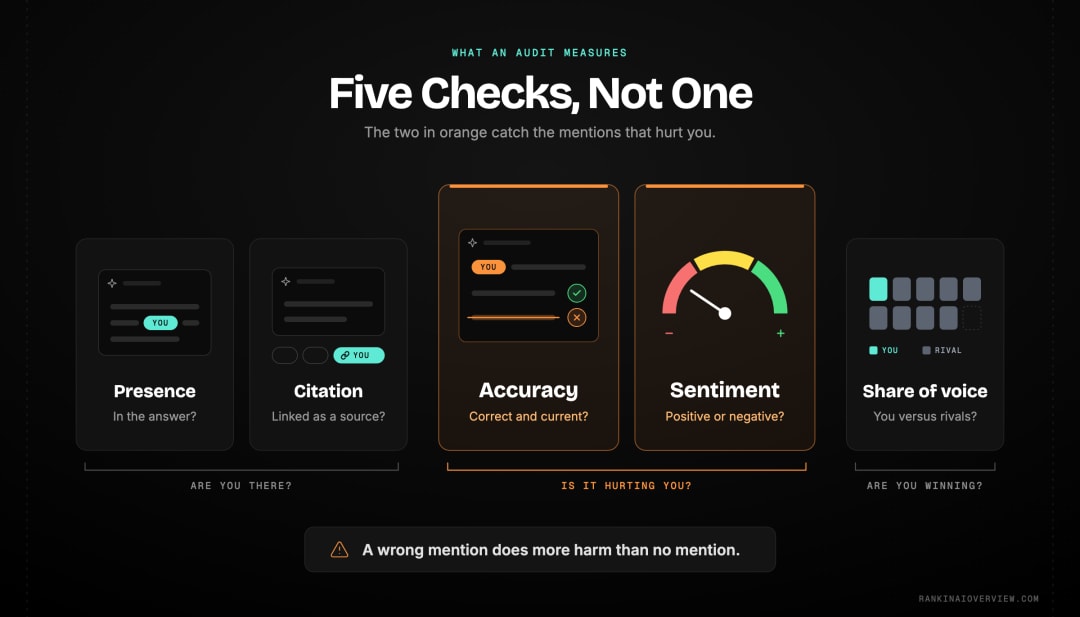
An AI search visibility audit measures five dimensions: presence, citation, accuracy, sentiment, and share of voice. Together they describe not just whether you appear, but whether you are credited, described correctly, framed positively, and winning against competitors. Measuring all five stops you celebrating a mention that is actually doing you harm.
Each dimension answers a distinct question, and each maps to a different fix later.
- Presence: does your brand appear in the answer at all, named or unnamed?
- Citation: is your website shown as a source, or are you mentioned without a link?
- Accuracy: is what the answer says about you correct and current?
- Sentiment: is the framing positive, neutral, or negative?
- Share of voice: how often do you appear compared with named competitors?
Presence and citation are related but not the same. You can be named in an answer with no link, which is influence without a clickable credit, or cited without much descriptive detail. Recording them separately shows whether your problem is being unknown or being uncredited. Our breakdown of how often engines actually cite any source helps set realistic expectations for the citation column.
Accuracy and sentiment are where audits earn their keep. A confident, wrong, or negative description does more damage than absence, because it actively misleads the buyer. These two dimensions are easy to skip and the most important to catch.
Share of voice ties the picture together. Being present is good, but being present in one answer out of ten while a rival appears in eight is a losing position dressed up as a win. Tracking your appearances against your competitors' converts a pile of individual answers into a clear competitive standing you can act on. It also tells you which rivals to study, because the ones that keep winning answers are showing you what the engines currently reward in your category.
How do you run an AI search visibility audit step by step?
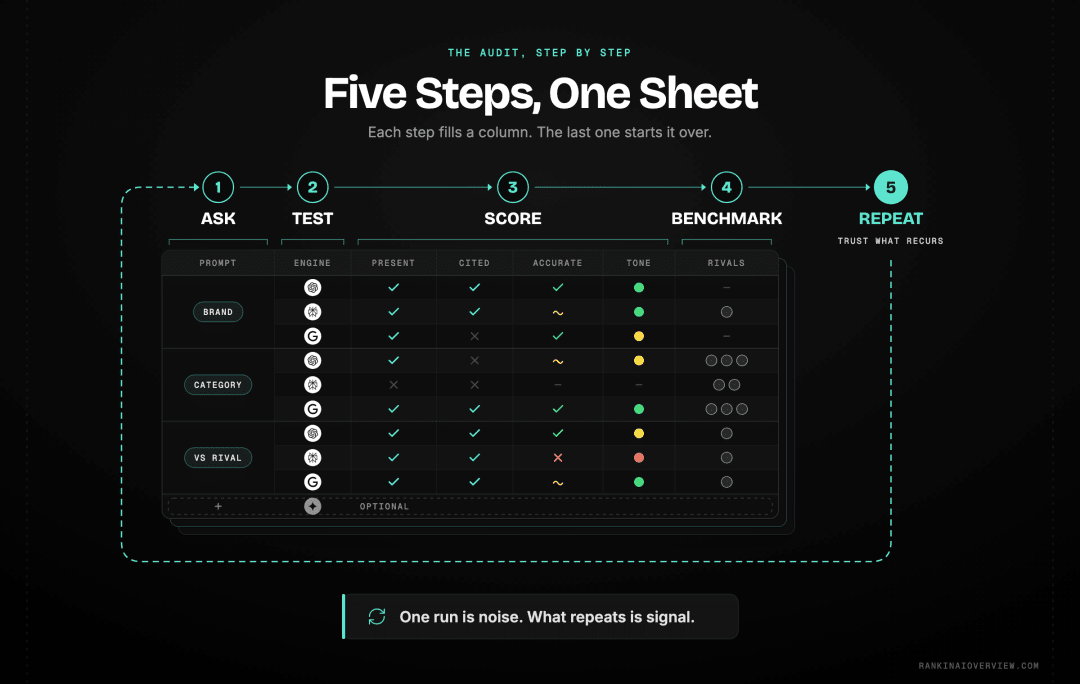
You run an AI search visibility audit by testing a fixed set of brand and category prompts across the main engines, then recording presence, citation, accuracy, sentiment, and competitors for each answer. The whole process fits in a spreadsheet and takes an afternoon. Doing it by hand once teaches you to read the patterns.
The steps below turn the five dimensions into a repeatable routine.
Define your brand and category prompts
Write 15 to 30 questions a real buyer would ask, phrased naturally. Include direct brand questions, category questions where you should appear, and comparison questions against rivals. The prompts decide what the audit can see, so make them mirror genuine buyer language, not internal jargon.
- Direct: "What does [your brand] do?" and "Is [your brand] any good?"
- Category: "What are the best tools for [your category]?"
- Comparison: "[Your brand] vs [competitor], which is better?"
Test across the main engines
Run every prompt through ChatGPT, Perplexity and Google AI Overviews at minimum, adding Gemini if it matters to your audience. Save the full answer text and any citations for each. Testing one engine gives a false read, because representation varies so much between them.
Record presence, citation, accuracy, and sentiment
For each answer, fill one row per engine with columns for presence, citation, accuracy, sentiment, and which competitors appeared. Keep the scoring simple and consistent, such as yes or no for presence and citation, and correct, partly correct, or wrong for accuracy. Consistency in how you score is what lets you count and compare later.
Benchmark against competitors
Note which rivals show up, how often, and how they are described. This turns your audit into a scoreboard rather than a solo report. The comparison questions matter most here, because they reveal the head-to-head framing an engine has settled on for your category.
Repeat to handle variability
AI answers change run to run, so a single pass mixes signal with noise. Run the prompt set two or three times over a week or two and trust what recurs. Note how much the answers move between runs, because that volatility is itself a finding worth recording.
Also read: A case study on getting a client's site cited in AI Overviews
How do you turn an audit into a score you can track?
You turn an audit into a trackable score by converting each dimension into a simple number and combining them into one figure you re-measure each quarter. A score is not the point on its own, but it makes progress visible and gives your team a single line to move. Keep the maths transparent so the number stays meaningful.
Score each dimension per prompt, then average. A workable scheme gives a point for presence, a point for a citation, a point for accuracy, and a point for positive or neutral sentiment, across every prompt and engine. Divide by the maximum possible and you have a percentage you can chart over time. Weight the prompts by buyer intent if you want the score to reflect commercial reality, so a win on a high-intent question counts for more than one on a trivial query.
Layer in share of voice separately, because it is comparative rather than absolute. Count how often you appear against the total appearances of you plus your main competitors, and track that ratio alongside your own score. One number tells you how well you are represented, the other tells you whether you are winning.
Resist the urge to over-engineer the score. A clear, rough number you actually re-run beats a precise one you abandon after a quarter. The value is in the trend line, not the decimal places, so favour a method simple enough to repeat without dread. Pair the score with a few saved example answers, so the number always has real quotes behind it.
How do you read your AI search visibility audit results?
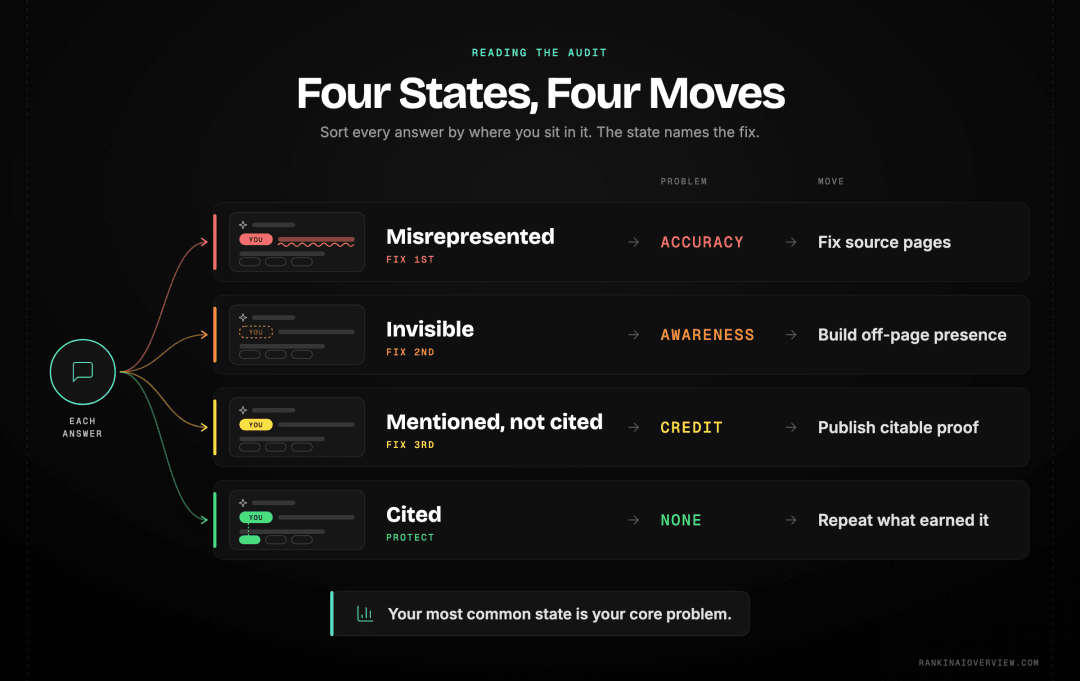
You read your audit results by sorting each answer into one of four states: invisible, mentioned but not cited, cited, or misrepresented. Each state points to a different action. The pattern across your prompts tells you whether your core problem is awareness, credit, or accuracy.
Start by counting the states across all prompts and engines. If most answers leave you invisible, your problem is awareness, and the fix is presence and entity building. If you are mentioned but rarely cited, your problem is credit, and the fix is distinctiveness and trust. If you are misrepresented, your problem is accuracy, and the fix is clear, consistent, correct source content.
- Invisible: the engine does not mention you where it should. Highest priority for category questions with buyer intent.
- Mentioned, not cited: you influence the answer without a link. Convert this by becoming the source worth naming.
- Cited: protect it, and note what earned the citation so you can repeat it.
- Misrepresented: the answer is wrong or negative. Fix the underlying source content fast, because this actively costs you.
Prioritise by intent, not volume. A misrepresentation on a high-intent buying question matters more than invisibility on a trivial one. Reading the results through the lens of buyer value is what turns the audit into a plan rather than a list of complaints.
What do you do after an AI search visibility audit?
After an audit you act on the gaps: build presence where you are invisible, earn citations where you are only mentioned, and correct the sources behind any misrepresentation. Each audit state maps to a specific move, so the audit becomes a prioritised backlog rather than an interesting snapshot.
Translate the four states into work. Invisibility calls for entity building and off-page presence so engines learn you exist. Missing citations call for distinctive, verifiable content that gives an engine a reason to credit you. Misrepresentation calls for fixing the pages the engine is drawing on, because AI restates what your sources and the wider web say about you.
Consistency across the web does a lot of the heavy lifting. When your brand name, category, and core facts match everywhere, engines store you accurately and repeat you with confidence. When they conflict, you invite exactly the vague or wrong answers the audit flagged. This is the same reputation-driven pattern behind why AI engines rank reputation, not keywords.
Sequence the work by impact. Fix high-intent misrepresentations first, then claim invisible category questions, then convert mentions into citations. Re-audit after each batch so you can see the answers change, which keeps the effort honest and motivating.
How often should you run an AI search visibility audit?
You should run an AI search visibility audit quarterly, or sooner after a major product change or an engine update. AI answers drift as models retrain and the web changes, so a once-a-year audit slowly stops matching reality. A fixed prompt set makes each re-run fast and directly comparable to the last.
Between full audits, spot-check your highest-intent prompts monthly. These are the questions where a misrepresentation costs you real revenue, so they deserve a lighter, more frequent watch. A ten-minute monthly check on your top five prompts catches big problems early.
Tie the cadence to your own change calendar too. Launch a product, rebrand, or publish a big piece of coverage, and re-audit soon after to see whether the engines have picked it up. Waiting for the next quarterly pass means living with a stale description of your newest news for months, which is exactly when accurate representation matters most.
Treat the audit as a loop, not an event. Measure, fix, and measure again, so you can prove the fixes worked and catch new gaps as they appear. That cadence is what separates brands that manage their AI presence from brands that merely worry about it.
What mistakes make an AI visibility audit unreliable?
The most common audit mistakes are checking one engine, running each prompt once, and scoring presence while ignoring accuracy. Each one produces a tidy report that does not reflect reality. Avoiding them costs nothing and is the difference between a plan and a false comfort.
Single-engine auditing is the classic error. Because representation varies so much, a strong result on one engine can hide invisibility on another. Always test across several, and never generalise from one system to the rest. What is true on Perplexity often does not hold on ChatGPT.
Testing only once is the next error. AI answers shift between runs, so a lone pass blends real signal with random variation. Repeat the prompt set and keep only the results that hold up. Treating a single answer as settled truth leads to chasing a problem, or celebrating a win, that was never stable in the first place.
- Scoring presence only: a mention that is wrong or negative counts against you. Always score accuracy and sentiment, not just whether you appeared.
- Vague prompts: keyword-style prompts do not match how buyers ask. Use full, natural questions or you measure the wrong behaviour.
- No competitor benchmark: your score means little without context. Track share of voice so you know if you are winning or just present.
- Ignoring the sources: when an answer is wrong, find the page it drew from. Fixing the answer means fixing the source, and AI engines often cite pages that do not rank on Google.
Steer clear of these traps and your audit mirrors what buyers actually see. Fall into them and you will make confident decisions from a picture that is half noise. The care is unglamorous, and it is precisely what makes an audit worth acting on.
What tools can run an AI search visibility audit?
You can run an AI search visibility audit manually with a spreadsheet and the engines themselves, or use monitoring tools that automate the prompts and scoring. Manual auditing is ideal for learning and for small prompt sets. Automated tools help once you want scale, history, and alerts on change.
Start manual. Running the prompts yourself teaches you to judge accuracy and sentiment, which no tool does as well as a human who knows the brand. It also costs nothing and works today, which makes it the right first step for any team.
Add automation once your prompt set is stable and you want to track drift over time. Tools that capture answers and citations across ChatGPT, Perplexity and Google AI Overviews save the repeated manual runs and make trends easy to read. An AI visibility tool from Rank in AI Overview is being built for exactly this, and a free AI visibility audit is available now to give you a first read without any setup.
Conclusion
You cannot manage how AI represents you until you measure it, and right now most brands are guessing. An AI search visibility audit replaces that guesswork with evidence: where you appear, where you are cited, whether the description is correct, and how you stack up against competitors across every engine that matters. Given how loosely AI answers are grounded, assuming you are represented well is a risk you do not need to take.
The method is within reach of anyone with a spreadsheet and an afternoon. Define your prompts, test across engines, score the five dimensions, benchmark your rivals, and act on the gaps you find. Rank in AI Overview researches how AI engines mention and credit brands, and is building an AI visibility tool that is coming soon. Start with a free AI visibility audit to see how the engines describe you today.
Frequently asked questions
What is a good AI visibility score?+
There is no universal number. A good result is appearing, cited, and accurately described on your high-intent category questions, and holding a strong share of voice against competitors. Judge your score against rivals and against your own trend, not an absolute benchmark.
Can you audit AI visibility for free?+
Yes. You can run a full manual audit with just a spreadsheet and access to the AI engines, at no cost. Free audit tools also exist to give you a quick first read. Automation becomes worthwhile only once you want history and scale.
How is an AI visibility audit different from an SEO audit?+
An SEO audit checks rankings, links, and technical health for search results. An AI visibility audit checks whether AI answers mention, cite, and describe you correctly. One is about positions on a page, the other is about representation inside a generated answer.
Which AI engines should an audit cover?+
Cover the engines your audience actually uses, at minimum ChatGPT, Perplexity, and Google AI Overviews. Add Gemini or others if they matter for your market. Because representation varies so much between engines, testing several is essential rather than optional.
How long does an AI search visibility audit take?+
A first manual audit of 15 to 30 prompts across three engines takes roughly an afternoon, plus repeat runs over a week or two to handle variability. Later audits are faster, because your prompt set and scoring method are already built.
Can a small business run its own AI visibility audit?+
Yes. The manual method needs no special tools, only a spreadsheet and a clear prompt set. A small business can audit its own presence in an afternoon and act on the biggest gaps immediately, well before investing in any paid monitoring.
Explore with AI
Share this