Does Google Ranking Affect Whether You Appear in AI Answers?
Ranking well qualifies your page but does not win the citation. See what AI answers actually weigh on top of position, and how to earn it.

Key Highlights
- Google ranking helps but does not guarantee AI answer appearance. AI systems weigh clarity, structure, and trust on top of position.
- Google AI Overviews often cite lower-ranked pages with cleaner answers, and other engines like ChatGPT and Perplexity use their own signals entirely.
- The safest strategy is to rank well and optimize for extraction and trust, since neither alone is enough.
It is one of the most reasonable assumptions in SEO: if I rank number one, surely the AI will use my page. Then you check, and the AI cites someone ranked eighth instead. That gap between ranking and AI appearance confuses even experienced marketers, and it leads to a lot of wasted optimization aimed at the wrong target.
The confusion comes from treating AI answers like an extension of the blue links. They are related but not the same. Ranking is one input into whether AI cites you, and for some engines it is barely an input at all. Understanding the real relationship changes how you optimize, and it prevents you from over-investing in position while ignoring the signals that actually drive citation.
This guide answers the question directly. It covers whether Google ranking affects AI appearance, why high-ranking pages still get skipped, how the relationship differs across AI engines, and what actually determines whether you show up in AI answers. For a closely related take, our piece on why ranking number one on Google does not guarantee AI visibility goes deeper on the disconnect.
Does Ranking Number One on Google Guarantee AI Answer Appearance?
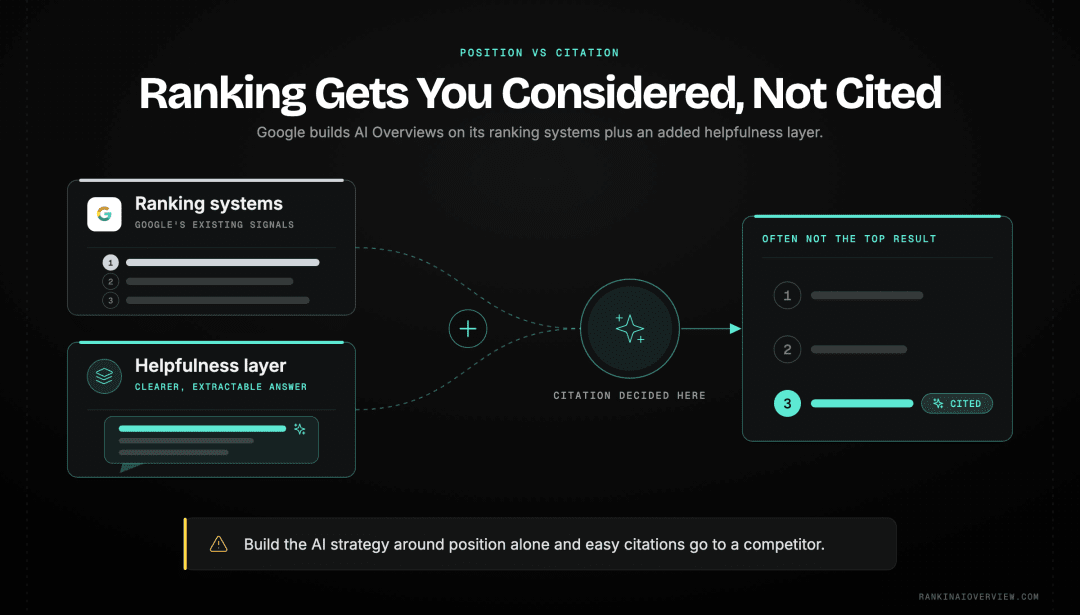
No, ranking number one does not guarantee AI answer appearance. Strong rankings help, especially for Google AI Overviews, but appearance also depends on how clearly your page answers the question, its structure, and its trust signals. Position is one factor among several.
Google itself frames AI Overviews as built on its existing ranking systems plus additional helpfulness signals. So ranking contributes, but the extra layer means the top page is not automatically the cited one. A clearer, more extractable answer can win from below, which surprises teams used to position determining everything.
The result is a weaker link than most expect between position and citation. Ranking well improves your odds. It does not settle the question, and building your whole AI strategy around position alone leaves easy citations on the table for competitors who optimize the answer itself.
Why Do High-Ranking Pages Still Get Skipped by AI?
High-ranking pages get skipped when their answers are buried, vague, or hard to extract, or when a lower-ranked page answers the question more directly. AI systems prioritize clear, self-contained answers and trust, so a well-ranked but poorly-structured page can lose to a cleaner one.
The most common reason is structure. A page can rank on overall relevance and links while burying its actual answer under long introductions. AI extracts passages, so if the answer is hard to find, the AI reaches for a page where it is not. This is the single biggest cause of the ranking-to-citation gap.
Trust and freshness play a part too. A high-ranking but stale page can be passed over for a fresher, equally credible one. Ranking reflects many factors accumulated over time; citation rewards a narrower set focused on the specific answer right now, which is why the two diverge so often.
There is also intent alignment. A page can rank for a keyword without directly answering the exact question the AI is addressing. When your content and the query's precise intent do not line up, a more on-point page earns the citation, regardless of who ranks higher. We cover this pattern in why page-one pages miss AI Overviews.
How Does the Ranking-to-AI Relationship Differ Across Engines?
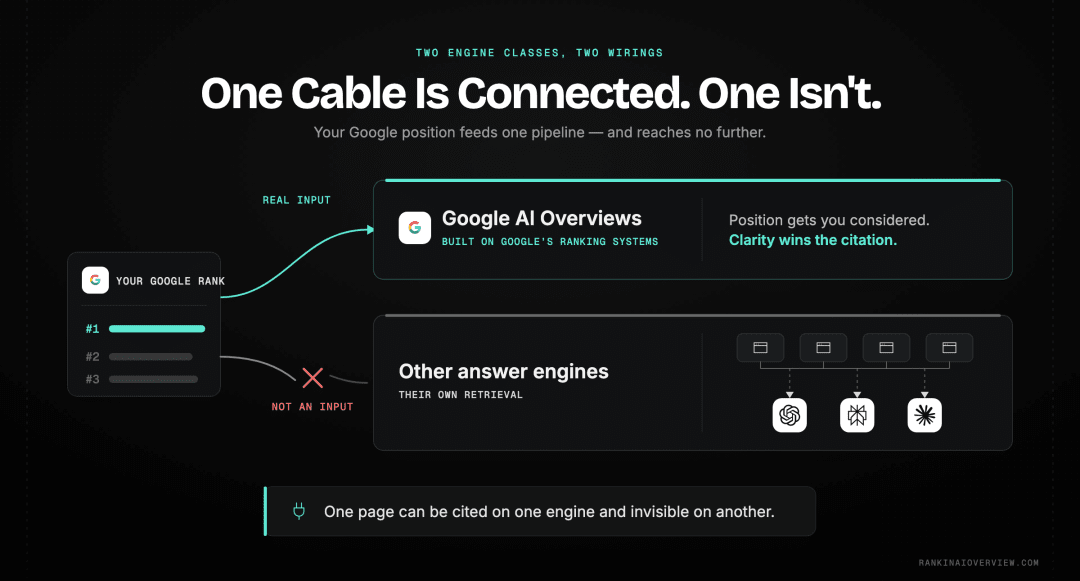
The relationship varies by engine. Google AI Overviews lean partly on Google rankings, so position matters more there. ChatGPT, Perplexity, and Claude use their own retrieval and trust signals, where your Google rank has little direct influence and web presence matters more.
Detailed breakdown by engine type:
Google AI Overviews
Because Overviews are built on Google's ranking systems, your organic position has real influence here. Ranking well genuinely improves your chances of being pulled into an Overview, though clarity and trust still decide among strong candidates. Our explainer on how Google AI Overviews select sources breaks down exactly which signals matter.
For Google specifically, the smart approach is to rank well and then optimize the answer for extraction. Position gets you into consideration; clarity and trust win the citation among the pages considered.
ChatGPT, Perplexity, and Other Answer Engines
These engines use their own retrieval and source-selection logic, often weighting broad web presence, citations, and community and reference platforms. Your Google ranking is not a direct input. A page can be cited by Perplexity while ranking poorly on Google, and vice versa.
This is why a single-engine mindset fails. Optimizing only for Google position leaves your visibility on other engines largely to chance, when those engines reward a different mix of signals entirely, as our look at non-Google AI citations shows.
What Actually Determines Whether You Appear in AI Answers?
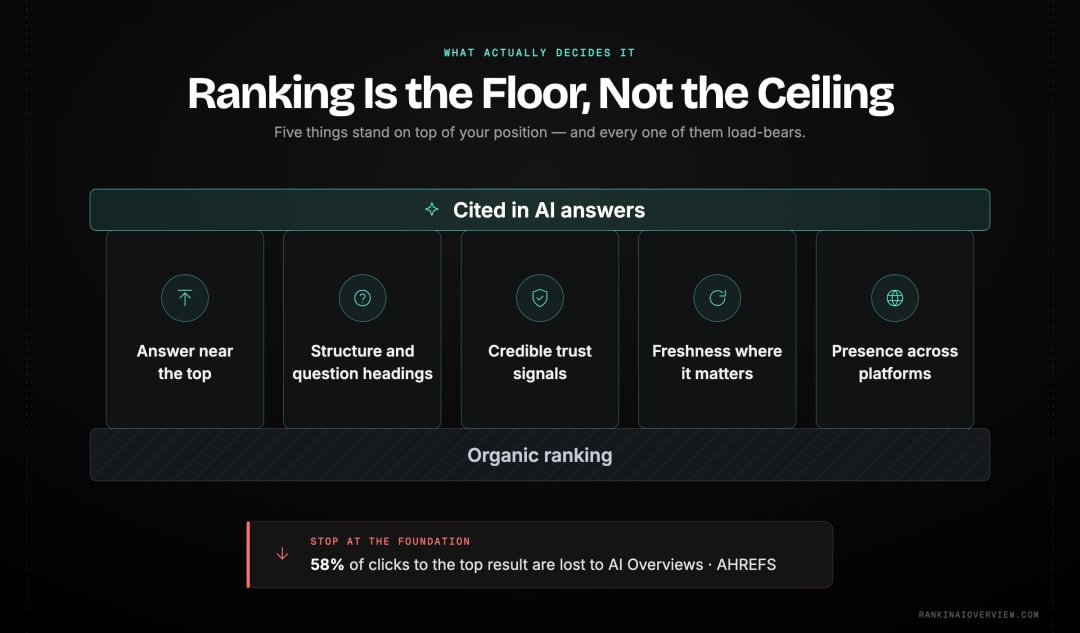
What determines AI appearance is a mix of clear direct answers, strong content structure, trust and entity signals, and broad web presence, alongside ranking where it applies. Being the clearest, most trustworthy answer to a specific question matters more than position alone.
The factors that consistently drive AI appearance:
- A direct, complete answer near the top of the page
- Clean structure and question-style headings that aid extraction
- Trust signals: credible mentions, authority, consistent entity data
- Freshness on topics where current information matters
- Presence across the platforms each engine draws on
Rank well and optimize for these, because neither ranking nor extraction alone is enough. The pages that win AI citations tend to combine a solid organic position with a crystal-clear answer and genuine trust, which is a higher bar than ranking used to require.
The behavioral backdrop makes this urgent. Ahrefs found AI Overviews cut clicks to the top result by 58%, so a top ranking that does not translate into citation increasingly means lost visibility. To see whether your rankings are turning into AI citations, Rank in AI Overview offers a free AI-visibility audit.
Conclusion
Google ranking and AI appearance are related but not the same. Ranking helps, most of all for Google AI Overviews, but clarity, structure, trust, and broad web presence decide whether you actually get cited. And on other engines, your Google position may barely matter at all.
The winning approach is to rank well and optimize for extraction and trust, across engines rather than just Google. Be the clearest, most credible answer to a specific question, and you appear in AI answers far more reliably than position alone would predict.
Want to know if your rankings are turning into AI citations? Run a free AI-visibility audit with Rank in AI Overview and see where the gaps are.
Frequently asked questions
Does ranking on Google help you appear in AI Overviews?+
Yes, ranking helps, because Google AI Overviews are built partly on Google's ranking systems. But it does not guarantee appearance, since clarity, structure, and trust also determine which pages get cited.
Can a page appear in AI answers without ranking well on Google?+
Yes. Engines like ChatGPT and Perplexity use their own retrieval signals, so a page can be cited while ranking poorly on Google. Even Google Overviews sometimes cite lower-ranked pages with clearer answers.
Why does AI cite a lower-ranked page over mine?+
Usually because the lower-ranked page answers the question more directly or is easier to extract. AI prioritizes clear, self-contained answers and trust, so structure and clarity can beat raw ranking position.
Should I still focus on Google rankings for AI visibility?+
Yes, especially for Google AI Overviews, but not exclusively. Combine strong rankings with clear answers, good structure, trust signals, and broad web presence to maximize appearance across all AI engines.
Do different AI engines use different ranking signals?+
Yes. Google AI Overviews lean partly on Google rankings, while ChatGPT, Perplexity, and Claude use their own retrieval and trust signals. Optimizing for only one engine leaves visibility on the others to chance.
How do I turn my Google rankings into AI citations?+
Optimize your ranked pages for extraction and trust: lead with a direct answer, use clear question-style structure, add schema, refresh content, and strengthen entity signals. Rankings get you considered; clarity and trust win the citation.
Explore with AI
Share this