Scrunch AI Review 2026: Is This Platform Right for You?
What Scrunch AI tracks, its enterprise features, pricing model, strengths and weaknesses, and how it compares to the alternatives today.

Key Highlights
- Scrunch AI tracks your brand's visibility, citations, and rankings across ChatGPT, Perplexity, Claude, Gemini and Copilot.
- It is built for enterprise and agencies, with SOC 2 Type II compliance, role-based access, and multi-site support.
- Standout features include real-time AI bot crawl monitoring and an Agent Experience Platform that serves AI-optimised page versions.
- Pricing is not public: access is through a 7-day trial or a booked demo, which signals enterprise, quote-based cost.
- Its strengths are depth, citation error detection, and enterprise security; its limits are opaque pricing and complexity for small teams.
- It suits large brands and agencies needing serious depth, less so a small site wanting a quick, cheap check.
Being cited by AI is worth little if the citation is wrong. According to a study of answer engines by Pranav Narayanan Venkit and colleagues, an evaluation of three popular engines quantified frequent hallucination and inaccurate citation as common limitations, drawn from 16 identified failure modes. If AI answers routinely misattribute and misstate, brands need tools that track not just whether they appear, but whether the citation is accurate. Scrunch AI is built for exactly that kind of scrutiny, and it aims it at the enterprise scale where the stakes are highest.
The catch is that Scrunch sits at the serious end of the market. It is not a light checker you glance at once a month; it is an enterprise platform with security certifications, deep analytics, and a demo-led sales process. That depth is a strength for the right buyer and overkill for the wrong one, so the question is which you are. This review is written to help you answer that honestly, rather than to sell you on a tool that may be far more than you need.
This Scrunch AI review breaks down exactly what it tracks, its enterprise features, how its pricing works, where it excels, and where it falls short. It also shows how it compares to alternatives, so you can decide whether Scrunch is the right AI visibility platform for your team or whether something lighter fits better.
What is Scrunch AI and what does it do?
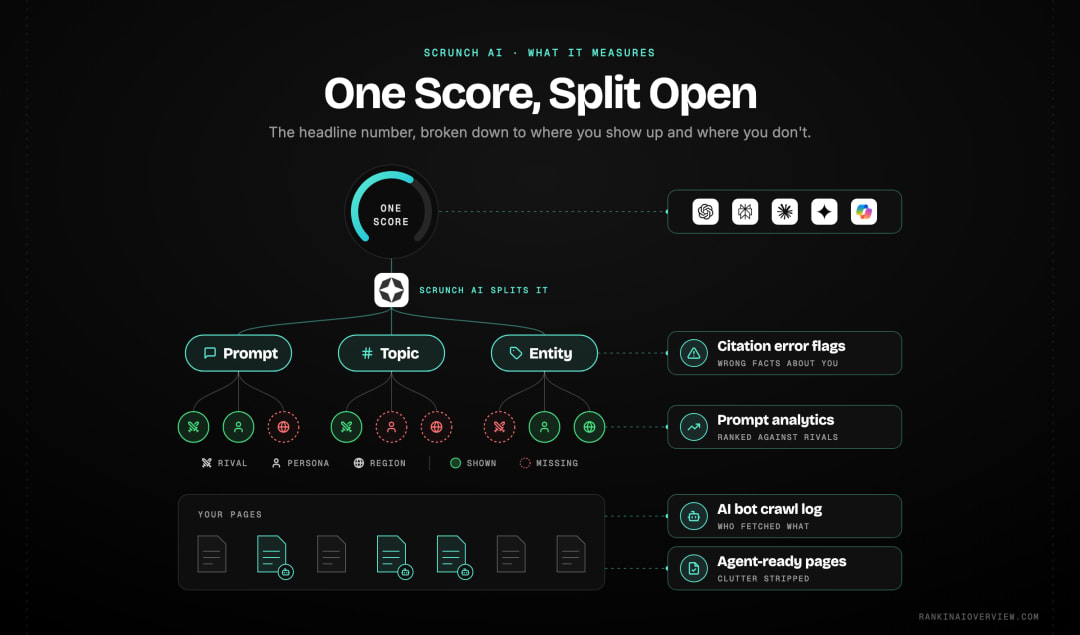
Scrunch AI is an enterprise AI visibility platform that monitors and optimises how your brand appears across generative AI search. It tracks your performance, citations, and rankings across ChatGPT, Perplexity, Claude, Gemini and Copilot, then flags where you are cited, where competitors beat you, and where citations are wrong.
The core aim is depth rather than a simple score. Scrunch analyses visibility across prompts, topics, and entities, so you see not just a headline number but the specific questions and themes where you appear or vanish. That granularity suits large brands with many products and markets to watch.
It is also explicitly built for scale. Features like SOC 2 Type II compliance, role-based access control, and multi-site, multi-region support signal a product aimed at enterprises and agencies rather than solo users. Its client list, which it says includes Lenovo, Skims, Crunchbase and Penn State, reflects that positioning. For a wider view of the category, our roundup of the best AI rank trackers shows where Scrunch sits among rivals.
"To understand these systems' limitations, we first conducted a study with 21 participants, evaluating interactions with answer vs. traditional search engines and identifying 16 answer engine limitations." Pranav Narayanan Venkit, Philippe Laban, Yilun Zhou, Yixin Mao and Chien-Sheng Wu, authors, "Search Engines in an AI Era: The False Promise of Factual and Verifiable Source-Cited Responses". Source: arXiv
What does Scrunch AI track and what are its main features?
Scrunch AI tracks brand performance, citations, and competitor standing across major AI engines, and adds real-time crawl monitoring plus an Agent Experience Platform. Its feature set goes beyond measurement into diagnosis and optimisation, which is what separates enterprise platforms from simple checkers. Each capability targets a different part of the visibility problem.
What ties them together is a focus on accuracy, not just presence. Many trackers stop at counting how often you appear; Scrunch also asks whether what the engine says about you is correct, and whether the engine could even reach your content in the first place. The main features break down as follows.
- Prompt analytics: performance across prompts, topics, and entities, with trends, citations, competitor data, and rankings.
- Real-time AI bot crawl monitoring: tracks how AI crawlers fetch your site and analyses that traffic.
- Competitive benchmarking: compares you by competitor, persona, topic, and geography.
- Citation analysis and error detection: flags where you are cited and where a citation about you is inaccurate.
- Agent Experience Platform (AXP): serves AI-optimised versions of your pages, stripped of unnecessary content.
The citation error detection deserves attention, because it addresses the exact problem the research above describes. Knowing you are cited is not enough if the citation misrepresents you, and a tool that surfaces those errors turns a vague worry into a fixable list. This connects to how engines choose and trust sources, a topic we cover in how often ChatGPT cites its sources.
The Agent Experience Platform is the more unusual feature. By serving cleaner, AI-optimised page versions, Scrunch tries to improve how engines read and represent you, moving from measurement into active optimisation. That is a meaningful step beyond tracking alone.
How do Scrunch AI's crawl monitoring and Agent Experience Platform work?
Scrunch AI's crawl monitoring watches how AI bots fetch your site in real time, while its Agent Experience Platform serves cleaner, AI-optimised versions of your pages. Together they move Scrunch from passive tracking into active influence over how engines read you. These are the features that most set it apart from simpler trackers.
Crawl monitoring answers a question few tools address: are the AI crawlers actually reaching your content? By tracking which bots fetch which pages, and analysing that traffic, Scrunch helps you diagnose whether an absence from answers is a retrieval problem rather than a content one. For a large site, knowing that a given crawler did or did not reach a page is a genuinely useful technical signal, and it connects directly to whether you can be cited at all, a theme in our analysis of what actually gets cited across 500 AI answers.
The Agent Experience Platform takes the next step. Instead of only reporting problems, it serves AI-optimised page versions stripped of clutter, aiming to make your content easier for engines to parse and quote. This is optimisation, not just measurement, and it reflects a wider shift toward building pages that machines read well, not only humans. Whether that approach fits depends on your appetite for serving engine-specific content, but it is a distinctive capability that most competitors do not offer.
How much does Scrunch AI cost?
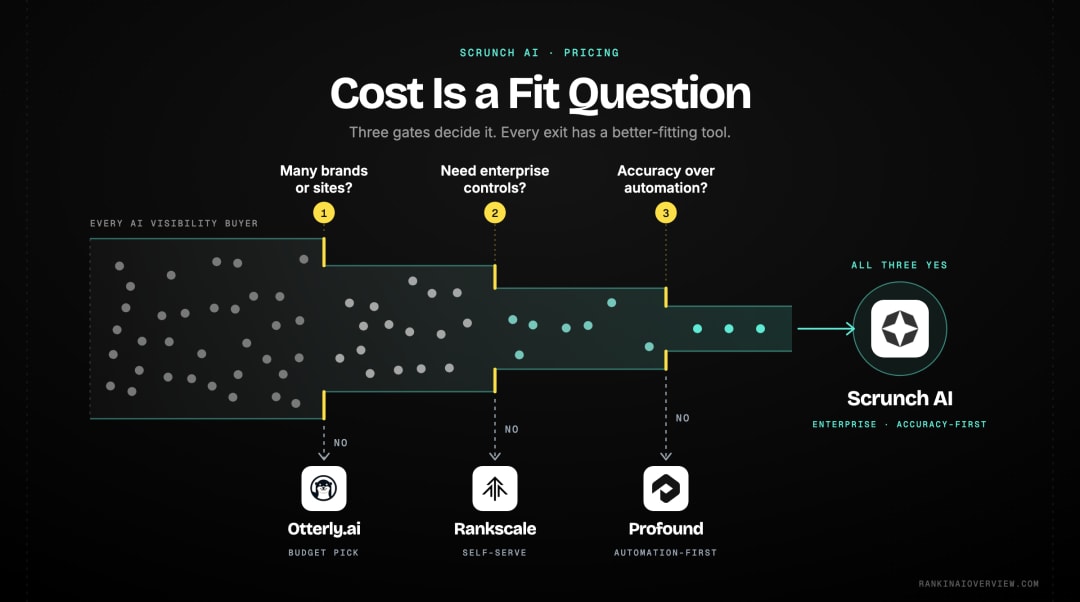
Scrunch AI does not publish its pricing; access is arranged through a 7-day free trial or a booked demo, which points to enterprise, quote-based cost. There are no public tiers to compare, so your real price depends on a sales conversation about your scale and needs. This model fits large organisations and rarely suits tight budgets.
The absence of published prices is itself informative. Tools that sell through demos and custom quotes are usually priced for enterprise deployment, with costs well above self-serve trackers. For a large brand or agency, that can be justified by the depth and security on offer, and enterprise buyers often expect custom pricing anyway, since their needs rarely fit a fixed tier.
For a smaller team, the demo-led model is a signal in itself. If a tool will not show you a price without a call, it is generally aimed above the small-business tier. The 7-day free trial does let you test the platform first, which softens the commitment, but the lack of transparent pricing is worth weighing before you invest the time. Being clear on what ranking even means in AI search helps you judge whether that depth is worth a sales process.
What does Scrunch AI do well?
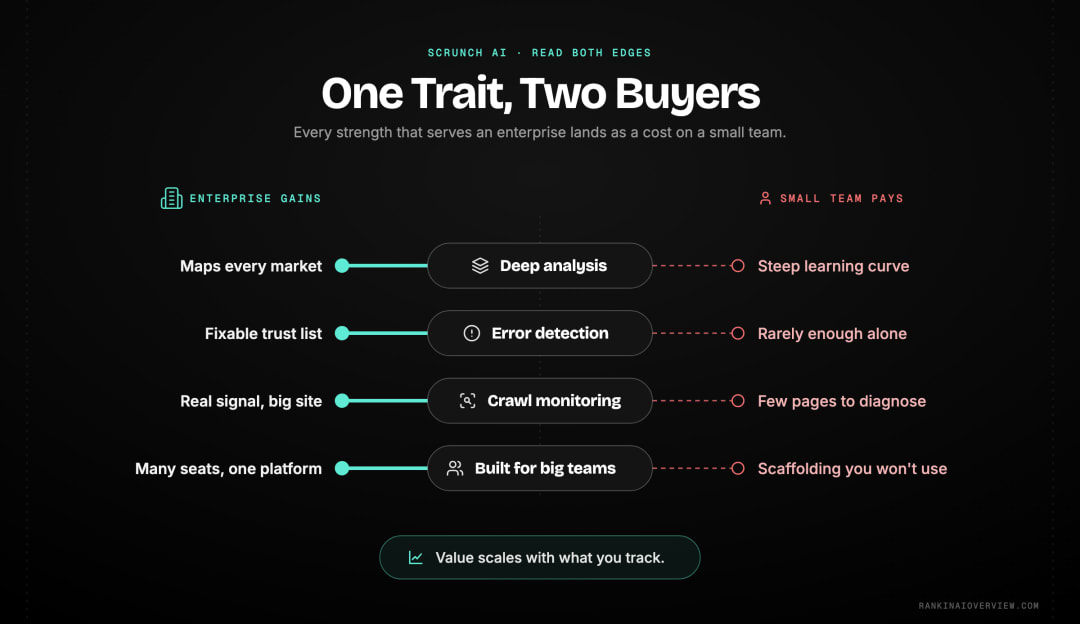
Scrunch AI's strengths are its depth of analysis, its citation error detection, its crawl monitoring, and its enterprise-grade security. Few tools combine this much diagnostic detail with the compliance features large organisations require. For enterprises and agencies, that combination is genuinely valuable.
The depth is the headline. Analysing visibility across prompts, topics, entities, personas, and geographies gives large brands a granular map of where they stand, not a single blunt score. That resolution matters when you manage many products across many markets, where an average hides more than it reveals.
- Citation error detection: surfaces inaccurate citations about your brand, not just presence, which addresses a real trust problem in AI answers.
- Crawl monitoring: shows how AI bots fetch your site, a technical insight few tools offer.
- Enterprise security: SOC 2 Type II, role-based access, and multi-site support meet the bar large buyers require.
- Active optimisation: the Agent Experience Platform moves beyond tracking into improving how engines read your pages.
The client list also signals reliability. When brands like Lenovo and Skims are named customers, the platform has cleared the scrutiny that large procurement teams apply, which reassures other enterprise buyers.
There is a practical benefit to that enterprise focus beyond prestige. Large organisations tend to have complex needs: many sub-brands, several regions, strict access controls, and multiple stakeholders who each want a different view of the data. Scrunch's role-based access and multi-site support are built for exactly that reality, letting a big team share one platform without stepping on each other. A lighter tool that ignores these needs can become unworkable at scale, so this is a genuine differentiator rather than a checkbox, and it is part of why the question of whether AI rank tracker tools actually work is answered differently for enterprises than for solo users.
Where does Scrunch AI fall short?
Scrunch AI's weaknesses are its opaque pricing, its complexity for smaller teams, and the sales-led buying process. The depth that makes it powerful also makes it heavier than a small business usually needs, and the lack of public pricing adds friction before you even begin. These are trade-offs of its enterprise focus.
The pricing opacity is the clearest drawback. Without published tiers, you cannot quickly judge fit or budget, and you must invest in a demo to learn the cost. For teams that want to compare options fast, that is a real barrier.
Complexity is the other caveat. A platform this deep has a learning curve, and much of its power, from persona-level benchmarking to crawl analytics, is more than a small site will use. As with any AI visibility tool, its metrics also inherit the run-to-run variability of AI answers, so no platform including Scrunch delivers perfectly stable numbers. That limitation is inherent to the category, and it is worth remembering before treating any single score as final.
The enterprise focus also narrows who benefits. A solo founder or a small marketing team may find that most of Scrunch's capability sits unused, which makes the enterprise price hard to justify. The value scales with the size and complexity of what you are tracking, so the same platform that is essential for a global brand can be overkill for a single local business. There is nothing wrong with the tool here; it is simply built for a particular buyer, and knowing whether you are that buyer saves both money and frustration.
How does Scrunch AI compare to alternatives?
Scrunch AI sits at the enterprise, depth-first end of the market, more advanced and security-focused than mid-market tools, and pricier and heavier than self-serve trackers. Its trade-off against rivals is enterprise depth and compliance versus the transparency and speed of lighter tools. The right pick depends on your size and needs.
The table below positions it against common alternatives.
| Tool | Positioning | Best for |
|---|---|---|
| Scrunch AI | Enterprise, deep, security-focused | Large brands and agencies needing depth |
| Rankscale | Mid-market, transparent self-serve | Mid-market teams wanting value |
| Profound | Enterprise, automation-focused | Large teams wanting agents and automation |
| Otterly.ai | Budget, simple | Small sites and first-time trackers |
Against mid-market tools like Rankscale, Scrunch offers more depth and stronger enterprise security, but at a higher, opaque price. Against budget tools, the gap is wider still. And against other enterprise platforms, the choice comes down to whether you value Scrunch's citation error detection and crawl monitoring over rivals' particular strengths. Our guide to measuring AI search visibility helps you decide which capabilities actually matter for your goals.
A useful way to frame the comparison is by what you are optimising for. If your priority is transparent pricing and speed to start, a self-serve tool wins. If it is automation and hands-off scale, an automation-first platform may edge ahead. Scrunch's clearest advantage is the pairing of deep, citation-level accuracy checking with crawl visibility and enterprise security, which is a specific combination that matters most to large, security-conscious organisations. Buyers outside that profile will often find a better fit elsewhere, and that is not a mark against Scrunch so much as a reminder to match the tool to the buyer.
Who should use Scrunch AI, and who should choose a different tool?
Scrunch AI suits large brands and agencies that need deep, secure, enterprise-grade AI visibility tracking, and it is less suited to small teams wanting a simple, cheap check. If you manage many products or clients, require compliance features, and value citation accuracy, it is a strong fit. If you just want to know whether ChatGPT mentions you, it is far more than you need.
Choose Scrunch if depth, security, and citation error detection matter, and if an enterprise budget and a demo-led process are acceptable. Its granularity and compliance make it especially practical for agencies serving large clients and for brands operating across many markets, where a single wrong AI answer can reach a lot of buyers at once.
Look elsewhere if your budget is small, your needs are simple, or you want transparent pricing before committing. A self-serve tool will serve a single small site better and faster, and you can always move up to an enterprise platform once your needs grow. Matching the tool to your scale matters more than any single feature, and there is no prize for paying for capability you will never use.
Conclusion
Scrunch AI is a serious, enterprise-grade AI visibility platform that goes well beyond simple tracking, with citation error detection, crawl monitoring, persona-level benchmarking, and an Agent Experience Platform that actively optimises how engines read your pages. For large brands and agencies that need this depth and require enterprise security, it earns its place on the shortlist. The trade-offs are opaque, quote-based pricing and complexity that a small team will not need.
Judge it against your scale. If you manage many products or clients and value citation accuracy, book the demo and use the trial to test the fit. Rank in AI Overview researches how AI engines choose and credit sources, and is building an AI visibility tool that is coming soon. Get your free AI visibility audit to see how AI engines represent your brand today, whichever platform you choose.
Frequently asked questions
Is Scrunch AI worth it?+
For large brands and agencies needing deep, secure AI visibility tracking with citation error detection, Scrunch AI is worth evaluating. Its depth and compliance justify the enterprise price for serious users. For a small site wanting a quick check, a lighter, transparent tool is better value.
Does Scrunch AI have a free trial?+
Yes. Scrunch AI offers a 7-day free trial, and you can also book a demo. The trial lets you test the platform before any purchase. There is no permanently free tier, and pricing beyond the trial is arranged through a sales conversation.
How much does Scrunch AI cost?+
Scrunch AI does not publish its pricing. Access is arranged through a 7-day trial or a booked demo, with cost set by a custom quote. This demo-led model is typical of enterprise platforms and usually means pricing above self-serve trackers.
Which AI engines does Scrunch AI track?+
Scrunch AI tracks brand visibility, citations, and rankings across ChatGPT, Perplexity, Claude, Gemini and Copilot, described as the major AI surfaces. This covers the main consumer engines most brands care about for their AI search presence.
Is Scrunch AI good for small businesses?+
Generally no. Scrunch AI is built for enterprise and agencies, with depth, security features, and quote-based pricing aimed at larger organisations. A small business is usually better served by a transparent, self-serve tool that is cheaper and simpler to run.
What makes Scrunch AI different from other trackers?+
Its standout features are citation error detection, real-time AI bot crawl monitoring, and the Agent Experience Platform that serves AI-optimised page versions. Combined with enterprise security like SOC 2 Type II, this depth is what separates Scrunch from lighter, measurement-only trackers.
Explore with AI
Share this