Grok vs ChatGPT: Which AI Fits You Better in 2026?
Grok vs ChatGPT on live news, work tasks, images, trust and price, plus our test of what each one cites. See which AI fits the way you work.
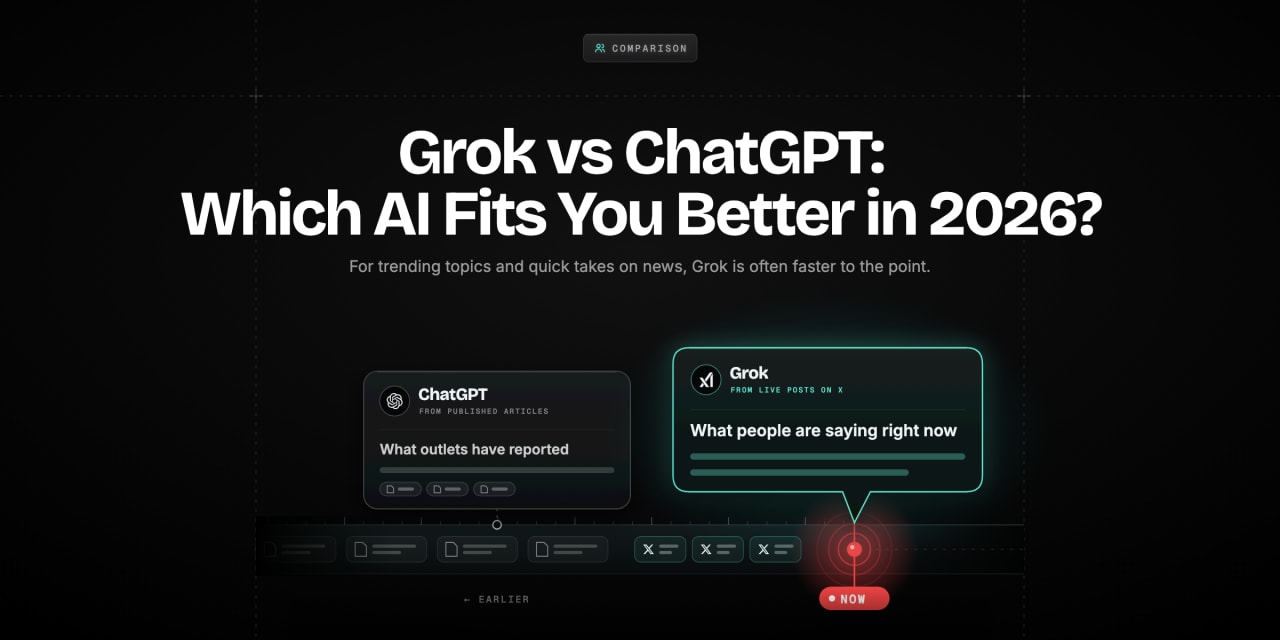
SummaryGrok read about 55 pages per answer in our test but showed only 3.6 links, while ChatGPT showed 5.9 citations. Grok leans into live news and X; ChatGPT is the steadier all-rounder for work.
Read moreShow less
Key Highlights
- Grok lives inside X, so its edge is what people are saying right now. ChatGPT's edge is depth, tools and polish across almost every kind of task.
- For trending topics, live reactions and quick takes on news, Grok is often faster to the point.
- For writing, coding, analysis and steady day-to-day work, ChatGPT is the safer default.
- Grok has a looser, cheekier personality. ChatGPT is more measured, and that difference shows up in every answer.
- Grok's main paid plan, SuperGrok, costs a bit more than ChatGPT Plus, and Grok also comes bundled with X Premium subscriptions.
- In our own test of 10 everyday questions, Grok read 55 web pages per answer on average but showed just 3.6 clickable links. ChatGPT showed 5.9 citations.
- Neither replaces checking your facts, especially on breaking stories where early posts are often wrong.
People ask the Grok vs ChatGPT question because the two feel like they come from different planets. According to a study of 41,735 public interactions by Katelyn Mei, Robert Wolfe, Nicholas Weber and Martin Saveski, Grok answers 62% of the requests users send it on X. Those replies land right in the middle of public threads. ChatGPT mostly lives in a private chat window. That's a very different way to use an AI.
So it's no surprise the advice online is all over the place. Some people love Grok's speed and attitude and find ChatGPT a bit buttoned-up. Others tried Grok once, got a strange answer about a news story, and went straight back to ChatGPT. If you're deciding where to spend $20 or $30 a month, you want something more useful than a fan's opinion.
This guide gives you that. It compares Grok and ChatGPT on the things that change your day: live information, personality, real work, images, trust and price. We also ran our own test on 29 October 2026, asking both the same everyday questions, so you'll see what they actually did rather than what they promise. You'll come away knowing which one suits you, which jobs to hand to each, and when one is plenty on its own.
Who Is Grok Built For, and Who Is ChatGPT Built For?
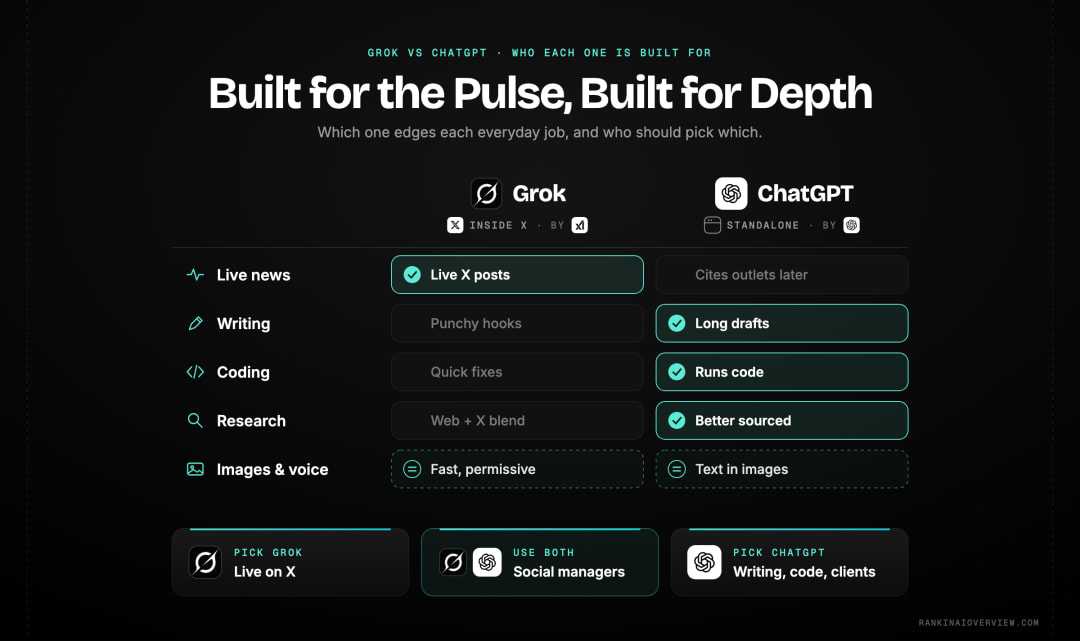
Grok suits people who live on X and want AI that knows what's trending right now. ChatGPT suits people who want a dependable all-round assistant for writing, research, coding and planning. Grok is a sharp companion for the news cycle. ChatGPT is a full toolkit for getting work done. Your daily habits decide which fits.
Here's a quick way to see where you land.
| If you mostly... | Better fit | Why |
|---|---|---|
| Follow news and trends on X | Grok | Reads live posts and conversations |
| Write emails, reports and content | ChatGPT | More range, better long drafts |
| Code or analyse data | ChatGPT | Stronger tools for sustained work |
| Want blunt, witty answers | Grok | Looser default personality |
| Need a careful, neutral tone | ChatGPT | More measured by design |
| Make images and video for fun | Either | Both have strong media tools |
| Already pay for X Premium | Grok | Access comes with your plan |
What exactly is Grok?
Grok is the AI assistant from xAI, the company Elon Musk founded in 2023, which now sits under SpaceX and signs its terms as SpaceXAI. It's built into X, the platform formerly called Twitter, and it also runs as its own app and website. Its signature trick is access to public posts on X, so it can tell you what people are saying about something as it happens.
And what is ChatGPT?
ChatGPT is OpenAI's assistant, launched in November 2022. It's the most widely used AI chatbot in the world. It has grown into a full workspace with search, memory, projects, file analysis, voice, image generation and custom GPTs. Most people's idea of "AI chat" was shaped by it.
Why do they feel so different?
Because they were designed around different homes. Grok was born inside a social network, so it's tuned for speed, conversation and the news cycle. ChatGPT was built as a standalone product, so it's tuned for depth and long sessions. The same question can get a punchy two-line take from Grok and a structured, sectioned answer from ChatGPT.
Which One Knows What's Happening Right Now?
Grok usually wins on live events because it reads public posts on X as they appear. Ask what people think of a match, a launch or a political moment, and it can sum up the mood within minutes. ChatGPT searches the web for recent news too, but it leans on published articles rather than the live social feed.
Where does Grok's real-time edge help most?
It shines when the story is still unfolding. Think a product launch, a sports result, a viral clip or a market wobble. Grok can pull together what's being posted, who's saying it and how sentiment is shifting. For social media managers, journalists and traders, that's genuinely useful.
What's the catch with live posts?
Early posts are often wrong. In the first hour of breaking news, rumours spread faster than corrections, and an AI summarising the feed can repeat them confidently. So treat Grok's live summaries as "what people are saying", not "what's true". Wait for reliable reporting before you act on anything important.
How does ChatGPT handle recent news?
ChatGPT searches the web when your question needs it and cites the articles it used. That makes it slower to catch the very first reactions but steadier once outlets have reported. If you want a sourced summary of what happened yesterday, ChatGPT is usually the cleaner read. Our explainer on how often ChatGPT cites sources shows why its links don't always appear.
How Do Their Personalities and Guardrails Differ?
Grok is deliberately more irreverent. It jokes, takes sides more readily and goes further on edgy topics. ChatGPT is calmer and more cautious, and it avoids strong opinions on contested issues. Neither style is better in itself. It depends on whether you want a sparring partner or a careful colleague.
What is Grok like to talk to?
Expect wit, sarcasm and fewer hedges. Grok was pitched from the start as an AI with a sense of humour and a willingness to answer questions others would dodge. Many users enjoy that. It makes brainstorming livelier and quick questions feel less robotic.
Has that looser style caused problems?
Yes. Grok has had several well-publicised incidents of offensive or false outputs, and xAI has had to change its instructions after some of them. If you're using AI for anything public-facing, like brand posts or customer replies, that history matters. Review its output before it goes anywhere with your name on it.
Why is ChatGPT more cautious?
OpenAI tunes ChatGPT to stay balanced, avoid harmful content and flag uncertainty. Some people find that frustrating, especially when it declines a harmless request or adds disclaimers. But for work where tone and risk matter, that caution is a feature. You'll rarely have to explain an embarrassing ChatGPT reply to a client.
Which Is Better for Writing, Coding and Everyday Work?
ChatGPT is the stronger work tool overall. It writes in more voices, handles long documents, codes and debugs well, and keeps context across projects with memory. Grok is capable, especially for reasoning puzzles and quick drafts, but ChatGPT's surrounding toolkit makes it easier to rely on all day.
How do they compare on writing?
Grok writes quickly and with personality, which suits social posts, punchy hooks and casual copy. ChatGPT is better for anything long, structured or formal: reports, emails, articles, proposals. It's also better at editing to a brief, like cutting to 150 words or matching a house style. For a marketer who writes every day, ChatGPT is less work to steer.
How do they compare on coding?
Both are strong coders now, and xAI has pushed hard on reasoning and maths benchmarks. In practice, ChatGPT tends to win on the full experience. It runs code, analyses files, explains errors step by step and keeps a long back-and-forth going. Grok is very handy for a quick fix or a second opinion on tricky logic.
What about research and analysis?
Grok's DeepSearch and ChatGPT's deep research both run many searches and write up a report. Grok's version can blend web pages with X posts, which helps when public reaction is part of the question. ChatGPT's version is usually more structured and cites published sources more consistently. For a business briefing, ChatGPT's report is easier to hand to someone else.
Also read: I asked ChatGPT, Claude, Gemini and Perplexity to rank each other
Which Is Better for Images, Video and Voice?
Both are strong here, and the gap is smaller than in other areas. Grok's Imagine tools create images and short videos quickly, with fewer style restrictions. ChatGPT's image generation is excellent at following detailed instructions and putting readable text into images. Both offer natural voice conversations on mobile.
Where does Grok stand out?
Speed and freedom. Grok makes images and short clips fast, and it's more permissive about styles and subjects. That makes it fun for experiments and memes. For brand work, that same freedom means you'll want to review results carefully.
Where does ChatGPT stand out?
Control and accuracy. ChatGPT is very good at sticking to a detailed brief: specific layouts, exact wording on a poster, consistent characters across a set. If you're making social graphics, mock-ups or slides with words in them, it's usually the more dependable choice.
Is voice any different?
Both offer real-time voice chat in their apps, and both feel natural. Grok's voice personas can be more playful. ChatGPT's voice mode is calmer and works well for practising a language, talking through an idea or getting hands-free help while cooking.
How Much Do Grok and ChatGPT Cost?
Both have free tiers with usage limits. ChatGPT Plus costs about $20 a month, while SuperGrok costs about $30 a month. Both also have cheaper entry plans and much pricier tiers for heavy users. Grok also comes included with X Premium plans, which can make it the cheaper option if you already pay for X.
How do the plans compare?
Here's the general picture at the time of writing. Prices change, so check each pricing page before you subscribe.
| Plan | Grok | ChatGPT |
|---|---|---|
| Free | Limited use on X, web and app | Everyday use with tighter limits |
| Entry paid | SuperGrok Lite, about $10 a month | Go, $8 a month |
| Standard paid | SuperGrok, about $30 a month | Plus, $20 a month |
| Heavy use | SuperGrok Heavy, $300 a month, which now includes X Premium+ | Pro, in tiers at $100, $200 and $500 a month |
| Bundled access | X Premium plans include Grok, from about $8 a month | Not bundled with other services |
ChatGPT prices come from OpenAI's ChatGPT Go announcement and its help page on what ChatGPT Go includes. The $300 SuperGrok Heavy price and its X Premium+ bundle are confirmed by xAI's own Grok account on X. xAI's plan page only shows prices once you're logged in, so treat the other Grok figures as approximate and check them on your account. | Business | Team and enterprise options | Business and Enterprise per seat |
Which gives better value?
If you already pay for X Premium, Grok is effectively free extra value, so try it before paying for anything else. If you don't use X, ChatGPT Plus usually gives more for less: lower price, more tools and a bigger ecosystem of integrations. Value really comes down to whether you'd use Grok's live X access often.
Is the free version enough?
For light use, either free tier is fine. Just know Grok's free limit is real: in our test it stopped answering after about 10 questions with a "High Demand" message asking us to upgrade, and it stayed blocked for a while. ChatGPT's free tier kept going. ChatGPT's free tier covers casual writing and research. Try both for two weeks on your real tasks, then pay for the one you keep opening.
What Happened When We Asked Grok and ChatGPT the Same Questions?
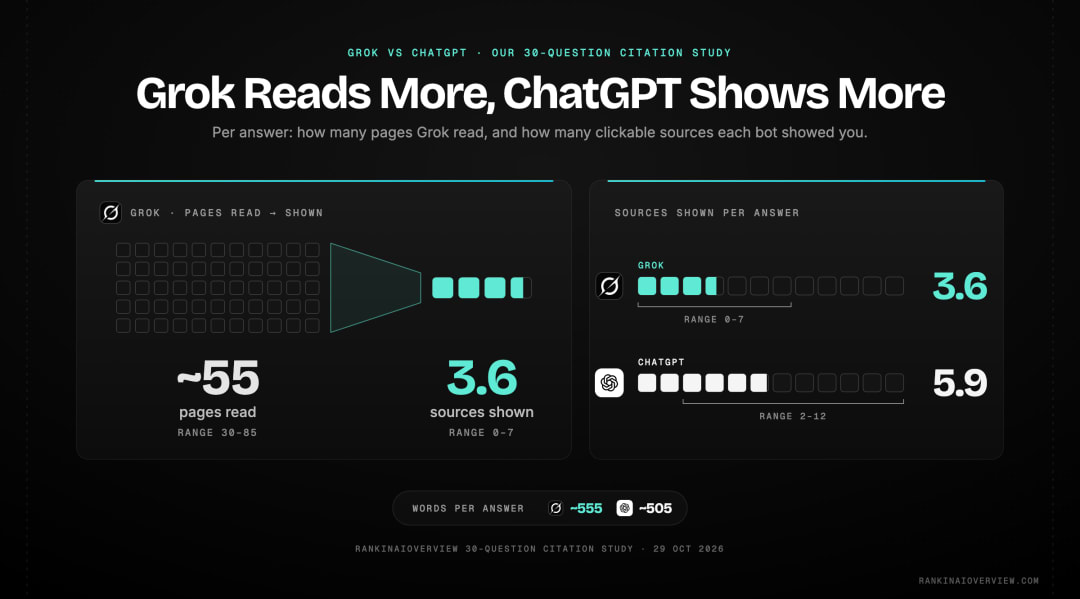
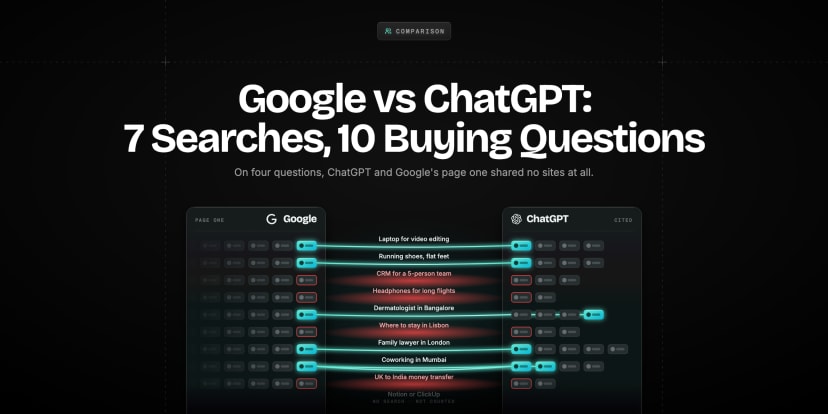
We asked Grok and ChatGPT the same 10 everyday questions on 29 October 2026, as part of our 30-question citation study. Grok read far more pages, about 55 per answer, but showed only 3.6 clickable links on average. ChatGPT showed 5.9 citations. They often named the same big brands, yet picked different winners on laptops and CRMs.
How did we test them?
We typed 10 questions the way normal people do, like "cheapest way to send money from the uk to india" and "good dermatologist in bangalore for acne scars". They covered shopping, local services and money. We ran them in the regular apps on free accounts, from one browser, on the same day. We also ran them in Perplexity as a third reference point.
How much did each one show its sources?
| Measure (same 10 questions) | Grok | ChatGPT |
|---|---|---|
| Pages read behind the answer | About 55 on average (30 to 85) | Not shown |
| Clickable sources shown in the answer | 3.6 on average (0 to 7) | 5.9 on average (2 to 12) |
| Typical answer length | About 555 words | About 505 words |
The laptop question sums it up. Grok said it read 85 sources and then gave a full recommendation with no clickable link in the text at all. The sources sit behind a separate panel you have to open. ChatGPT's tags are small, but they sit right next to the claims.
Did they recommend the same things?
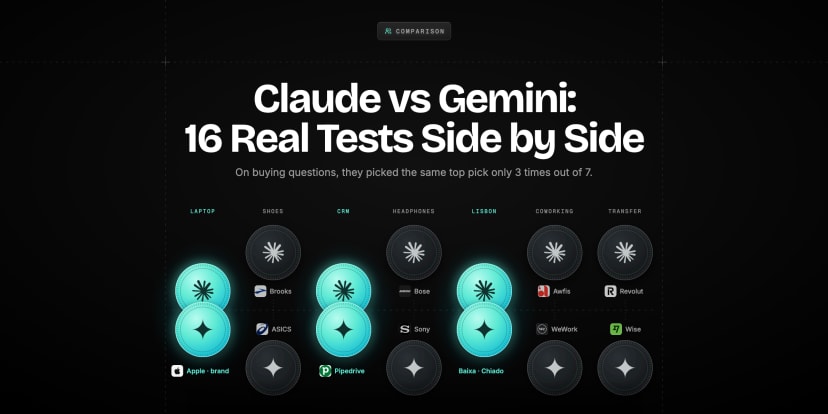
For big categories, mostly yes. Both named Brooks and ASICS stability shoes for flat feet, Sony and Sennheiser headphones for flights, and Wise and Remitly for sending money to India. Both sent a first-time Lisbon visitor to Chiado.
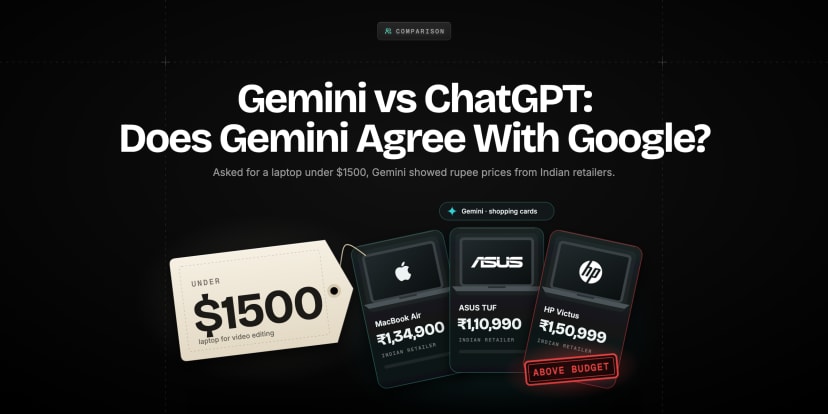
The top pick changed, though. For a video editing laptop under $1,500, ChatGPT led with an ASUS ProArt P16 while Grok led with an Acer Nitro V 16S. For a cheap CRM, ChatGPT led with Zoho CRM while Grok led with Freshsales.
What about local businesses?
This is where it splits apart. For a dermatologist in Bangalore, Grok named eight doctors and clinics. Perplexity named five for the same question. Not one name matched. If you run a local business, showing up in one AI tells you almost nothing about the others.
How much should you read into this?
It's a snapshot: one day, one browser, free accounts and 10 shared questions. AI answers move from run to run, so treat these as patterns, not fixed rates. But the shape is clear enough to act on: Grok reads widely and shows little, and the brands each engine surfaces only partly overlap.
Can You Trust What Grok and ChatGPT Tell You?
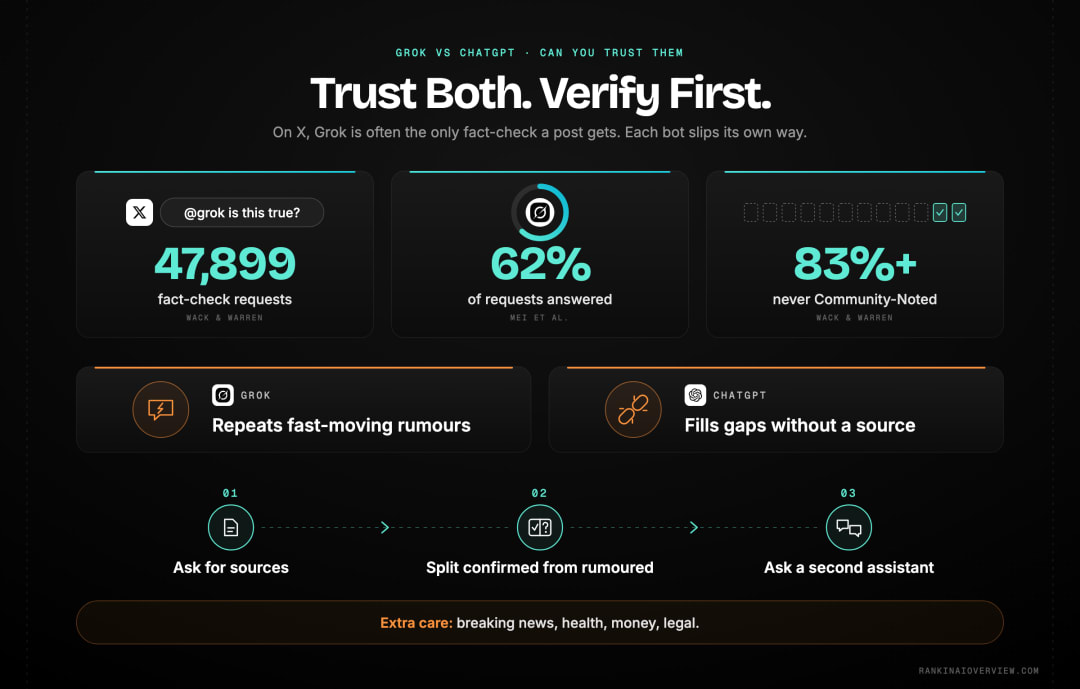
Trust both, but verify. Each can state wrong things confidently. Grok's risk is repeating claims from fast-moving posts. ChatGPT's risk is filling gaps from training data without a source. Ask either for sources, click through on anything important, and be extra careful with breaking news, health, money and legal questions.
Why do so many people ask Grok to fact-check?
Because it's right there in the thread. Typing "@grok is this true?" under a post has become a habit on X. A study by Morgan Wack and Patrick Warren looked at 47,899 queries where X users asked Grok to verify posts. More than 83% of those questioned posts were never flagged by Community Notes. In other words, Grok is now the only "checker" many of those posts ever get.
Should you rely on that?
Use it as a first pass, not a final word. An AI verdict is only as good as the sources behind it, and a single reply under a post rarely shows its full working. For anything you'll share or act on, look for the original source or a reputable outlet. That applies just as much to ChatGPT.
"xAI's large language model, Grok, is called by millions of people each week on the social media platform X." Katelyn Xiaoying Mei, Robert Wolfe, Nicholas Weber and Martin Saveski, authors of Grok in the Wild. Source: arXiv
How do you get more reliable answers from either?
Ask for sources up front. Ask the tool to separate what's confirmed from what's rumoured. And for important facts, ask the same question in a second assistant. If two tools disagree, that's your cue to check properly. Our piece on whether AI visibility is more about trust than rankings explains how engines decide whom to believe.
Should You Pick Grok, ChatGPT or Both?
Pick Grok if you live on X and care most about live trends and blunt takes. Pick ChatGPT if you want one dependable assistant for work. Use both if you manage social media or follow fast-moving markets: Grok for the pulse, ChatGPT for the finished output.
Choose Grok if...
- You spend a lot of time on X and want AI that understands its conversations.
- You track trends, sentiment or breaking stories for work.
- You already pay for X Premium, so access costs nothing extra.
- You enjoy a more opinionated, humorous assistant.
Choose ChatGPT if...
- Your work is mostly writing, coding, analysis or planning.
- You want a steady, professional tone you can use with clients.
- You value tools like memory, projects, file analysis and custom GPTs.
- You want the biggest range of integrations and support.
When does using both make sense?
Social media managers are the clearest case. Use Grok to see what's trending and how people are reacting, then use ChatGPT to draft the post, the reply or the report. The same split works for analysts and creators. Read the room in Grok, then build the thing in ChatGPT.
Also read: the best ChatGPT rank trackers for brands
Does Grok Matter for Your Brand's AI Visibility?
It can. Grok draws heavily on X, so how your brand is discussed there shapes how Grok describes you. ChatGPT draws more on the wider web and its training data. If your buyers use both, check each one separately, because a strong showing in one tells you little about the other.
What shapes how Grok talks about your brand?
Public conversation on X carries a lot of weight. Customer complaints, praise, founder posts and replies can all feed into what Grok says when someone asks about you. Being present and responsive on X isn't just social media hygiene anymore. It feeds an AI answer engine too.
And for ChatGPT?
ChatGPT leans on the open web: reviews, articles, comparison pages, your own site and how consistently you're described across them. That's slower to change but steadier once it does. Our guide to what actually affects AI search visibility breaks down which signals matter.
How do you keep track of both?
Pick the questions your buyers really ask, run them in each assistant, and note whether you're named, described accurately or missing. Repeat monthly. Once that becomes a chore, a tracker helps. See our roundup of the best AI rank trackers for tools that check multiple engines.
Conclusion
Grok vs ChatGPT comes down to where you spend your time and what you need from AI. Grok is the sharper pick for live trends, social conversation and a bit of attitude, especially if you're already on X. ChatGPT is the more complete, dependable assistant for writing, coding, analysis and client-facing work. Prices are close, and Grok may already be in your X plan.
Try both on a fortnight of real tasks, and let your habits decide. If your brand depends on how these assistants describe you, remember the split. Grok listens to X, ChatGPT reads the wider web, and each needs its own attention. RANK IN AI OVERVIEW studies how AI engines decide which brands to mention, and its visibility tracker is launching soon. Curious how Grok and ChatGPT see you right now? Run your free AI visibility audit here.
Frequently asked questions
Is Grok better than ChatGPT?+
Not overall. Grok is better for real-time trends and conversation on X, and it has a livelier personality. ChatGPT is better for writing, coding, analysis and dependable everyday work. The right choice depends on what you use AI for most.
Is Grok free to use?+
Yes, with limits. Grok has free access on X and on its own website and app. Paid plans, called SuperGrok, raise the limits and unlock more advanced features. Grok is also included with some X Premium subscriptions.
Is Grok more accurate than ChatGPT?+
Neither is reliably more accurate. Grok can repeat errors from fast-moving posts on X, while ChatGPT can state unsourced claims from its training. Ask both for sources, and verify anything important before sharing or acting on it.
Does Grok use ChatGPT?+
No. Grok runs on xAI's own models, built separately from OpenAI's. The two are competitors. Grok's main difference is its access to live public posts on X, which ChatGPT doesn't have in the same way.
Which is better for social media managers?+
Many use both. Grok helps spot trends and read audience reaction on X in real time. ChatGPT is better for drafting polished posts, captions, replies and reports. Together they cover listening and creating.
Who owns Grok?+
Grok is made by xAI, the AI company Elon Musk founded in 2023, which now operates under SpaceX. It's built into X, the social platform formerly known as Twitter, and also available as a standalone app and website.
Explore with AI
Share this