The One Content Change That Lifts AI Search Visibility
The highest-return change for most pages is not a schema tag. It is restructuring so a complete answer leads. Here is how to do it properly.

Key Highlights
- The highest-leverage single change for most pages is restructuring so a complete, self-contained answer leads the section, because AI search lifts passages, not whole pages.
- This is a document-level change, not a surface one. The evidence is clear that reorganising structure moves citation while formatting-only tweaks barely register, so schema tags and decorative boxes are the wrong thing to start with.
- You do not need a full rebuild. One focused structural change on your top pages can lift AI visibility within a recrawl or two.
- Measure it the same way each time: track citations for the same queries before and after, so the lift is attributable to the change and not to noise.
Most teams assume that improving AI search visibility means a giant overhaul: months of work, a full audit, a rebuild. That belief is exactly why so many never start. The project feels too heavy to schedule, so the pages stay as they are and the citations keep going to someone else, while the fix that would actually move the needle waits behind a plan that never gets booked in.
The reality is more encouraging, and more specific. According to a 2026 study that isolated content structure as a factor across six mainstream generative engines, reorganising a page's structure while preserving its meaning lifted its citation rate by 17.3%, and the same work points to document-level architecture, not surface formatting, as the thing that moves the needle. In other words, the biggest single lever is not a new tool or a schema tag. It is reorganising what you already have so the answer is easy to lift.
This guide focuses on that one change and gets specific about what it is, why it works, and what to ignore. It covers why a single change can matter so much, what the highest-leverage change actually is, how an engine decides which passage to lift, which single moves genuinely help versus which are overrated, how to measure the effect, and how to roll the winning pattern across your site. For the wider picture, our guide to AI content optimisation is a strong companion.
Why Can a Single Content Change Move AI Visibility So Much?
Because AI search rewards passages, not whole pages. Traditional ranking scored a document overall, so no single edit tended to decide the outcome. An answer engine instead hunts for one quotable chunk that resolves the query, which means a single change to that chunk, its completeness and its placement, can flip a page from ignored to cited.
That shift is what makes the effort-to-impact ratio so unusual here. You are rarely writing more or starting over. You are taking an answer that already exists on the page and making it the clean, self-contained unit an engine can lift without hunting. The information was always there. The change simply moves it from buried to extractable, and that reorganisation is often the whole difference.
It also explains why one change can outperform ten. If the binding constraint on a page is that its answer is scattered or buried, fixing that one thing removes the actual blocker, whereas piling on unrelated tweaks around a still-buried answer changes nothing. Leverage in AI search comes from fixing the constraint, not from doing more, which is why the right single change beats a long checklist applied blindly.
There is a diagnostic habit worth building from this. Before editing a page, ask a blunt question: if an engine could only quote one passage from here, which would it choose, and does that passage actually answer the query on its own? If the honest answer is that no single passage qualifies, you have found the constraint, and you have found your one change. That framing keeps you from spreading effort across cosmetic edits and points you straight at the reorganisation that matters. Most underperforming pages fail this test not because they lack the answer but because the answer is never gathered into one liftable place.
What Actually Is the One Highest-Leverage Change?
The single highest-return change for most pages is to restructure so that a complete, self-contained answer to the target question leads the relevant section. Say the whole answer first, in a passage that stands on its own without the surrounding context, then add nuance beneath it. That one move fixes the most common reason pages are skipped.
The emphasis on complete and self-contained is the part most advice misses. It is not enough to move a half-answer up the page, or to open with a sentence that only makes sense after three more. An engine lifting a passage needs that passage to resolve the query on its own, so the winning unit states the full answer, including the specifics, in a chunk a reader could quote out of context and still be correct. Anything less and the engine keeps looking.
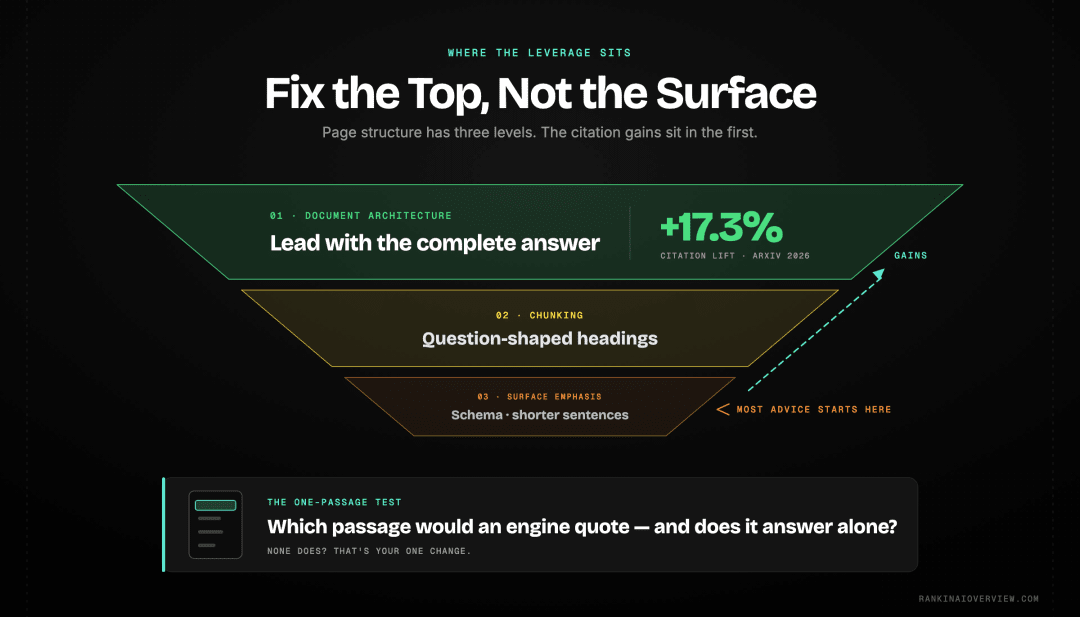
Crucially, this is a change to the page's structure and substance, not to its decoration. The study behind the 17.3% citation lift treats structure as a hierarchy: the document architecture that decides what leads, the chunking that keeps each answer self-contained, and only then the small visual emphasis at the surface. The gains come from the top of that hierarchy, from putting the right complete answer in the right place, which is why this is the lever to pull first and why the surface-level tricks that dominate most checklists sit far lower down. We dig into what separates cited pages from skipped ones in what content ranks in AI search.
What Does the One Change Look Like in Practice?
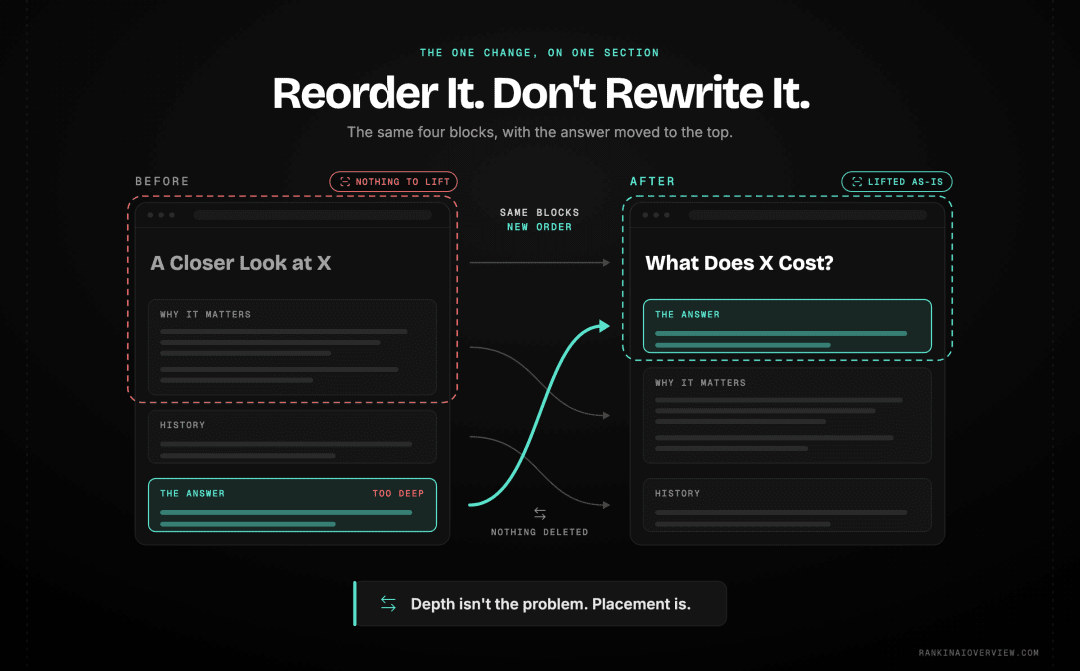
In practice the change is a reorder, not a rewrite. A typical page opens a section with background, defines terms, works through context, and only reaches the actual answer several paragraphs down. The fix is to lift that answer to the first position, make it complete on its own, and demote the context beneath it. The words barely change; their order and completeness do.
Picture a page section headed with a vague label, followed by two paragraphs explaining why the topic matters, a paragraph of history, and then, finally, the sentence that answers the question. To an engine scanning for a liftable unit, the top of that section reads as throat-clearing, and the answer is stranded too deep to be confidently extracted. The competitor that stated the answer in its first two sentences gets lifted instead, even if your page is more thorough overall. Depth is not the problem. Placement is.
The restructured version keeps every one of those details but changes the sequence. The heading becomes the actual question. The first passage states the complete answer, with the specifics included, in a chunk that would still be correct if someone quoted it with no other context. The why-it-matters, the history and the nuance all move below, where they enrich the page for a human reader without standing between the engine and the answer. Nothing of value is lost, and the page suddenly has a unit worth citing.
This is why the change is fast and low-risk. You are not researching new material, commissioning new copy, or gambling on a rebuild that might read worse. You are surfacing an answer the page already earned and letting it lead. On most pages the raw ingredients of a citation are already present and simply mis-ordered, which is exactly why one structural pass so often outperforms weeks of adding more.
It is worth naming what the change is not, because that is where people slip. It is not adding a longer introduction to seem thorough, not stuffing the top with keywords, and not bolting a plugin onto the page. Each of those either buries the answer further or decorates the surface without touching the thing that decides extraction. The change is narrower and more disciplined than any of them: find the answer, complete it, and put it first. Its power comes precisely from that restraint, because it fixes the one constraint that was actually stopping the citation.
How Does an AI Engine Decide Which Passage to Lift?
An engine looks for the clearest, most self-contained passage that fully answers the query, then favours the ones that are direct, well-organised and trustworthy. A complete answer sitting in a clean, standalone chunk near the top is far easier to lift than the same information spread across several paragraphs of narrative.
Think of the engine as scanning for a quotable unit rather than reading your page top to bottom. It wants a chunk it can drop into an answer with a citation attached, confident that the chunk stands on its own. Pages that offer such a unit get pulled in. Pages that make the engine assemble the answer from fragments scattered across the copy tend to lose to a competitor that did the assembly for it. Being quotable is a structural property, and it is one you control.
Trust and freshness act as tie-breakers rather than entry tickets. When two pages both present a clean, complete answer, the more credible or more current one tends to win the citation, which is why structural changes pay off fastest on pages that already carry some authority. Fix the extractability on a page people already trust and you are handing the engine both a liftable unit and a reason to prefer it. On a page with no standing, the same structural fix helps less, because the tie-breakers were never in your favour.
This is also why the study behind the citation lift decomposes structure into levels rather than treating it as one thing. The document architecture decides which passage leads and therefore which one an engine encounters first. The chunking decides whether that passage stands on its own or leaks into its neighbours. Only after those are right does the surface emphasis do any work, and even then it is a nudge, not a driver. When you understand the hierarchy, you stop reaching for the surface tools first and start with the architecture, because that is where the measured gains actually come from. The practical implication is simple: fix what leads and how it is chunked before you touch anything cosmetic.
Which Single Changes Genuinely Help, and Which Are Overrated?
The changes that genuinely move citation are structural and substantive: leading with a complete answer and organising sections around the real questions. The ones that are overrated are surface-level: schema tags, decorative summary boxes and cosmetic tweaks. The evidence consistently shows structural reorganisation lifts citation while formatting-only edits barely register.
It is worth being blunt about this, because a lot of AI-visibility advice inverts the priority and sends people to the low-leverage moves first. Here is the honest ranking.
Lead With the Complete Answer (highest leverage)
This is the change to make first on every important page. Open each section with the full, self-contained answer to its question, then layer nuance underneath. It is the document-architecture move that the citation evidence rewards most, it needs no tools, and on most pages it is the single biggest lever available. If you do only one thing, do this.
Rewrite Headings as the Real Questions (high leverage)
When a heading matches the question a user actually asks and the complete answer sits immediately beneath it, you mirror how an engine maps a query to a passage. This chunking makes each answer a clean, addressable unit and makes the page easier for humans to scan too. It is a genuine structural improvement, not a cosmetic one, which is why it earns its place near the top.
Summary Boxes, but Only If They Hold the Real Answer (conditional)
A summary at the top can become the lifted passage, but only when it contains the complete answer rather than a teaser. A box that says "here is what you will learn" is decoration and does nothing. A box that actually states the answers is just the lead-with-the-answer principle applied to the whole page. The value is in the substance inside the box, never in the box itself.
Schema Markup (overrated as a citation lever)
Schema helps machines parse your page and can support rich results, so it is not worthless. But treating it as the change that earns AI citations is a mistake the evidence does not support: surface and formatting-only signals show weak effects on citation compared with structural reorganisation. Add relevant schema where it genuinely applies, then stop expecting it to rescue a page whose answer is still buried. It is a micro-level touch, not the lever. Our look at what actually affects AI search visibility unpacks this myth further.
Shorter Sentences (minor, supporting)
Tighter sentences make a passage cleaner to lift, so trimming dense prose helps at the margin. But it is a readability polish applied on top of the structural work, not a substitute for it. Shorten sentences once the answer leads and the sections are chunked well, not instead of doing those things. It supports the content formats that get cited rather than driving them.
How Do You Measure Whether the Change Worked?
Measure it by tracking citation and mention frequency for your target queries before and after the change, across engines like ChatGPT, Perplexity and Google AI Overviews. Check the same prompts on a fixed schedule so any movement can be attributed to the specific change rather than to background variation.
Set a clean baseline before you touch anything. For each page you plan to restructure, record which queries it should win and whether the engines cite you today. Then make the one change, wait for the page to be recrawled, and re-check the identical prompts. Comparing the same queries before and after is what isolates the effect of your edit from the noise of a system that varies run to run, and it is the only way to know the change actually paid.
Watch the supporting signals alongside the direct ones. Branded search and referral traffic from AI sources should tick up if citations genuinely rose and the traffic is real. If the citations move and quality visits follow, the change earned its place and becomes your template. If nothing shifts after a fair window, treat that as information: the constraint on that page was something else, so move to the next candidate change rather than assuming the whole approach failed. Our guide to the metrics that measure AI visibility covers what to log.
One caution on measurement: because AI engines vary from run to run, a single before-and-after check can mislead in either direction. Sample each target query a few times on each side of the change rather than once, so you are comparing a stable pattern to a stable pattern, not one lucky pull to one unlucky one. Change one thing at a time, too. If you restructure a page and add schema and refresh the copy in the same week, a lift tells you nothing about which move earned it, and you lose the ability to build a reliable template. Isolating the single change is what turns a hunch into a repeatable playbook, and the discipline of one variable at a time is what lets the winning pattern scale with confidence.
How Do You Roll the Winning Change Across Your Whole Site?
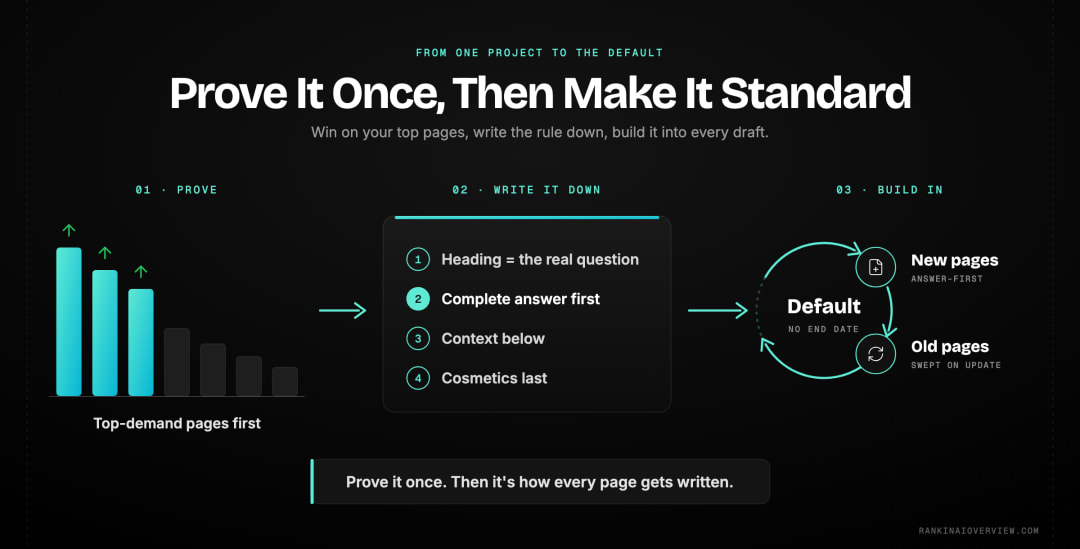
Start with your highest-value pages, apply the one change, confirm the citation lift, then use the proven pattern as a template for the next tier. Prioritise by search demand and citation potential, and expand the winning structure page by page rather than trying to fix everything at once.
Sequencing by value is what keeps the effort honest. A single structural change on a page that already earns traffic and targets questions engines answer often will return far more than ten changes on a page nobody searches. So let demand set the order: your best pages first, then the next tier, each one restructured to lead with its complete answer and chunked around the real questions. If you want a shortcut to spotting which pages sit closest to a citation, a free AI-visibility audit can highlight where a single change is most likely to tip you into answers before you invest the time.
The mistake to avoid is fixing everything simultaneously, which spreads effort thin and makes it impossible to tell what worked. Prove the change on your strongest pages, verify the lift with the before-and-after method, then apply the same repositioning and chunking to the next set. Over time this builds a site-wide standard where every important page leads with its answer and organises around real questions, and that consistency compounds into a durable extractability advantage. It is also what sustains getting featured in Google AI Overviews at scale, one proven change at a time.
Turning the change into a template is what makes it scale without ballooning into the overhaul you were trying to avoid. Once a handful of pages have proven the pattern, you no longer decide each edit from scratch. You have a short, concrete standard: heading is the real question, first passage is the complete self-contained answer, context sits below, and cosmetic touches come last. A writer can apply that in minutes per page, and a reviewer can check it at a glance. The work shifts from a heavy project to a habit baked into how every page is written and edited, which is where the compounding really comes from.
It helps to fold the standard into your production process rather than treating it as a one-off cleanup. New pages should be drafted answer-first from the start, so you are not re-editing them into shape later, and existing pages can be swept in priority order during normal update cycles. Handled this way, the single change stops being a campaign with an end date and becomes the default shape of your content, which is exactly what keeps the extractability advantage growing instead of decaying the moment the project is marked complete.
"This work establishes structural optimization as a foundational component of GEO, providing a data-driven methodology for enhancing content visibility in LLM-powered information ecosystems."
Junwei Yu and colleagues, Structural Feature Engineering for Generative Engine Optimization: How Content Structure Shapes Citation Behavior (arXiv, 2026)
Conclusion
AI search rewards content that is easy to lift, and most pages fail on one point: the complete answer is buried or scattered. Restructure so a self-contained answer leads the section and you usually fix the core problem in a single change. That is the highest-leverage edit available, and the evidence backs it, structural reorganisation moves citation while the surface tweaks most checklists start with barely register.
So skip the overhaul, and skip the schema-first thinking that sends so much effort to the wrong place. Take your best pages, make the one structural change, and measure it honestly against the same queries. Then stack the next proven win and roll the pattern outward. AI visibility improves in practice not through one massive rebuild but through focused, structural changes that compound quietly over time into a lasting advantage.
Want to know which of your pages are one change away from being cited? Run a free AI-visibility audit with Rank in AI Overview and see where your quickest structural wins are hiding.
Frequently asked questions
What is the single best content change for AI visibility?+
For most pages it is restructuring so a complete, self-contained answer leads the section instead of being buried. AI search lifts passages, so a full answer in a clean, standalone chunk near the top is far easier to cite than a scattered one.
Is adding schema the fastest way to earn AI citations?+
No. Schema helps machines parse a page but shows weak effects on citation compared with structural changes. Add it where it genuinely applies, but do not expect it to rescue a page whose answer is still buried or incomplete. Structure comes first.
How fast can one content change improve AI visibility?+
Often within a recrawl or two, so a few weeks for many sites. Speed depends on how frequently your pages are crawled and how competitive the query is, but structural fixes that improve extractability tend to show up relatively quickly once recrawled.
Do summary boxes at the top really help?+
Only when the box holds the complete answer rather than a teaser. A box that actually states the answers can become the lifted passage. A box that merely previews the page is decoration and does nothing for citation. The value is the substance inside it.
Do I need to rewrite my whole page for AI search?+
No. A full rebuild is rarely necessary. Most gains come from repositioning the answer to lead, organising sections around real questions, and keeping each answer self-contained, which are focused structural changes rather than complete rewrites.
How many pages should I change at once?+
Start with your ten highest-value pages, applying the one change and measuring its effect before scaling. Once you confirm the lift, expand the proven pattern to the next tier rather than changing everything simultaneously and losing the ability to tell what worked.
Explore with AI
Share this