
How to Write Title Tags and Meta Descriptions for AI Search
AI engines cite your body content, not your meta tags. Here is what title tags and meta descriptions still do, and where citation gains come from.
Key Highlights
- Title tags and meta descriptions still matter, but their job has narrowed to clarity, classification and human click appeal rather than keyword-led ranking.
- AI search engines read and cite your body content directly, so a clear title mainly helps a system understand and match your page, not win the citation.
- Research on what generative engines reward points at substance, coverage, depth, structure, sourcing and evidence, none of which lives in a meta tag.
- Question-format titles align with conversational AI queries while still performing in traditional results, giving you one honest line that serves both.
- The costly mistakes now are keyword stuffing, vague or clever titles, overpromising descriptions, and abandoning meta tags entirely because "AI reads the page anyway".
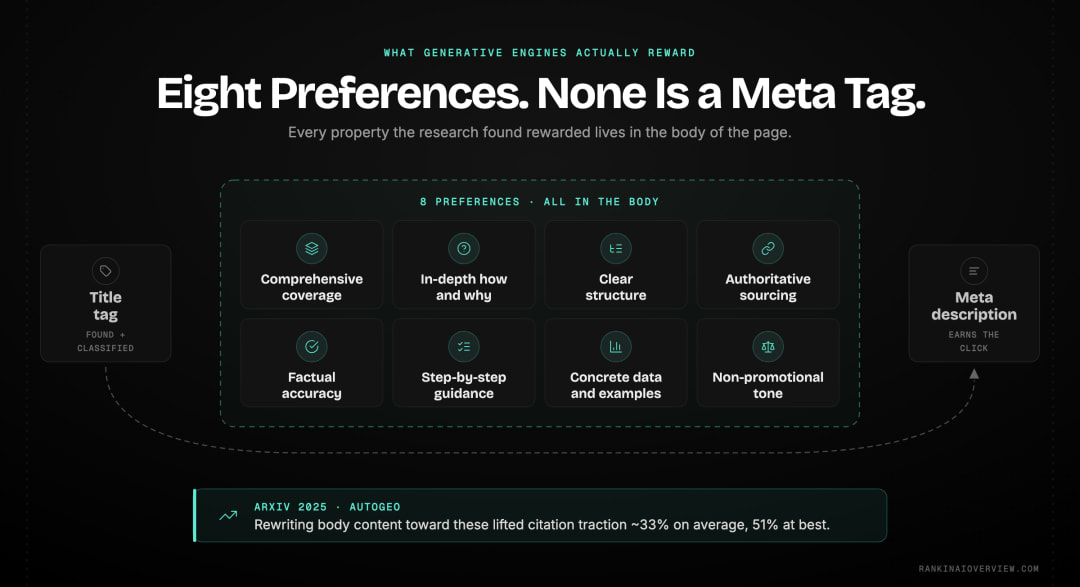
According to a 2025 study of generative search engines, rewriting a page's body content to match the preferences those engines actually reward lifted its citation traction by as much as 51%, and every preference the researchers extracted concerned the substance of the page, its coverage, depth, structure and evidence, rather than its title tag or meta description. That single result reframes a question many teams are quietly arguing about. In the AI search era, meta tags have not stopped mattering, but they have stopped being where the important work happens.
Every few months someone declares meta tags dead. AI reads the whole page now, the argument goes, so why bother with a title tag or a meta description at all? It is a fair question, and the uncertainty is real. Some teams keep polishing these fields out of habit, others quietly stop, and both extremes cost them something. The honest answer sits between the two: meta tags have not disappeared, their role has simply changed, and what earned clicks and rankings in 2018 is not what serves you today.
This guide gives an updated, practical approach for the AI search era. It covers whether these tags still matter, what actually earns a citation, how AI systems use titles and descriptions, how to write each one well, whether they influence citation at all, the mistakes to avoid, and how your day-to-day workflow should change. Because the body content does the real work here, our guide to optimising content for AI search is the natural companion read once your tags are honest and clear.
Do Title Tags and Meta Descriptions Still Matter in the AI Search Era?
Yes, title tags and meta descriptions still matter, but their job has narrowed. They shape whether people click you in traditional results and they help AI systems classify what a page is about. What they no longer do is win the citation itself, which the body content earns. Treat them as clarity and click tools, not ranking levers.
The shift is from optimisation to communication. You are no longer stuffing keywords to satisfy a ranking formula. You are stating plainly what the page delivers, which helps a human decide to click and helps a machine file the page under the right topic. That is a simpler, more honest job than the old keyword game, and it happens to be the job both audiences reward.
It also helps to remember that traditional search results have not vanished. AI answers now sit alongside classic blue links, not entirely in place of them, so a clear title and description still earn clicks in the results that remain. Abandoning meta tags because "AI reads the page anyway" throws away easy wins in a channel that is still very much alive for most queries.
So the tags are not dead. They are doing a more grounded job now: telling the truth about the page as clearly as possible, so the right people and the right systems understand it at a glance. That framing makes them far easier to write, because you stop reaching for tricks and start writing an honest summary of what the reader will actually get.
What Actually Earns an AI Citation, If Not the Meta Tags?
What earns a citation is the substance of your page, not its metadata. Generative engines retrieve and quote passages from the body, so the deciding factors are how completely, clearly and credibly the content answers the query. Meta tags help a system find and understand the page, but the citation is won by what the page actually says.
The evidence here is unusually direct. When researchers set out to learn what generative engines prefer, they did not find a list of metadata tricks. They found a set of content properties. The 2025 framework behind the opening statistic had frontier models explain those preferences and then distilled them into rules, and the rules read like a description of genuinely good writing rather than a checklist of tags.
The researchers behind that framework put the mechanism plainly. Instead of guessing at what to change, they had the models articulate what generative engines favour, then turned those explanations into concrete, reusable rules.
"AutoGEO first prompts frontier LLMs to explain generative engine preferences and extract meaningful preference rules from these explanations."
Yujiang Wu, Shanshan Zhong, Yubin Kim and Chenyan Xiong, authors of the AutoGEO generative-engine optimisation study
Read down the rules they surfaced and a pattern jumps out. The engines rewarded comprehensive coverage of a topic, in-depth explanation of how and why, clear structure, authoritative sourcing with real attribution, factual accuracy, actionable step-by-step guidance, concrete data and named examples, and a neutral, non-promotional tone. Every one of those lives in the body of the page. Not a single one is a title tag or a meta description. That is the whole argument in miniature: the levers that move citation are properties of the content, and rewriting toward them improved traction by roughly a third on average and up to half at the top end. We dig further into which factors genuinely move the needle in our look at what actually affects AI search visibility.
None of this makes meta tags worthless. It relocates them. Their contribution is upstream of the citation, in helping a system discover and correctly classify your page, and downstream of the ranking, in earning the human click. The citation itself is decided by the content in between, which is exactly where your real optimisation energy belongs.
How Do AI Search Engines Use Your Title Tag and Meta Description?
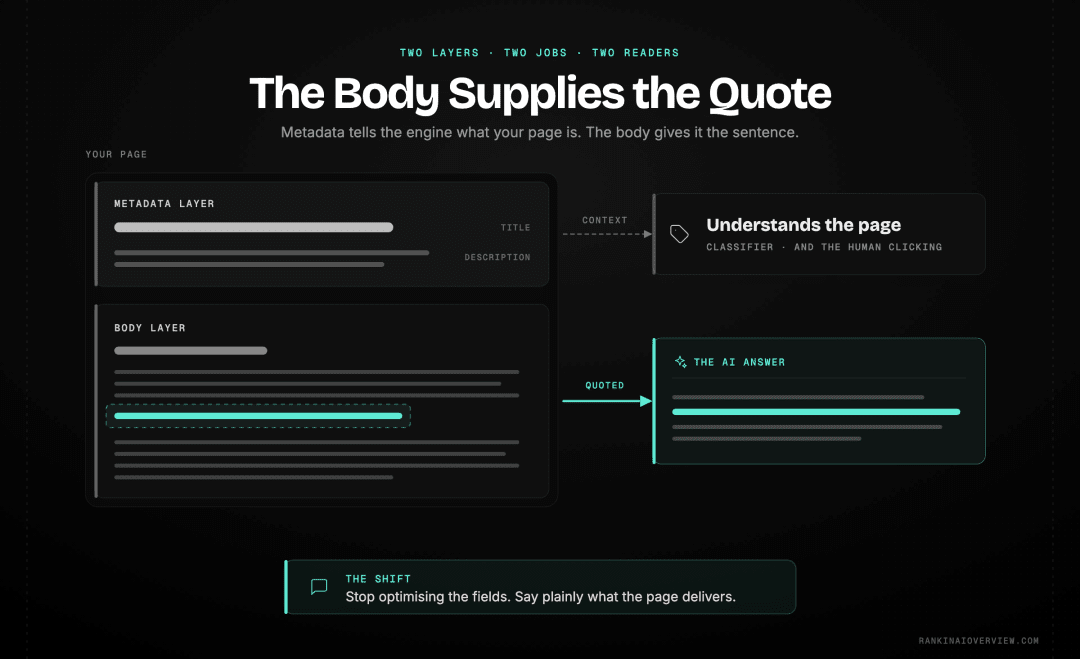
AI search engines use your title and description mainly as clarifying signals about a page's topic, then read and extract the answer from the body itself. A clear title helps a system understand and match your page to a query. The passage it actually cites comes from the content, not from your meta description.
This is the key mental shift. Older search snippets leaned heavily on the meta description because the engine was choosing which page to show, not composing an answer. A generative engine works differently. It retrieves candidate pages, reads the relevant passages, and builds a response grounded in what those passages say. Your description helps it grasp context and relevance; it does not supply the sentence that ends up quoted.
Because of that, a keyword-stuffed meta field gains you very little with AI and can actively cost you with humans. To a classifier, a clean and accurate summary is easier to interpret than a bag of repeated keywords. To a person scanning results, a natural sentence reads like a helpful page while a keyword pile-up reads like spam. The same honest summary serves both audiences, which is why the old stuffing habit has no upside left.
The practical consequence is a division of labour worth keeping in mind. Let the title and description do what they are good at, signalling topic and earning the click, and let the body do what only it can, answering the query in a way an engine will lift. When you stop asking your meta tags to carry weight they were never built for, you write them faster and you invest the freed-up effort where citations are genuinely decided. This mirrors what we see across what type of content ranks in AI search.
How Should You Write a Title Tag That Works in AI Search?

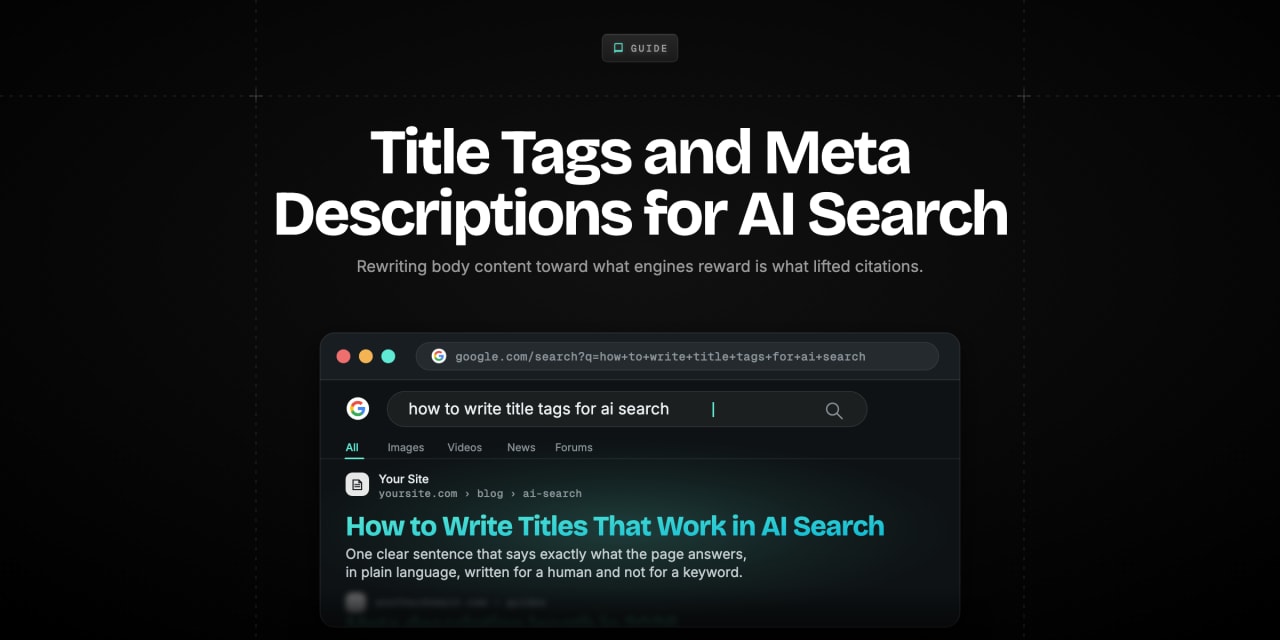
Write a title tag that states clearly and specifically what the page answers, in the words your audience actually uses. Favour clarity over cleverness, and consider a question format that mirrors conversational AI queries while still reading well in traditional results. The aim is instant, unambiguous recognition of what the page delivers.
Three habits carry most of the value, and it helps to take them one at a time.
Lead With Clarity, Not Cleverness
Clever, ambiguous titles cost you in the AI era. If a title leaves any doubt about what the page covers, rewrite it. Both machines and people need to know instantly what they will get, and a title that makes them guess loses on both fronts. Say the thing plainly, and save the wordplay for content where it genuinely helps rather than for the one line that decides comprehension. A title is a promise about the page, so the clearer the promise, the better it performs.
Use Question Formats Where They Fit
Phrasing a title as the exact question your audience asks aligns with how people query AI systems, which are increasingly conversational, and it still performs in traditional search. A title like "How Do You Track AI Citations?" matches intent directly and reads naturally in both contexts. Not every page needs the question form, a product or category page rarely does, but for informational content that answers a specific question, it is a strong default worth reaching for first.
Be Specific About Scope
A title that names the exact topic, and where useful the exact angle, helps a system match your page to the right query and helps a reader trust that the page fits their need. "AI Search Tips" is vague enough to match nothing well. "How to Write Titles That Work in AI Search" tells both machine and human precisely what is inside. Specificity is not the enemy of brevity; it is the difference between a title that gets understood and one that gets skipped. When you are unsure how specific to be, err toward naming the reader's exact question, because a slightly longer title that matches intent beats a short one that matches nothing.
Across all three habits the underlying instruction is the same. Describe the page honestly and precisely. The title is not a place to be found clever or to hoard keywords; it is the shortest accurate description of what the reader will get, and that is exactly what serves classification and clicks at once.
How Should You Write a Meta Description for the AI Search Era?
Write a meta description as one clear sentence that summarises exactly what the page answers, in plain language your audience understands. Treat it as a promise to a human reader about the value inside, not as a place to cram keywords for an algorithm. Honesty and specificity outperform density every time now.
The best meta descriptions today read like a helpful one-line preview. They tell a searcher precisely what they will learn and why the click is worth it. That human-first clarity also happens to help an AI system classify the page accurately, so the same honest sentence serves both purposes without any tension between them. You are not writing two descriptions, one for people and one for machines; you are writing one truthful line that satisfies both.
Keep it concrete and avoid overpromising. A description that inflates what the page delivers underperforms twice over: it disappoints the reader who clicks through, and it misrepresents the page to any system trying to classify it. One accurate sentence about the real value on the page does more than any keyword list, and it supports your appearance in the traditional results that still sit beside AI answers for most searches.
It is worth saying that search engines often rewrite the description they display anyway, choosing a passage from your page that best matches the query. That is another reason to stop over-engineering this field and another reason to make sure the body contains clear, quotable sentences. If the engine is going to lift its own preview from your content, the smartest move is to make that content easy to preview well. Write an honest description as your default, accept that it may be replaced, and invest the real effort in the passages the engine and the reader ultimately judge you on.
Do Title Tags and Meta Descriptions Influence AI Citation At All?
They influence citation only indirectly, by helping a system discover, understand and correctly classify your page, and by earning the human engagement that builds a page's track record over time. The citation itself is decided by the body: clear answers, strong structure, credible sourcing. Good meta tags support the path to a citation without ever winning one on their own.
It helps to picture two gates. The first is understanding: does a system grasp what your page is about and match it to the right queries? Clear title and description work here, making sure your page is considered for the questions it genuinely answers. The second gate is the citation: once your page is in the running, does its content answer the query well enough to be quoted? That gate is cleared by substance alone. A brilliant description cannot carry a thin page through it.
This is why chasing citations through metadata is a dead end. No title has ever been clever enough to make an engine cite a page whose body does not answer the question. What a good title does is make sure the page is understood and clicked when it appears, which feeds the engagement and reputation signals that matter across a whole site over time. Those signals are real, but they are earned slowly and indirectly, not conjured by a single field.
The practical rule is therefore simple to state and easy to follow. Write your meta tags for clarity, classification and the human click, then put your genuine optimisation effort into the body content that AI actually cites. For a fuller map of how those content factors fit together, our overview of AI ranking factors in 2026 sets the meta-tag question in its proper, modest place.
What Title Tag and Meta Description Mistakes Should You Avoid Now?
The mistakes to avoid are keyword stuffing, vague or clever titles, overpromising descriptions, and neglecting meta tags entirely. Each either misleads a human, confuses AI classification, or leaves easy click-through wins on the table in traditional results. The common thread is that all four break the one job these fields now have: describing the page honestly.
Keyword stuffing is the classic error that has fully outlived its usefulness. It gains almost nothing with AI, which reads and cites the body, and it hurts human click-through by making the snippet read like spam. The instinct behind it, that repeating a term signals relevance, belongs to an older era of search. Today, engines rank reputation and substance rather than keyword density, a shift we explore in why AI engines rank reputation, not keywords, and a clean, accurate line beats a stuffed one on every axis that still counts.
The opposite mistake is neglecting meta tags because "AI reads the page anyway". Traditional results still exist and still drive meaningful clicks, so a clear title and description remain worth writing for that channel alone. Treating the fields as irrelevant is as costly as over-optimising them; both ignore the real, if modest, job they do. The balanced approach, clarity for both humans and machines, avoids both extremes at once.
Two subtler errors round out the list. Vague or clever titles that hide what the page covers cost you comprehension with machines and trust with readers, so ambiguity is a defect, not a style choice. And overpromising descriptions that inflate the page's value disappoint the click and misrepresent the content to any classifier, which undermines the very understanding the field is supposed to build. Avoid all four and you are left with the only approach that works now: say what the page honestly is, as clearly as you can, in both fields.
How Should Your Meta-Tag Workflow Change Day to Day?
Your workflow should shrink the time you spend on meta tags and redirect it to the body. Write one honest, specific title and one accurate description per page, check they read clearly for a human, then spend the bulk of your effort making the content itself the best available answer to the query. Speed on the tags, depth on the content.
Concretely, that means resisting the old ritual of agonising over keyword placement in the title. Draft the title as the plainest accurate description of the page, prefer the question form for informational content, and move on. The same goes for the description: one true sentence about the value inside, written for a reader, then done. Minutes on each, not an afternoon, because the ceiling on what these fields can achieve is genuinely low now.
Reinvest that reclaimed time where the returns are real. Make sure each page leads with a clear answer, explains the how and why in depth, structures its sections cleanly, attributes claims to credible sources, and includes concrete data or named examples. Those are the very properties the research found generative engines reward, and they are the ones that convert directly into citations. A useful companion here is our breakdown of what type of blog content AI actually wants to cite, which turns those properties into editorial choices.
Finally, build the balance into a repeatable check rather than a case-by-case debate. For every new page, ask three quick questions: does the title state plainly what the page answers, does the description honestly preview the value, and does the body actually deliver the best answer to the query it targets? If the first two take a minute each and the third takes the rest of your effort, your allocation matches where citations are decided, and you stop pouring energy into fields that were never going to carry it.
Conclusion
Title tags and meta descriptions are not dead, but their job has changed. They now exist to communicate and classify, to tell a human and a machine exactly what your page is, and to earn the click when you appear in traditional results. What they no longer do is win the citation, because AI reads your content directly and quotes the body, not the metadata wrapped around it.
The evidence draws a clean line for you. When researchers learned what generative engines actually reward, every preference pointed at the substance of the page and none at the meta tags. So write titles that state plainly what the page answers, lean on the question form for informational content, and craft one honest sentence for the description. Then put your real effort where citations are genuinely decided: the content itself, made as complete, clear and credible as you can manage.
Want to see which of your pages AI already cites, and which titles are holding you back? Run a free AI-visibility audit with Rank in AI Overview to find where your meta tags mislead and where your content is ready to be cited.
Frequently asked questions
Do meta descriptions still affect SEO in the AI search era?+
Meta descriptions do not directly boost rankings, but they strongly influence click-through when your page appears in traditional results. For AI search they help a system classify your page, though the body content carries far more weight and earns any citation.
Should I write title tags as questions for AI search?+
For informational pages, question-format titles work well because they mirror conversational AI queries and still perform in traditional search. Not every page needs one, but it is a strong default for content that answers a specific, well-defined question.
Does keyword stuffing meta tags help with AI search?+
No. AI reads and cites body content directly, so keyword-stuffed meta copy gains little and hurts human click-through by reading like spam. A clear, accurate one-sentence summary serves both AI classification and human readers far better than density.
Do AI search engines read meta descriptions?+
AI systems can use meta descriptions as context signals about a page's topic, but they primarily read and extract from the body content. The description supports understanding and matching, not the actual answer that ends up quoted in a response.
What is the biggest title tag mistake in the AI era?+
Ambiguity. A clever or vague title that fails to state clearly what the page covers costs you comprehension with machines and trust with readers. Specific, direct titles that match the real query outperform wordplay on every measure that matters.
Should I stop writing meta descriptions altogether?+
No. Traditional results still exist and still drive clicks, so a clear, accurate meta description remains worth writing. Neglecting the field leaves easy click-through wins on the table, even though the body content is what earns your AI citations.
Explore with AI
Share this


