Where Does Google AI Overview Pull Its Answers From?
How Google AI Overview sources its answers, why displayed citations differ from what the answer actually used, and how to get pulled in.

Key Highlights
- Google AI Overview does not read the open web live for each query. It answers from a retrieved candidate pool assembled per question, so getting into that pool is the real gate, not holding the top organic spot.
- The sources you see listed are a display layer, not a faithful map of everything the answer leaned on. Research on machine-generated citations finds link-valid, on-topic citations that still fail a factual check.
- Overviews synthesise from several pages at once, so a modest page can contribute without being the single winner.
- The two moves that matter are getting selected into the pool and being the page whose claims survive verification, not simply looking relevant.
Every marketer eventually asks the same blunt question: where does Google's AI Overview actually get its information, and how do I become one of those sources? It sounds basic, yet clear answers are rare. Most explainers either shrink it to "just rank well" or inflate it into an unknowable black box, and neither tells you what to change on Monday morning.
According to a 2026 source-attribution study of deep research agents, even the strongest frontier models keep their displayed citations working, with link validity above 94% and topical relevance above 80%, yet only 39 to 77% of those citations survive a factual check against the source they point to. The paper is about research agents rather than Google specifically, but the mechanism travels: a citation can look impeccable, resolve to a live and on-topic page, and still not be the thing that actually grounded the sentence. That gap between what an AI answer shows and what it drew on is the heart of this whole topic.
This guide walks through the mechanics as far as the evidence allows. It covers whether Overviews only use top-ranked pages, what is genuinely feeding the answer, which signals get a page into the source pool, whether Overviews aggregate, whether low-ranking pages can appear, why the listed citations sometimes do not match the answer, how to inspect your own Overviews, and how to raise your odds. For the official framing, Google's own account of how it picks sources for AI Overviews is a useful companion read.
Does Google AI Overview Only Use Top-Ranked Pages?
No. Google AI Overview does not restrict itself to top-ranked pages. A strong organic position helps a page get considered, but Overviews frequently cite results sitting well down the first page, or beyond it, when those pages answer the question more directly. Clarity, structure and trust can outweigh raw rank in selection.
You can watch this happen in the wild. Search a question you know well, expand the Overview, and check the source ranks against the blue-link results underneath. It is common to see a page at position eight or nine cited while the number one result is nowhere in the summary. That page won selection because it stated the answer plainly, not because it topped the ranking.
This matters most for smaller sites and newer domains. It means the citation game is not gated behind winning first place against entrenched competitors, a target most sites will never hit. Being the clearest, most trustworthy answer to a specific question is a far more winnable objective, and it is the objective Overviews reward. We unpack the wider pattern in why AI engines cite pages that do not rank on Google.
What Is Actually Feeding a Google AI Overview Answer?
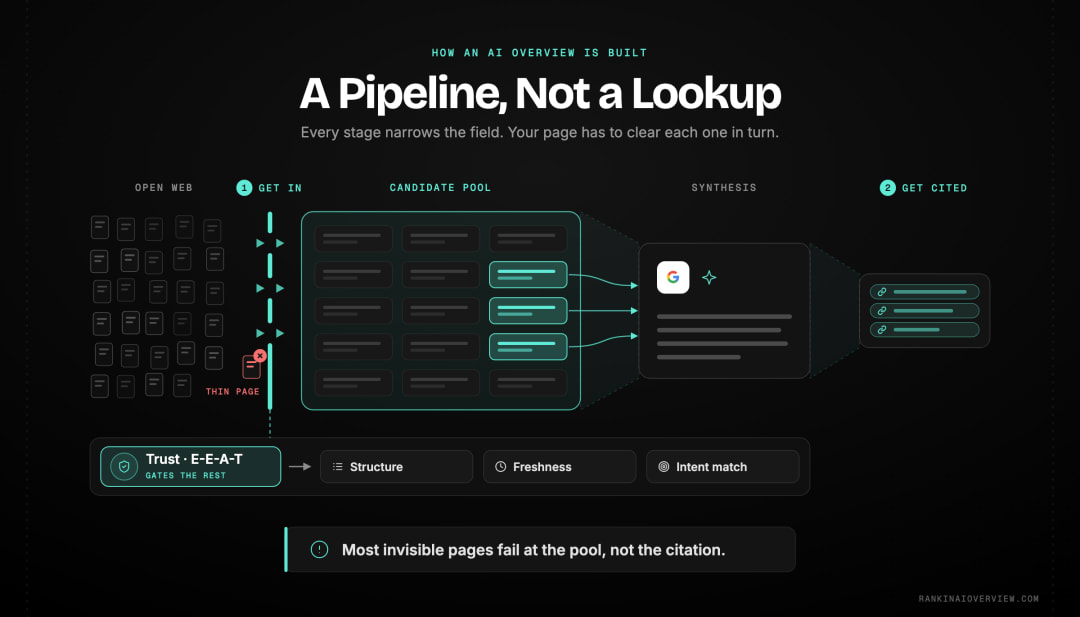
Two different things feed the answer, and confusing them is where most strategy goes wrong. First, a retrieved candidate pool of pages the system assembles for that query. Second, a small display layer of citations shown to the reader. The pool is what the answer is built from. The visible citations are a curated subset presented afterwards.
Think of it as a pipeline rather than a lookup. When a query triggers an Overview, the system does not scan the live web in real time. It retrieves a set of candidate passages it already considers relevant and trustworthy for that topic, drafts an answer grounded in that set, then surfaces a handful of links as attribution. Every stage narrows the field, and your page has to clear each one in turn.
The practical consequence is that "getting pulled in" is really two separate wins. You first need to enter the retrieved pool at all, because a page that never makes the candidate set cannot be used no matter how good it is. Then, among the pool, your content has to be the passage the model actually leans on and chooses to attribute. Most pages that feel invisible in Overviews are failing at the first stage, not the second, and they are optimising the wrong one.
That two-stage shape also explains a lot of the frustration around rankings. Classic organic position is one input into whether you enter the pool, and a weak one at that, as we cover in why page-one pages still miss AI Overviews. Entry into the pool leans on signals that are related to ranking but not identical to it, which is why a top result can be skipped while a lower one is used.
What Signals Decide Which Sources Get Into the Pool?
Pool entry leans on helpfulness and E-E-A-T signals, clean and extractable page structure, content freshness, and a direct answer to the query intent. Pages that are trustworthy, current, easy to parse, and unambiguous about what they answer are the ones most likely to enter the candidate set an Overview is built from.
None of these signals is a secret lever, but their relative weight shifts for Overviews compared with classic ranking. Here is how each one earns a page its place in the pool.
Helpfulness and E-E-A-T
Google's long-standing quality signals carry over: experience, expertise, authoritativeness and trust. Its own guidance on ranking systems has always put helpful, people-first content at the centre of how pages are assessed, and the same standard shapes which pages are trusted enough to feed a synthesised answer. Genuinely useful, credible pages get considered. Thin or derivative ones rarely enter the pool at all, however tidily they are formatted, because trust is the price of admission and formatting cannot fake it. Author transparency, a real organisation behind the site, and a track record on the topic all read as reasons to include a page, and their absence quietly keeps pages out.
Clean, Extractable Structure
An Overview has to lift a specific claim out of your page. If the answer is buried under a long preamble, wrapped in qualifications, or split across scattered sentences, it is harder to extract cleanly, and harder to attribute. Pages that lead with a direct answer, use descriptive question-style headings, and keep each point self-contained are simply easier to pull from. Structure is not decoration here, it is extractability. A useful test is to read only your headings and the first sentence under each: if that skeleton already answers the likely questions, an Overview can lift from it. If the meaning only emerges once a human reads the full paragraph, the page is working against the way answers are actually assembled.
Content Freshness
Freshness appears to weigh more heavily for Overviews than for standard rankings. On topics that move, a recently updated page often gets selected over an older, higher-authority one, because stale information is a trust risk in a synthesised answer. Keeping your key pages genuinely current, with real updates rather than a changed date, keeps you eligible on exactly the queries where freshness is a selection factor.
Direct Match to Query Intent
A page that answers the precise question wins over one that merely covers the general topic. If someone asks how long a process takes and your page explains the process without ever stating the duration, you will not be pulled in, however authoritative you are. Matching the specific intent, not just the subject, is what turns a relevant page into a usable source. Our AI ranking factors guide goes deeper on how these signals interact.
Does AI Overview Pull From Multiple Sources At Once?
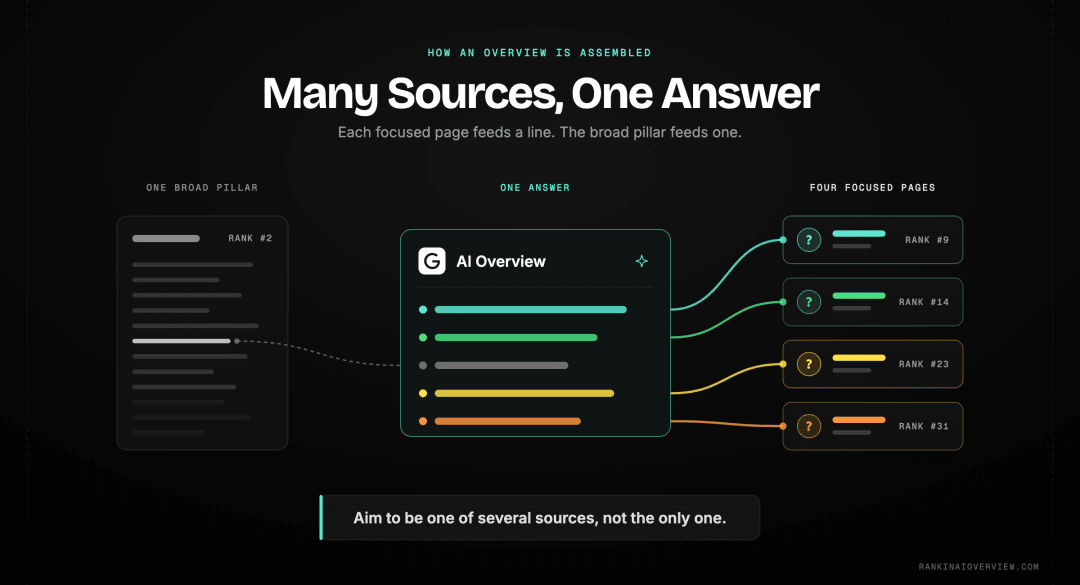
Yes. A Google AI Overview typically synthesises its answer from several pages in the pool rather than quoting one. It stitches together a response from multiple trusted sources, which means partial contribution is normal: your page can help shape an Overview even when it is not the sole or leading source cited.
This changes the shape of the competition. You are not fighting to be the single page an Overview quotes verbatim. You are competing to be one of the several sources the synthesis draws on, which is a lower and more realistic bar than being the outright winner. For most sites, contributing to the answer is a far more attainable goal than owning it.
It also means citation is not binary. Contributing across many related queries builds a pattern of visibility that compounds, even without dominating any single Overview. Breadth beats obsession here: covering a topic thoroughly, with several strong pages that each nail a sub-question, tends to earn more total contribution than pouring everything into one flagship page and hoping it becomes the one true source.
The aggregation habit also reshapes how you should plan content. Because an Overview would rather assemble a complete answer from several precise pages than stretch one generalist page to cover everything, a cluster of focused pages, each owning a single question cleanly, often out-earns a sprawling pillar that tries to say a little about all of it. Depth on one narrow question is easier to select than breadth spread thin, and a set of such pages gives the synthesis more distinct, quotable pieces to draw on across a whole family of related queries.
Can a Low-Ranking Page Get Pulled Into an AI Overview?
Yes. A low-ranking page can appear in an AI Overview when it answers the question more clearly or completely than higher-ranked pages. Because selection weighs helpfulness, extractable structure and trust rather than rank alone, a cleaner, more direct answer can be pulled from a modest organic position while the top result is passed over.
This is one of the least understood facts about Overviews, and one of the most encouraging. Rank is not a gate you must clear before you are eligible. A well-structured, trustworthy page with a direct answer can enter the pool and be cited from well outside the top few results, which is exactly why answer quality deserves as much of your attention as traditional ranking factors.
The strategic reading is to optimise the answer, not merely the position. If your page is the single clearest response to a specific question, it has a genuine shot at being pulled in regardless of where it sits organically. That reframes the work from an unwinnable rank race into a winnable clarity contest, and clarity is something you fully control on the page.
It is worth being honest about the limit of this, though. A low rank helps far less on broad, high-competition queries where established authorities crowd the pool, and far more on specific, long-tail questions where fewer pages answer the exact intent. The lesson is not that rank never matters, but that its grip loosens exactly where a smaller site can compete: the precise, narrowly worded questions your audience actually asks. Those are the queries to target first, because they are where a clear answer from a modest domain has the best odds of being selected over a vaguer answer from a stronger one.
"These findings reveal a critical disconnect between surface-level citation quality and factual reliability."
Hailey Onweller and colleagues, Cited but Not Verified: Parsing and Evaluating Source Attribution in LLM Deep Research Agents (arXiv, 2026)
Why Do the Displayed Citations Not Always Match What the Answer Used?
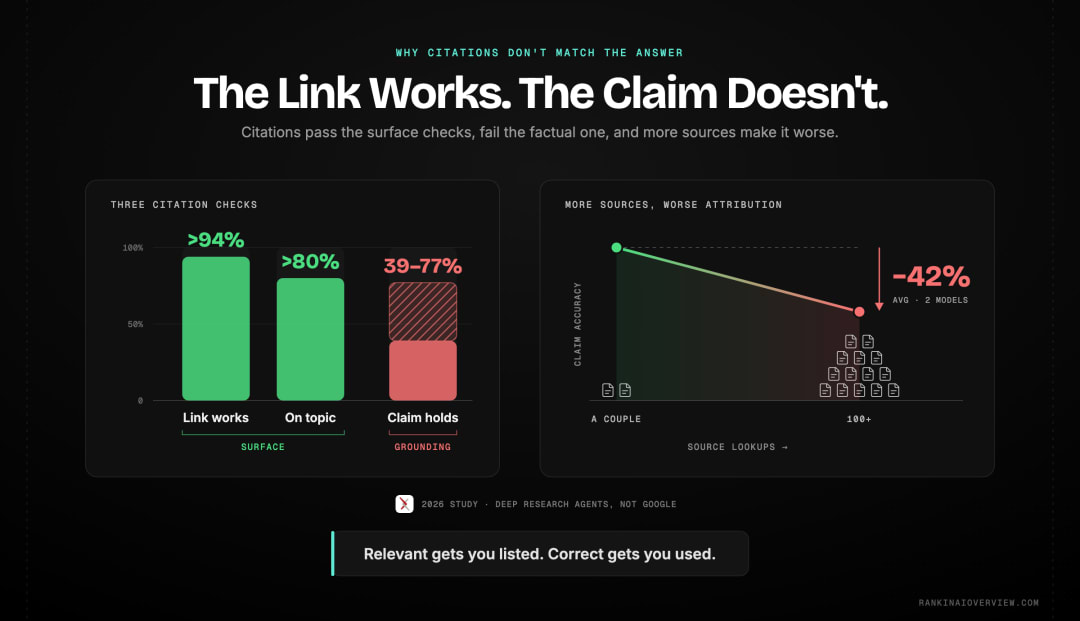
Because the citations you see are a presentation layer, not a verified trace of what grounded each sentence. A source can be listed because it is topically relevant and looks authoritative, while the actual claim came from elsewhere in the pool. The displayed list signals the neighbourhood the answer came from, not a line-by-line audit.
The source-attribution research makes this concrete. When machine-generated citations were checked along three dimensions, the links overwhelmingly worked and pointed to on-topic content, yet a large share failed when the specific claim was verified against what the cited page actually said. Surface quality, meaning the link resolves and looks relevant, turned out to be a poor predictor of factual grounding. A citation can pass every superficial test and still not support the sentence attached to it.
Depth does not fix this, and can make it worse. The same work found that as an agent made more retrieval calls and pulled in more sources, factual accuracy of its citations dropped rather than rose, by roughly 42% on average across two frontier models as tool calls scaled from a couple to well over a hundred. More sources meant a bigger pool to attribute from, not a more faithful answer. Piling on citations is not the same as grounding an answer well.
There is a further wrinkle worth understanding. Because the display layer is assembled to look coherent, a listed source often earns its slot for reasons that have nothing to do with whether it carried the load: it may be the most recognisable domain in the pool, the cleanest-looking URL, or simply a page the system is confident readers will accept. None of that guarantees the claim came from it. So a page can gain a citation partly on reputation and appearance, and lose one just as easily when a more quotable page enters the pool, even though its own content never changed. Treating a citation as proof that your specific words were used is exactly the mistake this research warns against.
For a site owner, the takeaway is sharp. Being the displayed source and being the page that actually grounded the answer are two different achievements, and only the second is durable. If your page is listed but your specific claim is not what the answer relied on, you are decorative, and easily dropped on the next refresh. The goal is to be the page whose statement the answer genuinely rests on, which is a matter of being unambiguously, verifiably correct on the exact point, not merely relevant to it. This is the same disconnect we examine in how often ChatGPT actually cites its sources.
How Can You See Which Pages Google Is Pulling Into Your Overviews?
Search your priority queries, expand each Overview, and record the cited sources, whether you appear, and which competitors do. Then repeat on a fixed schedule so you can see movement rather than a single snapshot. Visibility tools automate this across many queries and add competitor and trend data.
Start manually, because the manual pass teaches you what the tools later summarise. Take your ten or twenty most important questions, run each one, open the Overview, and log the sources it lists alongside your own presence or absence. Note which of your pages, if any, get pulled in, and which rival pages keep showing up. Within an afternoon you will have a concrete map of where you already contribute and where you are shut out, which turns a vague worry into a specific to-do list.
One detail to watch as you log is which specific page of yours gets pulled, not just whether your domain appears. Overviews cite at the page level, so you may find one under-loved article is quietly carrying your visibility while your intended flagship is ignored. That tells you where your genuinely extractable, verifiable answers already live, and it is often not where you assumed. Note the pattern across queries, because the pages that keep getting selected reveal the format and depth the pool rewards on your topic, which is a template you can apply to the pages that keep getting left out.
At scale the manual approach gets heavy, and this is where a tool earns its place by tracking many queries over time and flagging changes you would never catch by hand. If you want a fast baseline of which of your pages Google is already citing, and where the gaps sit, a free AI-visibility audit is a low-effort way to get that picture before you commit to any tooling.
How Do You Increase Your Odds of Being Pulled In?
Lead with a direct, verifiable answer, structure the page around clear question-style headings, keep the content genuinely current, and reinforce trust so you clear both selection stages. The aim is to enter the retrieved pool and to be the page whose specific claim survives a factual check, not just one that looks relevant.
The highest-leverage first move is almost always surfacing the answer you already have. A striking number of pages contain exactly what an Overview needs, buried three paragraphs down under a warm-up introduction. Lift that answer to the top, state it plainly in a sentence or two, and you often flip a page from ignored to eligible within a recrawl. It costs little and works fast because it fixes extractability, the thing pool entry depends on.
The second move is to make the claim verifiable, which is what protects you against the citation disconnect. Attach the specific number, date, or fact to a source a checker could confirm, and phrase it so the exact answer is unmistakable rather than implied. A page that is precisely, checkably right on the point is far harder to drop than one that is merely on-topic, because it is the one the answer can actually rest on.
Then reinforce with trust and freshness over time. Credible third-party mentions, consistent brand and entity data, and real updates on moving topics all raise your standing among the pages Google is willing to draw from. Combine a clean surfaced answer, a verifiable claim, and genuine trust, and you are optimising for both stages at once, which is what reliably moves a page into Overviews and keeps it there. Our guide to getting your pages featured in Google AI Overviews turns this into a step-by-step routine.
Conclusion
Google AI Overviews do not simply quote the top result, and they do not read the open web fresh each time. They build an answer from a retrieved pool of trusted, extractable pages, synthesise across several of them, and then show a curated set of citations that signals roughly where the answer came from rather than proving what grounded each line. Understanding those two layers is what separates a real sourcing strategy from guesswork.
For most sites, that is genuinely good news. You do not have to win first place to be pulled in. You have to enter the pool by being helpful, current and easy to extract, and then be the page whose specific claim actually holds up, not just one that looks relevant. Surface your answer, make it verifiable, keep it genuinely fresh, and track carefully where you are actually being cited.
Curious which of your pages Google is already pulling into AI Overviews? Rank in AI Overview offers a free AI-visibility audit that shows where you are cited today and where the gaps are, so you know exactly which pages to sharpen first.
Frequently asked questions
Does Google AI Overview pull only from the top-ranked page?+
No. Overviews often cite lower-ranked pages when those answer the question more clearly, and they usually synthesise from several sources at once. Extractable structure, direct intent match and trust can outweigh raw organic position in which pages get used.
Does Google read the live web for every AI Overview?+
Not in real time. The system answers from a retrieved candidate pool of pages it already considers relevant and trustworthy for that query, then shows a few of them as citations. Entering that pool is the real prerequisite for being used.
Why is my page listed as a source but my content is not in the answer?+
Displayed citations are a presentation layer, not a claim-by-claim audit. A page can be listed for looking relevant and authoritative while the actual answer drew on a different source. Being the true grounding page is more durable than merely being listed.
Does fresh content help a page get pulled into an Overview?+
Yes. Freshness appears to matter more for Overviews than for standard rankings, and genuinely updated pages are often selected over older ones on moving topics. Real substantive updates help, whereas simply changing the visible date does not.
Can my page contribute without being the main source?+
Yes. Overviews aggregate from several pages, so your content can help shape an answer even when it is not the leading citation. Contributing across many related queries builds compounding visibility without needing to dominate any single Overview.
How do I check which of my pages Google cites in Overviews?+
Run your target queries, expand each Overview, and record the cited sources and your own presence, then repeat on a schedule to see movement. Visibility tools automate this across many queries and show competitor citations beside yours.
Explore with AI
Share this