Getting cited by AI
How to earn a citation in ChatGPT, Claude, Perplexity and AI Overviews — and how to diagnose why your pages are skipped.
Find the guide for your question

How to Get Your Website Cited in ChatGPT Answers
Controlled experiments show what actually earns a ChatGPT citation, and it is not what most guides claim. Here is what the evidence supports.

How to Diagnose Why AI Is Not Citing Your Content
“Not getting cited by AI” is a symptom, not a diagnosis. Here is a repeatable workflow to find the failure mode behind each missing citation.

Why Do Pages Rank in Search but Not Get Cited by AI?
A page can rank on Google and still be missing from the AI answer above it. Here is why ranking and citation are decided separately.
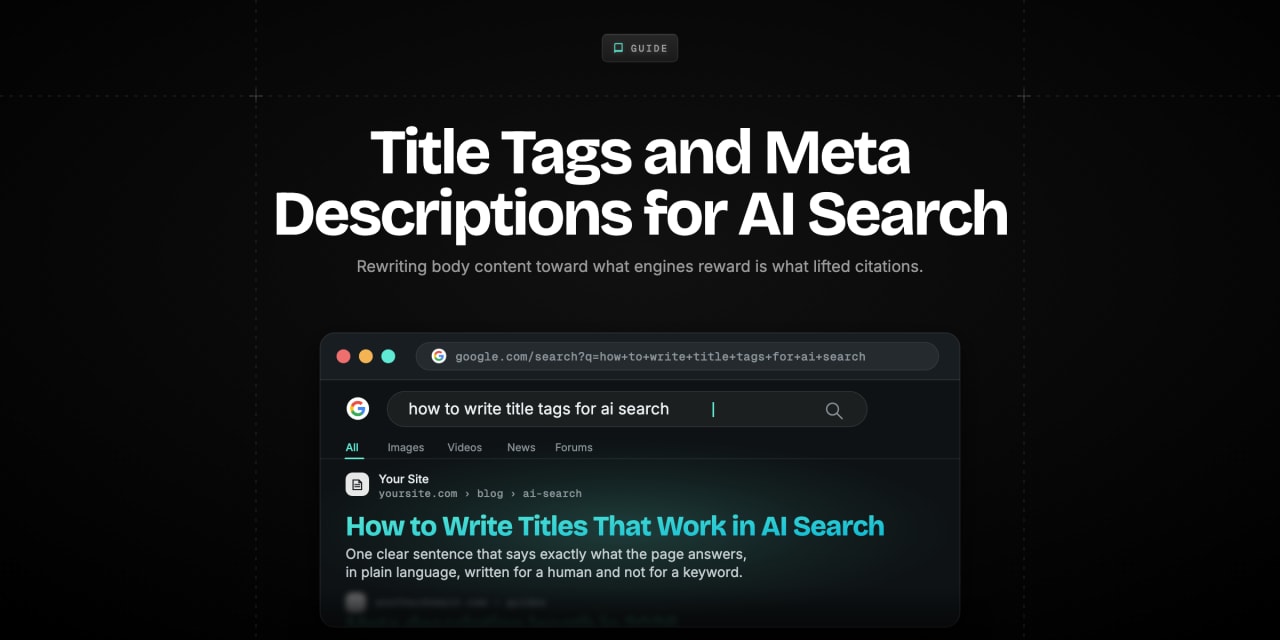
How to Write Title Tags and Meta Descriptions for AI Search
AI engines cite your body content, not your meta tags. Here is what title tags and meta descriptions still do, and where citation gains come from.
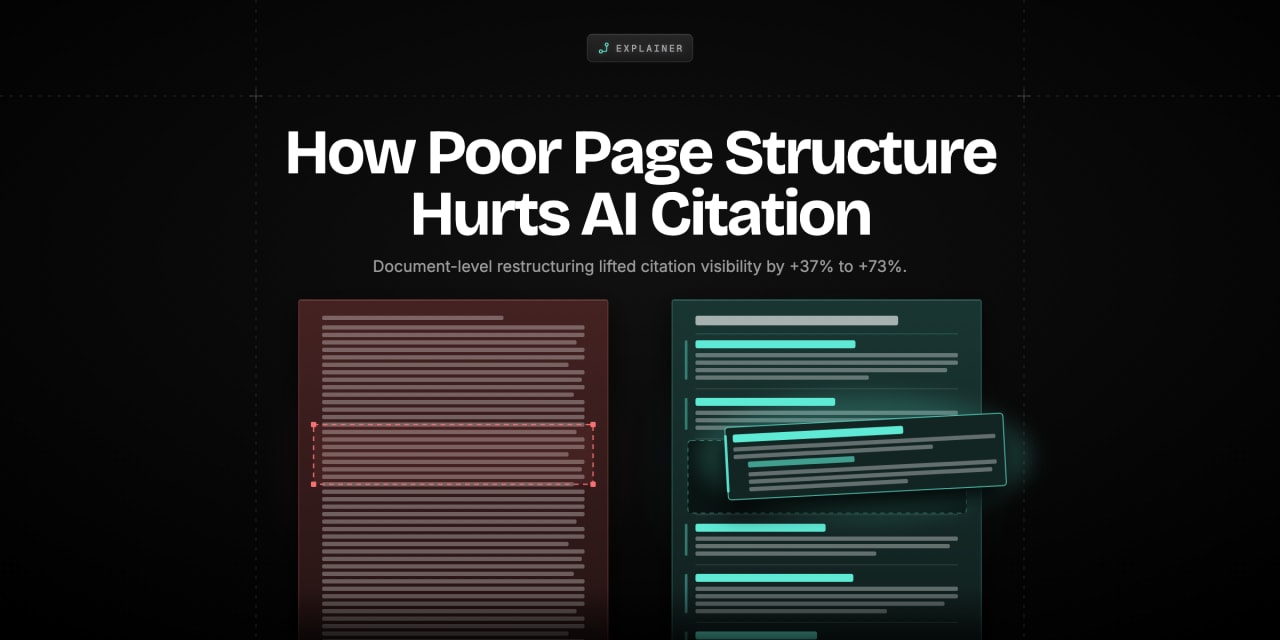
How Poor Page Structure Hurts Your AI Citation Potential
Poor structure keeps excellent content out of AI answers. See which structural faults cost citations, and how to fix them without a full rewrite.

Do AI Citations Replace Backlinks? What the Shift Actually Means
37% of AI-cited domains never appear in traditional search. Here is why citations are a new currency rather than a replacement for backlinks.

How Do I Build Trust Signals That AI Recognises?
Over 75% of ChatGPT's health citations came from institutional sources. Here is a four-part framework for building trust signals AI recognises.

The Fastest Ways to Increase Your AI Search Visibility Right Now
Not every AI visibility tactic works on the same clock. Here is what moves the needle this week, what takes weeks, and what is slow.

Why Branded Websites Rank Better in AI Search
Recognized brands get cited more in AI answers, but fame is not trust. Here is what drives the brand signal, and how a small site builds it.

How Often Does ChatGPT Actually Cite Sources?
Most ChatGPT citation stats floating around contradict each other. Here is what a 730,000-conversation study actually found about citation frequency.
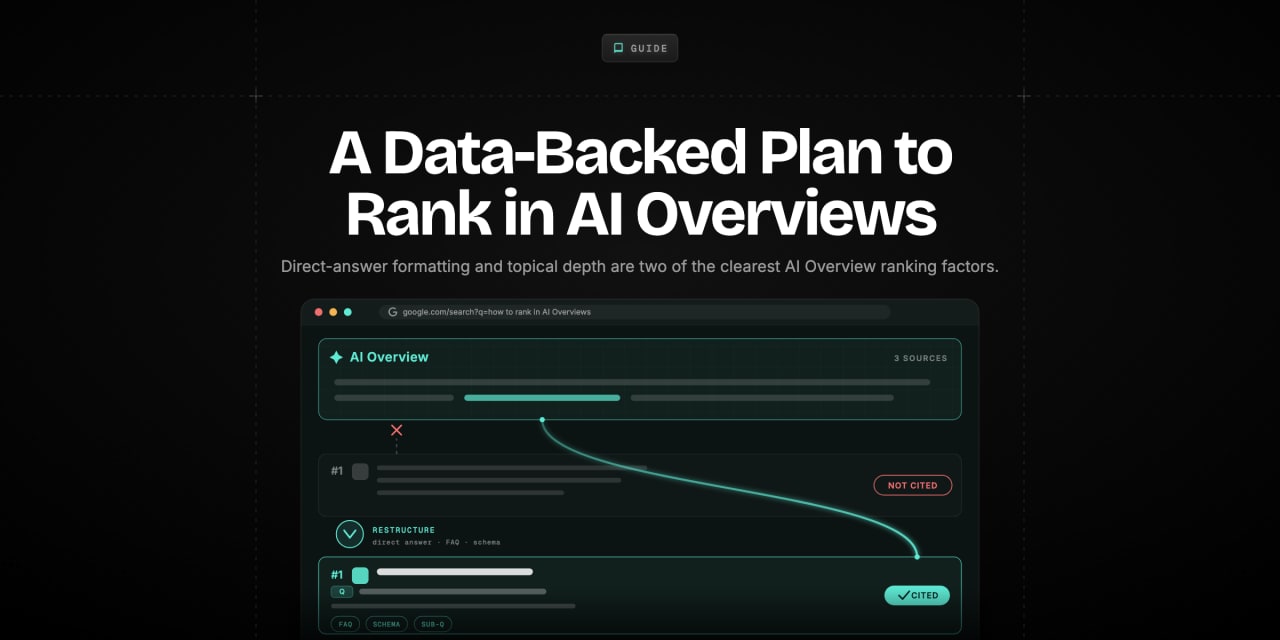
How to Rank in Google AI Overviews: A Data-Backed Action Plan
Learn how to rank in Google AI Overviews using real citation research, query fan-out data and a step-by-step optimisation framework for 2026.

How to Get Your Pages Featured in Google AI Overviews: A Practical Guide
A practical, tested approach to getting featured in Google AI Overviews: content structure, schema, freshness and domain authority, explained.

Is It Actually Possible to Rank Consistently in AI Search Right Now?
AI search citations swing harder than Google rankings ever did. Here is the real data on AI search volatility and what consistency actually looks like.
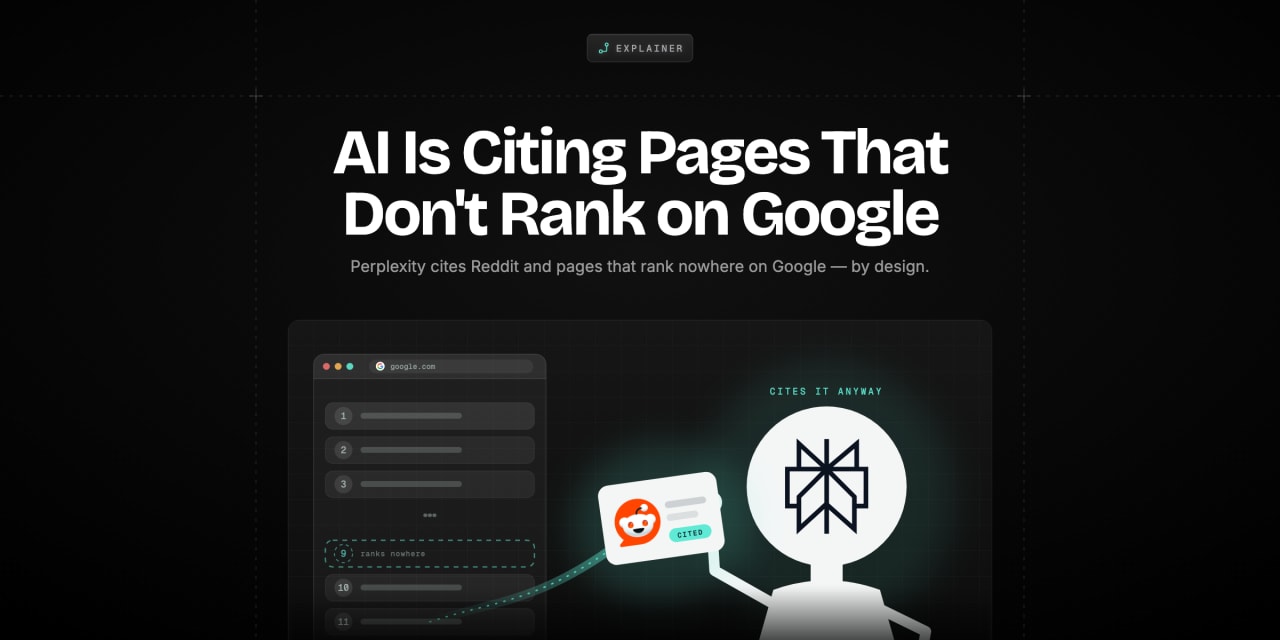
Why AI Engines Are Citing Pages That Don't Rank on Google (And What It Means for SEO)
AI engines like Perplexity are citing pages that rank nowhere on Google. Here is why it is happening, what it means for your content strategy, and how to take deliberate advantage of it.

Why Brands That Rank on Google Can Still Be Invisible to AI Search: Explained
Strong Google rankings do not guarantee AI search visibility. Here is the entity-level reason why established brands get ignored by AI search and the five-step fix that solves it.

Page Ranks on Google but Not in AI? Fix These 5 Things First
Your page is on page one of Google but invisible in AI Overviews and AI search. Here are the 5 most common reasons and exactly how to fix each one.

Is AI Search Visibility More About Trust Than Rankings? The Evidence Says Yes
The data increasingly shows that AI search citation is driven by trust signals, not just ranking signals. Here is what that means for your strategy and how to build the right kind of authority.
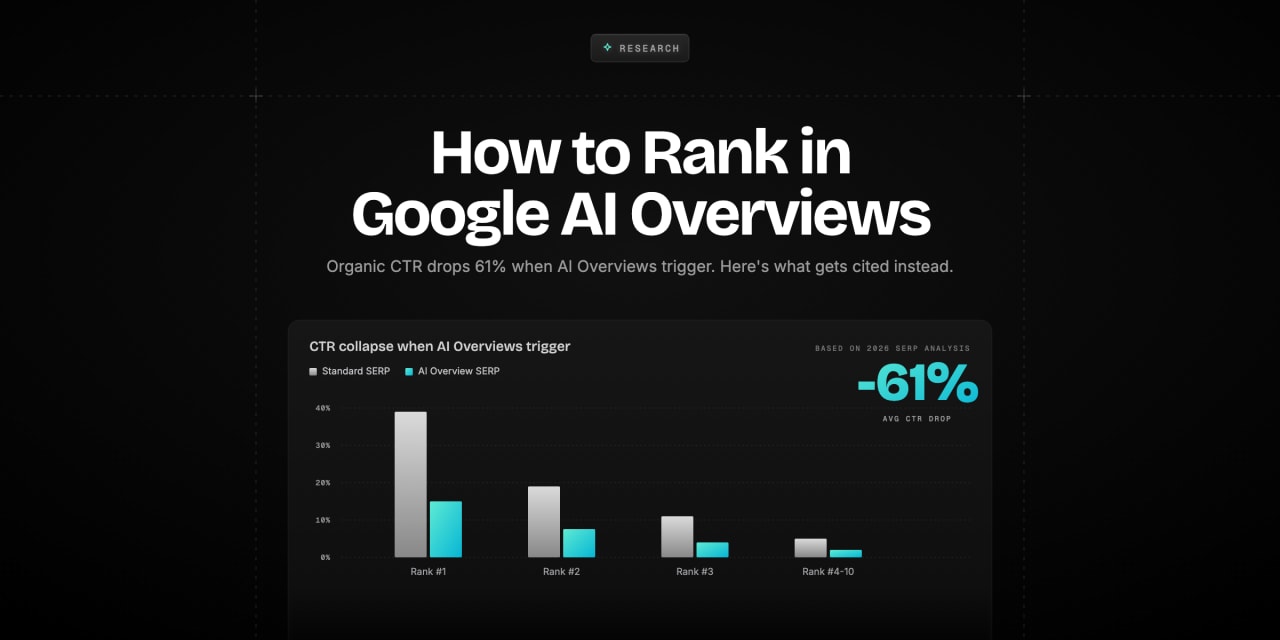
How to Rank in Google AI Overviews in 2026: What Actually Works
Organic CTR drops 61% when AI Overviews trigger. Here's what gets cited instead.
Getting cited by AI
answered.
Pulled from the questions already answered on the guides in this topic.
No. It cites sources when it browses the live web, which it does for some questions and not others. Answers drawn purely from training data usually name no sources, so brand presence still matters independently.
Full guide: How to Get Your Website Cited in ChatGPT Answers →It helps your content be understood and indexed, which supports retrieval. Controlled testing found formatting-only differences had little effect on which retrieved source gets cited, so schema is worth doing but should not be your citation strategy.
Full guide: How to Get Your Website Cited in ChatGPT Answers →Narrow a page to one question and answer it completely in the opening passage, with concrete figures and a visible recent date. Relevance and explicit specifics carry more measured weight than any presentational change.
Full guide: How to Get Your Website Cited in ChatGPT Answers →On-page changes can affect browsed answers within weeks once recrawled. Building the recognition that gets you into the candidate set consistently takes months, because it depends on accumulated references rather than edits you control.
Full guide: How to Get Your Website Cited in ChatGPT Answers →Yes, particularly on narrow questions where few credible pages compete. Small sites struggle on broad commercial questions where established sources dominate the candidate set, so specificity is the practical route in.
Full guide: How to Get Your Website Cited in ChatGPT Answers →Usually because your page is broadly relevant rather than precisely relevant, or because the answer sits too far down to be extracted cleanly. Ranking gets you retrieved; being quoted depends on relevance and quotability.
Full guide: How to Get Your Website Cited in ChatGPT Answers →Run a per-prompt diagnosis: list the queries you should win, check who is cited today, and compare your page against the cited sources at each stage of the citation pipeline. The earliest stage where the cited source clearly did better is your failure mode and your fix.
Full guide: How to Diagnose Why AI Is Not Citing Your Content →The page is never retrieved, is retrieved but buries its answer, is retrieved but not trusted enough, or is retrieved but answers a slightly different question than the one asked. Each is a different failure at a different stage and needs a different repair, which is exactly why diagnosing the stage first matters more than reaching for a standard fix.
Full guide: How to Diagnose Why AI Is Not Citing Your Content →